A mountain made of color
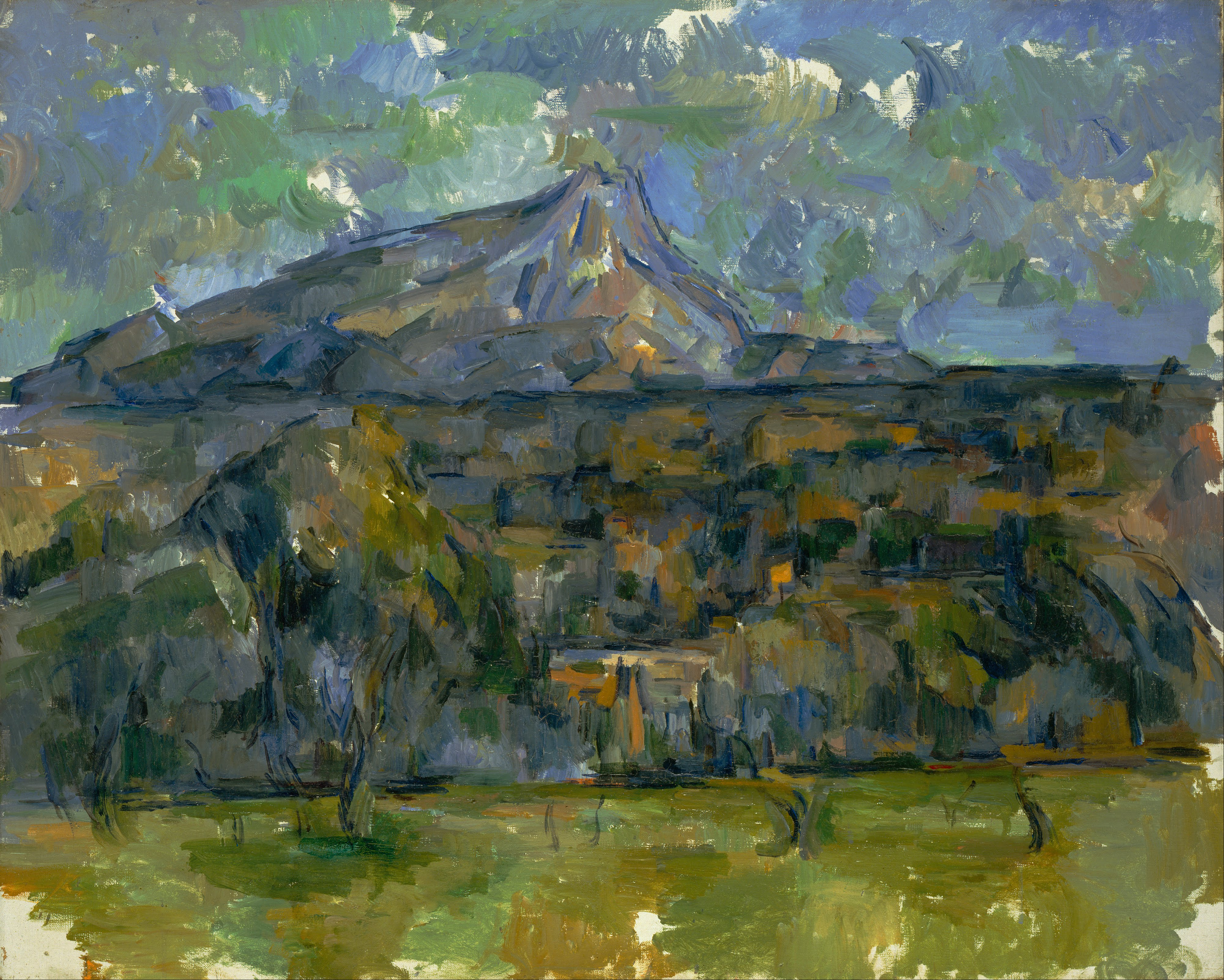
Stand close and the first surprise is that there is almost no drawing in it. The mountain, the plain, the sky: none of them is outlined and filled. The whole picture is built from overlapping, semi-transparent patches of color, green and ochre for the fields below, blue and violet for the ridge and the sky above, laid side by side and over one another until a landscape assembles itself out of pure color relationships.
What he left out
Two things to notice, because they are the whole argument of the picture. First, Cézanne left areas of bare canvas showing between the strokes. He simply stopped before he filled them. The painting looks openly, deliberately unfinished, and that is by design: the forms dissolve into a field of color rather than hardening into described objects.
Second, there is no single vanishing point pulling you back into depth. Near and far are knit into one shallow plane; the valley seems to tip up toward you instead of receding correctly the way a textbook landscape should. The mountain and the air in front of it are made of the same touches of paint. This flattening of deep space into a near-single surface is precisely what the next generation would seize on. It is why this canvas, a landscape of a quiet mountain, read to younger painters as proto-Cubist (an early, unnamed version of what Cubism would become: breaking a scene into planes of color instead of drawing it as it looks), the first stirrings of the method that would shatter perspective for good.
The technical name for the key move is passage: Cézanne lets adjacent color planes bleed across a contour, so an object and the space beside it share the same patches of paint and the hard edge between them softens away. It is exactly the device Cubism would take up a few years later to lock figure and background into one continuous surface.