
The Greeks had asked their questions to argument alone (the Greeks chapter): if a claim couldn't survive cross-examination, it lost, and no sacred book got a vote. Then the Western world changed its mind about books. Three traditions came to hold, each in its own way, that one particular text was not a human guess but a message from God, true before you opened it. Christianity had staked its claim first in the West. Islam arrived in the 7th century and within two centuries had built a richer philosophical apparatus than Latin Europe had. And the tradition of Jewish philosophical theology, ancient in its own right, found new tools in the same Greek inheritance. That should have ended philosophy. Why argue your way toward truth when revelation hands it to you?
It did the opposite. The texts turned out to be full of holes a believer had to think across. What is God's eternity? Did the world have a beginning? What is the soul, and where does evil come from in a world a good God made? Scripture raised these and walked off without answers. So the same Greek tools the new faiths might have buried got picked up instead, by people who now had to satisfy two masters at once. This is the story of that double loyalty, across three religions, for a thousand years.
The break
The Greek philosopher had one job: build a case good enough to beat the next case. "ALL men by nature desire to know," Aristotle wrote at the head of his Metaphysics (trans. W. D. Ross), and that desire was its own permission slip. No scripture was consulted, because there was no scripture with a vote. You followed the argument the way Socrates said you must, wherever it led.
The medieval thinker answered to that same argument and to something new beside it: a text he believed God had written, true before he reasoned a step. "I do not seek to understand that I may believe," Anselm would put it, "but I believe in order to understand" (Proslogion, trans. Deane). The starting point was now fixed by faith. The second half matters equally: the work was still argument, and Anselm went on to argue for God's existence using no premise from scripture at all. That is the era's whole paradox in one monk. The surprise that powers everything after is that the book needed the philosophy. Averroes, a Muslim judge in Spain, would insist the Law itself requires you to study creation by reason, and that "truth cannot contradict truth." Maimonides wrote his masterwork for the believer "lost in perplexity and anxiety" between the Law and philosophy. Revelation, it turned out, did not end the argument. It assigned it.
Chapter 1
The handoff
"There was a woman at Alexandria named Hypatia, daughter of the philosopher Theon, who made such attainments in literature and science, as to far surpass all the philosophers of her own time."
The last great teacher of the old pagan philosophy was a woman, and the way she died tells you the world was changing under her feet. Hypatia of Alexandria (pronounced "hy-PAY-shuh," born around 355, killed in 415) taught mathematics and philosophy in the Egyptian port city of Alexandria, the brainiest city of the ancient Mediterranean. Our best source for her is not a fan. Socrates Scholasticus was a Christian church historian writing within about twenty-five years of her death, and even he is dazzled: she "far surpassed all the philosophers of her own time." Crucially for our story, he records that she had "succeeded to the school of Plato and Plotinus." That is the baton being passed. Plotinus (the mystical reworker of Plato who closed out the Greek story, the Greeks chapter) was her intellectual lineage, and she was teaching his Neoplatonism (Plotinus' system, in which everything overflows from a single divine source called the One) to students who came from a distance to hear her.
Then a mob killed her. The documented core, from that same near-contemporary historian, is ugly and political: Alexandria was torn between its Christian bishop, Cyril (a bishop being the church official who governed a city and its region), and the Roman governor, Orestes, and Hypatia was close to the governor. A crowd "whose ringleader was a reader named Peter" pulled her from her carriage, dragged her into a church, stripped her, and "murdered her with tiles," then burned the body. Socrates Scholasticus's verdict is unflinching: the affair "brought not the least opprobrium, not only upon Cyril, but also upon the whole Alexandrian church." That is the historical Hypatia, and it is enough.
It needs guarding, because no figure in this whole era draws bad legends like she does. She was not killed for being a scientist; the sources point to political jealousy, not astronomy. Her death did not "end ancient philosophy" or "destroy the Library of Alexandria"; the Library's decline was long and tangled, the city's great pagan temple had already fallen in 391, years before she died, and pagan philosophy went on being taught in Athens for another century. And the dignified quotations you will find attached to her ("even to think wrongly is better than not to think at all") are not hers. They were invented in 1908 by an American essayist named Elbert Hubbard, complete with an invented portrait to match, and in Hubbard's own text that famous line is spoken not by Hypatia but by her father Theon, giving her advice; later retellings quietly re-attached it to Hypatia herself. Nothing Hypatia wrote survives. The honest fact is the silence: we have the titles of her mathematical works and not a sentence of her philosophy. The fabricated quotes are a warning about exactly the kind of history this era attracts.
What survived her was the thing that would matter most for the next thousand years, and it had already crossed over into the Church. A generation before Hypatia died, a restless young North African named Augustine (354 to 430) had read his way out of confusion using the same Plotinus. Augustine became bishop of Hippo (a Roman city in what is now Algeria) and the single most influential Christian thinker before the modern age, and the hinge of his intellectual life was a stack of books. "Thou procuredst for me," he tells God in his Confessions, "certain books of the Platonists, translated from Greek into Latin." From them, he says, he was "taught to search for incorporeal truth," to conceive of God as something other than a body in the sky, and, above all, to solve the problem that had tormented him for years.
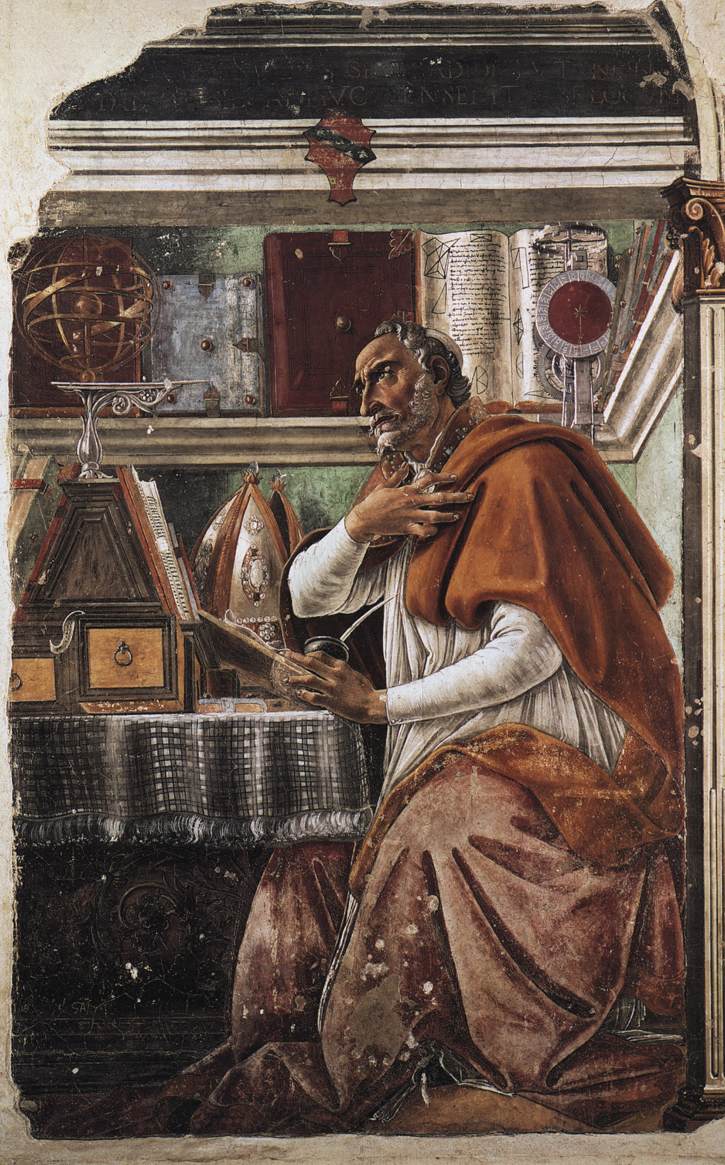
The problem is the one the era can never put down, and Augustine's answer is the era's founding argument. If a good God made everything, then where did evil come from? Run the options. Either God made evil too, in which case he is not good; or something other than God made it, in which case he is not the maker of everything. Both answers wreck the faith. Augustine had spent years inside a third answer, the one the Manichaeans (a rival religion he had followed) sold: that evil is a dark rival power, a substance, a kind of anti-God locked in eternal war with the good. But that just relocates the wreckage, because now there are two ultimate powers and your God is not supreme over the other one. The Platonists handed Augustine the way out, The move: evil is not a thing at all. It is a lack, a privation, the way darkness is not a substance pumped into a room but only the absence of light, and a hole in your sock is not made of anything. Blindness is not a something added to an eye; it is sight missing.
That move buys him more than it seems, which is why it is the founding argument and not just a clever image. The Manichaean had to say God either made evil or is not in charge of it. Augustine can now say neither. On the privation view, God made everything, and everything God made is good; evil is not a rival creation God failed to stop, it is good gone missing, a corruption in something that was made good, above all in a will that has turned from a greater good to a lesser one. There is no second power to explain, because evil was never a power, never a thing, in the first place. The dinner-table version: God didn't make evil, because evil isn't a thing you could make; it is the dent, not the car. You can argue with it (is a torturer's cruelty really just an absence?), and the era will. Pagan Greek , poured straight into Christian theology (the disciplined reasoning about God, his nature, and his relation to the world), had dissolved scripture's hardest problem. The load-bearing beams of the new religion's intellectual house were Plotinus's.
But Augustine was clear about what the Platonists could not give him. They taught him where to look; they could not teach him humility, or get him to actually change his life. His Confessions (written around 397, a decade after his conversion) is the era's founding book and something genuinely new in literature: not a record of deeds but a prayer addressed to God, an excavation of his own interior, memory and desire turned inside out on the page. Its opening line states the era's whole thesis before the argument has begun: "Thou madest us for Thyself, and our heart is restless, until it repose in Thee." The destination is fixed before the journey starts. That is the new condition. Reason still does the walking, but now it knows in advance where it is supposed to arrive.
Resist the cartoon Augustine while we are here, because two cartoons have stuck to him. He is remembered as a sex-obsessed killjoy, but the man who prayed, by his own honest report, "give me chastity and continency, only not yet" wrote the era's frankest analysis of a divided will, of wanting two opposite things at once and watching yourself choose the worse. He is the diagnostician of that split, not its prude. And the Confessions is not a modern memoir baring private secrets; it is a prayer with an audience, every scene shaped to a purpose. The famous conversion moment, where a child's voice in a garden chants "Take up and read" and Augustine opens Paul at random and is changed, is told that beautifully because he built it that way, writing as a master rhetorician ten years on, not because a documentary camera was running. As Augustine tells it, the voice came. That framing is the honest one, and he would not have minded it.
Chapter 2
Boethius and the quiet centuries
"This is my art, this the game I never cease to play. I turn the wheel that spins. I delight to see the high come down and the low ascend."
A century after Augustine, the Western Roman Empire was gone, and a Roman aristocrat sat in a prison cell at Pavia (in northern Italy) writing the most widely read philosophy book of the next thousand years. Boethius (pronounced "boh-EE-thee-us," born around 477, executed around 525) had served the Ostrogothic king Theoderic, a Germanic ruler now governing what had been Roman Italy, and had been accused of treason and of dabbling in magic. Awaiting death, he wrote The Consolation of Philosophy, and the era-1 story closes exactly here, with Boethius in his cell (the Greeks chapter). The book stages a vision: Philosophy herself appears at his bedside as a woman, her gown woven by her own hands, carrying a Greek letter at the hem and another at the top with steps between them like a staircase, the climb from practical to theoretical wisdom. The robe, he notices, has been "torn by the hands of violent persons." Philosophy explains that the rival schools have each ripped off a shred and run, mistaking their scrap for the whole.
Her cure for the condemned man is to confront him with Fortune, the fickle goddess of luck, whom she lets speak in her own voice. "This is my art," Fortune says, "the game I never cease to play. I turn the wheel that spins. I delight to see the high come down and the low ascend." The image of Fortune's wheel, lifting men up only to fling them down, became the single most durable picture in the medieval imagination. The point is bracing: you never owned the things Fortune lent you, the office, the wealth, the safety, so losing them takes nothing that was yours. The book climbs from there to its hardest problem. If God knows the future, are we still free? Boethius's answer turns on what eternity actually is. God does not exist inside time, foreseeing tomorrow the way you dread a Monday; God possesses all of time at once. He calls eternity "the possession of endless life whole and perfect at a single moment." God does not fore-see your choice; he simply sees it, the way you see someone walking in front of you without forcing their steps. The solution would be argued over for the next thousand years.

The Consolation never mentions Christ. A Christian on death row wrote a book of consolation built entirely from Greek philosophy and left his Savior out of it, and scholars have debated the silence ever since. Resist both easy readings, the "secretly pagan" and the "obviously Christian"; he wrote Christian theological works elsewhere, and the silence in this one is real and unexplained. Resist too the slick tag historians like to hang on him, "the last of the Romans and the first of the schoolmen." It is a description, not a quote, and nobody can source it.
Boethius matters past his book for a reason that shaped the next five centuries. His life's plan had been to translate and explain all of Plato and Aristotle into Latin, the entire Greek inheritance preserved for a West that was forgetting Greek. He was executed a few texts in. Those few translations, mostly Aristotle's elementary logic, were most of what the Latin West had of Aristotle for the next five hundred years. The intellectual thinness of the early Middle Ages is, in part, downstream of one execution. And buried in those logic texts, Boethius left a time-bomb. Commenting on an old introduction by Porphyry (a student of Plotinus), he relayed a question Porphyry had raised and ducked: do general categories like "humanity" or "animal" really exist out in the world, or are they only words and ideas in our heads? That question, the problem of universals, would become the era's longest-running fight, and it is bigger than it sounds: whether our general words name real features of the world or only conveniences of speech decides how much human reason can ever truly know. Put it concretely: if the categories we think in are real discoveries about the world, then reasoning can hand us the world's own furniture; if they are just labels we find handy, then reason works only on our own filing system, and faith and reason may not even be standing on the same map. Hold it; it detonates in three chapters.
After Boethius, the Latin West produced very little original philosophy for roughly five hundred years, and the textbooks get this wrong in both directions. That is a real fact, not a slur, and "the Dark Ages" is the wrong name for it, a piece of much-later contempt. The reasons were material, not mental. The Roman school system had collapsed with the empire; books survived only where someone copied them by hand; and the copying happened in monasteries (communities of monks, men who withdrew from ordinary life to pray, work, and study under a shared rule). A Roman official named Cassiodorus set up a monastery library, the Vivarium, specifically to preserve texts; later the Benedictine houses (monasteries following Saint Benedict's sixth-century rule, which made daily work and study a duty and which became the most widespread form of monastic life in western Europe) and the court schools of Charlemagne (the Frankish king, that is, a king of the Franks in what is now France and Germany, who built a short-lived western empire and sponsored a revival of learning), organized by an English scholar named Alcuin, standardized the texts and even the handwriting. Philosophy did not die in these centuries. It waited in the warehouses, recopied page by page by people who were not philosophers but who saved philosophy by being careful.
There was one exception, strange and isolated, and naming him keeps the "quiet centuries" claim honest rather than absolute. John Scotus Eriugena (pronounced "er-ee-OO-jeh-nuh," Irish, around 800 to around 877) turned up at the court of Charles the Bald, a Frankish king, with a rare skill: he could actually read Greek. He translated a set of mystical Greek theology and then built his own enormous system, the Periphyseon, which claimed that all of reality flows out from God and then returns to him, a single great circle of emanation and return, the most thoroughly Neoplatonist thing the Latin West produced in these centuries, and an heir straight from Plotinus by way of the Greek mystics he had translated. It was so unusual that almost no one knew what to do with it. He survives mostly in stories that arrived centuries late and should be enjoyed as legend, not believed. His biographer William of Malmesbury, writing about 250 years after, reports that Eriugena was stabbed to death by his own students with their pens (probably a tale borrowed from an old martyr's legend). The same late source preserves the best dinner-table joke of the era: King Charles, across the table, needling him, asks "What separates a sot from a Scot?" (a drunk from an Irishman), and Eriugena, deadpan, answers "Only a table." Too good to check, and far too late to check.
Chapter 3
The thread moves to the Islamic world
"We must not be ashamed to admire the truth or to acquire it, from wherever it comes. Even if it should come from far-flung nations and foreign peoples, there is for the student of truth nothing more important than the truth."
While Latin Europe was recopying its handful of books, the living edge of philosophy moved a thousand miles east, to Baghdad, and for the next three centuries the most important philosophical work in the world was done in Arabic. This is not a detour from the Western story. It is the road the Western story travels. The Greek texts Boethius never finished translating were translated instead by Arabic-speaking scholars, who did not merely store them but argued with them and pushed them further, then handed the whole enriched inheritance back to Europe. Without this chapter, the next ones do not happen.
It began with money, and the famous version is a romance. The story usually told features a grand academy called the House of Wisdom, a sort of medieval university. The honest picture is humbler and, in its way, better. The best modern scholarship suggests the "House of Wisdom" was probably a palace library, and the major translators don't mention working in any such academy. What actually happened was a movement: across the late 700s through the 900s, the Abbasid caliphs (the rulers of the Islamic empire from Baghdad; a caliph is a successor to Muhammad, the founder-prophet of Islam, as head of the Muslim community) and wealthy patron families paid serious money, by the book, to turn Greek science and philosophy into Arabic. The master of the craft was a Christian physician named Hunayn ibn Isḥāq (pronounced "hoo-NAYN ibn iss-HAAK"), who with his workshop set the standard for how a translation should be done, hunting down better manuscripts and rendering meaning over words. The closest analogy is patrons commissioning Aristotle the way a Renaissance prince would commission a painting.
The philosophical wing gathered around al-Kindī (pronounced "al-KIN-dee," around 800 to around 870), remembered as "the Philosopher of the Arabs" because he was the first to think philosophically in the language. His circle produced Arabic Aristotle and Arabic Plotinus (including a book labeled the Theology of Aristotle that was actually Plotinus misattributed, a clerical mix-up with centuries of consequences). Al-Kindī's own contribution was partly a manifesto, and one of the great sentences of the era: we must not be ashamed, he wrote, to take the truth "from wherever it comes," even "from far-flung nations and foreign peoples." Truth has no passport. A Muslim philosopher claiming pagan Greek reasoning for Islam, the religion whose holy book is the Qur'an (the text Muslims hold God revealed to Muhammad), needed exactly that principle, and he stated it without apology. His role was to open the door; he was not yet the equal of the giants who walked through it.
The first of those was al-Fārābī (pronounced "al-fa-RAH-bee," around 870 to 950), honored ever after as "the Second Teacher," second only to Aristotle himself. We know little reliable about his life, and the responsible thing is not to decorate it. What he did is clear: he naturalized Greek logic in Arabic, organized philosophy into a system of sciences, and wrote a political work, The Virtuous City, imagining a community led by a philosopher-prophet, Plato's philosopher-king fused with a religious lawgiver. His deepest influence ran through one reader.
That reader was Avicenna (pronounced "av-ih-SEN-uh"; in Arabic Ibn Sīnā, born around 970 to 980 by competing reckonings, died 1037), the towering mind of Islamic philosophy and arguably of the entire era. He grew up near Bukhara (in modern Uzbekistan), and by his own account, told with some self-flattery, had taught himself nearly everything by eighteen. He tells one story on himself that is the influence chain made personal: he read Aristotle's Metaphysics forty times and understood none of it, despairing, until he picked up a small commentary by al-Fārābī from a market book-crier and the whole thing snapped into focus. (That comes from Avicenna's own pen, so frame it as his telling.) His Canon of Medicine was still taught in European medical schools into the 1600s. But his philosophy is what concerns us, and the era's first great worked example is his.

Avicenna's most famous thought experiment goes like this: suppose you were created this instant, fully grown, floating in empty air, blindfolded, suspended so no limb touches another or anything else, in perfect silence, with no memory of ever having had a body. No sight, no sound, no sensation, nothing. In that state, would you know that you exist? His answer is that you would. Stripped of every sensation, you would still affirm your own self, your "I," even while you could not affirm that you had hands or a chest or a face. And if you can be certain of your self while uncertain of your body, then your self is not simply your body, and your awareness of it did not arrive through the senses. This is the flying man, and it walks straight up to a conclusion Descartes will reach by a different road six centuries later (era 3), with one sharp difference: Descartes will get there by doubting everything; Avicenna gets there by isolating, clearing the senses away to see what is left. (No public-domain English of Avicenna's text exists, so the argument here is faithfully restated, not quoted.)
Avicenna built one more distinction that runs through the rest of the era like a steel rod. Ask what a thing is, and you can answer completely without knowing whether it exists. You can define a horse and a unicorn with equal precision; the definition, the essence, tells you nothing about whether any such thing is out there. Existence, for Avicenna, is something extra, added to an essence. Now follow the chain: everything around you has its existence borrowed, handed to it by something else, the way a lit room borrows its light. A borrowed thing points to a lender, that to another, and the chain cannot hang on nothing. So there must be one being whose essence simply is to exist, who borrows from no one, the Necessary Existent. That is Avicenna's God, arrived at not by quoting scripture but by pure metaphysics, from the bare difference between what a thing is and that it is. Aquinas will build on this (Chapter 6).
If Avicenna shows philosophy at its height inside Islam, the next figure shows it challenged from inside with equal brilliance, and his case is the era's most slandered. Al-Ghazālī (pronounced "al-gha-ZAH-lee," around 1056 to 1111) was a superstar professor at the most prestigious school in Baghdad, lecturing to hundreds, when in 1095 he had a breakdown he later described himself, in an autobiography strikingly like Augustine's Confessions, both of them constructed conversion narratives written years later with shaping and purpose. He had pushed his own demand for certainty until it ate everything. He examined all he knew and found that only "sense-perceptions and necessary principles" carried real certitude, then realized even the senses could not be trusted, because in dreams we take baseless images "to be indisputably real" and only on waking see them for what they were, so "who can assure you" the waking senses are any better? For two months he was, in his words, "a thoroughgoing sceptic." What cured him was not an argument: "I owed my deliverance, not to a concatenation of proofs and arguments, but to the light which God caused to penetrate into my heart." Then his body broke under the strain: "God caused an impediment to chain my tongue and prevented me from lecturing... my mouth became dumb." He walked away from the great chair and spent years as a wandering Sufi (a practitioner of Islamic mysticism, which pursues God through direct experience rather than doctrine).
His great book against the philosophers, the Incoherence of the Philosophers, is where the slander lives, so steelman it first. It is not a book-burning. It is an argument, and a disciplined one, and understand who "the philosophers" are: above all al-Fārābī and Avicenna, the two giants we just met. The grandest system in Islam, fresh from reasoning its way to God, was being put on trial from inside its own religion. Al-Ghazālī takes the philosophers' twenty headline doctrines and tries to show that, by their own standard of strict logical proof, they cannot demonstrate them, that they have smuggled in assumptions and called them proofs. Only three of the twenty does he brand as outright unbelief. His sharpest move is about cause and effect. We say fire causes cotton to burn, but what we actually observe is: the fire, then the burning, side by side. We never see the necessity, the invisible link forcing one from the other. Al-Ghazālī's claim is that the necessity isn't in the world at all; God creates the burning alongside the fire each time, and the regularity we mistake for a law of nature is just God's reliable habit. (This position is called occasionalism, the view that created things are not true causes but only the occasions on which God, the one real cause, acts. The argument ships here as paraphrase; no public-domain English of the text exists.)
The blade lands at home before it travels. Avicenna had reasoned his way to God along a chain of causes: every borrowed existence points up to a lender, and the chain must end in the Necessary Existent. But that whole argument leans on causes necessitating their effects, on the links in the chain being real and binding. Pull the necessity out of cause and effect, as al-Ghazālī just did, and you have not only embarrassed the physicists, you have loosened the bolts on Avicenna's own road to God. The proudest proof in Islamic philosophy turns out to rest on exactly the link al-Ghazālī says nobody has ever seen. That is the present-tense crisis: the master argument of the age, challenged on its foundation from inside. The observation also has a long future: seven hundred years later a Scottish skeptic named Hume will rediscover that you never observe necessity, and will shake philosophy with it (era 3).
So put to rest the line you may have heard, that "al-Ghazālī killed Islamic philosophy." It is false, and it is the exact kind of potted summary this era breeds. He attacked a particular kind of philosophy by its own rules; he did not forbid reason, and in fact he imported Greek logic into mainstream theology himself. Philosophy went right on in the Islamic world. The proof is the next chapter, where a man in Córdoba answers him point for point.
Chapter 4
Córdoba and the handback
"truth cannot contradict truth, but verifies it and bears testimony to it"
The reply to al-Ghazālī came from the other end of the Islamic world, from Córdoba in Muslim Spain (al-Andalus, the name for the Iberian territory under Muslim rule), and its author would end up mattering more to Christian Europe than to his own tradition. Averroes (pronounced "uh-VAIR-oh-eez"; in Arabic Ibn Rushd, 1126 to 1198) was a working judge and a court physician, a man of affairs as much as a scholar, and he gave his life to a single project: making Aristotle make sense. He wrote commentaries on nearly the whole Aristotelian corpus, at three levels of depth, so thorough and so trusted that to Latin readers later he became simply "the Commentator," the way Aristotle was simply "the Philosopher." If you wanted to know what a hard passage of Aristotle meant, you read what Averroes said it meant.

He also wrote, in answer to al-Ghazālī's Incoherence of the Philosophers, a book with a wonderfully blunt title: the Incoherence of the Incoherence, a point-by-point rebuttal. But his most important short work is the Decisive Treatise, and it is cast in a revealing form: a legal opinion, the kind a judge issues, on the question of whether philosophy is permitted to a Muslim at all. His answer is bold. Not only is philosophy permitted, the Law itself requires it (the Law here is Islamic religious law, the sharia, the divinely given law drawn from the Qur'an and the Prophet's example): scripture, he argues, commands the believer to observe and consider creation by reason. God commands you to study the world, and studying the world rigorously is philosophy. And when the conclusions of solid reasoning seem to clash with the plain words of scripture, what then? Here Averroes lays down the era's cleanest principle: "truth cannot contradict truth." If a demonstration is genuinely sound and the scriptural surface seems to deny it, then the scripture was never meant to be read on the surface; it bears a deeper interpretation. Two truths from one God cannot war, so where they appear to, you have misread one of them.
This is the place to kill a famous error that gets pinned on Averroes: the "double truth," the idea that something could be true in philosophy and false in religion at the same time. He held nothing of the kind. His whole point is the opposite, that there is one truth wearing two faces. The "double truth" charge was manufactured later, in Paris, by a bishop accusing certain teachers of talking "as if there were two contrary truths" (we meet him in Chapter 6), and modern scholars doubt even those teachers actually held it. The caricature belongs to its makers, not to the man who wrote "truth cannot contradict truth." Averroes himself ended bruised: around 1195 he fell from favor and was briefly banished, for reasons that remain murky, before being restored. He died in Marrakesh in 1198, and his philosophy had a stranger fate than most. It withered in the Islamic world and was reborn in Latin, where for three centuries no university could discuss Aristotle without Averroes in the margin.
Beside the Muslim thread ran a Jewish one, and the era's third great religion now enters with its own giant. Moses ben Maimon, known as Maimonides (pronounced "my-MON-ih-deez," born around 1138, died 1204), was born in that same Córdoba, into a world about to turn on him. A hard-line Muslim dynasty, the Almohads, swept in with a brutal convert-or-leave policy, and Maimonides spent his early life in flight, through Morocco and finally to Egypt, where he settled near Cairo and became both the leading legal authority of the Jewish world and court physician to a sultan's chief minister. His great philosophical work, the Guide of the Perplexed (finished around 1190, written in Arabic in Hebrew letters), was addressed to a very specific reader, and that reader is this era's reader. Not the simple believer, and not the pure philosopher, but the person caught between, "a religious man who has been trained to believe in the truth of our holy Law" (the Law in his mouth is the Torah, the first five books of the Hebrew Bible, and the vast body of Jewish legal tradition built on it, a different Law from the sharia Averroes defended) and who is "at the same time successful in his philosophical studies," and who finds the two pulling apart until he is "lost in perplexity and anxiety." The whole era is that sentence. Maimonides wrote a book to walk that exact person back from the edge.

His most radical idea is about how little we can truthfully say about God, and it must not be softened into a gentle "God is mysterious." Maimonides argues that every positive description of God, every "God is wise," "God is powerful," "God is good," secretly smuggles in a comparison to creatures and so says something false, because God shares nothing with us, not even existence in the same sense. The only honest knowledge of God is knowing what he is not. "Our knowledge," he writes, "consists in knowing that we are unable truly to comprehend Him." The proper response, then, is not louder praise but discipline, even silence; he quotes the Psalmist approvingly, "Silence is praise to Thee," because whatever words we use "include derogatory expressions" by dragging God down to our level. This is the strong claim, not a humble one: positive God-talk is strictly false, and the religious payoff is not despair but a trained tongue. And keep one piece of geography in view: Maimonides wrote in Judeo-Arabic, for a Jewish audience inside Islamic culture, not in Latin for Christian Europe, and that was not only because he happened to live under Islamic rule. The Jewish communities of 12th-century Christian Europe faced their own legal exclusion and periodic violence; the Latin world was not a hospitable destination for the Jewish philosophical tradition, even as it would later borrow heavily from it. His equipment came partly from al-Fārābī and Avicenna, and it traveled onward: a century later Aquinas would cite him, respectfully, as "Rabbi Moses," and later still Spinoza, Leibniz, and Newton would read him. The Jewish thread and the Muslim thread were not running parallel to the Western story. They were braided into it. And they kept their own life past the braid point: Maimonides was disputed within Judaism for a generation after his death, the "Maimonidean controversy," a fight over whether his was compatible with traditional practice that was as sharp as anything in the Latin schools.
Now the braid touches Europe again, in one Spanish city. As Christian kingdoms pushed south into formerly Muslim Spain, they captured Toledo, a city with vast libraries of Arabic books, and there, across the 1100s, the handback happened. A loose community of translators, the most famous being Gerard of Cremona (an Italian who came to Toledo to read Ptolemy in Arabic and stayed to translate for decades, credited by his students with over seventy works), turned the Arabic Aristotle, the Arabic Avicenna, the Arabic Averroes, and Maimonides into Latin. (Call it the "Toledo school" loosely; it was a scene, not an institution.) The Aristotle that Boethius could not finish, the Aristotle that the Latin West had been missing for five hundred years, now came flooding back into Europe, enriched by three centuries of Arabic commentary, and the Latin scholars were not passive recipients caught off guard. They had gone looking for it (Gerard came to Toledo for Ptolemy and stayed for what else he found), and new schools were forming that would spend the next century arguing about what to do with what they had been handed. That is the next chapter.
Chapter 5
The schools
"By doubting we come to examine, and by examining we reach the truth."
Back in Latin Europe, the quiet centuries ended, and they ended in classrooms. Across the 1000s and 1100s, towns grew, cathedral schools swelled (a cathedral school being a school run by a cathedral, a city's main church, that trained clergy and administrators long before universities existed), and a brand-new kind of institution took shape: the university (from the Latin universitas, a "corporation" or guild, here a guild of masters and students with charters, curricula, and degrees). Bologna in Italy specialized in law, Paris in theology and the liberal arts (the medieval core curriculum: grammar, rhetoric, logic, then arithmetic, geometry, music, and astronomy, not the modern broad-major sense of the phrase), Oxford grew in England. Be careful with their famous founding dates; Bologna's "1088" is a nineteenth-century anniversary invention, Paris coalesced around 1200, Oxford grew gradually through the late 1100s, and none of them was founded on a Tuesday. But the new method they ran on was real, and it had a name: scholasticism (the rigorous, rule-bound classroom philosophy of the medieval schools, built on close logical analysis of authoritative texts). Its whole engine was dialectic (the Greeks' art of reasoning by question and answer, the Greeks chapter) now turned into a teaching machine.
The school revival's first great mind came a generation before the universities had quite jelled, in a Norman monastery (Norman meaning from Normandy, in northern France), and he left the era its most famous argument. Anselm (1033 to 1109), a monk and later abbot at Bec in Normandy who became Archbishop of Canterbury, opened his little book the Proslogion not as a treatise but as a prayer, with the era's motto: "I do not seek to understand that I may believe, but I believe in order to understand." And then, from inside that prayer, he tried to prove God exists using no scripture at all, only the meaning of the word "God," and the proof is genuinely strange, the kind of argument that feels like a trick until you try to say exactly where the trick is. Start with a definition almost anyone would grant: God is "a being than which nothing greater can be conceived." Even someone who denies God exists, the fool of the Psalm, understands that phrase when he hears it, so the idea of such a being exists at least in his understanding. But now, says Anselm, suppose that being existed only in the understanding and not in reality. Then you could conceive of something greater, namely the very same being existing in reality too, which is plainly greater than existing as a mere idea. So the being than which nothing greater can be conceived would be a being than which something greater can be conceived, which is a flat contradiction. The only escape is that the being must exist in reality after all. The definition seems to pull existence out of itself, like a magician producing a coin from your own ear.
A fellow monk named Gaunilo smelled the trick and pushed back, "in behalf of the fool," with one of philosophy's great counter-shots. By that same logic, he said, imagine the most perfect island conceivable, "more excellent than all other countries." I understand the phrase; so by Anselm's reasoning the island, to be truly most perfect, must exist in reality, or a greater one could be conceived. But that is absurd; no chain of words conjures an island into the sea. Anselm's reply is sharp and is the heart of the matter: the reasoning works for one concept only, the being than which nothing greater can be conceived, and for nothing else. Any island can always be out-islanded, a better one imagined, so "most perfect island" names nothing fixed. Only with the maximal being is non-existence a contradiction. Whether Anselm or Gaunilo wins is still argued today, which is the point: the argument is strong enough that you cannot just wave it off, and slippery enough that you cannot quite trust it. (The name everyone knows it by, the "ontological argument," is Immanuel Kant's label, slapped on six centuries later with a frown; Anselm never called it that.)
The man who built the classroom machine, and who is the era's great rock star, was Peter Abelard (pronounced "AB-uh-lard," 1079 to 1142), the most brilliant and most arrogant logician of his century. Students mobbed his lectures in Paris; rival masters dreaded him. His method is captured in a notorious little book, Sic et Non, which means "Yes and No." In it Abelard lined up 158 theological questions, "Should human faith be based upon reason, or no? Is God the author of evil, or no?", and under each one he stacked quotations from the great Christian authorities that flatly contradicted each other, the Fathers saying yes on this page and no on that one, and he supplied no answers. The point was not impiety; it was method. If the authorities disagree, you cannot just recite them, you have to think. As his prologue argues, "The master key of knowledge is, indeed, a persistent and frequent questioning," because "by doubting we come to examine, and by examining we reach the truth." That sentence is the program of the whole university. Recitation was the old way; cross-examining even the saints was the new one.
Abelard also waded into the fight Boethius had left ticking two chapters back, the problem of universals. The question sounds like nothing and decides everything. Look at two sheets of white paper. They share a color, "whiteness." Is that shared whiteness a real thing out in the world, present in both sheets the way a coin is real? The position called realism says yes (here "realism" means something counterintuitive: that universals like whiteness or humanity are genuinely real, existing things, not just words). On the realist view, "humanity" is an actual something you and every other human literally share, more real, even, than any individual person. The opposing position, nominalism, says no: out in the world there are only individual things, this white sheet and that one, this human and that human, and "whiteness" and "humanity" are just names (Latin nomina) we hang on groups that resemble each other. Nothing general is out there; only particulars are. Abelard came down close to the nominalist side, holding that what humans truly share is not a thing but a word. This looks like hairsplitting. It is not. Whether the categories we think in are discoveries about reality or conveniences of language is one of the deepest questions there is, and it will tear the era apart in Chapter 7.
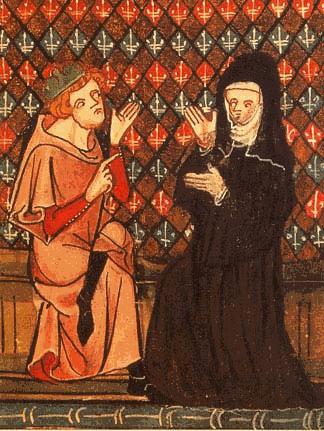
There is a love story tangled in Abelard's life, and it has done his partner a disservice, because the tradition remembers her as a romantic heroine and she was a formidable thinker. Héloïse (pronounced "EL-oh-eez," around 1100 to 1163/64) was famous for her learning before she ever met Abelard, fluent in Latin and reputed to know Greek and Hebrew, which almost no one did. Abelard, hired as her tutor, seduced her; there was a child, a secret marriage, and then a catastrophe. Her uncle, enraged, hired men who broke in at night and castrated Abelard, who recorded the outrage himself: "they cut off those parts of my body with which I had done that which was the cause of their sorrow." He became a monk; he made her become a nun. The romance is real, but what Héloïse actually argued is philosophy. By Abelard's own report, she opposed their marriage on intellectual grounds, asking "what possible concord could there be between scholars and domestics, between authors and cradles, between books or tablets and distaffs," a serious claim that the contemplative life and the domestic life are simply incompatible. And she pushed a startling ethical position, that love should be disinterested, wanting the person and not the bond: it would be sweeter, she said, "to be called my mistress than to be known as my wife," because then "love alone would hold me," with no marriage chain doing the holding. The force of that is considerable: she is arguing that a contract makes love less real, not more, because once a bond holds you in place you can no longer prove you are there for the person rather than the bond. That is an argument about the purity of motive, with the same shape as Abelard's own of intention, not a swoon. (Her own surviving letters are genuine and press the same ideas in her own voice; but the only easily found English translation online is an 18th-century embellishment that invents and romanticizes, so the case here rests on Abelard's report, the form we can actually verify.) She became abbess of the Paraclete, an abbey Abelard had founded, and made it one of the most flourishing religious houses in France.
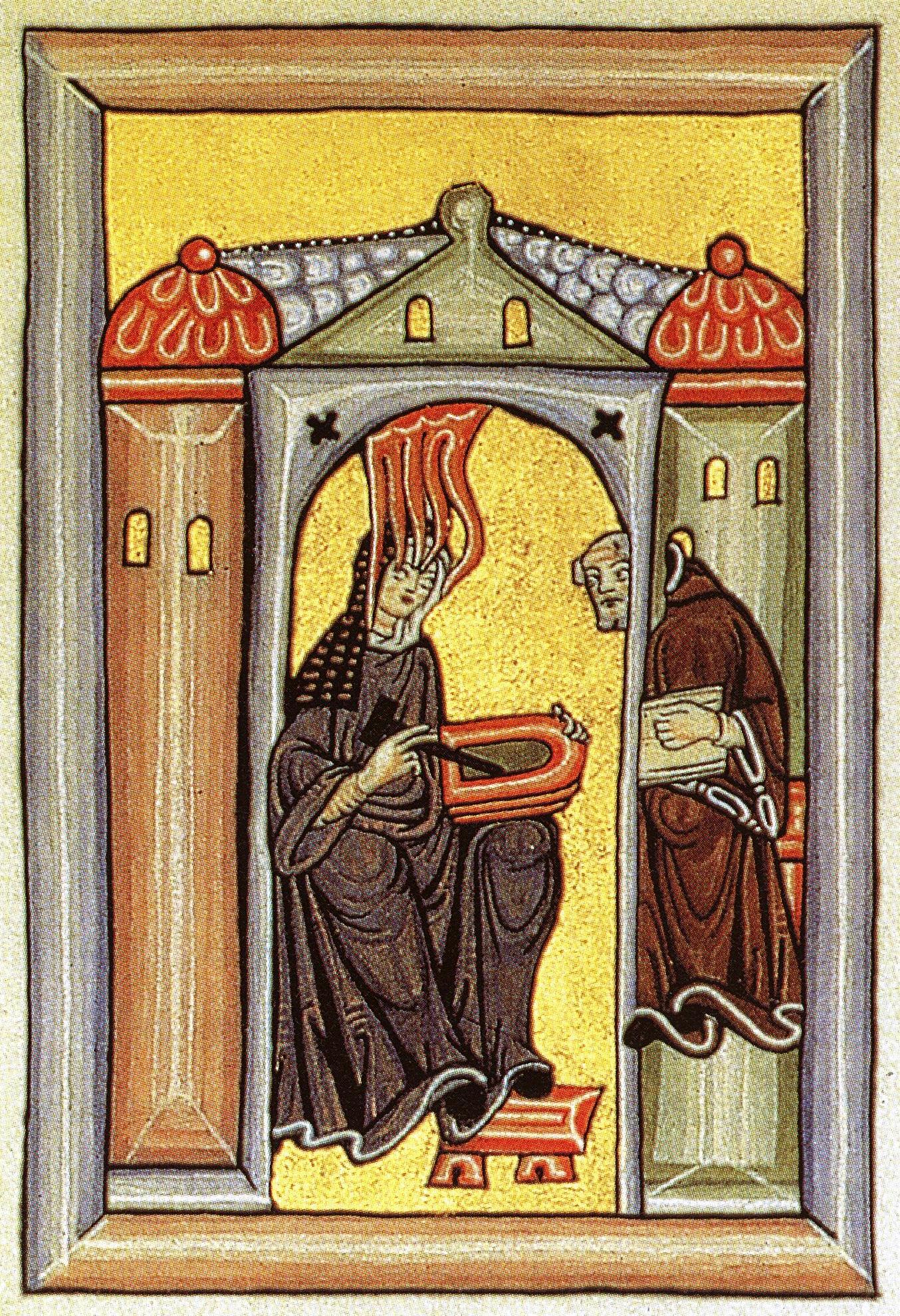
And the classroom was not the only channel a twelfth-century mind could run in. Hildegard of Bingen (1098 to 1179), given as a child to the care of a religious recluse in the German Rhineland and later elected leader of her community of nuns, had been seeing visions all her life, and in 1141, as she tells it, a voice commanded her to set down what she saw and heard. She did: Scivias, a vast account of the cosmos, creation, and salvation as she had seen them. She is not a scholastic and not a mascot; she is the other thing the era was doing at the same time as the logic machine. Where Anselm and Abelard argued their way toward God, Hildegard reported what she had seen and then built it into a whole worked picture of reality, and her century counted both as knowledge. The timing is telling: in the very decade the Church was moving to condemn Abelard's questions, Pope Eugenius III read Hildegard's visions at the Synod of Trier and sent his blessing, and the monk who drove the case against Abelard, Bernard of Clairvaux, was among those who endorsed her, the same man, opposite verdicts, because her mode was the mystical one he trusted and Abelard's was the dialectical one he feared. She founded her own abbey at Rupertsberg, wrote on medicine and the natural world, invented a private language, composed some seventy musical works (one of the earliest Western composers with a large surviving body of work attached to a name), and, in her sixties and seventies, preached on four public tours through German lands, nearly unheard of for a woman. She was venerated as a saint for centuries before Rome made it official, in 2012, the same year it named her a Doctor of the Church.
Abelard paid for his brilliance. His habit of cross-examining sacred doctrine got him formally condemned twice (a condemnation being the Church's official ruling that a teaching is in error and must be withdrawn, which here meant being forced to burn his own book and barred from teaching the position), at Soissons in 1121 and again at Sens in 1141. The force behind Sens was Bernard of Clairvaux, the most influential monk of the age, and he was not a villain throwing his weight around but a man with a coherent position. Bernard held that theology is not a debating exercise to be staged in front of a crowd of students, that the mystery of God exceeds what the dialectical method can hold, and that Abelard's public syllogizing of doctrines like the Trinity was exactly the kind of categorical mistake that breeds heresy. Behind that negative judgment sat a positive theology of his own: God is reached through love, humility, direct experience, and prayer, in the affective mysticism Bernard spent his life writing, and from inside that conviction, turning the classroom's cross-examination loose on the holy mysteries looked less like method than like pride. A mind that had read the Fathers as closely as Bernard had was making an argument, not just winning a fight. Abelard died under the protection of the kindly abbot of Cluny. But his method won, even as the man lost. The classroom procedure that took over the universities, posing a question, stacking the authorities on both sides, and reasoning to a resolution, was Sic et Non with the answers now required. And it was given a textbook. A theologian named Peter Lombard assembled the Sentences, a vast, organized collection of theological questions with the authorities arrayed under each, and it became the book that every later master, Aquinas, Scotus, Ockham, all of them, had to lecture on to earn his standing. Lecturing on the Sentences was the medieval equivalent of a dissertation, and that one textbook is why the whole later cast shares a vocabulary. These scholars knew they were building on those who came before. Bernard of Chartres, a schoolmaster of the age (not the more famous Bernard of Clairvaux above, but a different man, a Platonist scholar of the cathedral school at Chartres), used to say, as his student's student reported it, that we are dwarfs perched on the shoulders of giants, seeing farther than our predecessors not because our sight is keener but because their stature lifts us up. It is the perfect motto for a civilization that had just gotten its Aristotle back.
Chapter 6
Aquinas
"Therefore it is necessary to arrive at a first mover, put in motion by no other; and this everyone understands to be God."
All the era's threads, the Greek Aristotle, the Arabic commentators, the Jewish negative theology, the university machine, run together into one mind in the thirteenth century, as far as they will ever run together, and the synthesis they produce is the nearest thing the Middle Ages built to a finished cathedral of thought. But the cathedral had an architect-in-waiting, and skipping him makes the next leap look like magic. Albertus Magnus (Albert the Great, around 1200 to 1280) was a Dominican friar (a member of a preaching religious order; a friar, unlike a cloistered monk, lived and worked out in the towns) and an astonishing polymath who threw himself at the newly arrived Aristotle flooding in from Toledo and tried to digest the whole of it, science and all. Albert did the reconciling work first. His pupil finished it.
That pupil was Thomas Aquinas (pronounced "uh-KWY-nus," around 1224/25 to 1274), born into a noble Italian family that was so appalled when he joined the Dominicans, an order of mendicant preachers they considered beneath him, that they locked him up in the family castle for a year to break his resolve. It didn't work. He went to study under Albert at Cologne, and there a story attached to him that his canonization biographer would tell decades later: the other students, seeing a huge, silent young man who rarely spoke, mocked him as "the dumb ox," and Albert is supposed to have answered that this ox's "bellowing in doctrine will one day resound throughout the world." (That comes from a Life written for his sainthood case about seventy years on, so take it as the tradition's fond memory.) The bellowing took the form of the Summa Theologiae, an immense, orderly attempt to lay out the whole of Christian theology as a reasoned system, written as a beginner's textbook and never finished.
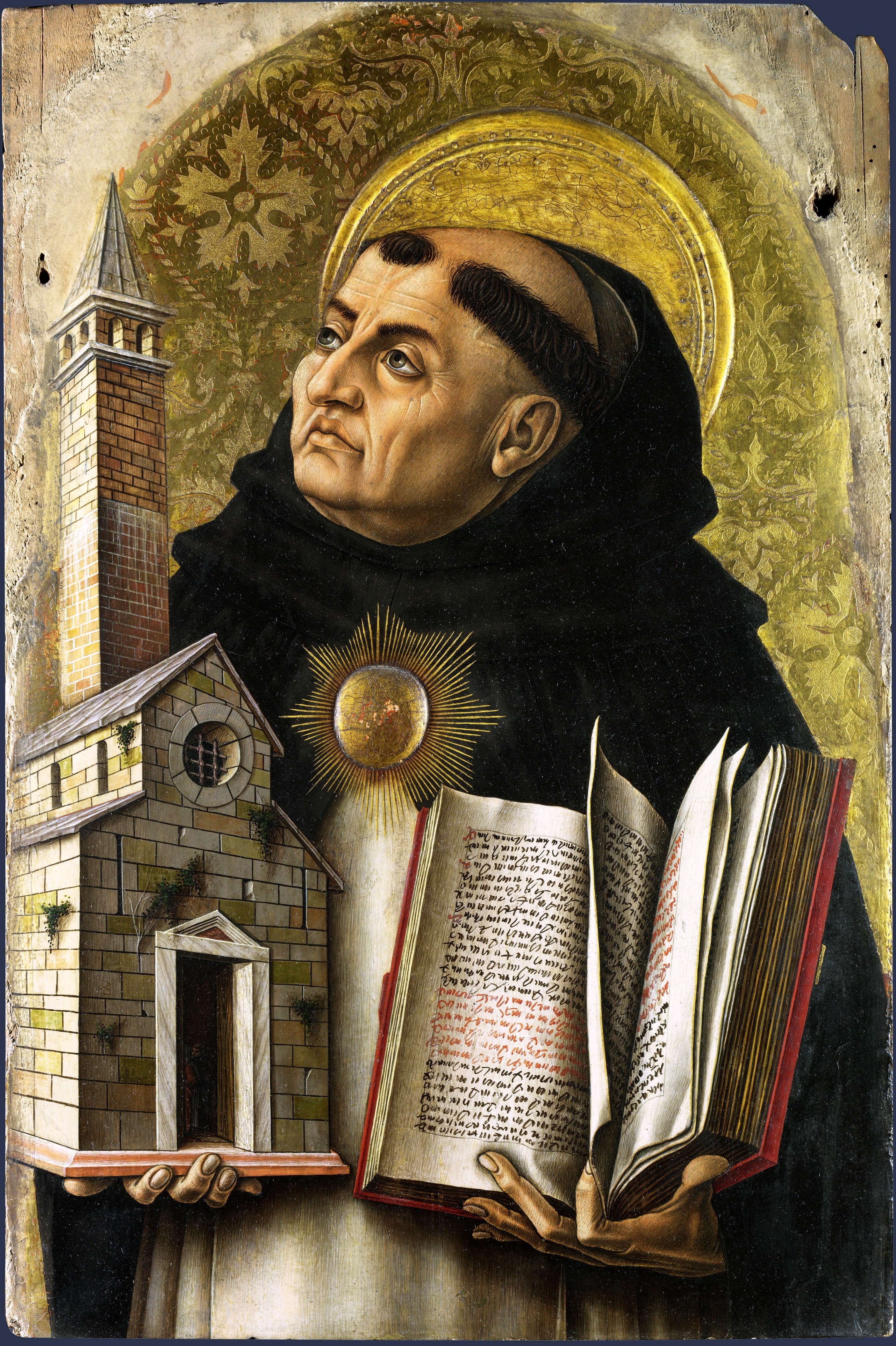
That a Dominican built this synthesis and not a Franciscan is the hinge of the next chapter. The two great new mendicant orders, the Dominicans (founded to preach and to argue down error, intellectual by design) and the Franciscans (founded by Francis of Assisi, sworn to poverty and leaning toward a piety of love and will over cool intellect), would come to host two different instincts about how far reason should go. Aquinas, the Dominican, bet big on Aristotle and on reason's reach. The men who later pulled his synthesis apart, Scotus and Ockham, were Franciscans, suspicious from the start of so tidy a marriage of faith and philosophy.
Aquinas's master idea is the cleanest answer the era ever gave to its own central problem, the relationship between faith and reason. They are, he held, two roads to one truth, and they cannot truly conflict because both come from the one God who is their author. Some truths reason can reach on its own (that God exists, for instance); others only revelation can give us (that God is a Trinity, three distinct persons, Father, Son, and Holy Spirit, who are at the same time one God, a specifically Christian teaching that Jewish and Muslim thinkers reject and that no argument could ever have deduced); but none of them contradict. His image for it is a single sentence that holds the whole architecture: "grace does not destroy nature but perfects it." Faith does not cancel reason or override it; it completes it. His own tendency was to reach for light as the image: natural reason sees the world by a natural light, the ordinary daylight of the mind, and faith does not paint over what that light shows, it adds a second, higher light that lets the eye see further into the same room, up toward things the daylight alone could never reach. Reason builds as far as it can see, and revelation lights the rest of the wall. (The light image is ours, drawn from his family of metaphors, not a quotation.)
His most famous argument shows the method at work. Aquinas offers "five ways" to demonstrate God's existence near the start of the Summa, and the first, the one he calls "the more manifest," is the argument from motion. It is obvious to your senses that some things in the world are in motion, changing. Now, Aquinas holds, whatever is being moved is being moved by something else; a thing doesn't move itself from nothing. His own illustration: "the staff moves only because it is put in motion by the hand." He is not, as is almost always assumed, talking about a long-ago first push that toppled a chain of dominoes through time. He means right now, this instant: the staff moves because the hand is moving it at this moment, and if you trace the chain of what's-moving-what at any single instant, it cannot run back forever, because then nothing would actually be doing the moving, it would be a line of staffs with no hand. So "it is necessary to arrive at a first mover, put in motion by no other; and this everyone understands to be God." (There is an honest seam in that last clause. "This everyone understands to be God" does a lot of quiet work; the argument, even if it lands, gets you only to a first mover, not yet to the God of any particular scripture, and Aquinas knew it. The Five Ways are compressed sketches in a textbook, each leaning on a whole worked-out metaphysics, not five knock-down proofs that settle God in five easy steps.)
What makes Aquinas a great philosopher and not just a great believer is that he argues against himself harder than his critics do. In the very same article where he proves God exists, he first lays out the two strongest objections to God's existence, and they are devastating. One is the problem of evil: if God were infinitely good, "there would be no evil discoverable; but there is evil in the world. Therefore God does not exist." The other is a principle of economy that will matter greatly in the next chapter: "it is superfluous to suppose that what can be accounted for by a few principles has been produced by many," and maybe everything in the world can be explained without dragging God in at all. That second objection, stated by Aquinas himself around 1270, is Ockham's razor pointed straight at God, sixty years before William of Ockham picked it up. Aquinas raises it against his own case and then answers it. A mind that arms its enemies that well is not doing propaganda.
Aquinas was not crowned in his own lifetime; that is a later legend's tidiness. He died in 1274, at forty-nine or so, on the road to a Church council, at a Cistercian monastery. (Dante would later repeat a rumor that he was poisoned by a king's order; modern historians dismiss it, and it should be told only as a rumor Dante repeated.) Months before, in December 1273, something happened that his canonization witnesses swore to: while saying Mass, Aquinas had some experience he never explained, and afterward he simply stopped writing, leaving the Summa unfinished. Pressed by his secretary Reginald to go on, he is reported to have said, "All that I have written seems to me like straw compared with what has now been revealed to me." (The line comes third-hand through sworn testimony at his sainthood hearing, so quote it with that chain showing.) The greatest system-builder of the Middle Ages put down his pen and called his life's work chaff.
And then his own Church came after his school. On the seventh of March, 1277, three years to the day after Aquinas died, the bishop of Paris, Étienne Tempier, condemned 219 propositions on pain of excommunication (formal expulsion from the Church, cutting a person off from its sacraments and community). The principal targets, identified by later historians though named in no surviving document, were arts-faculty masters suspected of pushing Aristotle and his Arabic commentator Averroes too hard, above all Siger of Brabant and Boethius of Dacia, and Tempier's preamble charged them with teaching things "true according to philosophy" but false "according to the Catholic faith." That preamble is the birth certificate of the "double truth" caricature from Chapter 4, the one Averroes never held and modern scholars doubt these Paris masters held either. And understand what was actually being condemned: not stray provocations but teachings out of Aristotle himself, the eternity of the world above all (that the universe never had a beginning, the same thesis al-Ghazālī had branded unbelief two centuries earlier, Chapter 3) and the determining grip of the heavens on events below. It was the Philosopher on trial, not just his Paris admirers. Some of the condemned propositions brushed against Aquinas's own teaching: the new synthesis, barely finished, was already under official suspicion. (Some have argued the 1277 condemnation, by knocking the props out from under Aristotle's physics, accidentally cleared the ground for modern science; most historians now find that story too neat, so flag it as one famous claim, not a fact.) The peace between faith and reason that Aquinas had built so carefully was not going to hold, and the man who would prove it could not had just been born.
Chapter 7
Ockham and the fraying
"Pluralitas non est ponenda sine necessitate." ("Plurality is not to be posited without necessity.")
Between Aquinas and the man who took the era apart stands one figure the story needs, or the last leap looks like a cliff. Duns Scotus (pronounced "dunz SKOH-tus," around 1266 to 1308), nicknamed "the Subtle Doctor" for the fineness of his distinctions, taught at Oxford and Paris in the generation after Aquinas, and he is the bridge. Part of what opened the road for him was the 1277 condemnation itself: with Aristotle's confident reach under official suspicion, there was room for a will-centered, less necessitarian metaphysics, and Scotus, a Franciscan, was the one who built it. He pushed three ideas the next man would inherit and sharpen. He gave new weight to the will over the intellect, in God and in us, the sense that a free choice is more fundamental than a reasoned conclusion. He was the one who actually worked out and used the parsimony formulas, the principles of economy in explanation, that the next man would get famous for. And he argued that the word "being" means the same thing whether you say it of God or of a creature, the doctrine called the univocity of being, that we can reason about God and creatures using exactly the same logical concepts. That sounds technical, and it is a loaded gun, because Aquinas had denied exactly this: for Aquinas you could only speak of God by analogy, stretching creaturely words toward a God who exceeds them, so God always stayed partly out of logic's reach. Scotus pulls God back inside the same logical net as everything else, which is precisely what lets the next man run the same ruthless logic on God and the world without special pleading. Hold all of it: the will, the razor, the one logic for everything. They arrive together at William of Ockham.
William of Ockham (pronounced "OCK-um," born around 1287, died in April 1347) was an English Franciscan friar who lectured on Lombard's Sentences at Oxford but, in a detail that fits the whole tenor of his career, never finished the formal steps to become a full master, which earned him the wry nickname Venerabilis Inceptor, "the Venerable Beginner." He is the era's last great mind and its great unraveler, and the unraveling runs through that universals fight Abelard stirred and Boethius first lit (Chapter 5). Recall the question: is "humanity," the thing all humans share, a real entity out in the world, or just a name? Ockham's answer is the most ruthless nominalism in the whole tradition, stated flatly: "everything that exists in the created universe is a singular substance or a singular quality." There is no "humanity" floating out there that you and I both partake of. There are only individual humans, full stop. Generality lives in our concepts and our words, never in the world. Reality is a heap of particulars, and the universal is something the mind does, not something it finds.

This is the moment for the era's signature catch, exactly the trap the Greeks chapter sprang with Zeno's tortoise: a famous saying pinned on the wrong words. Everyone knows Ockham's razor: "entities must not be multiplied beyond necessity." Trim your explanation; don't posit more than you need. The principle is genuinely useful and really is associated with Ockham. But that exact sentence is nowhere in anything Ockham wrote. The famous Latin wording, entia non sunt multiplicanda praeter necessitatem, first shows up in 1639, in an Irish editor named John Punch, who calls it a common scholastic saying, not Ockham's coinage. What Ockham actually wrote, over and over, were lines like "plurality is not to be posited without necessity" and "it is futile to do with more what can be done with fewer." And those very formulas were in Duns Scotus before him. So the razor is real, medieval, useful, and shared, just not Ockham's sentence; it bears his name the way America bears Amerigo Vespucci's, by a later accident of labeling. In his own hands the razor shaves away the realist's universal: why posit a mysterious shared "humanity" out in the world when individual humans, plus the mind's power to group them by resemblance, already explain everything we observe? Singular things suffice, he wrote, "so such universal things are posited entirely in vain." A whole layer of reality the realists believed in falls away.
But the razor has a safety-catch, and it is the key to why the era ends here. Ockham was a Franciscan theologian, not a proto-atheist sharpening a blade against God, and his razor never shaves God away. It governs our explanations, not God's freedom. And God's freedom, for Ockham, is the radical fact under everything. God is absolutely free, bound by nothing except not contradicting himself; he could have made the world entirely otherwise, attached burning to ice instead of fire, made different acts good or evil. This is voluntarism (the view that will, not reason, is fundamental, so that things are good because God wills them, rather than God willing them because they are good). The stakes are sharp: if things are good only because God chose to will them, then morality has no rational basis standing on its own, independent of what God happened to command, and there is no goodness reason could deduce without revelation telling it where God landed. And here is where Aquinas's beautiful synthesis cracks. If God could have wired the world any way he pleased, then the connections we see in nature, fire-then-burning, this-cause-then-that-effect, are not necessary at all. They are just how God happens to have set things up, and he could suspend them at will. (This is al-Ghazālī's point from Chapter 3 arriving in Latin.) But if no connection in the world is truly necessary, then reason cannot deduce how the world must be by pure thought; it can only watch how the world happens to be. Reason's reach shortens. The two roads Aquinas had run side by side, faith and reason climbing one wall together, begin to file for separation: theology keeps the truths only God can reveal, and natural knowledge shrinks to what observation can catch.
Ockham lived the fraying in his own body. In 1324 he was summoned on suspicion of heresy (holding a belief the Church had officially declared false, a charge that could cost a teacher his license, force a public recantation, or bring excommunication) to the papal court at Avignon, a city in southern France where the popes were then living instead of in Rome (the papacy had relocated there under French political pressure, a move many Christians regarded as a scandal and a sign of how dislocated the Church's own house had become). There he got drawn into a furious fight over whether Christ and the apostles had owned property (the Franciscans, sworn to poverty, said no; the pope said yes), studied the pope's pronouncements, and concluded that the pope was not merely teaching error but was himself a heretic. The inversion is striking: the man hauled up on a heresy charge studied his accuser and threw the same charge back, declaring the pope the real heretic. In 1328 he fled to the protection of a German emperor at war with the papacy, was excommunicated, and spent his last two decades in Munich writing political pamphlets against papal power. The era's premier logician ended as a fugitive polemicist, the unity of faith and reason he had philosophically dissolved now literally at war in his own life.
What the era settled, then, is worth accounting, the way the Greeks chapter accounted at its close. The thousand-year experiment, three religions trying to keep faith with a book and with an argument, did not fail, exactly. It built astonishing things under that double load, things you only build when you must satisfy two masters: Anselm's argument that God's very definition guarantees his existence, Avicenna's God reasoned out from the bare fact that things exist, Maimonides' God known only by what he is not, Aquinas's vaulting peace between grace and nature. None of those gets built by a mind answering to argument alone, or to scripture alone. The strain was the engine. But the same strain that built the cathedral eventually pulled it apart, and Ockham is where the keystone slips. His God was simply too free for the tidy two-roads architecture to contain; if nothing in the world is necessary, then reason and revelation can no longer be sure they are climbing the same wall.
The era did not hand its question straight to the next era; it set it down, and the question sat for two and a half centuries while the medieval world slowly ended. Add the fourteenth century's catastrophes, a papacy split and discredited, and the Black Death arriving the year after Ockham died and erasing a third of Europe, and the question the era had carried for a thousand years sat exposed and unanswered: what, exactly, can reason establish on its own, with no book to lean on and no necessity to grip? Ockham's nominalism did not vanish with him. It spread through the universities as the via moderna, "the modern way," with Ockham's Parisian contemporary Jean Buridan leading the nominalist current at the heart of the university world, and it became the air a whole generation of students breathed, including the young friar Martin Luther, who trained under nominalist masters at Erfurt before he broke the Western Church in two. Alongside it, in Renaissance Italy, ran a rival revival, scholars like Marsilio Ficino reaching past Aristotle to put Plato back at the center, trying to do for Plato what Aquinas had done for Aristotle. None of it settled the era's question. Then, in 1619, a young Frenchman named Descartes, shut in a warm room against the winter, picks it up and tries to answer it from nothing but his own doubting mind, and the next era begins. The faith-and-reason marriage that started when Augustine opened the books of the Platonists ends, a thousand years on, with a logician proving the two could not be held together, and handing the loose ends forward on purpose.