
Around 585 BC, somewhere on the western coast of what is now Turkey, a man named Thales looked at the world and did something quietly radical: he tried to explain it without a single god in the explanation. No Poseidon shaking the earth, no divine moods behind the weather, just stuff and the way stuff behaves. His answer (everything is ultimately water) was wrong. That barely matters. What matters is the kind of answer it was, a guess you could argue with, test against the next guess, and improve. That is philosophy (literally "love of wisdom," the practice of chasing the hardest questions and refusing to accept "because everyone says so" as an answer), and in the Western tradition it begins here.
That move set off the longest argument in Western history. Over the next thousand years the Greeks asked whether anything really changes, whether we can know anything at all, what a good life even is, and whether the universe cares. They didn't agree. That was the point. This is the story of people who decided that "the gods did it" was no longer a good enough answer, and what they built instead.
The break
When an earthquake hit the early Greek world, everyone knew the cause. Poseidon was angry. His standing nickname in Homer is "the Earth-shaker," and that nickname was the explanation: the sea-god was in a mood, the ground moved. Where did the world come from? Hesiod, an early Greek poet, answered with a family tree of gods (first Chaos, then Earth, then a long chain of divine births). To explain something was to say which god, in what mood, and the cure was a ritual to fix the mood. None of this was stupidity. The mythic framework was internally consistent and worked perfectly well for the people living inside it; the shift that follows is not the correction of an obvious error but the decision to adopt a new standard of explanation.
Then Thales said the earth floats on water and the eclipse was a natural event you could see coming. Same world, no gods. Explanation stopped being a who answered by worship and became a what and a how answered by argument, the kind of claim you could doubt and a student could improve on. A warning runs through everything that follows: these earliest thinkers survive almost entirely as quotations in much later writers, often their enemies, so we are reading them through other people's hands.
Chapter 1
Before philosophy, and the move that started it
"…just as the battle was growing warm, day was on a sudden changed into night. This event had been foretold by Thales, the Milesian, who forewarned the Ionians of it, fixing for it the very year in which it actually took place."
There is a date you can hang the whole of Western philosophy on, and it is a strange one: the afternoon of May 28, 585 BC. On that day a solar eclipse swept across Asia Minor (modern Turkey), and according to Herodotus (the earliest Greek historian we have, writing about 150 years later) it stopped a war. Two armies, the Medes (from what is now Iran) and the Lydians (from the western part of what is now Turkey), were in the middle of a battle when the sky went dark in the middle of the day. They took it as a sign, dropped their weapons, and made peace.
What makes the date matter is the footnote Herodotus adds: a man named Thales of Miletus (pronounced "THAY-leez," a Greek living in the coastal city of Miletus) had said the eclipse was coming. He fixed "the very year." Herodotus says only that Thales named the year, not the day, and modern astronomers doubt anyone in 585 BC actually had a method to predict a solar eclipse. So the prediction may be the legend's seed rather than a real feat. Even the story assumes that an eclipse is not a god's tantrum but a regular natural event, the sort of thing that runs on a schedule a clever person might work out. In Homer, an eclipse is an omen. Here it is a mechanism. That shift is the birth of the whole enterprise.
Tradition, following the philosopher Aristotle (more on him later), calls Thales the first philosopher of the Western tradition. That qualifier matters. India and China had deep traditions of thought that are older than or as old as this one; they are simply a different story, deferred here by scope, not by rank. What Thales started was specifically the Western branch.
Thales wrote nothing that survives. Everything known about him comes from later writers describing what he supposedly said, the most important being one line from Aristotle two centuries on: Thales held that the fundamental principle of everything (the Greeks called this the archê, pronounced "AR-kay," the source-stuff and starting-point of all things) is water, and that the earth rests on water like a raft. Why water? Probably because it is the one substance you watch turn solid (ice), liquid, and vapor; because life needs it; because seeds and food are moist. The answer is wrong. But look at the form of it. It names an ordinary substance, available to anyone, and a process anyone can watch, and it invites the obvious next question: well, what holds up the water?
Thales' student Anaximander (pronounced "an-ax-ih-MAN-der," active a generation later in the same city) looked at "everything is water" and disagreed. He reasoned that the source of all things couldn't itself be one of the things, because water is wet and cold, and how would wet-and-cold ever produce its own opposite, the dry and the hot? So he proposed something stranger and bolder: the source is the apeiron (pronounced "ah-PIE-ron," literally "the boundless"), an indefinite stuff with no qualities of its own, out of which all the opposites separate. We have one fragment of his actual words, possibly the oldest surviving sentence of Western philosophy, and even its exact extent is debated. As John Burnet (a Scottish scholar whose 1892 translations are the standard public-domain English) renders it, things "make reparation and satisfaction to one another for their injustice according to the ordering of time."
It is a courtroom image. The hot and the cold, summer and winter, wet and dry, take turns dominating, and each pays the other back in due season, as if nature ran on something like law. A third Milesian, Anaximenes (pronounced "an-ax-IM-uh-neez"), then disagreed with both and said the source is air, but he added something neither predecessor had: an actual mechanism. Air thins out into fire and thickens, by stages, into wind, then cloud, then water, then earth, then stone. One substance, one process, the whole world.
Three men in one city, across two generations, each correcting the one before. That, not any of their wrong answers, is the invention. The old way was recitation: you handed down the sacred story unchanged. The new way was correction: a student could tell his teacher he was wrong and offer a better account, and the better account could itself be beaten. Put plainly, philosophy begins not when someone gets the right answer, but when someone offers a kind of answer you are allowed to argue with.
Chapter 2
The problem of change
"You cannot step twice into the same rivers; for fresh waters are ever flowing in upon you."
The Milesians had asked what the world is made of. The next generation found a deeper and more disturbing question hiding underneath: does anything ever really change at all, and if it does, how is that even possible? It sounds like a non-problem. Of course things change. But two thinkers pushed on it from opposite ends until it became the hardest puzzle in early philosophy, and almost everything after them is an attempt to climb out of the hole they dug.
On one side stood Heraclitus of Ephesus (pronounced "hair-uh-KLY-tus," active around 500 BC; we have no reliable dates for him, and the ancient stories about his life were, in one scholar's phrase, apparently invented to fit his gloomy writings). His famous image is the river. The line everyone quotes, that you can't step in the same river twice, is genuinely his idea, though the exact wording is slippery. Of the surviving river fragments, scholars trust only one as his real phrasing, and the snappy one-liner actually comes down to us secondhand, through the philosopher Plato paraphrasing him; the wording is the tradition's, not a transcript.
Heraclitus' real point is not "everything is chaos." It is almost the reverse. The river stays the same river precisely because different water is always flowing through it. The identity is in the flow, not in spite of it. Stop the flow and you don't have a river, you have a pond. Change isn't the enemy of stability; it is how some things stay themselves. Heraclitus thought all of reality worked this way, held together by what he called the logos (pronounced "LOH-gos," a rational order or pattern running through all the change). Fire was his emblem, a thing that is nothing but ongoing process, always consuming and renewing, and yet recognizably one flame. As he put it, "an ever-living Fire, with measures of it kindling, and measures going out."
On the opposite side stood Parmenides of Elea (pronounced "par-MEN-ih-deez," from a Greek colony in southern Italy, born around 515 BC), and he is the roadblock the whole era has to get past. His argument is short, strange, and weirdly hard to break. It goes like this. Whatever is, is; whatever is not, is not, and you cannot even think or talk about what is not, because the moment you do, it is something. Now consider change. For something new to come to be, it would have to come from what is not (which doesn't exist, so nothing can come from it), or from what already is (in which case nothing new came to be at all). Either way, real coming-to-be is impossible. Run the same on motion, on plurality, on anything: it all dissolves. Parmenides' conclusion, delivered, oddly, as a poem in which a goddess reveals the truth, is that reality is one single, unchanging, eternal thing, and that the changing many-colored world your senses show you is an illusion. "It is," he wrote, "and it is impossible for it not to be."
The smartest people of the next two centuries couldn't simply wave it away. The argument has no obvious bad step. Each move seems forced. And yet the conclusion is monstrous to common sense: nothing moves, nothing changes, your whole life is a deception. When an argument you can't refute leads somewhere you can't believe, you have a genuine crisis, and that is what Parmenides handed the Greeks.
His student Zeno of Elea (not to be confused with the later Zeno who founded the Stoics, a different man in Chapter 6) defended him with a set of paradoxes designed to show that motion, if you take it seriously, is absurd. The best one is Achilles and the tortoise. (Aristotle's own text says only "the slowest runner." The tortoise is the name the tradition gave him, arriving via the commentator Simplicius about a thousand years after Zeno, and it stuck so well it is now the paradox's permanent cast.) Give the tortoise a head start in a race against Achilles, the fastest runner alive. As Aristotle preserves the argument, the quicker runner "can never overtake the slowest," because before Achilles can reach the tortoise he must first reach where the tortoise started, by which time the tortoise has crawled a little further; reach that spot, and the tortoise has moved again; and so on forever. Achilles closes the gap infinitely many times but, the argument says, never quite shuts it. We know perfectly well he passes the tortoise. Zeno's point is that you cannot explain how, not without untangling what it means to add up infinitely many shrinking steps. That knot wasn't fully cut until the calculus of the 1600s and, more rigorously, the 19th-century mathematics of infinite series showed that infinitely many shrinking distances can sum to a finite one (the gap really does close). (And we only have Zeno because Aristotle quotes him in order to refute him.)
So: Heraclitus says change is the deep truth of things; Parmenides says change is impossible. Both have arguments. The rest of Greek thought is largely the project of buying back the ordinary world from Parmenides, of finding some way to say "yes, things really do change" without breaking his logic.
Three thinkers tried, and all three made the same concession to Parmenides: nothing truly real ever comes from nothing or perishes into nothing. Empedocles of Acragas (pronounced "em-PED-uh-kleez," a colorful Sicilian) proposed four eternal "roots" that never themselves come to be or pass away (earth, air, fire, and water, which he named grandly after gods, "shining Zeus, life-bringing Hera, Aidoneus and Nestis"). What looks like birth and death is just these four roots mixing and unmixing, driven by two cosmic forces he called Love and Strife. Anaxagoras of Clazomenae (pronounced "an-ax-AG-or-as"), the first philosopher to settle in Athens, added a single ordering principle he called Nous (pronounced "noose," Mind) that set the cosmos (the whole ordered universe, sky and earth together) spinning and sorted it out. He also made a claim that would get him prosecuted and would echo, decades later, in the most famous trial in this whole book: that the sun is not a god but a red-hot stone, and the moon is made of earth.
The most radical answer came from Leucippus and his student Democritus of Abdera (pronounced "de-MOCK-rih-tus," born around 460 BC). Their solution: concede everything to Parmenides about each individual bit of reality, then make reality plural. Imagine the world is made of countless tiny, solid pieces, each one indivisible, unchanging, and eternal, exactly the kind of unbreakable "being" Parmenides insisted on. They called these pieces atoms (from the Greek atomos, "uncuttable"). Between them is empty space, the void. Every atom obeys Parmenides; it never changes. But the atoms move around in the void, and as they rearrange, clump, and separate, that rearrangement is what we experience as change, growth, decay, and color and taste. Nothing is created or destroyed; the furniture just gets moved. Democritus drew the unsettling conclusion himself: "by convention sweet and by convention bitter, by convention hot, by convention cold, by convention color; but in reality atoms and void."
It is tempting to cheer this as ancient science getting it right two thousand years early, but that gets the achievement backward. This was not science. It was a piece of reasoning, a clever escape from a logical trap, with no experiment anywhere near it; the atoms were posited to satisfy Parmenides, not discovered by looking. The resemblance to the atoms of modern chemistry is a genuinely delightful coincidence, and a coincidence is all it is.
One more figure, slightly off to the side: Pythagoras of Samos (pronounced "pih-THAG-or-as," active in the same southern-Italian world as Parmenides, around 530 BC). Almost everything told about him is legend (he wrote nothing, and his followers were a secretive religious community who mythologized him freely, so the famous theorem that bears his name was known to Babylonian mathematicians long before and was probably never proved by the man himself). But one idea his school planted matters enormously for what comes next: that the deep structure of reality is number. Musical harmony turns out to be whole-number ratios of string lengths; the heavens seem to move in mathematical order. If the truest things about the world are not the messy objects you see but the unchanging numbers and ratios underneath them, then maybe the really real is something the mind grasps, not something the eye sees. Two chapters from now, Plato builds a universe on it.
Chapter 3
The Sophists and Socrates
"I am better off than he is,—for he knows nothing, and thinks that he knows; I neither know nor think that I know."
By the middle of the 400s BC, the action moved to Athens, and the questions moved with it, away from what the cosmos is made of and toward how a human being should live, argue, and govern. There is a good reason for the shift. Athens was one of hundreds of independent city-states (the Greeks called them poleis, each one its own miniature nation with its own laws, gods, army, and courts), and Athens had become a democracy. In a democracy the man who could stand up in the assembly or the law courts and speak well held real power. (This was a democracy of a particular and narrow kind: it ran on the votes of adult male citizens only, and excluded women, the tens of thousands of enslaved people, and resident foreigners, who together were most of the people in Athens.) Persuasion was the currency. And where there is demand, there is supply.
The suppliers were the Sophists (pronounced "SOFF-ists"), and they have one of the worst reputations in history, almost all of it unfair. The Sophists were professional teachers, the first paid higher education in the Western world. They traveled city to city selling instruction in rhetoric (the art of effective speaking), and also in things like running a household, managing public affairs, geometry, astronomy, and the precise use of words. They had no shared doctrine and no single school, which means the blanket charge against them, that they were a gang of cynical word-twisters, can't even be true as stated, because there was no "them" to share a creed. The closest modern analog is the debate coach who teaches you to argue any side of a question convincingly, win or lose, which is exactly why a democracy found them both useful and alarming: the same skill that wins a just case wins an unjust one. The most famous, Protagoras of Abdera (pronounced "pro-TAG-or-as," around 490 to 420 BC), was respected enough to be hired to write the law code for a brand-new city, and according to Socrates in Plato's dialogue the Meno, he earned more in fees than the celebrated Phidias himself, or any ten other sculptors.
So where did "sophistry" (meaning slippery, dishonest argument) come from? Overwhelmingly from one source: Plato, who wrote a generation later and needed to draw a sharp line between his hero, Socrates, and these men Socrates could otherwise be mistaken for. The smear stuck so well that the word still carries it. Naming that is only fair to the people on the losing end of the story.
That said, the Sophists really did say startling things. Protagoras' most famous line is the measure doctrine: "Man," as Plato quotes him, "is the measure of all things, of the existence of things that are, and of the non-existence of things that are not." On the reading Plato gives it, this says that truth is relative to the perceiver: the wind is cold to me if I feel cold and warm to you if you feel warm, and there is no further fact about whether it is "really" cold. But that is Plato's packaging, and scholars still argue over whether it is the right reading or whether Protagoras meant something subtler, less a denial of all truth than a claim that the perceiver is genuinely the gauge. Either way, take the relativist version seriously and it is dizzying. Apply it to right and wrong, to law, to the gods, and you have pulled the floor out. Protagoras did exactly that with the gods, opening a book with a line so careful it could be written today: "As to the gods, I have no means of knowing either that they exist or that they do not exist." Not a denial. A shrug. Which, in a city that executed people for impiety, was its own kind of dangerous. (Another Sophist, Gorgias of Leontini, pushed the to its limit, arguing in a showpiece work that nothing exists; that even if something did, we couldn't know it; and that even if we knew it, we couldn't communicate it to anyone else. His text survives only in later summaries, so we read it at second hand, and scholars debate whether he meant it or was flexing his rhetoric, but it shows the range of the movement: these were not mere fee-collectors.)
Into this world walked Socrates (469 to 399 BC), and he is the hinge of the entire book. The hard limit on what anyone can say about him: Socrates wrote nothing. Everything we have is secondhand, and the sources contradict each other: Plato's Socrates is a profound philosopher, Xenophon's Socrates is a sensible moral advisor, and the comic playwright Aristophanes' Socrates is a ridiculous quack who studies the clouds. Scholars call this the "Socratic problem," and there is no solving it. We are always meeting a Socrates as someone wrote him.
What that someone shows us is a method, not a doctrine. Socrates went around Athens asking people to define the things they claimed to understand (what is justice? what is courage? what is piety?), and then, by patient questioning, showing them that their confident definitions fell apart. This is the famous Socratic method (the elenchus, pronounced "eh-LEN-kus," meaning cross-examination). The method is the man, so here is one.
Suppose you say courage is standing your ground in battle and never retreating. Socrates agrees that sounds brave, then asks: what about a soldier who retreats in order to regroup and wins the war? Wasn't that wise, and brave too? You admit it was. So courage can involve retreating. Then your definition was wrong; standing firm isn't the essence of courage after all. You try again: courage is a kind of endurance. Socrates asks whether foolish, reckless endurance (charging a cliff for no reason) is brave. No, you say, that's just stupid. So courage must be endurance plus good sense. Good, you think, we have it. But Socrates isn't done. If courage is really just "doing the sensible thing," he asks, then what separates the courageous person from the merely prudent one who calculates the odds and acts safely? And isn't the bravest act often the one that looks reckless from outside, the soldier who holds a hopeless line? Now your tidy definition wobbles again, and you realize you are no closer to the bottom of "courage" than when you started. That is the scandal of the method: the cross-examination never hands you a finished answer. It only strips away the false ones. He made everyone around him wiser by proving to them that they did not know what they thought they knew, and then leaving them there. Socrates' whole wisdom, he insists, is just this: "I neither know nor think that I know," while everyone around him knows nothing and thinks they know plenty. (The popular bumper-sticker version, "I know that I know nothing," is not his; he never says that flat paradox, and the real line is subtler and better.)
He framed this mission as a divine assignment. As Plato has him tell it at his trial, a friend once asked the oracle at Delphi (a temple in central Greece where a priestess was believed to speak for the god Apollo, and whose pronouncements Greeks across the Greek world treated as divine truth) whether anyone was wiser than Socrates, and the priestess answered that no one was. Socrates, who felt wise about nothing, took this as a riddle and spent his life testing it by interrogating everyone reputed to be wise, finding each one a fraud, and concluding that his only edge was knowing the size of his own ignorance. He called himself a gadfly, a biting fly God had fastened on the city: "all day long and in all places am always fastening upon you, arousing and persuading and reproaching you." A city does not always thank the fly.
In 399 BC Athens put him on trial. The charges were impiety (not believing in the city's gods and introducing new divinities) and corrupting the young. To a modern reader this sounds like punishing a man for his opinions, so it helps to know that in Athens the city's gods were not a private matter of personal belief. They were the civic glue, woven into festivals, oaths, and the assembly itself, and failing to honor them counted as a crime against the whole community, not just eccentric theology. It is tempting to flatten the trial into a simple martyrdom, free thought murdered by a mob, but the honest version is tangled. Athens had just lost a long, ruinous war and suffered a brutal coup, and several of Socrates' former companions had been among the traitors and tyrants. The trial was about the principle of free inquiry, yes, and also about a frightened city settling scores. At the trial Socrates batted away the old slander that he was a sky-gazing crank, telling the jury that confusing him with that figure was confusing him with a character in Aristophanes' comedy, "going about and saying that he walks in air." When a prosecutor accused him of teaching that the sun is a stone and the moon earth, Socrates pointed out that those were the views of Anaxagoras (Chapter 2), not his, and that the jury was prosecuting the wrong man. None of it worked. He was convicted by a narrow margin; by his own account, a switch of just thirty votes would have acquitted him. Asked to propose his own punishment, he suggested, more or less, that the city should reward him with free meals for life, an honor normally reserved for Olympic champions. They voted for death.
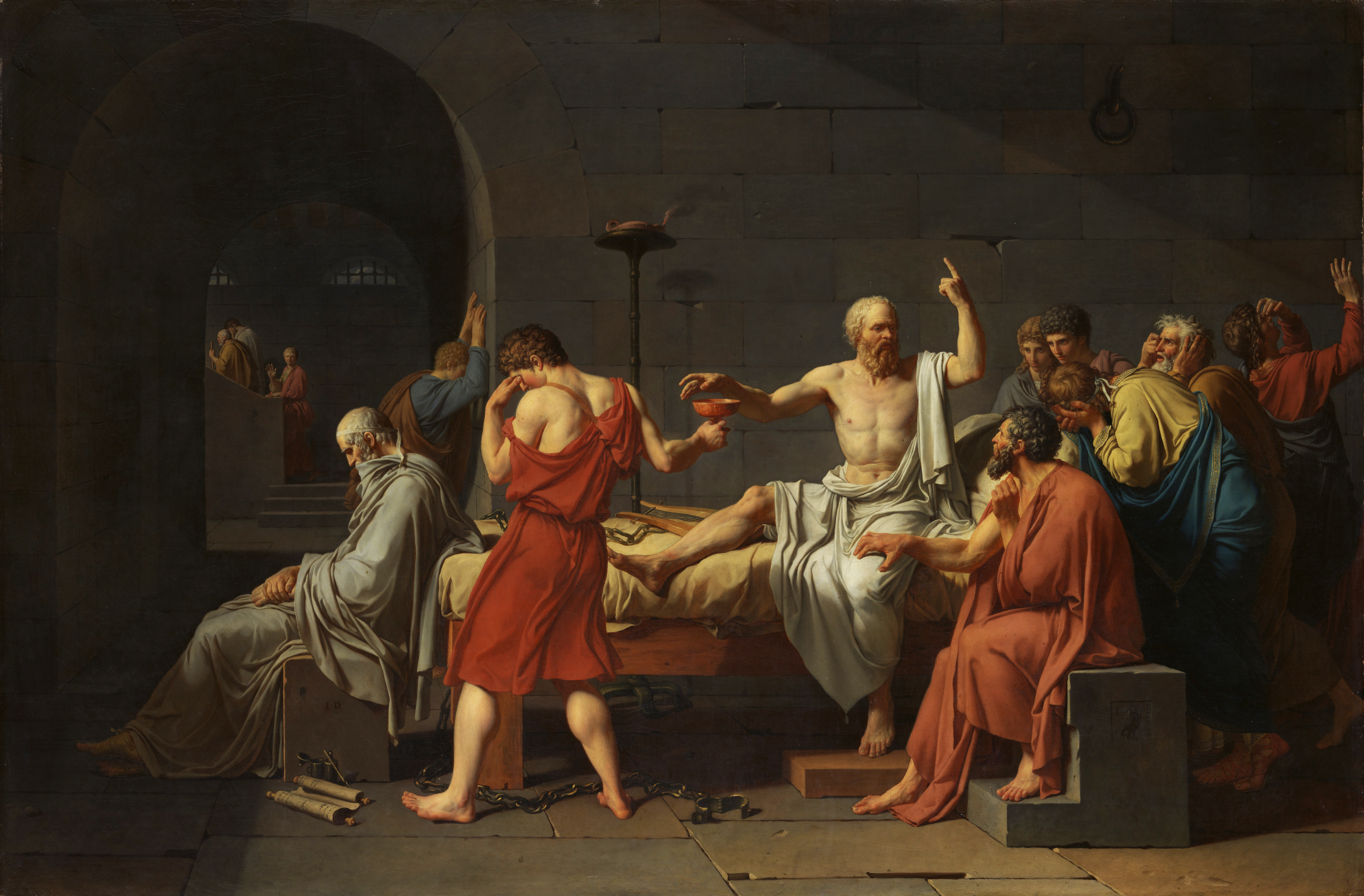
Chapter 4
Plato
"Until philosophers are kings, or the kings and princes of this world have the spirit and power of philosophy… cities will never have rest from their evils."
Socrates died without writing a word. His most gifted follower, Plato (born in the late 420s BC, dead in 347), spent the next half-century making sure he was never forgotten, and in the process built the first complete philosophical system in the Western tradition. He did it in an unusual form: dialogues, little dramas in which characters argue, with Socrates usually the star. This creates a permanent puzzle, where the historical Socrates ends and Plato's own ideas begin, and the honest answer is that we often can't tell. The figure who speaks in these dialogues is best thought of as "Plato's Socrates."
Plato's master idea is the one the whole tradition argues with forever, and it is the long-delayed answer to Chapter 2's crisis. Remember the deadlock: Heraclitus said everything is in flux, Parmenides said real change is impossible. Plato's move is to give each of them half of reality. The world you see and touch, he says, is the world of flux, exactly as Heraclitus described, always becoming, never quite being, never staying still long enough to be truly known. But that is not the only world. There is a second realm, which Plato calls the world of the Forms (sometimes translated "Ideas," and that translation is a trap, because they have nothing to do with ideas in your head; they are real things, just not physical ones). A Form is the perfect, eternal, unchanging original of which the things around you are imperfect copies.
Take a worked example. Think of every circle you have ever seen: a coin, a wheel, a drawn ring. Not one of them is a perfect circle. Look closely enough and every one is a little lumpy, a little off. And yet you know exactly what a perfect circle is; you can define it, reason about it, prove theorems about it that are true of no physical circle anywhere. So what is this perfect circle you clearly know but have never seen? Plato's answer: it is real, it is the Form of the Circle, and the lopsided coins of the world are its shadows. Now run the same thought on justice, on beauty, on goodness itself. We all have an idea of perfect justice that no actual law or verdict quite matches. For Plato that perfect justice is not a fantasy; it is the most real thing there is, more real than the courtroom, because it never changes and the courtroom does. Knowledge, real knowledge, is knowledge of the Forms; everything else is just opinion about shadows.
He made the case in the most famous image in philosophy, the Allegory of the Cave. Prisoners have been chained inside a cave since birth, facing a blank wall, unable to turn their heads. Behind them burns a fire, and between the fire and their backs people carry objects, so that shadows of those objects fall on the wall in front of the prisoners. The shadows are the only things the prisoners have ever seen. To them, the shadows are reality; they name them, predict them, get clever about them, hand out prizes to whoever guesses the next shadow best.
Now drag one prisoner loose and turn him around. At first the firelight blinds him and the real objects look less convincing than the familiar shadows. Drag him up out of the cave entirely, into the sunlight, and it is worse; he is dazzled, in pain, sure he was better off below. But slowly his eyes adjust. He sees real things, then the sky, finally the sun itself, and he realizes that everything he ever called real was a shadow of a shadow. That, says Plato, is what learning philosophy is like: a painful turning of the whole soul away from the flickering world of the senses toward the blazing world of the Forms, with the sun standing in for the Form of the Good, the source that makes everything else knowable. And the sting in the tale: if the freed prisoner climbs back down to tell the others, they will think he has ruined his eyesight up there, and if he tries to unchain them they may very well kill him. It is hard not to read Socrates' fate into that line. What if the things you are most certain are real are only shadows, and the truth is so unfamiliar it would hurt to look at?
Plato did not stop at knowledge. He turned the same picture on politics in his big book, the Republic. If most people are chained in the cave mistaking shadows for reality, then most people should not be running the state. To say which people should, Plato divided the soul into three parts (reason, which thinks; spirit, which feels pride and anger; and appetite, which hungers), and argued that a person is just and well-ordered only when reason rules the other two. The rare souls in whom reason genuinely rules, the ones who have made the hard climb to knowledge of the Good, are the only ones fit to rule a city. Hence his notorious conclusion, that there will be no end to human misery "until philosophers are kings, or the kings and princes of this world have the spirit and power of philosophy." It is one of the most influential and most criticized sentences ever written, an argument for rule by the wise that later readers have admired as an ideal and feared as a blueprint for tyranny, sometimes on the same page.
To train such people, Plato founded a school on the outskirts of Athens, in a grove sacred to a hero named Academus, which is why we call it the Academy and why we still call schools "academic." By the usual reckoning he started it in the 380s BC, and it was not a one-man operation that died with him: it ran as a working community of students and successors, in one form or another, for centuries after his death. It was something like the first enduring institution of higher learning in Europe, though calling it a "university," with degrees and faculties, would be reading our world back into his. Against the textbook caricature, one point: Plato did not think this world is an illusion, a mere dream to be escaped. The copy is defective, not fake. The coin really is round, just not perfectly; the point is that there is something more real that it is round toward.
Chapter 5
Aristotle
"ALL men by nature desire to know."
Plato's most brilliant student spent twenty years in the Academy and then disagreed with the master about nearly everything that mattered. Aristotle (384 to 322 BC) came from Stagira in the Greek north, joined the Academy around seventeen, and stayed until Plato died. The two are forever painted as opposites, and the Renaissance painter Raphael caught it perfectly in his 1509–11 fresco The School of Athens (which is, worth remembering, a Renaissance imagination of the Greeks and not a photograph of them): at its center Plato points up toward the heavens and his Forms, while Aristotle holds his hand flat toward the earth. That gesture is the whole disagreement.
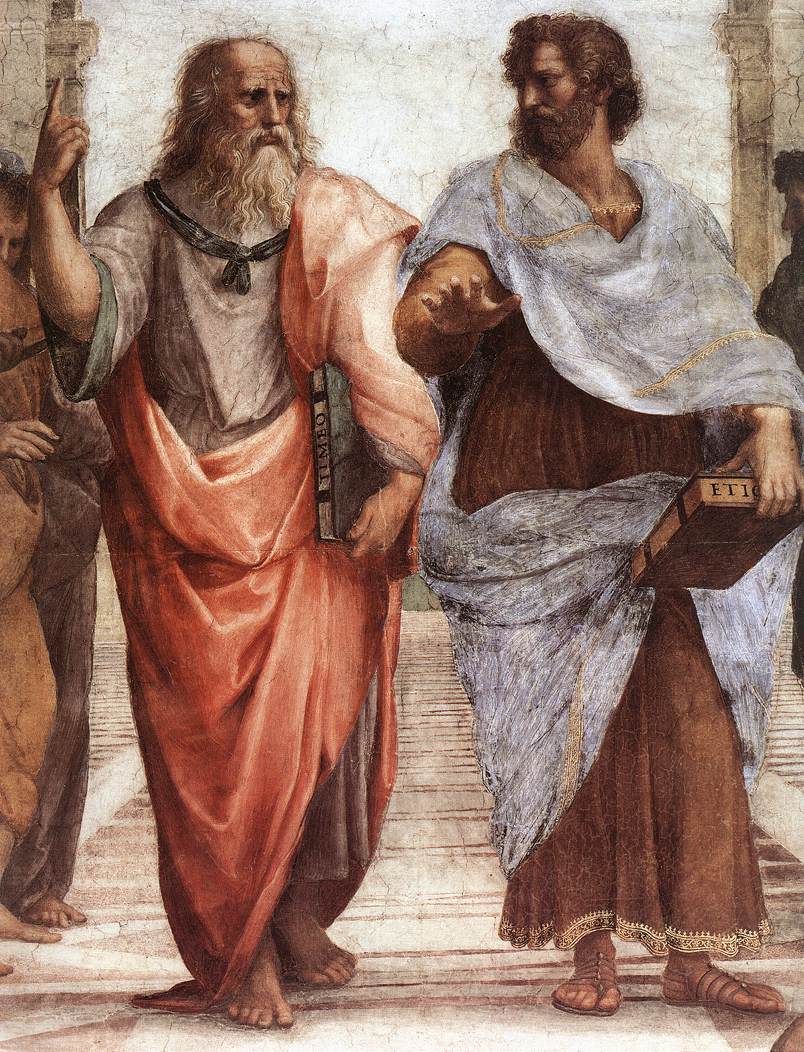
Aristotle's objection to the Forms was blunt. Plato had taken everything that makes a thing what it is and parked it in a separate, perfect realm, leaving the actual world a heap of inferior copies. Aristotle thought this solved nothing and doubled the work; now you had two worlds to explain instead of one, and no clear account of how the far-off Form of the Circle does anything to make this coin round. So he brought the Forms back down to earth. The "circle-ness" of a coin, the "oak-ness" of an oak, is not off in another realm; it is in the thing, the form that the wood or metal has taken. Reality is right here, in ordinary objects, and the job of philosophy is to study it, all of it, in obsessive detail. And he did. Aristotle wrote on logic, biology (he dissected animals and got a startling amount right, centuries before anyone had a microscope), physics, astronomy, the mind, , politics, and poetry, more or less inventing several of those as fields of study in the process.
One of them was logic itself. Aristotle was the first to lay out a system of valid reasoning that survives, the syllogism, which is just an argument with two premises and a conclusion that follows from them by pure form. All men are mortal; Socrates is a man; therefore Socrates is mortal. The point of his achievement is that the shape guarantees the conclusion, regardless of the content: anything of the form "all A are B; this is an A; therefore this is a B" is valid, whether A is "men" or "fish" or "triangles." Having a formal test for good reasoning, separate from whether you happen to like the conclusion, is one of those inventions so basic it is hard to imagine the world before it. (He wasn't the first person ever to reason well, obviously; he was the first to build a system for checking whether reasoning is good.)
His most powerful tool for understanding anything was the doctrine of the four causes, which is really four different answers to the question "why is this thing the way it is?" Take a wooden table. Its material cause is what it's made of: wood. Its formal cause is the shape or pattern that makes it a table and not a log: the design. Its efficient cause is what brought it about: the carpenter and her work. And its final cause is what it is for: a surface to eat and write on. Aristotle thought you hadn't really explained a thing until you could give all four, and the fourth, the final cause, the purpose, was for him the deepest. He saw purpose everywhere in nature, not just in tables: an acorn grows into an oak because being an oak is what an acorn is for; an eye is for seeing. This is teleology (pronounced "tell-ee-OL-uh-jee," the explanation of things by their goals or ends), and it ran through Western science for two thousand years until modern biology learned to explain the same apparent purposes without anyone designing them.
Where Aristotle is most useful to an ordinary reader today is ethics, and his central idea there is wonderfully practical. The goal of a human life, he says, is eudaimonia (pronounced "you-die-MOH-nee-uh"), and the standard translation, "happiness," is genuinely misleading. Eudaimonia is not a feeling, not a good mood, not pleasure. It means something more like flourishing, or living well across a whole life, the way we might say a plant is thriving. The practical question is how you become the kind of person who flourishes. Through virtue, which for Aristotle does not mean primness or rule-following but excellence of character, the settled habits that let a person live well. And you get those habits not by knowing the right things but by doing them, over and over, until they become second nature. "We become just by doing just acts," he writes, "temperate by doing temperate acts, brave by doing brave acts." Virtue, for Aristotle, is a habit you build, the way you build a skill: "men become builders by building and lyre-players by playing the lyre." You are not born honest; you become honest by telling the truth a thousand times until lying feels foreign. (The slick line "we are what we repeatedly do; excellence is a habit" is not Aristotle. It is a modern writer's paraphrase, from a 1926 popular history, that hardened into a fake quote. The real, clunkier lines are the ones above, and they say it better.)
And because flourishing is a matter of a whole life lived well rather than a passing high, Aristotle adds one of his most quietly devastating observations: "one swallow does not make a summer, nor does one day; and so too one day, or a short time, does not make a man blessed and happy." (That "happy" is Ross's English for the same word, eudaimonia, the flourishing we just unpacked, not a sunny mood.) A good afternoon is not a good life. He also thought a good life was impossible alone, because "man is by nature a political animal," meaning a creature built to live in a community (a polis, a Greek city-state); a person outside society isn't a free spirit but a stunted thing.
We should not leave Aristotle on only the admirable notes. In that same political work he defended slavery as natural, arguing that some people are suited by their nature to be ruled and owned. It was a monstrous position, common in his world and rejected in ours, and the right thing is simply to name it plainly: the man who systematized logic and taught the West to value purpose also wrote a justification for human bondage. Both are his.
When Plato died and the Academy passed to someone else, Aristotle eventually left Athens. He spent a stretch in the north tutoring a teenager named Alexander, the future Alexander the Great (the Macedonian king whose conquests would soon spread Greek culture from Egypt to the edge of India), then returned to Athens and founded his own school, the Lyceum, named for the grounds where it met. Like the Academy, the Lyceum outlived its founder as a working community of researchers. Plato's Academy and Aristotle's Lyceum, the upward point and the level hand, would be the two poles of Greek philosophy for the rest of antiquity.
Chapter 6
Philosophy as a way of life
"Some things are in our control and others not."
When Alexander the Great died in 323 BC, the tidy world of the independent Greek city-state died with him. His conquests had stitched a sprawling empire from Greece to India, and when it broke apart into warring kingdoms ruled by his generals, the ordinary Greek found himself a small subject in a vast, unstable world he could not control. This is the Hellenistic age (pronounced "hell-uh-NIS-tic," from Hellas, the Greeks' name for Greece; it means the era when Greek culture spread across Alexander's former empire, roughly 323 to 30 BC). Philosophy changed to meet it. The big questions about the nature of reality and knowledge did not vanish, but the urgent one became personal and practical: given that the world is mostly out of your hands, how do you live a good and untroubled life inside it? Philosophy stopped being mainly a theory about reality and became a kind of therapy, a set of trainable practices for the soul. Four rival schools offered four prescriptions, and they argued like rival gyms.
The first prescription was the rudest. The Cynics (pronounced "SIN-iks," and beware the modern word, because lowercase "cynicism," meaning a sneering distrust of everyone's motives, is almost the opposite of what these people believed; they were morally serious to the point of fanaticism). The Cynics held that virtue is the only thing that matters and that nearly everything society values (money, status, comfort, reputation, manners) is worthless clutter that gets between you and a good life. The cure was to train yourself, deliberately and publicly, to need almost nothing. The school's name comes from the Greek for "dog," an insult about their shameless, doglike disregard for convention, which they cheerfully adopted as a badge.
Their patron saint was Diogenes of Sinope (pronounced "die-OJ-uh-neez," roughly 404 to 323 BC), and he is the era's great comic philosopher, a one-man argument that you can make a point with a joke better than with a treatise. A caution, though: almost everything we know about him comes from a writer called Diogenes Laertius (a biographer who lived around 500 years after these events and who is the single biggest source of charming-but-unreliable philosopher stories in this whole book). So treat the famous anecdotes as the tradition Diogenes Laertius hands down, not the evening news. By that tradition, Diogenes lived in a large ceramic storage jar; by that same tradition, he owned a cup until he saw a child drinking from cupped hands, decided the child had bested him at plain living, and threw the cup away; and he walked through the marketplace in daylight with a lit lamp, and when asked what he was doing, answered, "I am looking for a man," meaning an honest human being he couldn't find. Best of all is the story where Plato's Academy had defined a human being as a "featherless biped." Diogenes plucked a chicken, carried it into the school, and announced, "Here is Plato's man." It is a joke and a serious philosophical objection at the same time, which is the entire Cynic method. And it was Diogenes who, asked where he was from, is said to have given an answer no Greek had given before, refusing the usual loyalty to one city: "I am a citizen of the world." The word cosmopolitan runs straight back to that line, at least as the tradition tells it.

One Cynic the later canon almost dropped deserves naming. Hipparchia (pronounced "hih-PAR-kee-uh") was a wealthy young woman who fell for the Cynic teacher Crates and, by the tradition Diogenes Laertius preserves, threatened to kill herself unless her family let her marry him and live his beggar's philosophical life. She got her way, lived openly as a Cynic philosopher alongside the men, argued with them in public, and earned something almost no woman of antiquity received: her own chapter in Diogenes Laertius' lives of the philosophers. That detail matters. It is not the praise of a modern editor reaching back to be inclusive; it is ancient evidence that her own world counted her a philosopher in her own right, not merely Crates' wife. She is a reminder that the women were there, doing the work, even when the later canon tried to forget them.
That same Crates took on another student, a Phoenician-descended merchant (Phoenicians were a seafaring trading people from the eastern Mediterranean coast, roughly modern Lebanon) named Zeno of Citium (pronounced "ZEE-no of SIT-ee-um," roughly 334 to 262 BC; again, not the paradox man from Chapter 2), and Zeno took the Cynic insight that virtue is the only real good and built it into a complete, livable philosophy: . He taught in a public colonnade in the Athenian marketplace called the Stoa Poikile, the "Painted Stoa" (a stoa being a long roofed colonnade, this one decorated with famous paintings), and the school took its name from that colonnade. Stoicism became the most influential philosophy of the ancient world, and it deserves to be rescued from its caricature, which is the gritted-teeth statue who feels nothing.
That is not the Stoic claim at all. The Stoics held that the universe is rational and orderly, that the only true good is virtue (a good character), and that everything else people chase or flee (wealth, health, reputation, even life itself) is, strictly speaking, an "indifferent," not bad to have but not what makes a life good. From this they drew their central practical tool, the one a person can actually use, stated most cleanly by the later Stoic Epictetus (a man born a slave, around AD 50): "Some things are in our control and others not. Things in our control are opinion, pursuit, desire, aversion… Things not in our control are body, property, reputation, command." The Stoic discipline is to draw that line ruthlessly and pour your energy only across it, onto your own judgments and choices, while accepting whatever falls on the far side.
Set it on something ordinary. Say you have an interview, or a test, or a first date, and you are sick with worry about how it goes. The Stoic sorts the situation into the two boxes. Whether you get the job, whether the other person likes you, whether the examiner is in a foul mood: none of that is in your control, so spending your peace on it is spending it on nothing. What is in your control is your preparation, your honesty, your effort, and the judgment you make about the outcome afterward. Pour everything into that side of the line and let the rest land where it lands. The second half of the claim is what saves this from cold detachment: the Stoic isn't numb, he is un-deceived. As Epictetus puts it, "Men are disturbed, not by things, but by the principles and notions which they form concerning things." Your misery before the interview isn't caused by the interview; it is caused by your judgment that the result will make or unmake you. Examine that judgment, see that it is false, and the misery loses its footing. The school's great systematizer, Chrysippus (pronounced "kry-SIP-us," c. 279 to 206 BC), is what turned this practical advice into a philosophy that could fight: he built the Stoa a rigorous logic (a propositional logic that was the most sophisticated in the ancient world after Aristotle's) and a worked-out physics to stand under the ethics, which is why the ancient saying went that without Chrysippus there would have been no Stoa.
The third school took the opposite-looking road to the same destination of inner peace, and it has the most thoroughly libeled name of all. The Epicureans, followers of Epicurus (341 to 270 BC), are remembered as pleasure-loving gluttons, and the modern word "epicurean," meaning a fancy foodie, keeps the slander alive. The reality is almost the reverse. Epicurus did teach that pleasure is the goal of life, but he defined pleasure as something austere: "the absence of pain in the body and of trouble in the soul." Not feasting, but the deep calm of a person who isn't anxious or hurting. He spelled it out: the pleasant life "is not an unbroken succession of drinking-bouts and of merrymaking, not sexual love, not the enjoyment of the fish and other delicacies of a luxurious table." His own community, a garden outside Athens that gave the school its name, ate bread and water, and Epicurus once wrote to a friend asking him to "send me a little pot of cheese, that, when I like, I may fare sumptuously." A pot of cheese was his idea of a blowout.
What was he so calm about? Two fears, he thought, poison human life: fear of the gods and fear of death. He defused both by borrowing, wholesale, the old atomism of Democritus (Chapter 2), repurposing that as therapy. If everything, including your soul, is just atoms in the void, then the gods don't meddle in your affairs, and death is simply the atoms coming apart, after which there is no "you" left to suffer anything. Hence the most consoling sentence in ancient philosophy: "Death, therefore, the most awful of evils, is nothing to us, seeing that, when we are, death is not come, and, when death is come, we are not." The argument is built to work on you. The thing you dread about death is being dead, the way you might dread a future toothache. But a toothache is something you will be present to feel; being dead is not. While you are alive, death has not arrived, so it is doing you no harm. Once death arrives, there is no you left to be harmed. The two of you, you and your death, are never in the room at the same time; the dreaded meeting can't happen. Epicurus thought, sincerely, that a person who really took it in would be freed. His garden, unusually for its time and place, admitted women and at least one enslaved man as full members, a quiet radicalism the sources confirm even while sneering at it.
The fourth school went furthest of all and doubted whether we can know anything at all. These were the Skeptics (capital-S, the ancient philosophical school, not the lowercase modern "skeptic" who just distrusts a particular claim). Their founder by reputation was Pyrrho of Elis (around 360 to 270 BC), who like Socrates wrote nothing and whom we know through his followers. Pyrrho's method was to set every argument against an equal and opposite argument until the scales hung perfectly even, then to suspend judgment, to simply stop insisting that things are one way rather than another, and he claimed that a deep calm followed once you stopped fighting to be certain. The tradition tells a story so extreme that even ancient readers found it too good to be true: that Pyrrho took his doubt so literally he would walk straight toward carts and off precipices and at cliff-edged dogs, trusting nothing his senses reported, and that his friends had to trail him to keep him alive. (Other reports say he lived sensibly enough to reach old age, which is the safer bet; the carts-and-precipices version is the legend, told here as legend.) The point underneath the joke is serious: if you can never be sure, the Skeptic says, then the honest and the tranquil thing is to stop pretending you are.
So the Hellenistic reader had four gyms to choose from: train yourself to need nothing (Cynic), sort the world into what you control and what you don't (Stoic), defuse your fears with a godless physics and a quiet garden (Epicurean), or suspend judgment and stop straining after certainty (Skeptic). Four prescriptions, one shared diagnosis: the world is out of your hands, and a good life is the one you can build inside that fact.
Chapter 7
Rome and the long afterlife
"For the whole life of a philosopher is, as the same philosopher says, a meditation on death."
In 155 BC (the date is sometimes given as 156), three Greek philosophers arrived in Rome as ambassadors, sent to argue down a fine their city owed, and one of them nearly got Greek philosophy banned. He was Carneades, the head of Plato's old Academy, which by then had turned Skeptic, and to show the Romans what a trained mind could do he gave a public lecture defending justice as the foundation of society. The Romans were impressed. Then, the next day, the story as it comes down to us has him give a second lecture demolishing everything he had said the first day, arguing just as forcefully that justice is a convenient fiction and the smart course is naked self-interest. The point was not that he believed either speech; it was that for any position you can build an equal and opposite case, which is the Skeptic's whole creed. The old Roman senator Cato, watching young Romans fall under the spell of a man who could argue any side of anything, was so alarmed he demanded the philosophers be sent home before they corrupted the youth. (The scene survives only through much later Roman writers, so treat the speeches and Cato's fury as the tradition's memory, not a transcript.) Cato lost the larger battle. Rome conquered the Greek world over the next century, and educated Romans fell hard for Greek philosophy, and the great act of preservation began.
The central figure in that preservation was Cicero (106 to 43 BC), the Roman statesman and orator, who trained in exactly that Skeptical Academy and carried its caution his whole life: we can't reach certainty, he held, but we can act on what seems most probable, which is why he weighed every school's arguments against each other instead of joining one. He was not an original system-builder, but he did something arguably more lasting. He translated Greek philosophy into Latin, inventing Latin words for Greek concepts as he went (some of the abstract vocabulary later European thought runs on, including the ancestor of our word "quality," exists because Cicero needed Latin for a Greek idea and coined it). And so he handed the entire tradition to a Western world that would soon forget how to read Greek. Much of what medieval Europe knew of Greek thought, it knew because Cicero had paraphrased it in elegant Latin first. (Cicero himself died in the conversation's worst tradition: murdered in 43 BC in Rome's political bloodletting.)
Epicurus found a second voice at Rome too, in the poet Lucretius (roughly 99 to 55 BC), who turned the whole of Epicurean physics, the atoms, the void, the mortality of the soul, the case against fearing death, into a long Latin poem called On the Nature of Things. The choice of verse was not decoration; Lucretius wanted to make a cold, godless universe feel beautiful enough to console, to do for the reader's fear what Epicurus' arguments did for the mind. We owe much of what survives of ancient atomism to that decision, the fullest account of a world made only of atoms and void coming down to us because it was set to poetry.
But the philosophy that truly became Roman was Stoicism, and here the era's deepest point lands almost by accident: the same school, the same handful of ideas about virtue and control and accepting fate, served as the working philosophy of people at the absolute opposite ends of Roman society. Consider three Stoics of the Roman empire. Seneca (born around 4 BC, died AD 65) was one of the richest and most powerful men alive, tutor and then advisor to the emperor Nero, forever uneasy about the gap between his Stoic principles and his enormous wealth. Epictetus (around AD 50 to 135) was born a slave. And Marcus Aurelius (AD 121 to 180) was the emperor of Rome itself, who scribbled Stoic reminders to himself in a private Greek notebook, never meant for anyone's eyes, that survives today as the Meditations. (We have, by now, crossed from BC into AD, from the years counted backward toward the conventional date of Christ's birth to the years counted forward from it.) A philosophy that can speak with the same voice to a slave and to the master of the world is telling you something about what it thought a human being fundamentally is: that the part of us that matters, our judgments and our character, is exactly the part that a throne cannot buy and a chain cannot take.
And it was meant to be used, which is why people still read these three on the train. Seneca's letters return again and again to the shortness of life and the foolishness of postponing it: "While we are postponing, life speeds by." Epictetus' line about control, which we met in Chapter 6, was his whole working method. Marcus, alone at night on the empire's frozen Danube frontier, kept reminding himself that the things upsetting him were his own judgments and nothing more, that "the universe is transformation: life is opinion." The thread runs all the way back to the chapter's opening line, Cicero's claim that the whole business of philosophy is, in the end, learning how to die well, an idea Cicero borrowed from Socrates and Plato's Phaedo, three centuries before. The Stoics meant it not as gloom but as training: rehearse the loss of everything you don't control, your wealth, your reputation, your body, your life, until the day it actually goes you meet it already practiced.
Seneca got to test the doctrine in the worst way. In AD 65 the emperor Nero, suspecting him of joining a conspiracy, ordered him to kill himself. The historian Tacitus (a Roman writing a generation later, our best source for the period) describes the scene: Seneca opened the arteries of his arms, but as "his aged frame, attenuated by frugal diet, allowed the blood to escape but slowly," he had to cut the veins of his legs and knees as well. It was a long, ugly death, not the clean serene exit a poster-Stoic might wish for, and that is exactly what makes it the chapter's truest moment. The doctrine never promised that dying well would be painless or quick; it promised that a person could meet even this with his judgments intact, treating his own body's failure as one more "indifferent" on the far side of the line. By Tacitus' account, that is roughly what Seneca did, dictating to secretaries as he bled, a philosopher spending his last hours practicing the one thing he had spent a lifetime saying was not really an evil.

After the great Romans, the philosophical energy of antiquity slowly faded, gathering at the end into one last original movement: Neoplatonism, a mystical, religious reworking of Plato, built largely by the thinker Plotinus (c. AD 204–270). Plotinus took Plato's world of Forms and crowned it with a single ultimate source he called the One, beyond being and beyond description, from which everything else overflows in descending levels, each fainter and further out; the human soul is a spark that has descended into the material world and longs to climb back up toward reunion with the One. It is philosophy turning into something close to a spiritual discipline, and that turn matters enormously for what came next: the Neoplatonists gave Augustine and the other early Christian thinkers a way to picture a single divine source, and so a pagan Greek's reworking of Plato became one of the load-bearing beams of Christian theology.
And then comes the date tradition uses to close the ancient story: in AD 529 the emperor Justinian issued measures that ended the public teaching of pagan philosophy in Athens, and the school descended from Plato's Academy, after nearly a thousand years, fell silent. It makes a clean, cinematic ending, the lights going out on Greek philosophy after a millennium. But the clean version is too clean, and honesty requires the qualification. Modern scholars doubt that Justinian "closed" any single institution in one dramatic stroke; it is not even clear the Athenian school of the 500s was truly continuous with Plato's original Academy; the philosophers who reportedly fled to Persia seem to have come back unharmed before long; and philosophical teaching went on privately and elsewhere. The year 529 is a useful bookmark, not a slammed door.
So step back and ask what the Greeks actually settled in their thousand-year argument, the one Thales started by leaving the gods out. The honest answer is that they settled less than you might hope and handed on more than you could measure. The first question, what does the world run on, they pried loose from the gods for good: after Thales, the default move in the Western tradition is to look for a how, a natural mechanism, even when the particular answer (water, the apeiron, atoms) is wrong, and the very idea that the universe runs on findable, arguable principles is their permanent bequest to science. The second question, can we really know it, they argued to a genuine standstill and left open, which is the Skeptics' parting gift: the awareness that certainty is hard and that the strongest mind is the one that can hold the case for both sides is woven into honest inquiry forever after. The third question, how to live, they answered not with one answer but with a shelf of rival practices, Stoic, Epicurean, Cynic, Skeptic, each still in print and still picked up by people trying to steady themselves, because the Greeks discovered that you can reason about how to live as carefully as about anything else, and that the reasoning helps. They did not finish the conversation. They were the first to insist it was the kind of conversation you could have, and they handed it forward unfinished, on purpose.
It never actually stopped. Around the time the Athenian school went quiet, a Roman official named Boethius, awaiting execution in 524, sat in his cell and wrote a book imagining philosophy itself as a woman who comes to console him, and so passed the torch one more time toward the Latin Middle Ages. The Greek texts themselves traveled on: copied by hand in monasteries, carried east, and above all preserved and extended by Arabic-speaking scholars. Over the following centuries al-Fārābī, Avicenna (Ibn Sīnā), and Averroes (Ibn Rushd) studied Aristotle in Arabic translation, wrote vast commentaries that thought with him and pushed his arguments further, and kept him alive and working when the Latin West had nearly lost him, before handing him back to Europe through the translation schools of Spain. That is where the next era begins, with faith and reason meeting across those translations. But the questions were all set here, on a coast in Ionia (the Greek-settled shore of what is now western Turkey), the afternoon someone decided the gods were not a good enough answer.
