
The faith-and-reason era had ended with a logician proving the two could not be held together, and handed its question forward unanswered (the faith-and-reason era). The next people to pick it up split into two camps that spent a century talking past each other. The rationalists (who held that reason alone, working in a quiet room with no need to consult the world, can deliver fundamental truths) said reason could deliver God, the soul, and the deep structure of the universe. The empiricists (who insisted everything we know walks in through the senses) said no: a mind with no experience knows nothing at all.
Then a Scotsman named David Hume took the empiricist principle seriously enough to wreck it. If all knowledge comes from experience, he asked, where in experience does anyone actually see one thing cause another? The answer, he argued, is nowhere. And if causation is not in the world, then physics, the proudest achievement of the age, is not knowledge at all. It is a very good betting system. That is the cliff the era opens on.
The break
Before Kant, the standard picture ran one direction: the world is whatever it is, and a good mind copies it faithfully, like a still pond reflecting the sky. Get the reflection right and you have knowledge; get it wrong and you have error. Both warring camps shared this picture. They only fought over how the copying happens, through pure reason or through the senses. Hume's torpedo worked precisely because everyone accepted the mirror. If the mind only copies, and the world hands the mirror no image of causation, then we simply do not have it.
Kant turned the picture inside out, and he compared his move to Copernicus on purpose. Copernicus stopped asking how the heavens revolve around the watcher and tried assuming the watcher moves instead. Kant stopped asking how the mind conforms to objects and asked how objects conform to the mind. The mind, on this new picture, is not a mirror. It is a machine with built-in equipment, space, time, cause, and the rest, and that equipment shapes everything that comes through before you ever experience it. We do not find causation out in the world and copy it. We bring causation to the world, because a mind without it could not have experience at all. The price is steep: we are forever sealed off from the world as it is in itself, behind our own machinery. The payoff is that Newtonian physics stands on solid ground again, and morality and faith get a room of their own that no skeptic can break into. Kant put the break in one line: "I must, therefore, abolish knowledge, to make room for belief" (trans. J. M. D. Meiklejohn). The rest of the era is two brilliant heirs deciding he had either not gone far enough or had built his machine out of a nightmare.
Chapter 1
The inheritance
"I openly confess, the suggestion of David Hume was the very thing, which many years ago first interrupted my dogmatic slumber, and gave my investigations in the field of speculative philosophy quite a new direction."
By the 1770s, European philosophy had argued itself into a corner with two walls and no door. Everything Kant built was built to get out of it.
The first wall was . Its great names were René Descartes and Gottfried Leibniz (the era-3 era), and its boast was enormous: reason alone, working from ideas the mind already has, with no need to go look at the world, can prove that God exists, that the soul is immortal, that the universe has such-and-such a structure. In Kant's own Germany this had hardened into a school system, the Leibniz-Wolff philosophy (the school that turned Leibniz's rationalism into a formal teaching system, named for the philosopher Christian Wolff who built it), that taught as if it were geometry, deducing the furniture of the cosmos from first principles in a lecture hall. The trouble is that two rationalists reasoning carefully from their armchairs reach opposite conclusions and have no way to settle it, because neither will check against the world. Pure reason cut loose from experience turns out to spin plausible stories that cannot be tested.
The second wall was , and it was built by people who noticed exactly that problem. John Locke and then David Hume (a Scottish philosopher, 1711 to 1776, the sharpest of the lot) said the cure was simple: all knowledge comes from experience. The mind starts blank and the senses write on it. No looking, no knowing. This sounds like sturdy common sense, and for a while it was the winning side. Then Hume followed his own principle one step further than anyone wanted to go, and the floor gave way.
The worked example the whole era turns on is a game of billiards. The cue ball rolls, strikes the second, and the second rolls away. Obvious: the first ball caused the second to move. Hume then asks the empiricist's own question. All ideas come from observation, so where in the observation is the causing? What the witness actually sees is: the first ball moves; the two balls touch; the second ball moves. One thing, then another, side by side and in sequence. Nowhere does the eye catch a force reaching out of the first ball and making the second move. The making is never in the observation. Repeat it a thousand times and the result is still only A, then B, never A necessitating B. The necessary connection, the very thing that makes it causation and not coincidence, is nowhere in the experience.
So where does our rock-solid sense of "the first ball made the second move" come from? Hume's answer is unnerving in its modesty. It comes from habit. We have seen A followed by B so many times that the mind slides automatically from one to the other and feels a necessity that is really just an expectation. Causation is not a fact about the world. It is a custom of the mind, a reliable hunch dressed up as a law.
The size of the wreckage is hard to overstate, and Hume knew it. Every law of physics is a causal claim: this force produces that acceleration, this cause that effect. Isaac Newton had just given Europe a clockwork universe of iron causal laws, the proudest intellectual achievement in human history to that point. If Hume is right, none of it is knowledge. It is an extremely successful betting system. We bet the sun rises tomorrow because it always has, and we will probably win the bet, but we cannot know it, because the necessity we imagine binding cause to effect is a feeling, not a fact. had eaten the rationalists' metaphysics from one side, and now it had eaten Newtonian physics from the other. Hume noticed that we never actually catch one thing forcing another to happen, we just catch them keeping company, and from that small honest point he made the entire edifice of natural philosophy look like a lucky guess.
A philosophy professor in the Prussian port city of Königsberg read this and could not sleep. Immanuel Kant later confessed that the suggestion of Hume was the very thing that first interrupted his dogmatic slumber, his comfortable assumption that the rationalist machinery worked. He had been one of the armchair metaphysicians. Hume woke him. And what he built in answer is the single most important move in modern philosophy. It is the next chapter.
Chapter 2
Kant and the Copernican revolution
"If the intuition must conform to the nature of the objects, I do not see how we can know anything of them à priori. If, on the other hand, the object conforms to the nature of our faculty of intuition, I can then easily conceive the possibility of such an à priori knowledge."
Immanuel Kant (1724 to 1804) lived almost his whole life in one city. He was born in Königsberg, in Prussia (the place is now Kaliningrad, in Russia), the fourth of nine children of a harness-maker, and apart from six years spent working as a private tutor in the countryside as a young man, he never left Prussia and spent his entire professional life in that one town as professor of and metaphysics. His routine was so exact that his neighbors are said to have called him "the Königsberg clock," though the famous story that they literally set their watches by his afternoon walk is the kind of detail that grows in the retelling. (Do not believe the even stronger version that he never left the city; he was away for six years.) Out of that quiet, regular life came a book that detonated.
The book is the Critique of Pure Reason (1781, revised in 1787), and its whole job is to answer Hume without giving up science. Kant's answer is so strange that he reached for the biggest analogy he could find. Before Copernicus, astronomers tried to explain the motions of the heavens by assuming everything revolved around the stationary watcher on Earth, and the math came out a tangled mess. Copernicus tried the reverse, assuming the watcher moves while the stars hold still, and the tangle resolved. Kant proposed the same reversal for knowledge itself. Philosophers had always assumed the mind must conform to objects, copy them, mirror them. Kant tried assuming objects conform to the mind. As he put it, if our perception has to conform to the nature of objects, he cannot see how we could ever know anything about them in advance of experience; but if objects conform to the nature of our perception, then knowledge in advance suddenly becomes possible.
Two words in Kant trip nearly everyone, and both compound into real confusion as the era unfolds if left loose. The first is transcendental, Kant's pet technical term, and it does not mean "transcendent" or mystical or spiritual or otherworldly. When Kant calls something transcendental he means it belongs to the mind's machinery for making experience possible, the built-in equipment we are about to describe. It is the opposite of the colloquial "transcendent." "Transcendental ," his name for his own position, is not a misty doctrine about a higher realm; it is a down-to-earth claim about how the machinery of human cognition works. The second word is idealism itself, which does not mean "having ideals" or thinking the world is wonderful. The root is idea, the mind's structures, not ideal, a fine thing to aim for. Kant's idealism is just the claim that space, time, and the categories (more on those below) are contributions of the mind rather than features of a mind-independent world. Nobody in this era is telling you to be a better person when they say "idealism." They are telling you the mind builds the world it sees.
The Copernican move is the hinge of the whole era. Kant's claim is that the mind is not a blank slate the senses write on (Hume's picture), nor a storehouse of ready-made truths (the rationalist picture). The mind is an active machine that processes raw sensory material before you ever consciously experience anything. And it processes that material using built-in equipment that is the same for everyone.
The two deepest pieces of equipment are space and time. Common sense says space and time are out there, the great containers the world sits in, and our minds discover them. Kant says no: space and time are not features of the world at all. They are the forms of our intuition. By intuition Kant does not mean a hunch or a gut feeling; it is his technical word for the mind's immediate reception of raw sensory data, the raw-input stage that happens before any thinking about it begins. The forms of intuition are the built-in shape that input always arrives in. Space and time are glasses worn from birth that cannot be taken off. Everything you will ever see comes to you already arranged in space and ordered in time, not because the world is that way in itself, but because your perceptual equipment cannot deliver anything any other way. You cannot peek around the glasses to check what the world looks like without them, because there is no looking without them.
The worked example Kant leans on is geometry. The statement "the shortest distance between two points is a straight line" has two odd things true of it at once. First, it is informative, it actually tells you something; it is not just unpacking a definition. The concept "straight" does not secretly contain the concept "shortest"; the predicate genuinely adds information. (Kant calls a judgment like this synthetic, meaning the predicate adds something not already inside the subject, as opposed to analytic, where the predicate just restates part of the subject, like "all bachelors are unmarried.") Second, and this is the strange part, it is known to be true without checking every straight line in the universe. No experiment needed. It holds necessarily, in advance, for all straight lines everywhere. (Kant calls knowledge that comes before and independent of experience a priori, Latin for "from the earlier"; knowledge that depends on experience is a posteriori, "from the later.")
The standard assumption before Kant was that these two pairs lined up in only two respectable ways: a priori went with analytic (pure logic and definitions, true but uninformative), and a posteriori went with synthetic (informative, but only ever learned by checking the world). Geometry sat in neither slot. It was both informative and known in advance, necessarily, and nobody could explain how. So geometry is both synthetic (informative) and a priori (known in advance, necessarily). This combination, synthetic a priori knowledge, is the thing Hume said could not exist, because Hume thought everything informative had to come from experience and so could never be necessary. How is it possible? Kant's answer is the glasses. Geometry is built out of the structure of space, and space is the form of our own perception. We are not discovering facts about an outside container; we are reading off the structure of the lens we see through. And because that lens shapes everything we will ever experience, the geometry is guaranteed to hold for everything we will ever experience. That is why it is both necessary and informative: it is necessary because it comes from our own equipment, and informative because the equipment genuinely structures the world we encounter.
Beyond space and time sits a second kind of built-in equipment. Where space and time shape how raw experience is received, this second kind is a set of conceptual tools the mind applies to what it has received, the stamps that turn a jumble of sensation into a recognizable world of objects with properties standing in relations. Kant calls these the categories, there are twelve of them, and causation is one of them. Substance is another, unity another. And now Kant can answer Hume directly, which was the point all along.
Hume was right, Kant says. You will never find causation by inspecting experience, because causation is not in the experienced world to be found. But Hume drew the wrong conclusion. Causation is not a weak habit we project onto a world that lacks it. It is a category, a piece of the mind's own equipment, that the mind imposes on experience in the very act of having experience. That is why it is necessary and universal: not because we read it off the world, but because no experience is possible without it. The mind does not discover causal order; it constitutes it. Newton's physics is saved, and saved exactly, because its causal laws are guaranteed to hold for everything we can possibly experience. Hume was right that we never see one ball make the other move, but he missed that "making things move" is part of the glasses, so it is stamped on every game of billiards we will ever watch.
(One potential confusion: "A priori" does not mean "innate ideas" in Descartes' sense, little truths printed in the soul before birth. Kant explicitly rejects innate ideas. Space and time are not content the mind comes pre-loaded with; they are the form, the processing shape, that raw experience has to pass through. Empty equipment, not pre-written answers.)
There is a bill to pay for this rescue, and it is enormous. If everything we know, we know only as it has been processed through our equipment, then we never know the world as it is in itself, apart from our processing. Kant has names for the two sides. What we know, the world as it appears under our equipment, he calls the phenomenon (the appearance). The world as it is in itself, behind the glasses, untouched by our processing, he calls the noumenon, or the thing-in-itself (in German, Ding an sich). We can know phenomena with full precision and certainty. The thing-in-itself we can know nothing about whatsoever. It is real, Kant insists, but it is permanently off-limits to us, on the far side of a wall we cannot see over.
That wall, the thing-in-itself we can never reach, is the most consequential thing Kant built, and not because of what it shuts out. It is because of what it shuts in. By proving that theoretical reason cannot get past the wall, Kant has also proved it cannot go meddling out there. And just beyond the wall lie exactly the things the rationalists fought over: God, the soul, free will, the universe as a finished whole. Kant has fenced them off from proof, which sounds like a loss. In the next chapter it turns out to be the setup for the most surprising move of his career.
Chapter 3
Kant and the moral law
"Two things fill the mind with ever new and increasing admiration and awe, the oftener and the more steadily we reflect on them: the starry heavens above and the moral law within."
The wall Kant built in the Critique of Pure Reason keeps theoretical reason from proving God exists. (Theoretical reason is reason directed at knowledge, at figuring out what is and is not the case.) It also keeps anyone from proving God doesn't. Both classical projects fail at the same wall, and Kant says so plainly: theoretical reason can neither prove nor disprove God, the soul, or free will, because they lie on the far side, outside any possible experience. The point gets garbled in both directions. Kant did not prove God exists; he showed the old proofs all fail. Kant did not disprove God either; he showed disproof is just as impossible. What he actually did is in his own famous sentence: "I must, therefore, abolish knowledge, to make room for belief" (trans. Meiklejohn). He cleared the field of theoretical knowledge precisely so that something else could move into the cleared space. That something else is morality.
Kant's moral philosophy gets its first full statement in the Groundwork of the Metaphysics of Morals (1785), a short, preparatory book leading into his second great Critique, and its driving conviction is austere. If morality has any real, binding force, it cannot rest on anything that happens to vary. It cannot rest on what makes people happy, because that changes person to person. It cannot rest on what a culture approves, because cultures disagree. It cannot even rest on consequences, because consequences are accidents of circumstance we never fully control. A moral law worth the name must hold for every rational being, always, no matter what. So Kant goes looking not for a list of good deeds but for the bare form a law would have to take to bind that absolutely.
He starts by sorting commands into two kinds. A hypothetical imperative has an "if" in it: if you want to be healthy, exercise; if you want people to trust you, keep your word. The command only grips you if you happen to want the goal, so it is conditional, hanging on your desires. A categorical imperative has no "if." It commands flat out, unconditionally, whatever you happen to want. Kant's claim is that the moral law must be a categorical imperative, because anything with an "if" in it bends to your wishes and so cannot bind absolutely. But if you strip out every "if," every particular goal, what is left to command? Only the bare form of lawfulness itself. And that gives the first and most famous formula:
"Act only on that maxim whereby thou canst at the same time will that it should become a universal law" (trans. T. K. Abbott).
A maxim is just the personal rule one is acting on, the principle behind the choice. The test asks: could you will that everyone act on this same rule, as a law of nature, without the whole thing falling apart? Kant's own worked example is the lying promise. A man badly needs money. He cannot pay it back. He is tempted to borrow it anyway, promising to repay while privately knowing he will not. His maxim is roughly: "when I need money I'll make a promise I don't intend to keep." Universalize it, and a world appears where everyone makes promises they don't intend to keep whenever it suits them. In that world, what happens to promising? It collapses. Nobody believes a promise, so the words stop meaning anything, so there is no such thing as a promise left to exploit. The maxim, made universal, destroys the very institution it depends on. It contradicts itself.
What Kant did not do is calculate that lying promises lead to bad outcomes, hurt feelings, ruined trust, a worse society. That would be a consequence-based argument, the kind he is explicitly avoiding. He showed something stricter and stranger: the maxim cannot even be coherently universalized. It is not that a world of liars would be unpleasant. It is that a world of universal lying-promises is logically impossible, because the practice eats itself. The categorical imperative is a logic test, not a welfare calculation, and that is the whole point of its severity.
There is a second formula Kant treats as another face of the same law:
"So act as to treat humanity, whether in thine own person or in that of any other, in every case as an end withal, never as means only" (trans. Abbott).
The phrase to weigh is never as means only. Kant is realistic: we use each other as means constantly. You use the bus driver as a means to get across town; the driver uses you as a means to a paycheck. That is fine. The word is only. You cross the line when you treat a rational being purely as a tool, with no regard for the fact that they too set their own ends and have their own reason. A concrete case: flattering a colleague you despise, purely to use their connections, with zero regard for them as a person, treats them as a means only, a lever to pull, and the formula forbids it. Slavery is the case at its starkest: a human being reduced entirely to an instrument of another's will, their own rational agency erased. The formula says every rational being carries a worth that is not for sale and not for using-up, an end in itself, and that worth sets a hard limit on what you may do to them.
Both formulas grow from a single deeper root, the one Kant himself thought was the heart of the whole thing: autonomy. The moral law is not handed down to rational beings from outside, by God or king or custom; rational beings give it to themselves, and that self-legislation is exactly what makes it binding. (Kant builds this into a third formula, the Kingdom of Ends, the idea that you should act as a member of a community in which every rational being is at once the author of the laws and bound by them.) To be a moral agent, on this picture, is to be your own lawgiver, and that is the root that makes both earlier formulas follow. It is also the seed of the idea that human beings have a dignity grounded in their rational agency, the idea on which a whole later tradition of human rights would be built.
It must be said, in the same honest breath, that Kant the moral universalist also wrote things that flatly contradict his own principle. In his Observations on the Feeling of the Beautiful and Sublime (1764) and in his lectures on geography and anthropology, he set out a hierarchy of races and made claims about the capacities of non-European peoples that cannot be squared with "every rational being is an end in itself." Scholars argue his views shifted toward a fuller universalism late in his life, but the tension between his and his prejudices was real, is documented, and is not resolved by leaving it out.
The categorical imperative is not the Golden Rule, a distinction that marks the single most common mistake people make about Kant. The Golden Rule says treat others as you would want to be treated. It sounds similar, but Kant explicitly argues in a footnote of the Groundwork that it will not do, and his reasons are sharp. The Golden Rule still routes everything through what you happen to want, and people want strange and inconsistent things; by Kant's account it contains the ground neither of duties to oneself nor of duties of benevolence toward others, since someone, he writes in that footnote, might readily consent to forgo any help from others if only he were excused from helping them. The misanthrope who genuinely wants to be left alone is the test case: by the Golden Rule he may leave everyone else to suffer, since he is happy to be left to suffer himself. The Golden Rule lets your personal preferences set the standard. The categorical imperative strips your preferences out entirely. It does not ask what you want; it asks what any rational being could will as a law for all rational beings. Same neighborhood, completely different machine.
Kant wrote three great works he called Critiques, and the map is this. The Critique of Pure Reason (1781) asks what we can know. The Critique of Practical Reason (1788) asks what we should do. The Critique of the Power of Judgment (1790) asks about beauty and purpose, how aesthetic and natural judgments work. That third Critique is easy to wave past as a leftover, but it does specific work: it throws a bridge across the gap the first two open up. The first Critique gives us nature, a realm of rigid causal law; the second gives us freedom, a realm of moral choice, and the two look like they can never touch. The third argues that when we find a sunset beautiful, or feel the dizzying vastness of the sea as sublime (an experience that overwhelms the senses and yet makes us feel the mind's own reach exceeds it), or sense that a living thing seems built for something, we are feeling the two realms quietly fit together, feeling at home in a world that is otherwise split in two. Those three domains, knowledge, morality, and judgment, became the standard map of philosophy itself; most Western philosophy syllabuses still run on Kant's division. (One housekeeping note: the Groundwork of 1785, where the formulas above first appear, is not one of the three Critiques. It is the short preparatory book leading into the second one.)
The payoff of the wall from the last chapter is here. Theoretical reason cannot prove God, the soul, or freedom. But morality, Kant argues, only makes sense if we assume them. This is the work of practical reason (reason directed at action, at figuring out what we should do, as opposed to theoretical reason, which figures out what is true). If the moral law genuinely binds us, we must be free to obey or disobey it, so freedom is real in the practical sense even though we cannot prove it theoretically. And if doing right is to make ultimate sense, there has to be some ultimate squaring of virtue with justice that this messy life never delivers, which is why practical reason postulates (requires, as a precondition for the moral life making sense) God and an immortal soul, not as things we know, but as things we must act as if are real. This is the precise sense in which Kant "limited reason to make room for faith." He did not sneak God back in as a proof. He relocated God from the courtroom of knowledge, where the case fails, to the workshop of practical life, where the moral law needs an ultimate guarantor. God is not a fact you know. God is a postulate you live by.
And the whole of it comes to rest in the sentence on Kant's tombstone, the era's key passage. Near the end of the second Critique, Kant writes that two things fill the mind with ever new and increasing admiration and awe: the starry heavens above and the moral law within. The pairing is the entire system in eight words. The starry heavens are the phenomenal world, the realm of causal law, of Newton's physics, the world the first Critique secured. The moral law within is the realm of freedom and duty, the world the second Critique secured. One is what we can know; the other is how we must live. Kant spent two enormous books proving they are different jurisdictions with different rules, and then stood under the night sky humbled by both at once.
Kant gave that whole stance a battle cry, in a short essay from 1784 called What is Enlightenment? Enlightenment, he wrote, is the human being's emergence from a self-imposed immaturity, the lazy comfort of letting priests, kings, and books do your thinking for you. His motto for the age was two Latin words borrowed from the Roman poet Horace: Sapere aude, which he glosses as "Have courage to make use of your own understanding!" (trans. Mary C. Smith). Do not let an authority think for you. Think. It is the perfect mission statement for the man who had just rebuilt the foundations of knowledge from scratch, and the perfect dare to hand his successors, who would take him at his word and tear his careful walls down.
Chapter 4
Hegel: Spirit moves through history
"The owl of Minerva, takes its flight only when the shades of night are gathering."
Kant left a wall, the thing-in-itself, the world as it is in itself, which we can never reach. His successors found it unbearable. If we can never reach the thing-in-itself, why even talk about it? How can Kant say the unreachable world causes our sensations, when he also says causation only applies inside experience? The wall looked less like a discovery and more like a contradiction the system had painted itself into. The men who set out to fix it were not a relay race of soloists; they were a conversation, most of it happening in and around the small university town of Jena in the 1790s and early 1800s, and the four of them, Kant included, make up the movement historians call German Idealism, a roughly sixty-year project (the 1780s to the 1840s) to finish Kant's revolution without keeping any of its limits. Two figures in that conversation cleared the ground for the man who really blew through the wall. Johann Gottlieb Fichte (1762 to 1814) said simply: throw the thing-in-itself out, it does no work, and make the active "I," the thinking subject, the ground of everything. In doing so he cracked open a question nobody had posed so sharply, the question of recognition: how a self comes to know itself as a self only through another self-consciousness confirming it. Friedrich Schelling (1775 to 1854) said nature and mind are not two things but one single Absolute (the Idealists' name for the one underlying reality, not a god but the whole of what is) unfolding in two directions. Both were genuine breakthroughs Hegel would build on, not just warm-ups he would surpass, and both, the third man thought, stopped short.
That third man was Georg Wilhelm Friedrich Hegel (1770 to 1831), born in Stuttgart, who as a theology student shared rooms at Tübingen with Schelling and the poet Hölderlin. He is Kant's most dazzling and most exasperating heir, and the most difficult mind in this entire corpus, so we are going to take him through one example that does more work than any summary could. But first the master move. Hegel accepts Kant's core insight, that the mind actively shapes experience rather than passively mirroring it, and then blows straight through Kant's wall. There is no forever-unreachable thing-in-itself, Hegel argues, because mind and world are not two separate things with a barrier between them. They are ultimately the same process, working itself out. What looks like an unknowable "out there" is really mind that has not yet recognized itself in what it is looking at. Reality is not a stuff the mind bumps against; it is a process coming to know itself, and that process has a name.

Hegel's name for it is Geist, a German word that can mean either "mind" or "spirit," and "Spirit" is the usual English choice because it captures something living and collective, the way we say "the spirit of an age" (the Germans have a word for that too, Zeitgeist). Spirit is not a ghost, a cosmic person, or a deity floating over history. Spirit is the self-knowing activity that runs through individual human minds, through institutions, through art and religion and law, and through time. It is not Kant's solitary individual subject sitting in its own skull. It is collective, historical, and on the move, gradually waking up to what it is. History, for Hegel, is Spirit becoming conscious of itself.
The single best worked example the era offers is from Hegel's first masterpiece, the Phenomenology of Spirit (1807). It is called the master-slave dialectic, or in the older English translation the dialectic of lordship and bondage, and it is the most influential few pages in modern philosophy. One word needs pinning first: dialectic. Here it does not mean "a kind of conversation," its everyday sense. For Hegel it names a specific motion: an idea pushes against its own internal contradiction until it generates its opposite, and the two then have to be reconciled into something fuller.
The puzzle begins with self-consciousness. Knowing one exists is easy. Knowing oneself as free, as a genuine self and not just a bundle of urges, is a different matter. Hegel's striking claim (this is the Fichtean recognition problem, now put to work) is that no one can achieve that alone. To know oneself as a real, free self-consciousness requires another self-consciousness to recognize it as one. Recognition is the thing. And there is a catch built into it: recognition only counts if it comes from someone who is themselves a genuine consciousness. Being recognized by a rock is worth nothing.
Two self-consciousnesses meeting for the first time each want to be confirmed as the real, unconditional self, and each sees the other as a threat to that standing. Each tries to prove its own supremacy by forcing the other to back down. This escalates, in Hegel's telling, all the way to a life-and-death struggle, because each is willing to risk everything to be acknowledged as the one who matters. And the struggle resolves the moment one of them flinches. One combatant values his life above his standing and submits rather than die. The other risked death for recognition and won. Hegel names them the Master and the Slave.
Almost everyone expects the story to end there, with the Master on top. Hegel's reversal is what made these pages immortal. The Master won recognition, but the recognizer is a person he has just reduced to a thing, a tool, a means. And the recognition of a thing is worthless. The Master craved acknowledgment from a genuine other, and by winning he has destroyed the very other whose acknowledgment he needed. He sits on top of nothing. Meanwhile the Slave, set to work, does something the Master never does: he labors. He takes raw nature, wood and clay and field, and transforms it into made things, and in those made things he sees his own intelligence, his own will, his own shaping power staring back at him. Through work, the Slave discovers his own free self-consciousness in the world he builds. And the Master, who has others do everything for him, slowly loses the self-consciousness he fought for, because he is now utterly dependent on the Slave for his every need. The one who seemed to win has hollowed out; the one who seemed to lose has grown a self. The slave, through labor and struggle, becomes the truly self-conscious one.
The short version: dominating others is no path to becoming a free, self-aware person. Self-consciousness is won the hard way, through encountering resistance, through work, through struggle, through being recognized by someone who is genuinely other than you. Freedom is not the absence of constraint. It is something you achieve by engaging with what constrains you. That is why Hegel thinks history is the story of freedom slowly developing, rather than freedom being something we naturally have and then lose. (The idea proved so fertile that later thinkers ran it everywhere: Karl Marx read it as the relationship between capital and labor; in the twentieth century Simone de Beauvoir read it as the structure between men and women, and Frantz Fanon read it as the structure between colonizer and colonized. We will meet Marx properly in the next era.)
The most famous thing "everyone knows" about Hegel is wrong. Everyone knows Hegel's method is thesis, antithesis, synthesis: you start with a thesis, it provokes its opposite, and the two combine into a tidy synthesis, which becomes the next thesis, and on you go. It is in every textbook. It is on every revision flashcard. And Hegel never used the phrase for his own philosophy, not once. The specific terms "thetic, antithetic, synthetic" appear in Fichte's Wissenschaftslehre of 1795, in his own quite different context (a point about his own logic, not a universal method for all philosophy). It got pinned onto Hegel as a handy summary by a now-obscure German philosopher named Heinrich Moritz Chalybäus, in an 1837 survey of philosophy from Kant to Hegel, and from there it spread into the textbooks and never left. The scholar Gustav Mueller formally demolished the attribution in a 1958 paper bluntly titled "The Hegel Legend of 'Thesis-Antithesis-Synthesis,'" and Walter Kaufmann put it flatly: whoever goes looking for the famous stereotyped dialectic in Hegel's Phenomenology will not find it. So: the famous "thesis-antithesis-synthesis" summary is Fichte's vocabulary, universalized by Chalybäus, never Hegel's own. It belongs next to "Ockham's razor" from the faith-and-reason era: a real and useful idea wearing a label its supposed author never wrote.
What Hegel actually did is carried in his own key word, Aufhebung, usually translated "sublation," chosen for a pun that carries the whole idea. The German verb aufheben means, at the same time, both "to cancel" and "to preserve" (it can even mean "to lift up"). When a stage of thought is sublated, it is negated and kept, simultaneously, lifted into a higher stage that includes what it overcame. And the negation is what Hegel calls determinate, meaning specific, not a blank collapse: when an idea breaks down under its own internal contradiction, it does not fall into empty nothing but into something definite, shaped by exactly what it was, the next, fuller form. Hegel's own opening case from the Science of Logic runs it directly. Pure Being, existence with no quality, no limit, nothing said about it at all: a Being with absolutely nothing to it, no this, no that, turns out to be indistinguishable from Nothing, and the concept collapses into its own opposite. Yet the result is not blank nothing either, because the starting point was Being; what the two empty concepts pass over into is Becoming, the restless movement of coming-to-be and passing-away that holds them both. Being is cancelled, Nothing is cancelled, and both are preserved inside the richer idea of Becoming. That single motion, an idea driven by its own contradiction into a fuller idea that keeps what it overcame, is what Hegel means by the dialectic, and it is the engine running under everything, the master-slave struggle included.
Two more Hegelian lines are routinely abused and need careful handling. The first is from the preface to his Philosophy of Right (1820; the title page reads 1821): "What is rational is real; and what is real is rational" (trans. S. W. Dyde). The careless reading runs the wrong way. The key is the German word Dyde translates as "real." The word is wirklich, which modern translators render as "actual," and for Hegel it is a technical term. Not everything that merely exists is actual in his sense. To be wirklich is to have fully realized your own nature, to be coherently and completely what you are meant to be; a corrupt government or a passing fad exists, but it is not wirklich. Hegel's claim, then, is that the genuinely rational (internally coherent, fully developed) and the genuinely actual (self-realizing) coincide. It is a claim about the deep structure of reality, not a blanket blessing on whatever happens to exist. Read carelessly, with "real" meaning "anything that exists," the line sounds monstrous, as though every tyrant were rubber-stamped by philosophy, and it has indeed been read that way. Hegel was in fact a conservative thinker by the standards of Restoration-era German politics. He accepted the Prussian state chair in 1818, he wrote against the irrational nationalism of the Burschenschaft student movements, and the Philosophy of Right praises the constitutional monarchy of his time as a high realization of freedom, which can fairly be read as philosophical cover for a particular political settlement (the cautious post-Napoleonic order, not despotism). Critics on the left and the right have read him as the Prussian state's apologist; admirers read him as a subtle theorist of how freedom gets embodied in institutions. The fair verdict is that he was not the official rubber-stamp of any regime, and also that the worry is not invented out of nothing.
The second line, from the same preface, is his own gentle defense against exactly that charge: "The owl of Minerva, takes its flight only when the shades of night are gathering" (trans. Dyde). Minerva is the Roman goddess of wisdom, and her owl is wisdom's bird. Hegel's image is that philosophy, like the owl, takes wing only at dusk, after a form of life has run its course. Philosophy cannot tell history what to do next; it can only understand, in retrospect, what has already happened. That is also his answer to anyone who says he is endorsing the present: he is describing it, after the fact, not prescribing it.
And the content of what philosophy understands, when it looks back, is freedom. "The history of the world is none other than the progress of the consciousness of freedom" (trans. J. Sibree). Hegel reads all of history as Spirit gradually waking up to freedom, in stages: ancient Eastern empires where, as he saw it, only one person, the despot, was free; the Greek and Roman world where some were free, the citizens; and the modern Christian world where, in principle, all are free. He thought Europe was heading toward that last stage, not that it had arrived. It must be said plainly that this scheme is both deeply Eurocentric and openly teleological (assuming history is aimed at a single pre-determined destination, freedom, which conveniently sits in modern Europe): Hegel ranks whole civilizations as earlier or later steps toward a freedom he locates in his own backyard, and treats the "Orient" as philosophy's childhood. That is a real and serious limitation in his thought, not a stray blemish, and reading him today means holding the brilliance of the master-slave dialectic and the parochialism of the history-scheme in the same hand.
Hegel died in Berlin in 1831, at the height of his fame, of what was reported as cholera, though the diagnosis is uncertain and it may have been some other gastrointestinal illness. By then he was the dominant philosopher in Germany, the man whose system seemed to have swallowed everything, history, art, religion, logic, the state, into one vast self-moving whole where Spirit comes to know itself. Which raises the obvious question that the next chapter answers. If history is Spirit triumphantly waking up to its own freedom, what would it look like if someone looked at the very same history and saw, instead, a blind and pointless hunger that explains why no one is ever satisfied? There was such a man, and he scheduled his lectures at the same hour as Hegel's on purpose.
Chapter 5
Schopenhauer: Will, suffering, and escape
"the will, which, considered purely in itself, is without knowledge, and is merely a blind incessant impulse..."
Arthur Schopenhauer (1788 to 1860) is the great counter-melody to Hegel, and he meant to be. He was born in Danzig (now Gdańsk) into a wealthy merchant family; his father died in 1805 in what was probably a suicide, and his mother became a celebrated novelist and Weimar salon host whom Schopenhauer came to detest, eventually cutting off contact for good. He took his doctorate at Jena in 1813 and, while still young, wrote the one book he would spend the rest of his life expanding: The World as Will and Representation (also translated The World as Will and Idea), published in 1818 (the title page reads 1819). It was almost completely ignored. Real fame came only in 1851, near the end of his life, with a collection of essays called Parerga and Paralipomena (Greek for, roughly, supplementary pieces and leftovers, the marginal notes that turned out more readable than the main work). He spent his last decades settled in Frankfurt, eating well, keeping poodles, and nursing a magnificent contempt for the academic philosophy of his day.
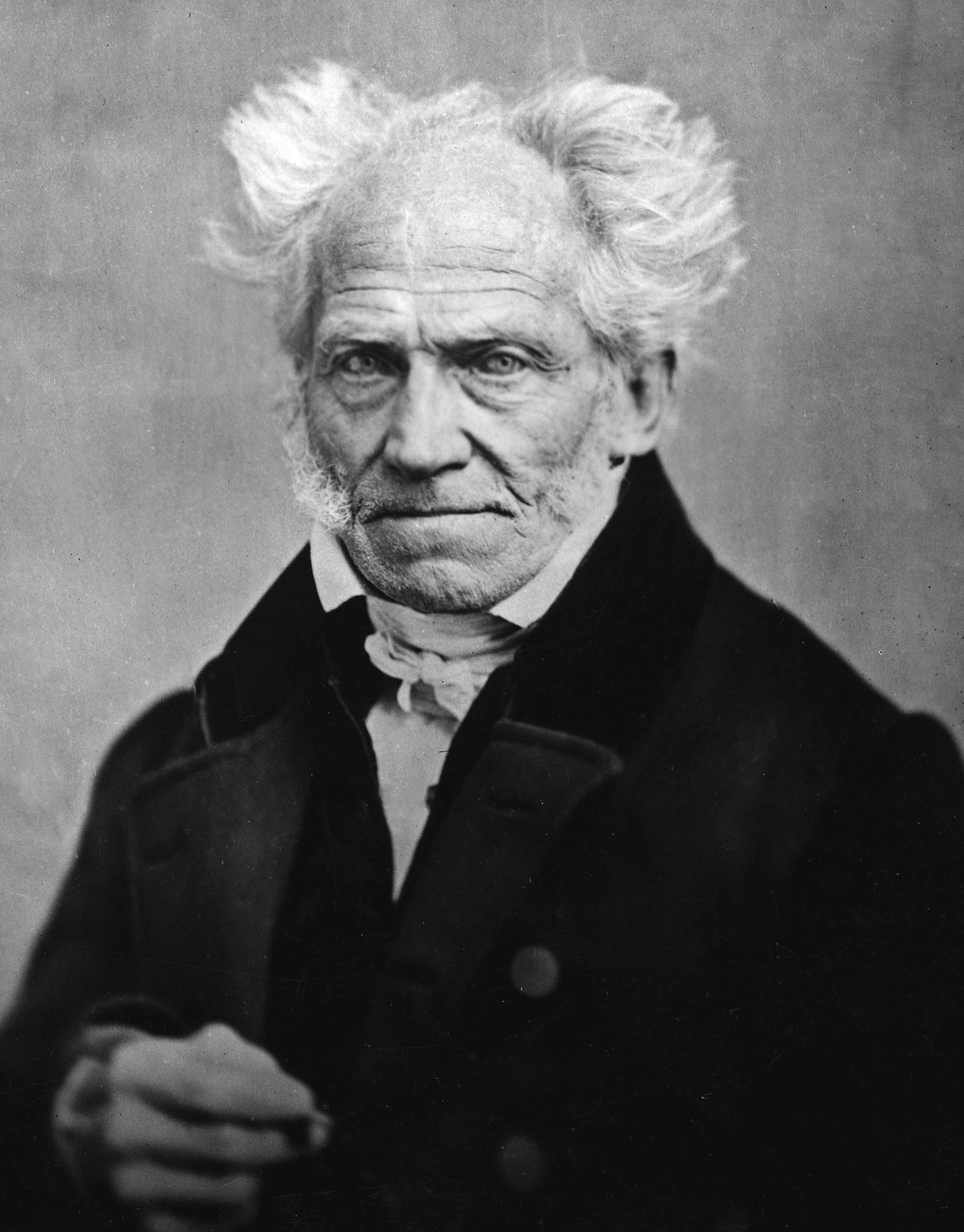
His starting point is pure Kant, and then a daring break. Kant's wall: we can never know the thing-in-itself, the world as it is in itself behind our equipment. Schopenhauer agrees we cannot reach it from the outside, through the senses, where we only ever meet appearances. But, he says, there is one single place in the entire universe where each of us stands on both sides of the wall at once: our own body. You know your body from the outside, as an object you can see and touch like any other. But you also know it from the inside, in a way you know nothing else, as will, as the felt drive to move, to reach, to want, to act. When you lift your arm, you do not first observe a cause and then watch an effect, the way you watch billiard balls. You feel the willing from within and the motion is that willing made visible. That inner access, Schopenhauer claims, is access to the thing-in-itself. Schopenhauer calls this blind inner striving the Will, with a capital W. The term needs a definition before he builds the universe out of it: not willpower, not deliberate choice, not wanting any particular thing, but the raw drive to exist and to want that lies underneath every particular desire. From the inside, what you are is Will.
And then comes the vault. If the thing-in-itself, in your own case, is Will, and if the thing-in-itself is one and the same reality underlying all appearances, then Will is what everything is, from the inside. Not just you. A hungry animal driving blindly toward food is Will in a form close enough to feel. Below that, the crystal forms its shape out of something like blind striving. Gravity pulling a stone is a kind of blind will. Plants turning toward light, rivers seeking the sea, the whole pushing, pulling, growing, hungering world is the one Will appearing in countless costumes. The Will in raw nature, Schopenhauer writes, is "without knowledge, and is merely a blind incessant impulse." This is the crucial word: blind. The Will is not God's plan, not Hegel's Spirit waking up to itself, not reason on the move. It has no mind, no goal, no destination. It just strives. (One caution on the word "idealism" carried over from Kant: Schopenhauer's idealism, like Kant's, is about the mind's role in constituting appearances, not a claim that the world is splendid. As we will see, he thinks it is the opposite of splendid.)
The blind striving made concrete: a force that wants, but wants nothing in particular, it just wants, the way hunger wants without caring what it eats. That is the Will. And because it wants without end and without object, the creatures it drives are caught in a trap. A man desires wealth. He works, he schemes, he sweats, and at last he gets it. For one bright moment, satisfaction. And then? The satisfaction curdles into boredom, and a new desire rises, for more, or for something else, and he is off again. A different man desires a particular love; he wins her; the same arc plays out, relief, then boredom, then the next wanting. Every desire satisfied simply clears the stage for the next desire. There is no final wanting, no last satisfaction that holds, because the Will underneath does not want this or that; it wants, full stop, forever. Life is therefore a pendulum, as Schopenhauer paints it, swinging between the pain of unsatisfied desire and the emptiness of boredom once a desire is met, with only the briefest flickers of contentment at the turning points. This is the beginning of what Schopenhauer would call philosophical pessimism, which is not a mood.
This is why suffering, for Schopenhauer, is not an accident of life that better planning could cure. It is built into the structure of being a willing creature at all. To exist is to will, to will is to lack, to lack is to suffer, and satisfaction merely resets the loop. He saw the Will using individuals to propagate itself, with sexual love as its most powerful lever (the species' Will in disguise, dressing up its agenda as your romance) and then discarding the individual once its purpose was served. This is philosophical pessimism in full, and it is the most rigorous defense of that position in the Western tradition. This is a metaphysical conclusion, derived from the Will-doctrine, not the grumbling of a depressed man. Schopenhauer himself ate heartily, kept his poodles, wrote prolifically, and lived to seventy-two. The pessimism is an argument, not a mood. (Schopenhauer's compassion ethics, which follow below, sit uneasily beside his own writings: his 1851 essay "On Women," collected in the very Parerga that made him famous, extends his pessimism into explicitly misogynist territory, treating women as intellectually and morally lesser. It is as documented as the compassion ethics, and both are his.)
If existence is structurally miserable, is there any way out? Schopenhauer finds two, and they are the redeeming heart of his bleak system. The first is aesthetic contemplation. Now and then, standing before great art, a painting, a building, above all a piece of music, the relentless machinery of personal wanting falls quiet. For a moment you stop being the hungry, striving individual and become, in his phrase, the "pure, will-less, painless, timeless subject of knowledge" (trans. Haldane and Kemp). Knowledge, as he puts it, "breaks free from the service of the will." You are no longer wanting the thing; you are simply, purely beholding it, a clear mirror held up to the world with no craving fogging the glass. It is a temporary parole from the prison of willing, and it is why beauty feels like relief. Music he ranked highest of all the arts, because where painting and poetry show us appearances, music, he thought, is the direct voice of the Will itself, the very inner striving of the world made audible without any veil. (The composer Richard Wagner read this and was electrified; the influence ran straight into his operas.)
The second escape is ethical, and it is compassion. The German word is Mitleid, which literally means "suffering-with." When you genuinely suffer alongside another being, Schopenhauer argues, you have seen through the deepest illusion of all: the illusion that you and the other are truly separate individuals. Underneath, the Will is one, expressing itself in every creature, so your suffering and the stranger's suffering are, at bottom, the same suffering wearing two faces. Real compassion is the moment you pierce that veil of separateness, the illusion that makes each ego look truly separate, which goes by a Sanskrit name, Maya, the veil of illusion. This is not a cheerful "do good deeds" morality. It is a glimpse of underlying oneness that makes the whole frantic competition of separate egos look absurd, and its highest expression, for Schopenhauer, is the saint and the ascetic (one who deliberately denies the body's wants, through fasting, celibacy, and poverty) who quiets the will-to-live entirely.
That Sanskrit word, Maya, points to the most distinctive thing about Schopenhauer, and it has to be stated with care, because it is easy to get romantically wrong. He was one of the first major European philosophers to take Indian thought seriously, but he did not, and could not, read the originals. In early 1814 a friend, the orientalist Friedrich Majer, introduced him to a book called the Oupnekhat, and what that book actually was matters. It was a Latin translation, made in 1801 by a Frenchman named Anquetil-Duperron (steeped in the Neoplatonist tradition that runs back to Plotinus), of a Persian translation, made in the seventeenth century by the Mughal prince Dara Shukoh (the eldest son of the emperor Shah Jahan, who had fifty Upanishads rendered into Persian), of the Sanskrit Upanishads, and the Persian version was itself selective and colored by Sufi mysticism. So the chain ran: Sanskrit originals, to a Sufi-influenced Persian rendering, to a Latin translation by a Neoplatonist Frenchman, to Schopenhauer, who knew no Sanskrit. What reached him was Indian thought several translations deep. He loved it without reserve; he later wrote that the Oupnekhat had been the solace of his life and would be the solace of his death. The relationship, stated precisely: Schopenhauer did not master Eastern philosophy and was not a Hindu or a Buddhist. He worked out his Will-doctrine independently, in his thesis of 1813 and his book of 1818, and then found in this mediated Indian thought a confirmation so striking, the Will as something like the underlying reality the Upanishads point to, Maya as the veil of appearances, the Buddhist insight that to exist is to suffer, that it seemed to him too exact to be coincidence. He drew on its vocabulary; he did not derive his system from it. And the engagement deepened with time: by the 1840s, as the first real European scholarship on Buddhism became available, his reading grew more direct, and the early confirmation turned into something more like a sustained dialogue, even if always at one or two removes from the originals.
That leaves his feud with Hegel, which is one of the funniest grudges in the history of philosophy. When Schopenhauer briefly tried university teaching in Berlin around 1820, he deliberately scheduled his lectures at the very same hour as the great Hegel's, certain that students would flock to the deeper man. To be fair to both men before the punchline: Hegel's hall was not full merely because he held the chair. The Phenomenology and the Logic had already done what no other post-Kantian had managed, an entire architecture in which art, religion, law, and history were explicable within one developmental logic, and the students filling his lectures had real reasons to be there. Schopenhauer was sure they would come to him anyway. Five students showed up. Hegel's hall was packed. Schopenhauer never taught a regular university course again. The defeat did nothing to soften his opinion; he spent the rest of his career calling Hegel a windbag, a charlatan, and a humbug (though it should be said he called Fichte and Schelling charlatans too; the insult was his house style, not a measured verdict), and dismissing the whole post-Kantian idealist movement as obscurantist sophistry. Underneath the insults was a real disagreement, and it is the cleanest contrast the era offers. Hegel looked at history and saw Spirit progressing, rationally and triumphantly, toward freedom and self-knowledge: optimistic, developmental, going somewhere. Schopenhauer looked at the exact same history and saw the blind Will dressing its pointless striving in fresh costumes, war after war, dynasty after dynasty, ideology after ideology, all of it equally without purpose, the same hunger in different clothes. One of them thought history was waking up. The other thought it was only ever turning over in its sleep.
Chapter 6
What the Germans handed forward
"Enlightenment is the human being's emergence from his self-incurred minority."
What got built across these three lives, and what it handed forward, comes into focus as a set of four loose threads the next era unspools. Kant, Hegel, and Schopenhauer did not settle the old rationalist-empiricist war so much as detonate it and rebuild on the crater, and the shapes they left behind structure philosophy to this day. The cleanest way to see it is by who picked up which loose end, because the next era, the nineteenth century proper, is largely a set of replies to these three.
From Kant, three things survived intact. First, the basic picture of the mind as an active machine that structures experience rather than a passive mirror that copies it; that idea, once thought, could not be unthought, and it runs through psychology and cognitive science as much as philosophy. Second, the divide between phenomena (the world as it appears to us) and the thing-in-itself (the world as it is), which set the terms every later philosopher had to argue with, even just to reject. Third, the categorical imperative, and underneath it the idea of autonomy, that a rational being is its own moral lawgiver and carries a dignity grounded in that rational agency. That became one of the two or three permanent options in moral philosophy, and the seed of a whole later tradition of human rights. It also drew an immediate answer in the next era from John Stuart Mill, who argued that consequences are exactly what morality is about, that the rightness of an act turns on the happiness it produces, and built the rival tradition () more or less in opposition to Kant.
The Kant, Hegel, and Schopenhauer an English reader meets are all to some degree their translators' work. Meiklejohn's Kant gave English readers one particular Kant, and Norman Kemp Smith's later translation substantially revised that picture; Hegel in English still defeats most readers partly because no single English word can carry Aufhebung the way the German does. The English-language reception of this whole era is itself a chain of mediations, the way Schopenhauer's Upanishads were.
From Hegel, the lasting bequest was different in kind: not a fixed doctrine but a way of thinking in motion. The idea that reality and history develop, dialectically, through contradiction and its overcoming, that nothing is understood except as a stage in a process, became one of the most fertile and dangerous tools of the nineteenth century. (And it was a method Hegel sharpened in a conversation with Fichte and Schelling, not one he conjured alone.) Its most consequential heir was Karl Marx, who said he found Hegel's dialectic standing on its head and set it back on its feet: keep the engine of development through contradiction, but make the driver matter, economics and class struggle, rather than Spirit. The whole of Marxism is, in one sense, Hegel's dialectic turned from ideas to material life. And Hegel drew the era's other great answer too. The Danish thinker Søren Kierkegaard looked at Hegel's gleaming System, where everything is a rational moment in Spirit's self-development, and revolted against it in the name of the single, suffering, choosing individual, the person who cannot be tidied into anyone's grand scheme. Where Hegel had the universal, Kierkegaard insisted on the particular human being making a leap. Both Marx and Kierkegaard belong to the next era; both are unthinkable without the Hegel they are pushing against.
And from Schopenhauer, the line runs straight to the figure who closes the next era. In 1865, a twenty-one-year-old student named Friedrich Nietzsche stumbled on a copy of The World as Will and Representation in a secondhand bookshop and read it in a fever; it was the first philosophy that ever truly gripped him, and he later called Schopenhauer his "educator." (They never met; Schopenhauer was not his teacher in any literal sense, only on the page.) Nietzsche took Schopenhauer's central insight, that a blind striving Will underlies everything, and then did something startling: he kept the Will and inverted the verdict. Where Schopenhauer said the Will is a curse to be escaped through art, compassion, and the quieting of desire, Nietzsche would say the Will, re-pointed as the will to power, is to be affirmed, embraced, said yes to, that life's endless striving is not a sentence but the only thing worth celebrating. The whole of Nietzsche's rebellion is Schopenhauer's pessimism turned inside out, which is why we cannot meet Nietzsche until we have met the man whose conclusion he spent his life refusing. (Schopenhauer's blind, underlying Will would also seep into Sigmund Freud's picture of the unconscious, but that is a story for well past this era's edge.)
So the era that opened with a Scottish skeptic threatening to dissolve all of science into a betting habit closes with the foundations rebuilt and four enormous loose threads handed forward: Mill answering Kant on what morality is, Kierkegaard answering Hegel on what a human being is, Marx inverting Hegel on what drives history, and Nietzsche inheriting Schopenhauer's Will only to turn its despair into a yes. Kant had dared his successors to think for themselves, sapere aude, have the courage to use your own understanding. They took the dare so seriously that they tore his careful walls down and built four rival worlds in the rubble. That is the next era.