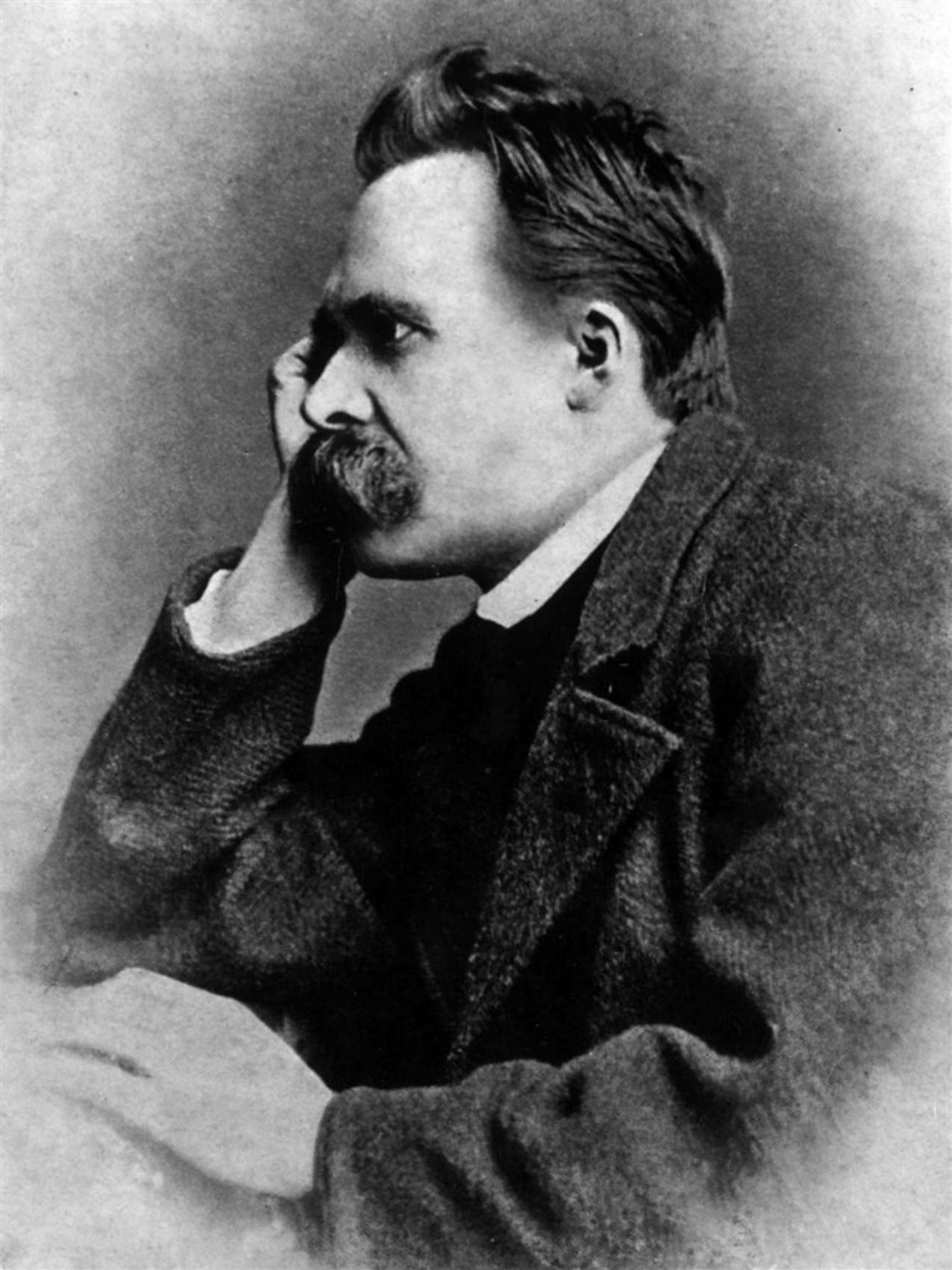
The last era handed philosophy a finished cathedral. Kant had drawn the limits of reason (the rationalists-and-empiricists chapter), and Hegel had made history itself into reason waking up, a great system in which the Absolute unfolds through time and everything, the state, art, religion, even you, has its assigned place in the plan. It was the most complete picture of everything anyone had built since Aquinas. And the next generation could not breathe inside it. The system had a slot for the species, for the epoch, for Spirit on the march, but no slot for the particular, sweating, frightened person who has to decide, this afternoon, what to do with one short life. So four very different minds climbed out, in four different directions, each one chasing the human being the system had filed and forgotten. This is the story of those four, and it ends the whole long story, because the fourth of them announces that the ground everyone had been standing on is gone.
The break
Kant and Hegel had aimed philosophy at the whole. Kant mapped what reason could and could not know; Hegel mapped how reason marches through history toward the Absolute, contradiction driving it forward, until everything from the Prussian state to your own self-consciousness finds its place in one unfolding plan. It was breathtaking, and it was airless. The nineteenth century breaks from it in three directions at once. Kierkegaard turns on the system itself: it explains everything except the single suffering individual who must actually decide how to live, and Abraham on the mountain cannot consult a system. Marx keeps Hegel's engine of history but flips it over, ideas do not drive the world, the way people produce their food and shelter does, and so philosophy's job changes from interpreting the world to changing it. And Nietzsche turns on the ground under all of it. He had started as a disciple of Schopenhauer, the gloomy heir of Kant who taught that a blind "will to live" drives everything, and Nietzsche kept the idea of a deep driving force but rejected the gloom: the drive is not mere survival but self-overcoming, a will to power. Then he went further than any of them. The whole moral order of the West, he argued, had been grounded in the Christian God, and that God was now dead, killed by the very Enlightenment that produced these thinkers, and almost nobody had felt the floor go. Mill is the fourth exit, and his break has a different address: he is not running from Hegel but from Bentham's British , his entry ramp English rather than German, though the era's shared question (how should a single person live?) runs through all four. The before is a reader who has Aquinas's two roads and Kant's moral law carved into every rational mind. The after is a reader standing where that ground used to be, asking what on earth to build now.
Chapter 1
Climbing out of the system
"It is not the consciousness of men that determines their existence, but their social existence that determines their consciousness."
All four of them are running from the same thing. Hegel had died in 1831, and he left behind the most ambitious philosophy Europe had ever produced: a single system in which "Geist," Spirit or Mind, gradually comes to know itself across all of history, every conflict a necessary step, every era a stage in reason's climb toward full self-awareness. It was a machine that could swallow anything. A war, a religion, a work of art, your own private misery, all of it found a place in the plan, all of it meant something inside the march of the whole. To a certain kind of mind this was glorious. To the four minds this era belongs to, it was a cage, and each one filed a different complaint.
Before any of them, though, there was a smaller and stranger entry ramp, and it ran through England rather than Germany. While the Germans were systematizing Spirit, a blunt English legal reformer named Jeremy Bentham (1748 to 1832), a man who wanted to replace custom and scripture with pure calculation in the design of laws and prisons, was systematizing pleasure. Bentham's idea, called utilitarianism (the view that the right action is the one that produces the most happiness, counting pleasure as a plus and pain as a minus, for the greatest number of people, a principle Mill would later formalize under the name "the greatest happiness principle"), was meant as a tool for fixing laws. Run any proposed law through the calculation, total up the happiness it produces against the misery, and you have your answer, no scripture and no tradition required. It was radical in a quiet way: nobody's happiness counted more than anybody else's, so a beggar's pain weighed the same as a duke's on the scale. (He was so committed to being useful even in death that he left his body to be preserved and kept on display, and it still sits in a cabinet at University College London, the head a wax replacement; that part is not legend.)
The era runs on potted summaries and the first one needs correcting. Bentham is usually credited with the slogan "the greatest happiness of the greatest number." He did not coin it. It goes back to the philosopher Francis Hutcheson in 1725, and Bentham himself later even criticized the phrase as muddled (what if maximizing the total requires crushing a minority?). Bentham's real achievement was not the slogan but the machine: the idea that morality could be calculated, made into a system of public reasoning. Which puts him in surprising company. The English reformer counting pleasures and the German idealist tracking Spirit were doing the same century-defining thing from opposite ends, building a system meant to contain everything.
And containing everything was exactly the problem. The Hegelian system handed each of our four thinkers their starting shove, and each pushed off it differently. Marx kept the engine and inverted the fuel: Hegel said ideas drive history, and Marx said no, the way human beings produce what they need to survive drives history, and the ideas come after. That is the inversion compressed into Marx's most quoted line, "it is not the consciousness of men that determines their existence, but their social existence that determines their consciousness." Kierkegaard kept nothing of the engine and attacked the whole premise: a system that finds a place for everything has lost the one thing that matters, the individual who has to choose. And Nietzsche, the youngest, would eventually decide that the real problem was deeper than Hegel, that the ground all of European thought stood on, the Christian moral order itself, was already crumbling and the systematizers were rearranging furniture in a house with no foundation. Four exits from one room. We take them one at a time, starting with the one that looks least like a revolt and turns out to be the gentlest and most durable of the four: a quiet Englishman arguing that you should be left alone.
Chapter 2
Mill, Harriet Taylor, and the free individual
"Over himself, over his own body and mind, the individual is sovereign."
John Stuart Mill (1806 to 1873) was raised as an experiment. His father, James Mill, a disciple of Bentham, decided to grow a reasoning machine and started early: by his own later account, John was learning Greek at three and Latin at eight, doing political economy (the study of how wealth is produced and distributed, what we now call economics) as a boy the way other children do chores. (That account comes from Mill's own Autobiography, a carefully shaped book, and should be taken as his telling rather than a transcript.) The experiment produced a brilliant young utilitarian and then, when Mill was twenty, a total breakdown. He asked himself one morning whether, if every social reform he was fighting for were achieved tomorrow, he would actually be happy, and the honest answer was no. The pleasure-calculus he had been raised inside had no room for the question. The breakdown told him something Bentham's system could not hold: that what kind of happiness matters, not just how much of it you can stack up. Climbing out of that was the work of his life, and it pulled utilitarianism into a richer shape.

The first repair: Bentham had treated pleasure as one homogeneous stuff: more is better, and a given quantity of pleasure from poetry is worth exactly the same as the same quantity from a children's pin game. Mill found that crude, and he replaced it with a distinction between higher and lower pleasures, the pleasures of the mind and imagination ranked above the pleasures of mere sensation, with the ranking decided not by a theory but by the testimony of people who have genuinely tasted both. Mill's test is experiential: anyone who has truly known both the absorption of a hard idea finally cracking open and the easy buzz of mindless diversion would not trade down permanently to the lower for any quantity of it. We would rather be a little unsatisfied as a thinking creature than perfectly content as a contented animal, and his line for it is one of the most quoted in philosophy: "It is better to be a human being dissatisfied than a pig satisfied; better to be Socrates dissatisfied than a fool satisfied. And if the fool, or the pig, are of a different opinion, it is because they only know their own side of the question." That last clause is the whole argument. The fool cannot outvote Socrates on which life is better, because the fool has never been Socrates and Socrates has been the fool.
There is also a Mill the practical chapters tend to skip, and he anchors the era's other leg. Mill did not only refine ; he wrote the century's most influential book on how we know anything, the System of Logic (1843), and its argument runs straight out of the Hume-versus-Kant fight the last eras left open. Against the rationalist claim that some truths are known in advance of all experience, written into the structure of the mind, Mill held that even the laws of mathematics and are inductive generalizations, conclusions we have drawn so many times, so reliably, from what the world shows us that they feel necessary but are in fact learned. It is Hume's (the rationalists-and-empiricists chapter) pushed to its limit and aimed at Kant: where Kant had saved necessary truth by lodging it in the mind's own architecture, Mill puts it back out in experience, and makes science, not pure reason, the model of knowledge. The same Mill who said your liberty is your own said your certainty is earned from the world, never given for free.
The second and more famous repair is On Liberty (1859), and its core is a single principle clean enough to carry in your pocket: the harm principle. The only justification for society using force against an individual against his will, Mill argues, is to prevent harm to others. Your own good, whether physical or moral, is never sufficient warrant. In his own words, "the only purpose for which power can be rightfully exercised over any member of a civilised community, against his will, is to prevent harm to others." And so, "over himself, over his own body and mind, the individual is sovereign." A man wants to take a drug that will ruin his health. May the state stop him? On the harm principle, no, not for his own good, because his body is his own territory. May the state stop him from driving while he does it? Yes, instantly, because now the wreckage lands on other people. The principle sounds simple and is not: it generates hard cases the moment you touch it (does offending people count as harming them? does failing to rescue someone count?), and Mill knew this and spent the book working the edges. The simplicity is the bait; the difficulty is the point.
Mill aimed the harm principle at a danger he thought democracies were uniquely bad at seeing. The old worry was tyranny by a king. The new worry, in a country where the majority rules, is tyranny by the majority, the crowd's power to crush an odd opinion or an unusual life as thoroughly as any despot, not with prisons but with disapproval, until nobody dares think sideways. Mill did not invent that phrase, "the tyranny of the majority," and he says so in the text; he borrowed it from the French observer Alexis de Tocqueville, who had coined it watching American democracy in the 1830s. Mill's contribution was to turn it into a reason to wall off a zone of individual liberty that no majority, however large, gets to enter. This is the democratic anxiety running under the whole chapter: a free society is not automatically a society where you are free, and the loudest threat to the lone dissenter may be his own neighbors.
The standard story leaves out a critical part. On Liberty opens with a dedication, and the dedication is to a woman: "the beloved and deplored memory of her who was the inspirer, and in part the author, of all that is best in my writings." Her name was Harriet Taylor Mill (1807 to 1858), and she was not a muse. She was a working intellectual partner. Mill met her around 1830 when she was married to someone else; they worked side by side for two decades, married in 1851 after her first husband died, and she died in 1858, the year before On Liberty appeared, in the same French city where Mill himself would die fifteen years later and be buried beside her. In his Autobiography Mill called the book "more directly and literally our joint production than anything else which bears my name," and said many of its most important portions were hers. How much exactly we cannot fully reconstruct, partly because Harriet herself burned many of their early letters, so the evidence is thinner than it should be. But what is on the record is firm: the dedication names her as in part the author, and the 1851 essay "The Enfranchisement of Women," published under Mill's name, is now generally taken to be primarily her work. The recognition has even reached print: in 2026 a new edition of On Liberty (Hackett Publishing) became the first in the book's history to name Harriet Taylor Mill as co-author on its title page, formalizing what Mill himself had said in his Autobiography.

That partnership shaped what became Mill's most radical book. The Subjection of Women (1869) grew from arguments Harriet had been developing since at least her "Enfranchisement of Women" essay of 1851, though the book itself was Mill's, drafted in 1861 and revised for publication eleven years after her death. And it matters that it is an argument and not a plea. Mill's case is a logical trap sprung on his own century. The subordination of women, he argues, originally rested on nothing but force, the simple fact that the stronger ruled, and it has since been dressed up in custom until people mistake the habit for the natural order. The trap is logical: people say women are naturally suited only to the domestic sphere, and offer as proof that women have only ever occupied it. Mill points out that this proves nothing, because women have never been allowed anything else, so we have no idea what their nature is. You cannot read off someone's natural capacities from a cage and call the cage their nature. It is the same move Mill makes everywhere, refusing to let "this is how things have always been" pose as a reason, and it grew directly out of a partnership the dedication insists on naming. The gentlest of our four revolts turns out to be the one whose conclusions the modern world simply adopted.
Chapter 3
Kierkegaard and the individual before God
Subjectivity is truth.
Søren Kierkegaard wrote in Danish, and every English translation of his major works is still in copyright, which means he is the one major thinker in this whole long story we cannot quote directly. Everything in this chapter is in our own words, his ideas restated rather than his sentences reproduced, with the key terms given in his own Danish where they carry weight. That is a real loss: Kierkegaard of all people wrote in sentences built to ambush. The restatements that follow are faithful, not verbatim.
Kierkegaard (1813 to 1855) grew up in Copenhagen under a severe, guilt-haunted father in the Lutheran tradition (the branch of Protestant Christianity most saturated with the idea of sin and grace), broke off an engagement to a woman named Régine Olsen in 1841 for reasons he never fully explained (the wound runs visibly through book after book), and then did something no philosopher had quite done before: he published most of his major works under invented names. Victor Eremita, Johannes de silentio, Vigilius Haufniensis, Johannes Climacus, a whole cast of pseudonyms, each one a character with a viewpoint Kierkegaard could present from the inside without signing off on it. This was method, not cowardice. His conviction was that the truths that matter most, how to live, what to commit your one life to, cannot be handed over like information in a lecture. They have to be lived into by each person alone, or they are not really had at all. So he wrote in voices, staging positions rather than asserting them, forcing the reader to do the work instead of taking dictation. (He admitted the pseudonyms were his own in a later book, The Point of View for My Work as an Author, published partly in his own lifetime, as On My Work as an Author in 1851, and in full only posthumously in 1859; this was an open secret, not a fraud.)

His work would later be called existentialist, a label he never used and that belongs to Sartre, Camus, and the twentieth century, applied to him in hindsight a hundred years after he died. Better to say what he actually was: the first philosopher to put the single individual, the one suffering, deciding person, at the dead center of philosophy. His map of how such a person can live runs through three stages, or better, three spheres of existence, and the point is not the taxonomy but the pressure that pushes you from one to the next. The first is the aesthetic: life organized around what is interesting, pleasurable, immediate, the life of the connoisseur who keeps every option open and commits to nothing because commitment would close doors. It looks like freedom. From the inside it curdles: the man who has tried everything interesting finds that the trying itself goes stale, that even his boredom bores him, that there is no one home to enjoy any of it because he has refused to become anyone in particular. That hollow is what drives a person toward the second sphere, the ethical: life organized around duty, commitment, the social roles a person takes up and sustains. Kierkegaard's example is marriage, chosen as the ethical life's emblem precisely because it means sustaining love by decision over years rather than chasing the next feeling. The third is the religious, and it is not simply a more intense ethics. It is a relationship with God that the ethical categories cannot contain, where a person can be required to do something the universal moral law forbids.
That third stage gets its terrifying worked example in Fear and Trembling (Frygt og Bæven, 1843), written under the name Johannes de silentio, "John of the silence." The case is Abraham, commanded by God in the book of Genesis to take his son Isaac up a mountain and kill him. The ethical law could not be plainer: thou shalt not murder, and certainly not your own child. Abraham prepares to do it anyway. Now, Kierkegaard asks, what separates Abraham from an ordinary murderer? His answer is the chapter's hard idea, the teleological suspension of the ethical: a higher duty, the absolute duty to God, can suspend the universal ethical rule for a single individual in a way that cannot be generalized or explained. Abraham cannot justify himself to anyone. He cannot sit Isaac's mother down and lay out the syllogism, because there is no syllogism; faith here is irreducibly first-person, a relation to God that no third party can audit. The pseudonym matters: Johannes de silentio narrates from outside this faith. He admires Abraham and confesses he cannot understand him. Kierkegaard does not claim to stand where Abraham stands. He writes about the leap from the near edge, like a man describing a canyon he has not crossed.
The word "leap" is genuinely his, and one famous phrase genuinely is not. Kierkegaard used the Danish word for leap (Spring) repeatedly for the movement into religious existence, a jump across a gap that no amount of evidence or argument can bridge, because the categories on the two sides do not connect; he called it a qualitative leap, a leap between incommensurable things, not a long stride along the same road. But the slogan everyone attaches to him, "leap of faith," appears nowhere in his writing. It is later English shorthand. The concept is his; the catchphrase belongs to his interpreters. The phrase makes it sound like reckless guessing; the concept is something stranger and more precise.
Two more ideas finish the picture. Both are given in Danish below because the English translations are still in copyright. In The Concept of Anxiety (Begrebet Angest, 1844) he analyzes angst, which is not fear of any particular thing (that is just fear) but the dizziness of freedom itself, the vertigo a being feels when it grasps that it is free, that the future is open, and that the whole weight of choosing falls on it alone. The analogy is standing at a high edge with not just the fear of falling but the awful awareness of being able to jump, with nothing deciding it but oneself: that is closer to angst, and it is the mood of a creature that knows it is free. And in the Concluding Unscientific Postscript (1846), under the name Johannes Climacus, comes his famous claim that subjectivity is truth. It is easy to misread as , as "believe whatever you like." It is the opposite of careless. Kierkegaard's claim is narrower and sharper: for questions of existence, how to live, what to stake your life on, the detached, objective, view-from-nowhere stance is not just unavailable but is the wrong tool entirely, like trying to measure courage with a ruler. Truth here is a matter of how passionately and honestly you hold a commitment in the face of uncertainty you can never resolve, not a matter of matching an impersonal fact. That key passage from Kierkegaard is paraphrase rather than quotation, and the silence is itself part of the story: the man who insisted truth must be lived first-person is the one whose own words we are not allowed to reprint.
He died mid-fight. His last campaign, in 1855, was signed in his own name and aimed straight at what he called Christendom, the comfortable European arrangement in which an entire society calls itself Christian while quietly declining the actual difficult demands of the faith. He published a run of fierce, readable pamphlets attacking the state church for selling an easy Christianity, collapsed in the street that autumn, and died weeks later, refusing the church's last rites to the end, consistent to the last with a life spent insisting that faith is the hardest thing a single person can do, not the easiest thing a whole nation can claim.
Chapter 4
Marx, the philosopher
"The philosophers have only interpreted the world, in various ways; the point is to change it."
Karl Marx (1818 to 1883) demands a kind of care the others don't, because a hundred years of twentieth-century politics have been piled on top of him, and almost none of it is what this chapter is about. The states that flew his name, the revolutions, the regimes, all came long after his death and leaned heavily on a curated, simplified Marx assembled by his collaborator Friedrich Engels (a German industrialist's son who co-wrote the Communist Manifesto with Marx in 1848 and spent decades editing and publishing his notes) and by later political movements. Engels was not only a posthumous editor: he was a genuine lifelong collaborator. The two men wrote the Manifesto together, and the later simplification ran through that partnership, not past it. Stranger still, the writings where Marx is most clearly a philosopher, his early manuscripts on alienated labor, were not even published until 1932, half a century after he died, so they had zero influence on anyone in his own century. The Marx this chapter is after is the philosopher: a thinker who took Hegel's engine, turned it over, and asked what human work does to the human being.
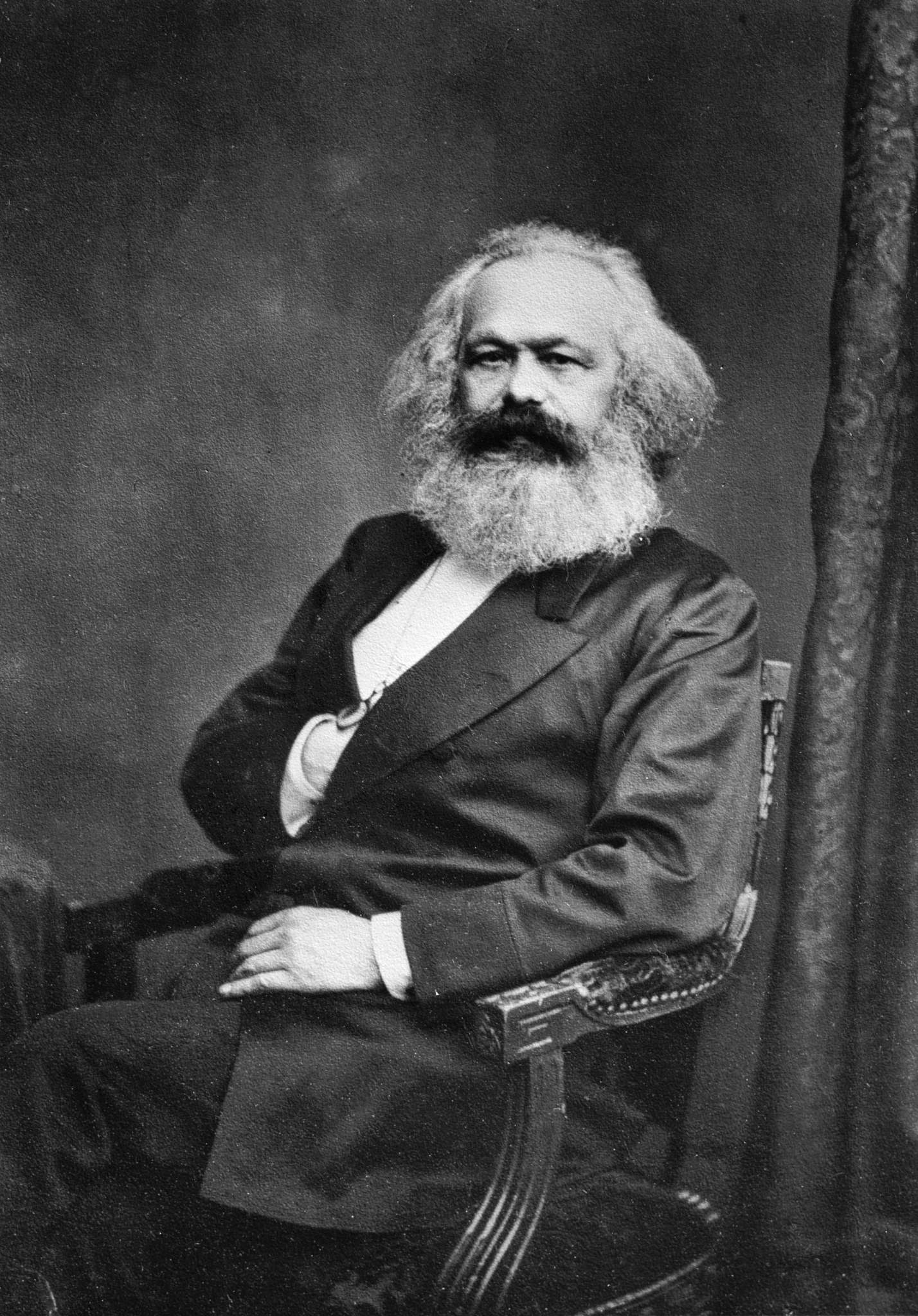
The inversion is the philosophical move underneath everything else. Hegel had made ideas the driving force of history, Spirit working itself out, and the material world a kind of byproduct of mind. But Marx did not flip Hegel single-handed. A predecessor named Ludwig Feuerbach had already tried, in The Essence of Christianity (1841), reducing theology to anthropology: God, Feuerbach argued, is not a being above us but a projection of human nature, our own best qualities thrown onto the sky and worshipped back. Marx took the move and said it did not go far enough. Feuerbach had explained the projection but not what produces it; the answer, Marx said, is material. The driving force is how a society organizes the production of food, shelter, and goods, and that shapes everything else, its laws, its politics, its religion, even its philosophy, and the projection too. He put the relationship in a famous spatial image. In his Afterword to Capital he wrote that Hegel's method, with idea on top and matter below, "is standing on its head. It must be turned right side up again, if you would discover the rational kernel within the mystical shell." (A precision matters here, since this gets garbled: Marx's word is "turned right side up," or inverted; the popular paraphrase "standing Hegel on his head" actually says the backwards thing, since for Marx it is Hegel who was upside down.) From this comes the model called historical (the view that the material conditions of production, not ideas, are the engine that drives historical change).
The model has a two-floor architecture. At the bottom is the base: the way a society actually produces things, its tools, its factories or its farms, and the relationships those create (who owns the factory, who works in it). On top of the base sits the superstructure: the laws, the government, the religion, the art, the reigning ideas. Marx's claim is that the base shapes the superstructure, not the other way around. The ideas a society holds about justice and property are not free-floating truths; they grow out of, and tend to defend, the way that society makes its living. And since the class that owns the factories also controls the schools and the printing presses, its preferred story about the world, that property is sacred and the current arrangement just, tends to be the story everyone is taught. Hence Marx's line, "it is not the consciousness of men that determines their existence, but their social existence that determines their consciousness." "Shapes" is doing careful work here: Marx's defenders argue endlessly over how tightly the base determines the superstructure, whether it is an iron law or a strong tendency, and the looser reading is the more defensible one. The point at era altitude is the direction of the arrow: from the loom and the factory up to the law and the church, not down from the idea.
The idea that makes Marx a philosopher of the human being and not just an economist is alienation. The early manuscripts where he worked it out have no public-domain English translation, so the following is a restatement in our own words. The thought goes back to a claim about what humans are. Unlike other animals, Marx held, human beings are conscious self-creators; we can make our own life-activity, our work, the deliberate object of our will and imagination. That capacity is what Marx (borrowing the term from Feuerbach) calls our species-being, our nature as the one kind of animal that works consciously and imaginatively rather than by instinct, and creative, self-directed labor is where that nature is most fully expressed. A man spends twelve hours a day fitting one bolt to one part on a line. The product he makes is not his; it belongs to the owner, the class Marx calls the bourgeoisie (the people who own the factories, tools, and capital), and is sold past him. The man himself belongs to what Marx calls the proletariat (the class that owns nothing but its own labor and must sell it to survive). The work itself is not chosen; it is compelled, dull, and external, something he does only to earn the bread that lets him do it again tomorrow. The men beside him are not comrades but competitors for the same wage. And the very capacity that was supposed to be the height of his humanity, conscious creative work, has been ground down into a numb means of survival. Marx calls this alienation: the worker is cut off from the product of his labor, from the act of laboring, from his fellow workers, and from his own species-being. The thing that should most make him human is the thing the system uses to grind him down.
Two more pieces, and then the line that defines him. First, the most quoted sentence Marx ever wrote about religion, which is almost always quoted wrong. People remember "religion is the opium of the people" as a sneer, contempt for the gullible faithful. The full passage is the opposite of a sneer. "Religious distress is at the same time the expression of real distress and also the protest against real distress. Religion is the sigh of the oppressed creature, the heart of a heartless world, just as it is the spirit of spiritless conditions. It is the opium of the people." Read in full, it is a diagnosis, even a compassionate one. Religion, Marx is saying, is a real cry of real pain and a real comfort, the heart of a heartless world, and it is a painkiller that lets people endure suffering instead of ending its causes. Both halves at once. (Two small corrections that travel with this line: it is "of the people," not "of the masses," a different German word; and quoting the painkiller clause without "the heart of a heartless world" turns a diagnosis into a slander.)
Second, commodity fetishism, the one piece of his mature economics that is pure philosophy. A commodity (Marx's word for any good produced not to use but to sell) carries a strangeness he wants us to notice. In Capital he writes: "A commodity appears, at first sight, a very trivial thing, and easily understood. Its analysis shows that it is, in reality, a very queer thing, abounding in metaphysical subtleties and theological niceties." What is queer about it is this: when everything is produced to be sold, the relationships between the people who make things start to appear as relationships between the things themselves. The price of a coat seems to be a fact about the coat, a property it carries around like its weight, when really it is a frozen relationship between everyone whose labor went into it. People's social bonds get mystified into a marketplace of objects with lives of their own, and Marx borrows the word "fetishism" from the study of religion, where it means treating an object as if it had powers that really come from human beings.
Which brings us to the sentence on his gravestone. The Theses on Feuerbach are eleven terse notes Marx jotted in 1845 (the title is no accident: the whole document is his settling of accounts with Feuerbach); the eleventh, as Engels later published it, reads: "The philosophers have only interpreted the world, in various ways; the point is to change it." There is the whole break in one line. For two thousand years, from the Greeks forward, philosophy had understood itself as the attempt to understand the world correctly. Thesis XI declares that project finished and insufficient: understanding is not the goal, transformation is. It is carved on Marx's grave at Highgate Cemetery in London, alongside the closing cry of the Communist Manifesto (the 1848 pamphlet, written with Engels, calling on the workers of the world to unite). Whatever you make of where his followers took it, the philosophical move is clean and enormous: he turned philosophy from a mirror held up to the world into a lever placed under it.
Chapter 5
Nietzsche and the death of God
"What our Cheerfulness Signifies. The most important of more recent events — that 'God is dead,' that the belief in the Christian God has become unworthy of belief — already begins to cast its first shadows over Europe."
Friedrich Nietzsche (1844 to 1900) was the son of a Lutheran pastor who died when the boy was four, became at twenty-four the youngest person ever appointed to a classical philology professorship at the University of Basel, broke his health by his mid-thirties, and wrote his strangest and greatest books in a decade of migraines and failing eyesight before his mind collapsed entirely in January 1889. One translation matter shapes every quotation that follows: the famous modern English Nietzsche (the Kaufmann translations) is still in copyright, so every quotation here comes from the older public-domain translators, chiefly Thomas Common, whose 1910 English is sometimes stiff and dates badly in places. Where it clunks, that is the translator, not Nietzsche. We use it because it is the version we are allowed to print, and the meaning carries.
His most quoted line is also his most misunderstood. Nietzsche did not announce that God is dead as a cheerful atheist spiking a football. He took for granted that the Enlightenment had already done the intellectual work of killing belief; that was old news. His point was the consequence nobody had noticed yet. The entire moral order of the West, its sense of good and evil, of meaning, of why anything matters, had been quietly resting on the Christian God for a thousand years. And that morality cannot simply detach itself and survive on its own: it grew up inside the theology, assumed it, borrowed its authority from it, so when the theology goes, the morality has no ground left to stand on either. Pull that God out, as European culture had effectively done, and the whole structure of values hangs in midair with nothing under it, the condition philosophers call (the collapse of any ground for saying that anything matters or has value), and almost no one has felt the floor disappear. That is the catastrophe. The most famous passage he ever wrote stages it directly, The Gay Science §125, the parable of the madman. A madman lights a lantern in broad daylight and runs into the marketplace crying that he is looking for God. The crowd, men who have already stopped believing, laugh at him. And he turns on them with horror: "God is dead! God remains dead! And we have killed him! How shall we console ourselves, the most murderous of all murderers? ... who will wipe the blood from us?" This is not a boast. It is a man staring at a wound the size of the sky and asking who could possibly clean it. The crowd laughs because they think the death of God is a small thing, a private loss of faith; the madman is the only one who grasps that it is the largest event in the history of the West, done without understanding what was being done. "I come too early," he tells them. The deed is finished but the news has not arrived.
So when, in §343, Nietzsche calls the death of God "the most important of more recent events," and says it "already begins to cast its first shadows over Europe," it is the opening of a crisis, not a victory lap. §343 is where he turns, very carefully, toward what might come after, a possible new dawn for what he calls free spirits (his term for the rare type of mind that can bear the death of God and treat the wreckage as possibility rather than only a grave). But the dawn is for the few who can bear it, and the dread comes first. The task he names is almost unimaginably hard: if values are no longer handed down from a divine source, then human beings will have to create new ones themselves, from nothing, and stand behind them with no cosmic backing. Most of his philosophy is an attempt to figure out who could possibly do that, and how.
The size of his break only becomes clear against what he was breaking from, and that means Schopenhauer. Arthur Schopenhauer was the gloomy heir of Kant whose books captured Nietzsche as a young man. Schopenhauer held that underneath the orderly world of appearances there is a single blind striving force, the will to live, churning through everything, indifferent, never satisfied, and that to be alive is therefore to suffer, because the will is always wanting and never at rest. His prescription followed from his diagnosis: since life under the will is suffering, the wise response is to turn away from it, to quiet the willing, through art, through compassion, through a saint's renunciation of desire. Pessimism, in other words, as a flight from life. Nietzsche thought the diagnosis was half right and the prescription exactly backward. He kept the deep driving force and threw out both the gloom and the escape.
His own name for that force is the will to power, and it is the single most abused idea he had. The will to power is not a lust to dominate other people. It is his correction of Schopenhauer: the basic drive in life is not mere survival and not mere willing-that-suffers, but the urge to expand, to overcome resistance, to discharge strength, above all to overcome oneself. Where Schopenhauer said turn away from the will, Nietzsche said turn into it. His own examples lean on the artist straining against a hard form, the thinker mastering a problem, the person conquering something in themselves, not the strongman crushing the weak. The will to create is the model, not the will to rule. (We meet shortly the person who turned it into the cartoon, and it was not Nietzsche.)
Underneath all of it is a claim about knowledge itself, which he calls perspectivism. There is, on his account, no single God's-eye view of the world, no set of facts that are simply true from nowhere. Every interpretation is made from a position, shaped by the needs and drives of the creature making it; what we call "the laws of nature" are themselves interpretations, not a text read straight off reality. In Beyond Good and Evil §22 he puts this against the physicists who think they are reading nature's own statutes, and insists they are reading their own grammar into it. This is not the lazy relativism that says every opinion is as good as every other; Nietzsche held nothing of the kind. But it does mean that any claim to absolute, context-free, eternal truth, including the truth the West's morality claimed for itself, should make you suspicious about whose perspective is being smuggled in as the view from nowhere. Once God, the one guaranteed standpoint above all the others, is gone, the claim that any human morality is objectively, cosmically true loses its last support. Perspectivism is the quiet engine under the death of God.
From the same instinct comes his most provocative analysis, the genealogy of our morals, set out in On the Genealogy of Morality (1887), the book where he traces the historical origins of our moral vocabulary rather than asking whether good and evil are true. The analysis needs careful handling, because it is easy to flatten into a comic book. Nietzsche distinguishes two value systems by their origin. Master morality is the self-affirmation of the strong and noble: they call themselves and their own qualities "good," vigor, courage, health, fullness, and call what they are not "bad," meaning poor, common, weak, with no resentment in it, just an overflow of self-regard naming the world in its own image. Slave morality arises later and in reaction, among the people the strong trampled. Unable to win by force, they win by revaluing: they name the strong "evil," and their own enforced meekness "good," and from that inversion the whole vocabulary of pity, humility, and equality is born. The engine of this revaluation is what Nietzsche calls, using the French word on purpose, ressentiment. He borrows the French deliberately to mark it as a technical term, not ordinary resentment (which is a passing feeling) but a chronic condition: a bottled hostility that cannot vent itself in action and so turns inward and becomes creative, generating values instead of blows. He puts it directly in the Genealogy: "The revolt of the slaves in morals begins in the very principle of resentment becoming creative and giving birth to values." The twist that makes it serious rather than nasty is that slave morality, Nietzsche argues, won. Christianity and modern democratic equality are, on his telling, its triumphant children; the morality most of us breathe is the slave's. He is not saying the strong are morally better and the weak contemptible. His claim is genealogical, an account of where our values came from, and his challenge is uncomfortable in a different way: he wants us to look at the resentful, reactive origins of our own deepest moral feelings and ask whether we hold them because we have examined and chosen them, or because we inherited them in our sleep. His real target is not the weak. It is morality that secretly hates life, whatever it calls itself. (The same genealogical hammer is also what makes him a rival, not just a neighbor, of the Mill we met two chapters ago: where Mill grounds morality in human welfare and the greatest happiness, Nietzsche denies that moral claims have any such authority at all, welfare included; they have histories, and should be examined as such.)
Two more ideas carry everything else. The first is eternal recurrence, posed in The Gay Science §341 as a thought experiment, a demon's whisper. Imagine, Nietzsche says, that "a demon were to steal after you into your loneliest loneliness" and tell you that this life, exactly as you have lived it, down to "every pain and every joy and every thought and sigh," you will have to live again and again, endlessly, with nothing new in it ever. Would the thought crush you, or could you welcome it? He calls it the heaviest burden, and the weight is specific, not just a mood. It strips every consolation exit at once. You cannot tell yourself this bad stretch will pass and you will be wiser and different on the far side, because the self who lives it all again is exactly this self, unchanged, the regrets and the failures included, returning in the identical order forever. There is no forward arrow, no edited replay, no "next time." To affirm the thought you must will this life, this one, down to its worst hour, and want it back unaltered an infinite number of times. That is the weight: not "is life nice enough to repeat?" but "can you say yes to the whole of it with nothing taken out?" The person who could hear the demon and say yes, again, and again has achieved what Nietzsche calls the love of fate (amor fati in Latin), a total affirmation of one's actual life with nothing edited out. And that person points toward his most loaded term, the Übermensch. Thomas Common's 1909 translation renders it "Superman," which is unfortunate (it came before the comic-book character but reads like him now), and the modern preference is "overman," which we will use. The overman is not a race and not a master race; it is whoever can do the thing the death of God demands, create new values out of the wreckage and bear the heaviest burden without flinching. It is an existential type, not a biological one. This matters more than any other distinction in the chapter, because of what happened to it after he was gone.
One more wart, because the chapter has just spent two chapters' worth of care on Harriet Taylor Mill and fairness cuts both ways: Nietzsche's scattered remarks on women, across the Genealogy, Beyond Good and Evil, and Zarathustra, range from performative provocation to what reads as plain contempt, and they are a genuinely difficult surface in his work, contested by his readers and not to be explained away. Naming it is not a detour; it is the same honesty the next paragraphs are about to demand of his admirers, who would rather skip it, and of those who would draft him as a proto-Nazi, who would rather it were the whole man. He is neither caricature.
Which is where honesty requires the ugliest part of the story, told plainly. Nietzsche collapsed into insanity in Turin in January 1889, at forty-four; the cause is medically uncertain to this day, and the famous tale that he broke down while embracing a beaten horse is thirdhand hearsay told after his death, not a fact, so set it aside. What is a fact is what happened to his work. He spent his last eleven years incapacitated, cared for first by his mother and then by his sister, Elisabeth Förster-Nietzsche, who took control of his archive and his legacy. She was married to a prominent antisemitic German nationalist, the very kind of man Nietzsche despised; he had broken with her over the marriage and mocked her husband in his letters. After his death she shaped the published record in ways that aligned with her own nationalist, antisemitic sympathies; the effect is documented, the intent still debated by scholars (some read deliberate falsification, others a true believer's instinct to protect a brother's reputation), but the distorting result is not in question. She assembled a book called The Will to Power out of scraps from his notebooks, selecting and ordering them to support that reading. That "book" is not a book Nietzsche wrote. It is her construction from his discarded notes, and it became one of the main channels through which a falsified Nietzsche reached the twentieth century. The Nazis later embraced this version; Hitler attended Elisabeth's funeral in 1935. None of it is what Nietzsche believed. The man who actually wrote the books was, by his own published words and letters, a cosmopolitan who held German nationalism in contempt and prized what he called the "good European" standing above national feeling; he attacked antisemitism directly (in one informal note he reportedly wrote that all antisemites ought to be shot, though the stronger evidence is in his published work and his break with his sister); and the overman was never an Aryan superman. The man who actually wrote the books would have loathed almost everything done in his name. The distortion is documented, and it has to be named, because the most influential misreading in the history of philosophy happened to the very man this whole arc has been climbing toward.
Chapter 6
The reckoning
"God is dead! God remains dead! And we have killed him! How shall we console ourselves, the most murderous of all murderers? ... who will wipe the blood from us?"
This era's four thinkers walked out of Hegel's system in four directions. Mill defended the individual's right to be left alone, a free zone no majority may enter. Kierkegaard defended the individual standing alone before God, doing what no system and no community can explain. Marx defended the individual ground down inside his own labor, and demanded the world be changed rather than merely understood. And Nietzsche stood the individual on ground that had just fallen away and asked what could possibly be built there now. Four answers, and they do not combine into a fifth system. That is the shape of the century: not a new cathedral but the careful demolition of the idea that one was even possible.
The four of them, especially the last, close a book that has been open for two and a half thousand years. The first thing philosophy ever did, in a Greek port town, was a man named Thales looking at the world and trying to explain it without reaching for a god, guessing that everything was, at bottom, water (the Greeks chapter). That was the founding gesture: the world can be understood by reason alone, no divine story required. From there the arc ran for a thousand years through the long experiment of the faith-and-reason era, three religions trying to keep faith with a book and with an argument at once (the faith-meets-reason chapter), until a Franciscan logician decided God was too free for that tidy peace to hold. Then a Frenchman in a warm room rebuilt knowledge from his own doubt, and the rationalists and empiricists spent two centuries fighting over how much the mind can know on its own (the rationalists-and-empiricists chapter), until Kant drew the borders of reason and Hegel turned history into reason's autobiography. And now, at the far end of all of it, Nietzsche announces that the God whose existence the whole middle of this story labored to reason out, defend, define, and reconcile with philosophy, is dead, and that his death pulls the floor out from under the values the West had built on him. Thales tried to explain the world without gods at the start. Nietzsche announces, at the end, that the West's God is gone and nobody is ready for what that means. The snake has reached its own tail.
The story ends here without a resolution, and that is not a failure of the telling but the actual state of things. The earlier eras at least closed their questions or passed them forward intact. This one closes the whole arc on a crisis with no answer attached. The madman's question is left open on purpose: "How shall we console ourselves, the most murderous of all murderers? ... who will wipe the blood from us?" Nobody in this era answers it. Nietzsche himself only gestures at who might, the free spirit, the overman, the person who can create new values and love even a life lived over and over, but he hands us a task, not a solution, and then his mind goes dark in a Turin square in 1889 with the work unfinished and the question hanging.
The twentieth century, which we do not enter here, would split this inheritance in two, though both halves are still working the same problem Kant left them, the question of where reason's limits fall and what lies past them. One line of thinkers chased clarity, trying to make philosophy precise and modest, more like a careful science of language and logic. Another line, the existentialists and their heirs (the movement, named only in the next century, that holds that existence comes before essence, that a human being is thrown into the world with no given nature or purpose and has to make meaning for itself), picked up exactly Nietzsche's and Kierkegaard's question, how to live, how to make meaning, in a universe that no longer hands it to you, and made it the center of everything. Both are still arguing. That is where the question goes, but the question itself is the gift this era leaves on the table, and it is the same gift it received, just stripped of every comfort. Western philosophy began when a man decided the world could be understood by human reason without appealing to a god. Twenty-five centuries later, the same project arrives at a man declaring that the god the West had reasoned its way into needing is dead, and that the hardest work, deciding what is worth anything at all and why, is now entirely, terrifyingly, ours. The Greeks asked what everything is made of. We end not knowing what any of it is for, and being told, by the last and loneliest thinker in the arc, that finding out is up to us. That is where the story stops. Not because it is finished, but because this is as far as the ground goes.