
The medieval era ended with a logician deciding God was too free for the old peace between faith and reason to hold (the faith-and-reason chapter). The question it set down, what can reason establish on its own with no book to lean on, sat unanswered for two and a half centuries while the medieval world slowly ended. Part of what ended it was a revolution in how Europeans understood nature. The old framework had been Aristotle's, taught in every university: a cosmos of fixed spheres with the earth at the center, things moving because it was their nature to seek their proper place. Then Copernicus moved the earth, Galileo's telescope and falling bodies broke the Aristotelian physics, and a new picture took hold of a universe running on matter, motion, and mathematics rather than purposes. By the 1630s the old certainties were rubble, and "starting from scratch" was not a stunt but a necessity. Then, in 1619, a young Frenchman named René Descartes shut himself in a warm room against the winter and picked the question up. He decided to doubt everything he could possibly doubt, to throw out every belief he had not personally verified, and to see what, if anything, was left standing when the smoke cleared. What was left would be the new foundation. This is the story of the people who tried to build on it, and of the quiet Scotsman at the end who showed that the foundation might not hold the house they wanted.
The break
Open Aquinas, the era-2 summit, and the framework is already there before he reasons a step. The articles of the Summa Theologiae march in the same shape every time: the question, the objections, then "I answer that," with scripture and the Church Fathers standing behind the answer like witnesses called to confirm what is already settled. Reason does serious work, but it works inside a house faith has already built. The starting point is given.
Now open Descartes' Meditations, published in 1641, and the room is empty. "Now will I shut my eyes, I will stop my ears, and withdraw all my senses," runs the Molyneux translation of 1680, and there is no one else in there. No scripture is consulted as a premise. No authority gets a vote. A single mind sits alone and refuses to grant anything it has not established for itself, then tries to rebuild the world, God and soul and matter included, from whatever survives the demolition. That is the break. The question stops being "what does revelation tell us?" and becomes "what can I establish by reason alone, starting from nothing I have not personally verified?" The whole era is six minds answering that, and a seventh, Hume, asking whether reason can answer it at all.
Two caveats on the cast. The textbooks split these six into two tidy teams, the rationalists (philosophers who hold that reason alone, without leaning on the senses, can establish real knowledge of how the world is) and the empiricists (who hold that all real knowledge has to come through experience). The split is real enough to use as a map, but it hardened mostly in hindsight, fixed in place by Kant a generation later (the next era). The era is better read as one long argument running through six minds than as a tournament between two squads. The second warning is the one Descartes himself answered: the medieval era had already planted the seed of his most famous doubt. Ockham, the era-2 logician, had pressed the point that God is free to do anything not self-contradictory, so that no connection in the world is guaranteed and God could in principle deceive us about any of it (the faith-and-reason chapter). Descartes' all-powerful deceiver is that medieval thought experiment taken to its limit, an ancestor in the family line, not a thing he invented from nothing.
Chapter 1
The man in the heated room
"I think, therefore I am (COGITO ERGO SUM), was so certain and of such evidence that no ground of doubt, however extravagant, could be alleged by the sceptics capable of shaking it."
It begins, as Descartes tells it in the Discourse on the Method, with a young man shut in a heated room. In the winter of 1619 he was a soldier with no campaign to fight, and he withdrew from the world for a full day's thinking. He came out of it with a plan to tear down everything he believed and start over. We should take that opening exactly as he hands it to us, which is as a story he is telling, the way Augustine staged his own conversion in the Confessions a thousand years earlier (the faith-and-reason chapter); the heated room is in his own account, and the rest of the legends that cling to that winter night can stay where they belong.
His tool was the method of doubt, and it is the founding move of the whole era. The method is not for its own sake. It is a procedure for finding what cannot be doubted, and it works by trying to doubt everything and seeing what refuses to go. Descartes runs it in three escalating levels. First, the senses. Your eyes have fooled you before (a straight stick looks bent in water, a tower looks round from far off and square up close), so anything resting on the senses might be wrong. Out it goes. But surely you know you are sitting here reading this? Level two: dreams. When you dream, you take the dream for real, every time, and you cannot point to a mark that proves you are awake right now rather than dreaming you are awake. So even "I am sitting here" goes out. That still seems to leave arithmetic standing, because two plus three makes five whether you are dreaming or not. So Descartes builds the strongest doubt he can, level three: imagine "some Evil Spirit which is very Powerful and crafty has used all his endeavours to deceive me," as the Molyneux translation of the Meditations puts it (Veitch's version of the same figure calls it an evil genius, the name that stuck in English). Suppose a being with unlimited power is rigging your mind so that you go wrong even in arithmetic, even in the things that feel most certain. This is not a thing Descartes believes. It is the strongest possible challenge he can construct, the terminal doubt, and against it nothing seems to survive. The senses, the world, your own body, mathematics, all of it could be a lie fed to you by the demon.
And then the floor stops dropping. Descartes notices something the demon cannot touch. Suppose the demon is deceiving me about absolutely everything. Then I am being deceived. And to be deceived, I have to exist; there has to be a me for the demon to fool. The harder he tries to convince me I am nothing, the more certain it becomes that I am something, because nothing cannot be tricked. The one thing the universal doubt cannot reach is the doubter. Here is where the era's most famous sentence lives, and here is where it is most often gotten wrong. The punchy Latin slogan, cogito ergo sum, appears as an actual Latin axiom not in the Meditations people usually cite for it but in the later Principles of Philosophy of 1644; in the 1637 Discourse it shows up only because the translator Veitch slid it into a parenthesis as his own gloss on Descartes' French "je pense, donc je suis." And in the Meditations itself, the slogan is not there at all: the conclusion arrives as a bare first-person fact, "I am, I exist," which Molyneux renders true "whenever this sentence I am, I exist, is spoken or thought of by Me." No "therefore." The famous tag belongs to the Principles, and the people who hang it on the Meditations are quoting a book it isn't in.
This is not quite the first time someone cleared away the senses to find a self underneath. Six hundred years earlier Avicenna had run his flying man (the faith-and-reason chapter), imagining a person waking into existence suspended in empty air with no sensation at all and still knowing his own self. Avicenna got there by isolating, stripping the senses away to see what remained; Descartes gets there by doubting, attacking everything to see what fights back. Different roads, same strange destination: a self you are sure of before you are sure of your own hands.
From that single fixed point Descartes tries to rebuild the world, and the rebuild needs a second beam. What am I, this thing that is certain it exists? Not a body, he argues, because the body is exactly what the demon put in doubt. I am a thing that thinks, and thinking is the one activity I cannot pretend away, because doubting my thinking is itself thinking. So the self is essentially a mind, a thinking thing (res cogitans), and it is a different kind of stuff from the body, which is an extended thing (res extensa), a thing that takes up space. This is Descartes' dualism: mind and body are two completely distinct substances ("substance" here meaning a basic, self-standing kind of stuff, something that can exist entirely on its own without depending on anything else to be what it is) with no property in common. The mind does not take up space; the body does not think. The strangeness runs deep. The act of reading these words is an event in the mind, made of no matter and located nowhere in particular; the eyes tracking the page are an event in the body, made of matter and located exactly here. On Descartes' view those are not two aspects of one thing; they are happenings in two utterly different kinds of stuff, as unlike each other as iron and a number, sharing not one property between them, and yet they have to march in perfect step. The whole chapter turns on whether that can possibly be true. The claim that Descartes invented the picture also needs care. Plato split soul from body, Augustine anatomized the divided inner life, the Scholastics distinguished the two for centuries. But in Plato the soul is the higher and better part of a single person, soul and body still belonging to the same creature; what is new in Descartes is the sharpness, two complete substances like iron and water that happen to be fitted together, the body a pure machine with the mind as its ghost. He even named the spot where they meet, the pineal gland deep in the brain, the lever where mind tugs on matter. It sounds absurd, and his system required it: if mind and body are that different and still have to cooperate every time you lift a cup, something has to connect them, and Descartes needed a place to put the seam.
Which is exactly where the best objection of the century came in, and it came from a woman the textbooks long filed under "correspondent." Princess Elisabeth of Bohemia (1618 to 1680) was a daughter of a deposed king, raised in exile by the Thirty Years' War, and a sharp enough reader of Descartes' own physics to find the load the system could not bear. She was also no isolated fan writing to a great man: she was a node in the Republic of Letters, the era's loose network of intellectuals who argued across borders by post, an active interlocutor who later ran a convent as its abbess and knew the network's other players. In a letter of May 1643 she put the question that has never gone away. In your physics, she pointed out, one thing makes another thing move only by pushing it, by contact, by being extended and touching the extended thing it shoves. But you have just told me the mind is not extended at all and touches nothing. So how, exactly, does a mind that takes up no space and cannot push anything get a body to move? By what mechanism does a pure thought lift an arm? This is the interaction problem, and it is not a clever quibble; it is the 's central beam, the exact place where the strange two-stuff picture has to deliver and cannot. She put her finger straight on it. Descartes' replies were weak. At one point he reached for the analogy of heaviness, the way weight seems to pull a body downward, and she caught him at once: heaviness was exactly the kind of occult pulling-power his new mechanical physics had set out to abolish. He was rescuing his mind-body theory with the very thing he had built his physics to destroy. He never gave her a satisfactory answer, and the honest verdict is that there isn't one inside his system. The mind-body problem in its modern form is this exchange. Elisabeth did not ask Descartes a question; she identified the structural flaw in the most influential philosophical system of the century, and his failure to close it is as much a part of the story as the cogito. (Her side of the correspondence has no public-domain English edition, so her argument here is faithfully restated, never quoted.)

There is one more move, the one that gets him from the lone certain self back out to a whole world, and it limps. Having proved he exists, Descartes argues his way to God, and the argument is elegant before it fails. He finds in himself the idea of a perfect, infinite being, and asks: where could a finite, imperfect, error-prone mind have gotten the idea of infinity, of a perfection that outruns anything it has ever met? You can build the idea of a unicorn out of horse and horn, things you know; but infinite perfection is not a patchwork of finite parts, it is a positive idea of something with no limit at all, and a limited mind seems too small a cause for so large an effect. So something perfect, Descartes concludes, must have placed the idea there. If that holds, and if this God is no deceiver, the demon dies: a good God would not let me go wrong about everything I see clearly and distinctly. On that guarantee Descartes rebuilds mathematics, the external world, the lot. The trouble, which his contemporary Antoine Arnauld named before the ink was dry, is that the rebuild leans on God being real while the proof of God leans on trusting clear and distinct ideas, the very thing God was supposed to underwrite. It runs in a circle, the famous Cartesian circle (the charge that Descartes uses God to certify clear ideas and clear ideas to certify God, each propping up the other), and Descartes never untied it. He had reset the question for the whole era. He had not answered it. (One small, lovely argument from the Meditations survives him cleanly: take a piece of beeswax with its smell, color, and shape, then hold it to the fire until every one of those qualities vanishes. It is still the same wax, but everything the senses said about it is gone. Whatever lets us identify it as the same wax was never sensory in the first place. We grasp the world, says Descartes, by mind, not by the senses. The rationalists are off and running.)
Chapter 2
God or Nature
"Besides God no substance can be granted or conceived."
Descartes had left two big problems on the table: how two utterly different substances could possibly interact, and whether his lone reasoner could really rebuild the world without arguing in a circle. The next two thinkers both took his method seriously and both decided he had stopped too soon. The first of them dissolved the interaction problem by an audacity nobody had tried: he decided there was only one substance in the entire universe, and that it was God.
His name was Baruch Spinoza (1632 to 1677), and the era's first dramatic act fell on him. He was born into the Sephardic Jewish community of Amsterdam, refugees and their descendants who had fled the Inquisition, and on 27 July 1656, when he was twenty-three, that community pronounced over him a herem, an excommunication, the harshest it ever issued and one it never lifted. The document curses him with a ferocity that is hard to read, for "monstrous deeds and abominable heresies." It does not say what he did. The specific charge is unknown. People have guessed (that he had begun denying the soul's immortality, or a personal God, or the divine authorship of scripture), but the grounds are simply not recorded, and inventing one would be a lie. The community's action was also not mere piety with a grudge. Amsterdam's Sephardic Jews were refugees who had survived the Inquisition and were living under a Dutch tolerance that could be revoked if a member's views grew scandalous enough to embarrass their hosts; the herem was a community protecting its own fragile safety as much as policing a doctrine. Spinoza took a Latin first name, Benedictus, ground optical lenses for a living, and wrote, in a quiet that suited a man cut off from everyone he had grown up with.
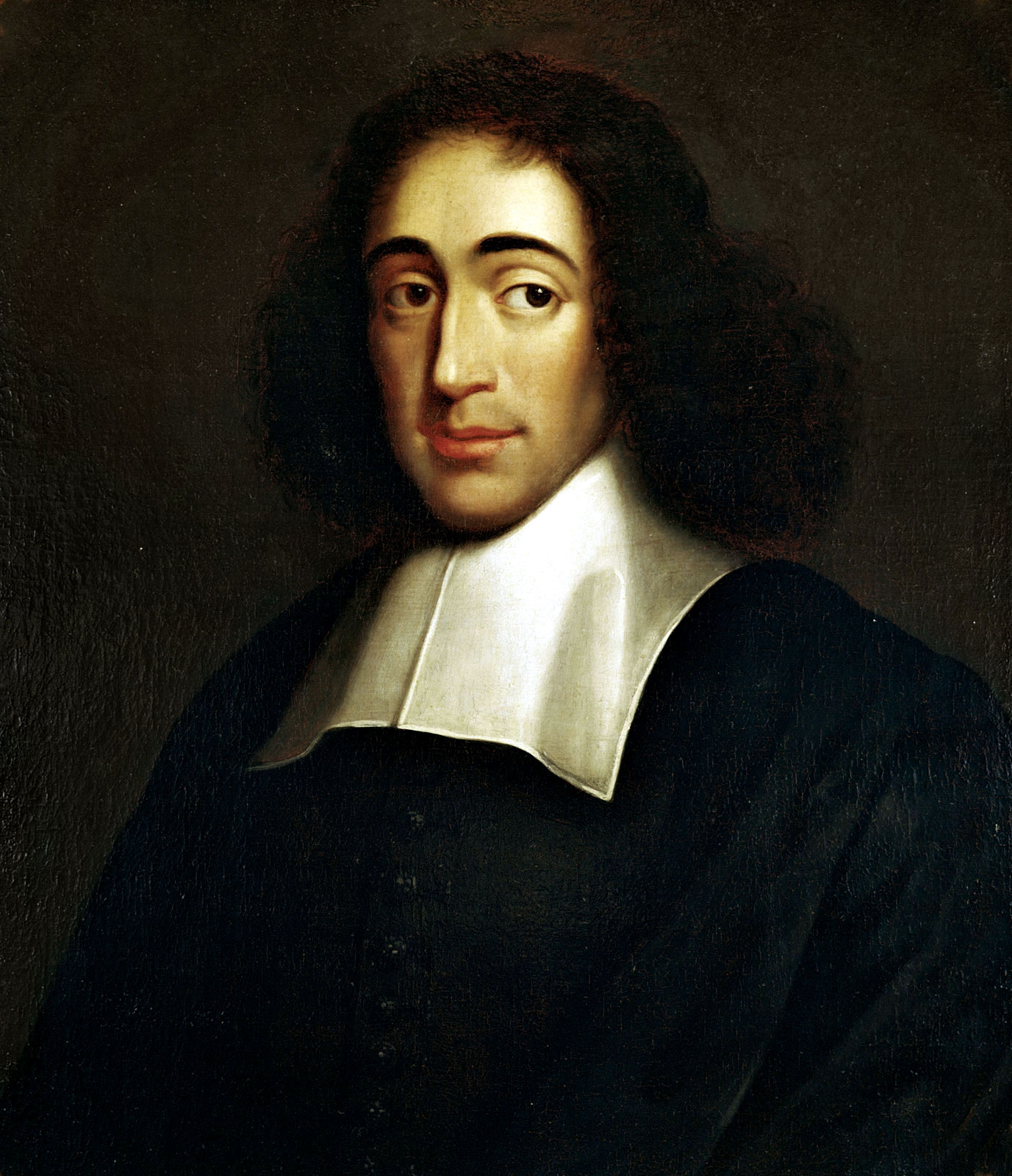
What he wrote was the Ethics, and the first shock is its form. It is laid out like Euclid's geometry: definitions, then axioms, then propositions proved one after another and stamped, like a math problem, with the equivalent of "which was to be demonstrated." Spinoza is going to deduce the nature of God, the mind, the emotions, and human freedom the way Euclid deduces that the angles of a triangle sum to two right angles. It is either the bravest thing anyone ever did in philosophy or the most grandiose, depending on your mood. The engine of the whole construction is the word substance, which here keeps its strict sense: a thing that exists entirely on its own, depending on nothing else to be what it is. Descartes had counted at least two kinds of substance (mind and body) plus God. Spinoza asks the brutal question. If substance is what depends on nothing else, can there really be more than one of it? Two independent substances would have to be limited by each other, each stopping where the other begins, and a thing limited by something outside it is not fully independent after all. Push the and you get his Proposition XIV: "Besides God no substance can be granted or conceived." There is exactly one substance. It depends on nothing, is caused by nothing outside itself, is infinite, and could not fail to exist. And that one substance is God. There is nothing else for it to be. The label for this position is monism (the view that reality is, at bottom, one single thing or one kind of thing), and Spinoza's is the most thoroughgoing version in the Western tradition.
Now the line that made him notorious and, much later, beloved. This one substance, this God, is not a person sitting above the world and running it. It is the world. In the preface to Part IV Spinoza writes of "the eternal and infinite Being, which we call God or Nature." God or Nature: the two words name the same thing. Everything that exists, every star and stone and person and thought, is not a separate creation standing outside God but a way the one substance expresses itself, a ripple in the single infinite stuff. The technical term is that finite things are modes of the one substance, the way a wave is not a separate thing from the ocean but a particular shape the ocean is taking right now. To his contemporaries this looked like atheism dressed up: he had taken the personal God who hears prayers and judges souls and replaced him with impersonal Nature. A century and a half later the Romantics looked at the same sentences and called him a God-intoxicated man, drunk on the divine in everything. The fairest description is neither. Spinoza was a naturalist who put God and Nature in the same equation; whether that makes him the most religious or the least religious philosopher of the era is a question his sentences will not settle for you, and the standard label, pantheist, was actually coined decades after he died.
What the one substance does to Descartes' interaction problem is the payoff. Descartes was stuck because mind and body were two different substances that somehow had to touch. For Spinoza they are not two things at all. The one substance can be conceived under different attributes (fundamental ways of grasping it), of which humans can know two: thought and extension, mind and matter. But these are not two substances; they are two descriptions of the very same thing. Your decision to raise your arm and the physical event in your nerves are not a ghost shoving a machine. They are one and the same event, read once in the language of mind and once in the language of matter. Mind and body never interact for the simple reason that they were never two things to begin with. The problem Elisabeth had sharpened against Descartes does not get solved so much as it gets dissolved.
The price is steep, and Spinoza pays it without flinching. If everything is the one substance unfolding by its own nature, then everything that happens follows necessarily, the way the triangle's angles follow from its definition. There is no free will in the sense of a choice that could have gone otherwise. This is determinism (the view that every event, including every human decision, is the necessary consequence of prior causes, with no genuine alternatives), and Spinoza embraces it fully; you feel free only because you are aware of your desires and ignorant of the causes pushing them. And yet Spinoza insists there is a real freedom worth having, and it is not the freedom to have done otherwise. It is the freedom of acting from your own nature instead of being yanked around by things outside you. The free person is not the uncaused person, who does not exist; it is the person who understands the causes and so acts from understanding rather than from blind reaction. The Ethics ends, strangely for a geometry book, in something like serenity. To grasp things "under the form of eternity," as Elwes renders Spinoza's famous phrase, to see your own small life as a necessary expression of the one infinite substance rather than a string of accidents that might have gone better, is itself a kind of peace, and from it flows what Spinoza calls the intellectual love of God. He died at forty-four of a lung disease, probably worsened by years of breathing glass dust from the lenses, and his friends published the Ethics only after he was safely beyond the reach of anyone it might offend.
Chapter 3
The windowless clocks
"The monads have no windows through which anything may come in or go out."
The other man who took Descartes' method seriously and decided he had stopped too soon reached the opposite conclusion from Spinoza, and from the same starting line. Gottfried Wilhelm Leibniz (1646 to 1716) was the last universal genius in an old sense: a diplomat, a librarian, a mining engineer, a historian, and the co-inventor, independently of Newton, of the calculus (the notation we still use, the elegant dy and the long integral sign, is Leibniz's, not Newton's). In 1676 he visited Spinoza at The Hague and almost certainly read the Ethics in manuscript, and the system he built can be read as a long, polite refusal of everything Spinoza had just concluded. Where Spinoza had one substance, Leibniz would have infinitely many. Where Spinoza had God identical with Nature, Leibniz would have God standing above creation, choosing it.
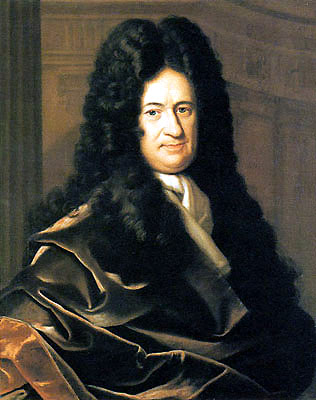
The argument starts with a question about stuff. What is matter ultimately made of? It cannot be made of smaller bits of matter forever, because anything extended, anything that takes up space, can always be divided again, and you never reach a floor. So the real building blocks of reality cannot themselves be extended. Leibniz's answer is that the ultimate constituents of everything are monads: simple substances with no parts, unextended, more like points of perception than like tiny pebbles. A monad is "a simple substance, which goes to make up compounds; by simple, we mean without parts." Everything that looks like a solid object is really an enormous colony of these partless, perceiving units. So far this is just unusual . Then comes the line that makes it strange and beautiful: "The monads have no windows through which anything may come in or go out." Nothing gets into a monad from outside and nothing leaves. Each one is sealed, and unfolds entirely from its own internal nature, like a clock running down a program set at the start. And each monad mirrors the whole universe from its own single point of view, which makes it, in his phrase, "a perpetual living mirror of the universe." (Where Spinoza's one substance makes him the era's great monist, Leibniz's infinity of separate substances makes him its great pluralist; the two rationalists sit at opposite ends of the same question.)
This raises an obvious problem, and the answer is the most charming idea in the era. If no monad can affect any other monad, if every one is a sealed clock running its own program, then how does anything seem to interact? When you decide to raise your arm (a change in your mind, one monad) your arm goes up (a change in your body, a colony of others), and the two track each other perfectly. How, if nothing passes between them? Leibniz's answer is pre-established harmony (his own coined term for it). Imagine two clocks on a wall, keeping perfect time together. You might think one is driving the other, but actually they were simply built and set so precisely at the start that they will agree forever without any connection at all. That, says Leibniz, is mind and body, and indeed every pair of substances in the universe. "The soul follows its own laws, and the body likewise follows its own laws. They are fitted to each other in virtue of the preestablished harmony between all substances." God wound every clock in creation at the first instant so that they would run in eternal, undriven agreement. The interaction problem vanishes a second way: Spinoza dissolved it by making mind and body one thing; Leibniz avoids it by making them two things that never touch but were synchronized in advance. (A third thinker of the era, Nicolas Malebranche, took the problem in yet another direction with his occasionalism, the claim that God directly causes every interaction between mind and body, every time, so that nothing in the world truly causes anything else. Three solutions, three very different universes.)
Underneath all of this runs a single principle Leibniz wields like a crowbar, the principle of sufficient reason: "no fact can be real or existing and no statement true unless it has a sufficient reason why it should be thus and not otherwise." Nothing just is, for no reason. There is always an answer to "why this and not something else," even if we cannot find it. Turned on the biggest question there is (why does anything exist at all, and why this universe rather than some other), that crowbar delivers Leibniz's most famous and infamous answer. There are infinitely many possible worlds in the mind of God, all of them fully worked out, only one of which can be made real. A God who is all-knowing surveys them all, a God who is all-powerful can actualize any of them, and a God who is perfectly good must, having a sufficient reason, choose the best one. So the world that exists is the best of all the worlds that could have existed. The argument does not say nothing in the world is bad. It says this is the best overall arrangement available, the one combining the simplest laws with the richest results, and that a world wholly without the possibility of evil would actually be a poorer world, flatter, with less freedom and fewer goods, than this one.
That is the serious theodicy (the attempt to square a good God with a world full of suffering) that Leibniz worked out at length in his one popular book, the Theodicy of 1710. And it is the argument that got the cruelest reception in the era. In 1755 an earthquake killed tens of thousands in Lisbon on a holy day, in church, and four years later Voltaire published Candide, whose Dr. Pangloss keeps insisting through plague, war, and rape that "all is for the best in the best of all possible worlds." Pangloss is a comic inflation of Leibniz, and "all is for the best in the best of all possible worlds" is Voltaire's line, not Leibniz's; the catchphrase everyone quotes against Leibniz was written by his mocker. The joke is not a refutation. Leibniz's argument engages the Lisbon dead on its own terms (the theodicy is exactly the claim that even appalling suffering can be compatible with a good God who chose the best world available); what Voltaire's wit demands is a different kind of answer than a metaphysical optimum, an answer that meets the corpses where they are, and his refusal to accept the cool calculation as consolation is what made the joke sting and what has given it the last laugh culturally. The disagreement is real, but it is about what an answer to suffering should look like, not about whether Leibniz had an argument. Leibniz died in 1716, his court having largely forgotten him, and his greatest single work, the Monadology, was published only after his death.
The two rationalist poles are worth holding side by side. On the one hand, one infinite God-or-Nature, a single necessary whole in which everything and every choice is a determined ripple, nothing standing outside it, nothing that could have gone otherwise. On the other, an infinity of sealed, windowless clocks, each a private living mirror of the whole, never touching, kept in eternal step only because a loving God wound them all at the first instant and picked this arrangement as the best on offer. Both men started from Descartes. Both used reason alone to try to finish what he left undone. Same inheritance, same method, opposite universes. That is what reason alone, trusted all the way down, turned out to deliver: not one answer but two magnificent and incompatible ones. The thinkers who would test the rationalists' confidence against what experience could actually deliver were about to ask whether reason alone should have been trusted that far in the first place.
Chapter 4
Nasty, brutish, and short
"the life of man, solitary, poore, nasty, brutish, and short."
While the rationalists were rebuilding metaphysics from the inside of a single mind, another set of thinkers turned the same starting move (start from scratch, derive rather than inherit) onto a more dangerous subject: the state, and who has the right to rule it. The two great names here, Thomas Hobbes and John Locke, were both children of the same English catastrophe, the civil wars that killed a king, and they read its lesson in exactly opposite ways. They are usually filed with the empiricists, and that fits: instead of asking what political authority ought to be in some ideal heaven, they ask what it actually is, what bare human beings would do if you stripped the state away. This is the empiricist instinct turned on politics, observe first and theorize second instead of deducing what governments must look like from pure reason. The thought experiment they both run is the state of nature: imagine humans with no government at all, no police, no courts, no shared power above them, and ask what life would be like. Their answers launch modern .
Thomas Hobbes (1588 to 1679) lived ninety-one years and wrote the most frightening political book in the language, Leviathan, in 1651, much of it in exile in Paris while England tore itself apart. Start with what kind of thing he thought a human is. Hobbes was a thoroughgoing materialist: everything that exists is matter in motion, including thought, including you. There is no ghost in the machine because there is no ghost anywhere; the mind is just the body doing what bodies do. That already sets him apart in this era, and the position was brave and contested, not just a warm-up to the politics. To Hobbes, Descartes' mind-body problem was not a hard puzzle but a badly framed question: if there is no immaterial mind in the first place, there is nothing to connect to the body and no seam to find. The whole interaction problem dissolves not by clever metaphysics but by denying one of its terms. Now drop a few thousand of these matter-in-motion creatures onto the earth with no power over them and run the experiment. Each one wants to live and wants the means to go on living. Resources are scarce, everyone is roughly equal in that even the weakest can kill the strongest in his sleep, and no one can trust anyone else not to strike first. The rational thing, for each, is to strike first. The result is "such a warre, as is of every man, against every man," and in it "nothing can be Unjust," because with no common power there is no law and so nothing to break. (Hobbes wrote "every man, against every man." The neat Latin tag "war of all against all" that gets hung on him is a later gloss, not his sentence.) The consequence is the most quoted phrase in political philosophy: in such a condition there is "continuall feare, and danger of violent death; And the life of man, solitary, poore, nasty, brutish, and short."

His solution is the social contract, and his version of it is iron. Since the war of every man against every man is intolerable, rational people agree, each with all the others, to hand over their power to a single sovereign, "that great LEVIATHAN called a COMMON-WEALTH, or STATE," an artificial giant assembled out of all their surrendered wills. The deal is security in exchange for obedience. The contract is among the subjects, who agree with one another to authorize the sovereign; the sovereign himself makes no promise and signs nothing. Once you have authorized him, his power is effectively absolute, because the only alternative to an overwhelming common power is the slide back into the war that the whole arrangement existed to escape. It is easy to read this as a court flatterer's apology for kings, and easy to get it wrong. Hobbes is not defending the divine right of any particular monarch; his sovereign could just as well be a parliament or an assembly. His claim is structural and bleak: almost any stable authority is better than none, because the one thing worse than a bad government is no government, and he had watched no-government up close. You do not have to agree to feel the force of it from a man who wrote in exile while his country bled.
John Locke (1632 to 1704) read the same wars and drew nearly the reverse conclusion, and the two books that carry his answer came out in the same remarkable year, 1689, when he returned to England from his own exile in the wake of a revolution that had just thrown out a king. (His other masterpiece, the Essay on human understanding, came out that year too; the same mind built the politics and the theory of knowledge, and the next chapter is the Essay.) Locke's state of nature is not Hobbes' battlefield. Strip the government away, Locke argues, and you do not get war; you get people in "a state of perfect freedom to order their actions... within the bounds of the law of nature." There is a moral law operating even with no police to enforce it, a law of nature knowable by reason, and its core command is that "no one ought to harm another in his life, health, liberty, or possessions." People have rights before any government exists, not because a state granted them but because they are human. The trouble with the state of nature, for Locke, is not that it is a war but that it is inconvenient: with no shared judge, every man has to defend his own rights and punish his own wrongs, and that gets messy and biased. So people consent to set up a government. The difference that changed the world: for Hobbes the sovereign makes no promise; for Locke the government is a trustee, hired by the people to protect the rights they already had, and bound by the terms of the job. If it turns predator, if it starts attacking the very lives, liberties, and property it was set up to guard, the people may dissolve it and start again. Power flows up from the consent of the people, not down from a sovereign who answers to no one. Locke added one more piece the age badly needed, a Letter Concerning Toleration, also 1689, arguing that the state's power covers civil things only and has no business over souls, because forced belief is not belief at all; you cannot torture a person into genuine faith, so coercion can never serve the religious end it claims. The same year, the same mind: a theory of rights, a theory of consent, and a wall between the magistrate and the conscience.

The social-contract tradition did not end with Locke. Jean-Jacques Rousseau (1712 to 1778) would take it in a more radical direction in The Social Contract of 1762, grounding legitimate authority in what he called the "general will" and carrying the argument toward the French Revolution, which is the next era's story.
One detail the standard textbook portrait of Locke quietly omits. The philosopher of natural liberty was a shareholder in the Royal African Company, the English crown's monopoly on the Atlantic slave trade, and he had a hand in drafting the Fundamental Constitutions of Carolina (1669), a colonial charter that explicitly entrenched hereditary slavery, giving every freeman "absolute power and authority over his negro slaves." The man who wrote that no one may harm another in his life, liberty, or possessions, and that power flows up from the consent of the people, was at the same time an investor in, and a legal architect of, a system that treated certain people as property and asked no one's consent at all. The point is not to catch a hypocrite and move on. It is that "natural rights" and "consent of the people," in Locke's own hands, covered a far narrower set of people than the words suggest, with the enslaved, the indigenous, and others simply outside the circle, and the tension between the theory and its author's conduct is part of the intellectual record, not a footnote to it. It became especially load-bearing a century later: when the American founders borrowed Locke's frame, they borrowed it at the very moment American slavery was expanding, and the same selective reach traveled with it. (A footnote that became a country: Locke's protected triad was "life, liberty, and estate," estate meaning property. When Thomas Jefferson borrowed the frame for the American Declaration in 1776 he swapped the last term for "the pursuit of happiness," and the phrase "consent of the governed" is Jefferson's too, not Locke's, who wrote "consent of the people.")
Chapter 5
White paper
"white paper, void of all characters, without any ideas."
Locke's politics and Locke's theory of knowledge came off the same desk in the same year, and they are the same instinct pointed at two targets: do not start from grand assumptions handed down from above; start from what people actually are, and what they actually experience. The Essay Concerning Human Understanding is the founding document of empiricism, the view that all our knowledge comes from experience rather than being built into the mind in advance. (The empiricists were picking up a method Francis Bacon had named two generations earlier, start from observation, not from first principles; Locke gave it a theory of mind to stand on.) Its opening target is the rationalist confidence we just watched: the idea, running from Plato through Descartes, that the mind comes furnished with some truths it did not learn, knowledge it has a priori. Two pieces of jargon will carry their weight here, so take them one at a time. A priori means knowable by thought alone, before any experience, the way you know all bachelors are unmarried without having to survey any. A posteriori means knowable only through experience, the way you know it is raining by looking out the window. Locke says the mind has no a priori knowledge of the world at all. There is no innate furniture. The mind at birth is blank.
His image for it is famous, and the words everyone quotes are not actually his. The mind, Locke writes, is at first "white paper, void of all characters, without any ideas," and the whole question of the Essay is: "How comes it to be furnished?" His answer, "in one word, from EXPERIENCE." Elsewhere he calls the newborn mind a "yet empty cabinet" that the senses gradually fill. White paper and an empty cabinet: those are Locke's metaphors. The Latin tag tabula rasa (scraped tablet) that gets quoted as if it were his catchphrase appears nowhere in the Essay; it is an ancient phrase, traceable back through Aquinas to Aristotle, that later commentators pinned on Locke. He wrote in plain English about paper and cabinets. Everything that ends up in the cabinet, Locke says, gets in by one of two doors: sensation, the five senses reporting the outer world, and reflection (Locke's own technical term for the mind turning around to watch its own operations, noticing itself remembering, doubting, willing). Out of the simple ideas let in through those two doors, the mind builds everything else. Nothing comes from nowhere.
Then Locke makes the move that the next thinker will turn against him. He divides the qualities of objects into two kinds. Primary qualities are the ones genuinely in the object whether anyone looks or not: its solidity, its extension (the space it takes up), its motion or rest, its number, its shape. These really are out there in the thing. Secondary qualities are different. They are not really in the object as we experience them; they are powers the object has, by way of its primary qualities, to produce certain sensations in us. Color, sound, taste, smell: these live in the meeting between the object and your sense organs, not in the object alone. Locke is blunt about it: the ideas produced in us by secondary qualities "have no resemblance of them at all. There is nothing like our ideas, existing in the bodies themselves." The redness you see is not sitting in the apple waiting for you. The apple has a surface that, lit a certain way, causes the experience of red in a creature built like you; a differently built creature would get something else; in the dark there is no red at all, only the surface. The apple's shape and size, though, stay put whether you look or not. Half the qualities of the world, on Locke's account, are partly contributed by the mind that perceives them.
George Berkeley (1685 to 1753) read that and saw a crack Locke had not noticed he was opening, and he is the most misunderstood figure in the era. Berkeley was an Irish clergyman, later a bishop, who once spent years and much of his own money trying to found a college in Bermuda, waited three years in Rhode Island for a government grant that never came, and went home defeated; he was a serious, practical man, not a crank, and that matters, because his philosophy gets cartooned as the silliest position anyone ever held. The cartoon says Berkeley denied that tables and chairs exist, that he thought the world was a kind of dream, that he ought to have stopped doubting the floor and bumped into a wall to cure himself. That is not his view. Berkeley does not deny that the table exists. He is as sure as you are that he can sit at it. What he denies is something much narrower and much harder to shake off: that the table exists as mind-independent matter, as a chunk of stuff sitting out there in itself, behind and underneath all anyone's experience of it.
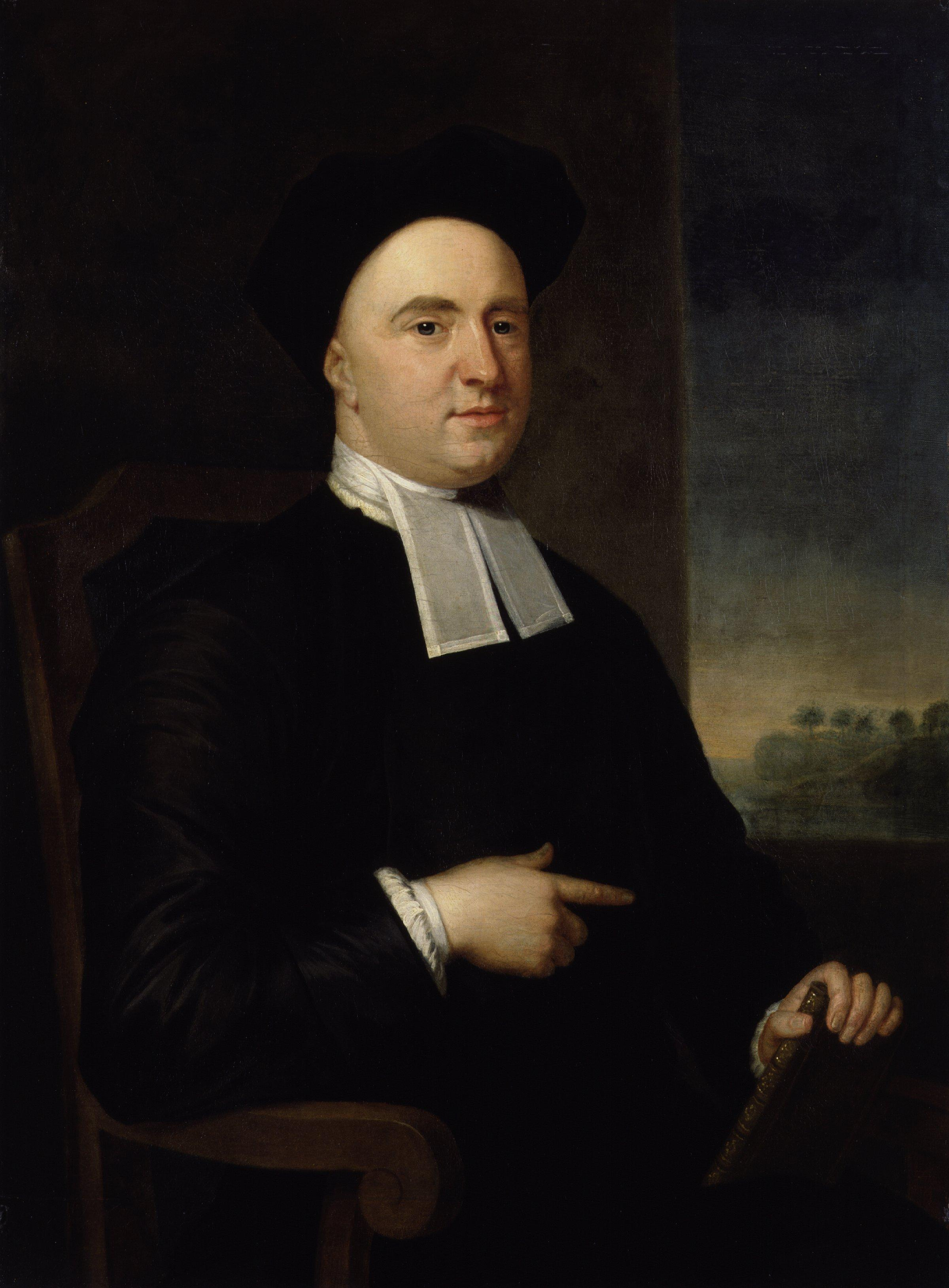
His reasoning is just Locke's empiricism followed one step further than Locke dared. Locke had already granted that secondary qualities, color and sound and taste, exist only in the mind, only in the perceiving. Berkeley asks the obvious next question: why stop there? Look at what you actually have access to when you know an object. After all, you never experience the shape or size of a thing directly: you see it or you feel it, and both seeing and feeling are just more perceptions happening inside your mind. Every primary quality reaches you as an idea in your mind just as much as every secondary one does; you never get at the supposed bare matter directly, only ever at your perceptions of it. So what work is the extra thing, the "mind-independent matter," even doing? It is by definition something you can never perceive, never experience, never have any idea of, because the moment you perceive it you have an idea, which is in a mind. A something-we-can-never-experience, posited behind everything we can: an empiricist, of all people, should be suspicious of that. Berkeley's conclusion is that it is an empty posit, a word doing no work, and he cuts it. What is left is the world of experience, entirely real, made of ideas in minds. His Latin tag, in the Principles of 1710, is "Their ESSE is PERCIPI": their being is their being perceived. The standard English, "to be is to be perceived," is a fair paraphrase though not quite his own words. He even says flatly that "the very notion of what is called MATTER or CORPOREAL SUBSTANCE, involves a contradiction in it." This position, that reality consists entirely of minds and their ideas with no mind-independent matter underneath, is called idealism (which has nothing to do with having high ideals; it is named after ideas, not aspirations) or, in Berkeley's own preferred word, immaterialism. It is the most counterintuitive conclusion in the era and also the most logically airtight follow-through from Locke's own starting point. Note what survives and what does not: the table survives, the chair survives, the tree survives. The metaphysical lump of mind-independent stuff underneath them does not. The common-sense objection (but I walked into the table) Berkeley would happily accept as proving his point: yes, you experienced the table, vividly and against your will; what you did not experience, then or ever, was matter independent of all perceiving. He was not the world's worst reasoner. He was Locke's most rigorous student, taking the empiricist premise all the way to where it actually leads.
One loose end Berkeley had to tie, and it tells you he was not arguing the world winks out when you blink. If a thing exists only in being perceived, what happens to the tree in the quad when everyone leaves? It keeps existing, Berkeley says, because it is always being perceived, by God, whose continuous awareness holds the whole world steady whether or not any human is looking. (A famous comic verse much later put it as a pair of limericks ending "I am always about in the quad, / and that's why the tree / will continue to be, / since observed by, Yours faithfully, God"; the verse is not Berkeley's, but it catches his move exactly.) Whether that argument for God is any good is another matter, and most readers then and since found it more elegant than convincing. What Berkeley had done that genuinely lasted was sharpen a knife. He had shown that if you take seriously the empiricist rule (knowledge comes only from experience, and what we never experience we have no right to assert) then a whole layer of the supposed world, mind-independent matter, falls away. He pointed that knife at matter. The man in the next chapter would pick it up and point it at everything, including the self that holds it.
Chapter 6
The fork
"Reason is, and ought only to be the slave of the passions."
David Hume (1711 to 1776) inherited the whole empiricist line, Locke's and Berkeley's both, and pushed it to a conclusion so clean and so devastating that philosophy has been arguing with him ever since. He wrote his masterpiece young: A Treatise of Human Nature, finished before he was thirty, which, by his own rueful account, "fell dead-born from the press." Nobody read it. He spent the rest of his life recasting its ideas in clearer, more public form, above all in the Enquiry Concerning Human Understanding of 1748, and earning his living and his fame as a historian. He was genial, fat, beloved by his friends, and quietly the most dangerous thinker of the age.

Begin with the tool that does most of the damage, Hume's fork. Everything the human mind can know, Hume says, falls into exactly two bins and no third. The first bin is relations of ideas: truths you can establish by thought alone, by seeing how the ideas connect, with no need to check the world. Mathematics and logic live here. That the angles of a triangle add to a straight line, that all bachelors are unmarried: these are, in his words, "discoverable by the mere operation of thought, without dependence on what is anywhere existent in the universe." Deny one and you contradict yourself. The second bin is matters of fact: everything you know about how the world actually is, and you know it only through experience. That the sun will rise tomorrow, that water boils at a certain heat, that this fire is hot. The mark of a matter of fact is that its opposite is always perfectly conceivable; "the contrary of every matter of fact is still possible," because denying it never lands you in a contradiction. The sun failing to rise is imaginable in a way that a four-sided triangle is not. Two bins, and Hume's whole campaign is to walk the great claims of philosophy and religion up to the fork and ask which bin they go in, because anything that fits neither, that is neither true by pure logic nor established by experience, is not knowledge at all.
The fork's deadliest application is to causation, the glue that seems to hold the whole world together. We think we see causes everywhere: the fire causes the heat, the first billiard ball striking the second causes the second to move. But what any observer actually sees is: the first ball rolls up, it touches the second, the second rolls away. The connection itself, the necessity, the invisible force that makes the second one have to move: that, Hume insists, is never observed. "Motion in the second Billiard-ball is a quite distinct event from motion in the first; nor is there anything in the one to suggest the smallest hint of the other." All you ever observe is one thing, then the other thing, over and over: constant conjunction, never the link. So where does our rock-solid conviction that the one must follow the other come from, if we never see it? Not from reason, Hume answers, and not from the senses, but from custom or habit. "This principle is Custom or Habit": having seen fire followed by heat a thousand times, the mind forms a gentle compulsion to expect heat the next time, and mistakes that internal expectation for a necessity out in the world. Causation, the spine of all science, turns out to rest not on anything we observe or prove but on a mental habit. (Six hundred years earlier, in the faith-and-reason era, al-Ghazālī had made nearly the same observation, that we see the fire and the burning but never the necessity binding them; he concluded the only real cause was God acting each time, while Hume concludes it is a habit of our minds. Same gap spotted, very different things put in it.) This is the problem of induction. Induction is the logical move of drawing a general expectation from particular cases: you have seen fire burn a thousand times, so you conclude fire always burns. It is the engine of nearly all science and all everyday reasoning. The problem is that all such reasoning assumes the future will resemble the past, and that assumption is itself just a matter of fact, which we can only support by appeal to experience, which is the very thing we were trying to justify. The argument bites its own tail. Nothing in pure reason, and nothing in past experience, can prove the sun will rise tomorrow. We believe it from habit, and habit is not proof.
Then Hume turns the same knife on the self, and this is Berkeley's move on matter done to the soul. Everyone assumes there is a stable "I" sitting behind experience, a single perceiver that has the perceptions. Hume goes looking for it. Turn your attention inward and try to catch this self, he says, and all you ever find is a particular perception, a feeling of warmth, a thought, a flicker of color. You never catch the perceiver, only more perceptions. So what we call the self is not a thing that has experiences; it is "nothing but a bundle or collection of different perceptions, which succeed each other with an inconceivable rapidity, and are in a perpetual flux and movement." The mind, he writes, "is a kind of theatre, where several perceptions successively make their appearance." (And he adds, with the honesty that makes him great, that there is no actual theatre, no stage they appear on, just the appearings.) This is the bundle theory of the self: the self is not a container that holds experiences, but the bundled, fast-running stream of experiences themselves, and the unified "I" you were so sure of is a story the mind tells about that stream.
Two more strokes finish the picture, and both keep his name alive. The first is a tiny honest confession against his own system, the missing shade of blue. Here Hume does the bravest thing a system-builder can do, which is point at the hole in his own floor. His master rule is that every idea is a faded copy of some sensory impression you actually had; you cannot have an idea of a color you have never seen. But suppose, he says, a man who has seen every shade of blue except one is shown a chart of blues with that one shade left as a gap. Could he, from the shades on either side, conjure up the missing one in his mind's eye, never having seen it? "I believe there are few but will be of opinion that he can." If so, here is one idea that did not come from an impression, a real exception to his own central law, the whole "knowledge comes only from experience" rule with a hole punched in it. Hume notes it, shrugs that the case is too singular to bother overturning the theory, and moves on. It has bothered philosophers for two and a half centuries. The second stroke is the is/ought gap, and it quietly demolished a whole way of doing . Reading the moralists, Hume says, he keeps noticing the same sleight of hand: an author reasons along for a while about what is the case, about God or human nature or society, and then, "of a sudden," every sentence switches to what ought or ought not to be done, with no account of how he got from the one to the other. But "ought" is a new relation; you cannot squeeze it out of premises that only ever said "is." From facts about how the world is, no conclusion about how it should be follows, not without some further premise that already contains an "ought." Hume did not claim to have closed the gap; he just showed it was there, and moral philosophers have been trying to get across it ever since. Every moral system that claims to read its values straight off the facts of nature has, somewhere, made an illegal crossing.
There is a hard thing to set against all this rigor, and the honest version of Hume cannot skip it, least of all here, beside the is/ought gap. The man who showed that you cannot derive how the world ought to be from how it is did not apply that scruple to the racial prejudices of his own society. In a footnote he added in 1753 to his essay "Of National Characters," Hume wrote that he was "apt to suspect the negroes, and in general all the other species of men... to be naturally inferior to the whites." It is not a reported remark or a private letter; it is a published claim, in print, under his own name, asserting a racial hierarchy as a matter of fact, on exactly the kind of thin evidence his whole philosophy was built to distrust. The philosopher who taught the West to ask what any belief is actually grounded in did not turn that question on this one. Both facts stand together: the rigor and the failure to apply it here.
Which brings us to his most quotable and most misread line, the era's great trap for the lazy reader: "Reason is, and ought only to be the slave of the passions, and can never pretend to any other office than to serve and obey them." This sounds like a celebration of unreason, a manifesto for doing whatever you feel. It is nothing of the kind. Hume's point follows directly from the is/ought gap. Reason, on its own, can tell you what is true and how to get from where you are to where you want to be; what it cannot do is supply the wanting. Reason can tell you that this road leads to the city, but only desire makes you want to reach the city. Our ends, the things we ultimately care about, come from feeling, from the passions; reason is the brilliant servant that works out how to reach them. Calling reason a slave is not contempt for reason. It is a precise claim about its job, and it is the foundation of how most philosophers think about action to this day.
Chapter 7
Commit it then to the flames
"Commit it then to the flames: for it can contain nothing but sophistry and illusion."
Hume's fork, with its two and only two bins, was built to be turned on the biggest claims of all, and he turned it there at the end, mostly on religion, and he did it with a care that is itself part of the philosophy. Followed to its conclusion, the fork's logic is brutal: a claim that is neither a relation of ideas (provable by pure thought) nor a matter of fact (established by experience) is not a piece of knowledge at all, it is just words. And so the Enquiry ends with one of the coldest sentences in philosophy. Pick up any book, Hume says, and ask two questions of it. "Does it contain any abstract reasoning concerning quantity or number?" If no, it is not mathematics or logic. "Does it contain any experimental reasoning concerning matter of fact and existence?" If no, it is not science. "Commit it then to the flames: for it can contain nothing but sophistry and illusion." He is talking about the towers of theology and rationalist metaphysics, the grand systems that claimed to prove, by reason alone, the existence and nature of God and the soul and the deep structure of reality. By the fork, those claims belong to neither bin. There is the bonfire.
It is tempting to read that and call Hume an atheist, and it would be a mistake. Hume never once called himself an atheist, and that was not cowardice; he said plenty of dangerous things in print when he chose, and he could have said this one too. It was honesty about where his own fork left him. The existence of God is a matter of fact, in his terms, a claim about what exists, and so it can only be settled by evidence. Hume's whole life's work was about how thin our evidence really is. He held that the evidence offered for God did not come close to establishing the claim; he did not hold that he had evidence proving the opposite, which would have been the same overreach in the other direction. The honest position, given the fork, was suspension, what he called a mitigated skepticism (mitigated meaning partial: he doubted whether the evidence was good enough, not whether knowledge is possible at all, unlike the ancient Pyrrhonists who doubted everything): not enough to affirm, not enough to deny. Calling him an atheist puts a confidence in his mouth that his own philosophy forbade.
That knife-edge is clearest in his most explosive book, which he was careful never to publish while alive: the Dialogues Concerning Natural Religion, which came out only in 1779, three years after his death. Its target is the design argument, the most persuasive case for God then going, which runs: the world is full of intricate order, an eye, a wing, a solar system, just as a watch is full of intricate order, and a watch needs a designer, so the world needs a Designer too. In the Dialogues a character named Cleanthes makes this case, and a skeptic named Philo takes it apart, and Hume is too careful to say which one speaks for him. The argument is an analogy, world is to watch as Designer is to watchmaker, and an analogy is only as strong as the likeness it rests on. "Surely you will not affirm, that the universe bears such a resemblance to a house, that we can with the same certainty infer a similar cause"; the universe is not very like a watch or a house at all, and the more unlike the two cases are, the weaker the inference from one to the other. We have seen thousands of watches made and know watches have makers; we have seen exactly one universe and never watched one get made, so we have no basis for saying universes are the kind of thing that come from designers. And our sample is hopeless besides: "From observing the growth of a hair, can we learn any thing concerning the generation of a man?" The design argument, Philo shows, is at best a feeble guess dressed up as a proof. Hume lets Philo win on the merits and lets the book end without ever stamping his own name on the verdict. The ambiguity is not evasion. It is the fork applied to himself: about God, he thought, the honest answer was that we do not and cannot know, and he refused to pretend otherwise in either direction. When he died, of a slow cancer, his composure unsettled people who expected a notorious religious skeptic to panic at the end; his friend Adam Smith wrote an admiring public account of how calmly and cheerfully Hume met his death, and the letter caused a small scandal precisely because a happy skeptic was not supposed to be possible.
There is one more person in this era, and the textbooks left her out for the worst of reasons, so we put her back where she belongs, at the bridge to what comes next. Émilie du Châtelet (1706 to 1749) was a French mathematician and physicist, and the standard French edition of Newton's Principia (the book that had laid out the mathematical laws governing how every physical body moves, the most powerful scientific framework the century produced) is still her translation, with her own commentary. But she was no mere translator decorating someone else's work. Newton's physics was a triumph at calculating how bodies move, the most accurate machine for prediction anyone had built. Du Châtelet's claim, in her Institutions de Physique of 1740, was that for all that power it was metaphysically incomplete. Newton can tell you that force equals mass times acceleration, that this law holds here and now and at the next instant and the next, everywhere, without exception. But what entitles you to assume there is a reason it holds rather than not, that the universe will keep playing by lawful rules at all, instant after instant? The calculating machine does not contain its own license. The license, du Châtelet argued, has to come from somewhere deeper, and the place to find it was Leibniz, specifically the principle of sufficient reason from chapter three: nothing is the case for no reason, so there is a reason the world is lawful, and that is what underwrites Newton. There was an obvious objection, and it was the live one of her moment: isn't Newton's staggering predictive success its own sufficient reason, so who needs the metaphysics? Her answer was that prediction tells you that the laws hold, never why there should be laws to hold at all, and a physics that cannot say why is standing on a foundation it has not inspected. Newton tells you the rules of the game; Leibniz is needed to say why there is a game with rules at all.

And she was not only a connector of two men's systems. She reached her own conclusions inside a live scientific fight. The dispute of the day was over what quantity nature conserves when bodies collide, the so-called vis viva or "living force": the Newtonian-Cartesian camp measured it one way (mass times velocity), the Leibnizians another (mass times velocity squared). Du Châtelet sided with the Leibnizians, against the prevailing consensus, and she turned out to be right: the squared quantity is what we now call kinetic energy. That is not synthesis; that is an independent intervention in an open argument, made by a thinker backing her own analysis against the crowd and landing on the answer history kept. She died at forty-two, days after giving birth to her fourth child, having finished the Newton translation in a race against the pregnancy she feared would kill her. She belongs in this story not as a footnote to the men around her but as a thinker who reached her own conclusions, and the bridge she built, Newton's mechanics resting on Leibnizian metaphysics, runs straight into the next era.
What the era settled, measured the same way the faith-and-reason era measured itself at its close, is worth pulling together. It built six magnificent answers and could not choose among them. The rationalists trusted reason to rebuild the world from the inside of a single mind and delivered two glorious, incompatible universes, Spinoza's one God-or-Nature and Leibniz's infinite windowless monads. The empiricists trusted experience to keep reason honest, and the trust ate its own children: Berkeley's empiricism dissolved matter, Hume's dissolved causation and the self and finally the whole project of proving anything beyond experience by reason alone. The era that opened with Descartes confident that a lone mind could doubt its way to a secure foundation closed with Hume showing, politely and devastatingly, that the same lone mind, followed honestly, cannot even prove the sun will rise tomorrow. These were not, for all the textbook lists of solo geniuses, six hermits: they read and argued with each other across the post-offices of Europe, Leibniz calling on Spinoza, Locke soaking up in exile, Elisabeth and Descartes hammering out the interaction problem by letter, and the era's crisis was a shared inheritance, not six private ones. That crisis, and not a resolution, is what everyone could feel at the end.
Across the Channel a German named Immanuel Kant would read Hume, decide that the challenge had to be answered with a completely new architecture rather than waved away, and later write that it was Hume who had jolted him out of his complacency and set his own work going (the next era). And Kant was reading two problems at once, which is exactly where du Châtelet's bridge becomes load-bearing. One was Hume's: how can we know anything about the world beyond what experience hands us, when even causation turns out to be a habit? The other was the one du Châtelet had sharpened: what entitles Newton's mechanics, the most successful science ever built, to assume the world is lawful and ordered all the way down? Kant's whole next move would be to ask how mathematical physics like Newton's is possible at all, given Hume's doubts, and du Châtelet's question, the grounds of Newtonian lawfulness, is precisely half of what he set out to answer. Her bridge and Hume's knife arrive in the same German hands. The era did not solve its question. It sharpened it into a knife and handed the knife forward.