
For about a century, a line of British thinkers built a philosophy out of one stubborn refusal. They refused to believe the mind comes pre-loaded. Where the great continental systems started from ideas the mind was supposed to find already inside itself, and reasoned outward to God and substance and the structure of the world, the empiricists started from the opposite end: a newborn knows nothing, and everything it will ever know has to get in somehow, through the eyes and ears and skin. Knowledge is not deduced from within. It is gathered from without. That is the whole wager, and the strange thing is where it led the people who took it seriously: not to a tidy science of the mind but to a chain of conclusions each more unsettling than the last, ending with a man who could find no good reason to believe in cause and effect.
The claim is best stated plainly before the consequences start. An empiricist holds that all knowledge comes from experience. The mind at birth holds no ideas of its own; it is a blank surface, and the senses write on it. This is the exact denial of the rival doctrine, innate ideas (concepts and truths the mind is supposed to possess by its own nature, not learned from the world, such as the idea of God or of a triangle's properties). The empiricist says there are none. Strip away everything experience supplied and nothing is left, because there was nothing there to begin with. Even the most abstract thought, on this view, is built from raw materials the senses delivered first.
Four thinkers carried the claim, each pushing it further than the last. Thomas Hobbes (1588 to 1679) reduced the whole of the mind to matter moving. John Locke (1632 to 1704) wrote the founding system: the blank slate, the inventory of where ideas come from, and an honest accounting of the limits of what such a mind can know. George Berkeley (1685 to 1753) accepted Locke's premises and drew a conclusion Locke never wanted, that there is no material world at all, only minds and ideas. David Hume (1711 to 1776) took the principle to its sharpest point and turned it on the foundations of knowledge themselves. Same starting claim, four worlds, each more radical than the one before.
And the whole time, this was a quarrel with an opposite number. Across the Channel the rationalists were proving their way to substantial truths by reason alone, from ideas they held the mind possessed on its own. Empiricism is the other half of that argument, the senses-first answer to the reason-first wager, and the collision between the two organized European philosophy until a man in Königsberg decided each side was half right. The empiricist line begins not in a study but in the conviction that the way to know the world is to go out and watch it.
The break
The doctrine empiricism breaks from is the one the read tells in full: that reason, working on ideas it finds within itself, can reach the deepest truths about reality without leaning on the senses. The senses, for a rationalist, are at best a prompt and at worst a liar; the real work of knowing is done from within, because the mind arrives already holding the materials. Descartes found within himself an idea of God he judged the senses could never have supplied. Spinoza unrolled an entire from definitions. Leibniz reasoned from a principle no observation could deliver. The shared assumption underneath all three is that the mind is furnished from the start, and that careful thought can therefore prove substantial conclusions a priori, by reasoning alone.
Empiricism denies the furnishing outright. Its sharpest statement of the break is Locke's, and it is an argument, not a slogan. If the mind held innate ideas, Locke reasoned, everyone would possess them from birth: infants and the untaught would already know the supposed innate truths, and plainly they do not. So the mind at the start is, in his own words, "white paper, void of all characters, without any ideas." Where then does its whole furniture come from? "To this I answer, in one word, from EXPERIENCE." Ideas arrive by two channels and only two: sensation (the senses reporting the outer world) and reflection (the mind noticing its own operations, its perceiving, doubting, willing). Nothing reaches the understanding by any other door. The rationalist's innate idea of God is, for the empiricist, assembled like every other idea, out of materials experience handed in.
The break is a reversal of the source of knowledge: away from the mind reasoning from its own contents, toward the senses delivering everything the mind has to work with. Once that move is made, the tradition becomes a single argument pushed by four temperaments. Hobbes makes the mind matter and nothing else. Locke draws the blank slate and, honestly, marks how little can be built on it. Berkeley presses the principle until the material world drops out. Hume presses it until cause, self, and God drop out too. The starting point never changes. What changes is how much of the inherited world survives once nothing is allowed in except through the senses, and the answer, by the end, is alarmingly little.
Chapter 1
Go out and look
"The other derives axioms from the senses and particulars, rising by a gradual and unbroken ascent, so that it arrives at the most general axioms last of all. This is the true way, but as yet untried."
Empiricism is a child of the Scientific Revolution, and so is its rival, which is why the two define each other. By the early seventeenth century the old physics inherited from Aristotle was visibly failing. The earth had been moved out of the center of the cosmos; new instruments were showing the heavens did not match the textbooks. The question pressing on every serious thinker was where reliable knowledge could now come from, if the authorities everyone had trusted could be that wrong. The rationalists answered: from reason, rebuilding on a foundation reason could certify. The empiricists answered the other way. If the textbooks were wrong, it was because they had been spun out of the head instead of read off the world. The cure was to stop deducing nature and start observing it.
The man who made that cure into a program was Francis Bacon (1561 to 1626), an English lawyer and statesman who rose to Lord Chancellor and fell in a bribery scandal, and who spent his real energy on a plan to remake the whole method of knowing. Bacon is not strictly one of the four empiricists; he came a generation before them and worked out the procedure they would later turn into a theory of the mind. His complaint was with the reigning method, the Aristotelian syllogism, which starts from general principles assumed to be settled and reasons down to particular conclusions. The trouble, Bacon saw, is that the general principles are exactly what no one has checked. Build on an unexamined premise and every conclusion inherits its rot.
His alternative reverses the direction. In the Novum Organum (1620), the "new instrument" meant to replace Aristotle's , Bacon lays out two roads to truth. One starts from the most general axioms, assumed at the outset, and deduces everything downward from them, the road in fashion and, he thought, the road to error. The other works the opposite way, gathering many particular observations and rising slowly from them to general conclusions, reaching the broadest principles last of all. This second road is induction (reasoning from particular cases to a general rule), and Bacon's version is patient and ruthless: collect instances, including the ones that would disprove the guess, and let the regularities that survive that testing become the axioms. The genuinely general principle, on his method, is the destination, never the starting assumption.
Bacon also knew the looking would not be easy, because the mind distorts what it takes in. He catalogued four kinds of standing error, the Idols that corrupt observation: errors built into human nature itself, errors peculiar to one person's upbringing and temperament, errors smuggled in by loose language, and errors inherited from received philosophical systems. The point of naming them was practical. A method that gathers from the senses has to first scrub the lens the senses report through. The whole apparatus is aimed at one conviction, which Bacon turned into a slogan that history compressed into three words, that knowledge is power: understanding nature is the way to command it, and understanding comes by experiment, not by sitting and reasoning from what seems obvious.
Bacon never built a laboratory and never joined a scientific society, because there was none to join; he died in 1626, reportedly after an experiment stuffing a chicken with snow to test whether cold preserved flesh. His real monument came later. In an unfinished tale, the New Atlantis, he imagined a research institute he called Salomon's House, a community of investigators pooling experiments for the public good. When the Royal Society was founded in London in 1660 to pursue knowledge by experiment, its members named Bacon their inspiration and treated Salomon's House as the blueprint. Joseph Wright's air-pump painting, a lecturer working the machine before a rapt family, is that program a century on: knowledge being made, in a room, through the senses. Bacon set the task. The four who follow asked what kind of mind could carry it out, and the answers ran somewhere he never anticipated.
Chapter 2
Matter in motion
"...the life of man, solitary, poore, nasty, brutish, and short."
The first of the four to build a system on experience built it on a flat refusal to admit anything that was not physical. Thomas Hobbes lived ninety-one years, through the English Civil War that shaped everything he wrote, and produced in Leviathan (1651) the most uncompromising of the age. Materialism is the claim that everything that exists is matter, and Hobbes meant it without exception. There are no immaterial souls, no spirits, no incorporeal substances. The universe is bodies, and the changes in the universe are bodies in motion. Whatever is real can be pushed.
Applied to the mind, this dissolves the very problem the rationalists were tying themselves in knots over. For Descartes the hard question was how an unextended thinking thing could move an extended body; the two were different kinds of substance, and the gap between them never closed. Hobbes does not bridge the gap. He denies there are two things. Thought is not a ghost steering a machine; thought is the machine running. Sensation is matter from outside pressing on the matter of the sense organs and setting up motions that continue inward. Imagination is sensation's leftover motion, decaying like a wave after the wind drops. Memory is that same fading motion, recognized as old. The whole inner life, on this account, is the body's own movement felt from inside, which means there is nothing in the mind that did not enter as a push from the world. The empiricist principle falls out of the materialism: if the mind is just the body affected, then experience is the only thing that could ever have furnished it.
Hobbes turned the same materialist eye on human beings together, and the result is the era's bleakest thought experiment. Strip away government, law, and every authority that holds a society together, and what remains is the state of nature: people roughly equal in strength and cunning, each wanting the same scarce things, none able to feel safe. Hobbes reasons that such a condition is not peace but a standing war, not constant fighting but the perpetual readiness for it, since no one can trust anyone not to strike first. He calls it a war "of every man, against every man" (the famous "war of all against all" is a later Latin compression, not his English), and in that war there is no industry, no farming, no building, no knowledge, because nothing can be safely kept. The line everyone remembers is the verdict: "the life of man, solitary, poore, nasty, brutish, and short."
The escape is to manufacture the authority nature does not supply. People agree, each with all the others, to hand their right of self-defense to a single power, a person or an assembly, that will keep the peace by force. That power is the sovereign, and the artificial body it creates is the commonwealth, which Hobbes names in the book's opening: "that great LEVIATHAN called a COMMON-WEALTH, or STATE... is but an Artificiall Man," a giant assembled out of all the people who make it up. The sovereign's authority has to be near-absolute, on Hobbes's argument, not because kings are sacred but because a half-obeyed peacekeeper is no peacekeeper, and the alternative to one is the war that makes life nasty, brutish, and short. The position is easy to read as a defense of tyranny. It is better read as a man who had watched a civil war arguing that almost any settled order beats the collapse into everyone against everyone. He wrote it, fittingly, in exile in Paris, having fled the very disorder his book was built to explain.
Chapter 3
White paper
"Let us then suppose the mind to be, as we say, white paper, void of all characters, without any ideas:—How comes it to be furnished? ... from EXPERIENCE."
If Hobbes supplied the raw materialism, John Locke supplied the system, and he is the founder of empiricism as a worked-out theory of knowledge. A physician and political adviser who spent years in exile and returned to England with William of Orange in 1689, Locke published in that one year the Essay Concerning Human Understanding, the Two Treatises of Government, and a letter arguing for religious toleration. The Essay is the empiricist charter. Its question is deceptively modest: not what exists, but what the human understanding can actually do, how far it reaches, and where it gives out.
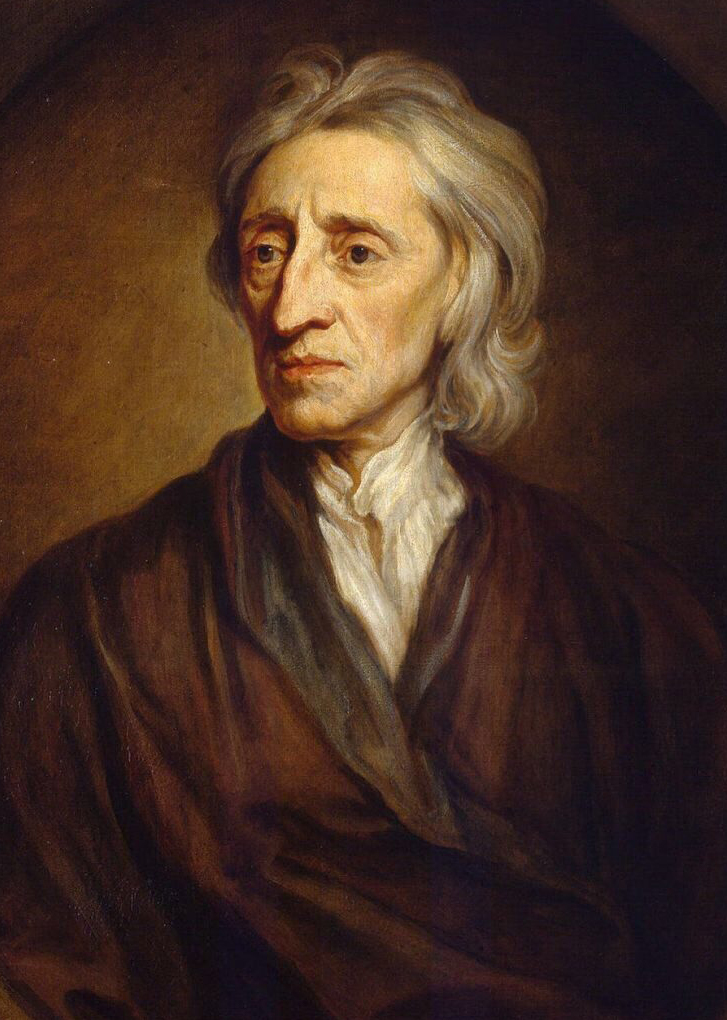
Locke opens by clearing the ground, and the target is innate ideas. The doctrine that the mind comes stocked with certain truths from birth was the rationalist's bedrock; Locke spends the Essay's opening book dismantling it. His argument is direct. If a truth were stamped on the mind from birth, every mind would carry it, and yet children, the uneducated, and people across the world plainly do not all assent to the supposed innate principles. A truth nobody can be shown to hold until they have learned it is not innate; it was acquired. With the innate furniture cleared out, Locke states the founding image. Suppose the mind to be, as he puts it, "white paper, void of all characters, without any ideas." How does it come to be furnished? "To this I answer, in one word, from EXPERIENCE." (This is the doctrine later labeled tabula rasa, the Latin tag for a blank slate, but the Latin phrase is not Locke's; it is an old term applied to him by later writers. His own words are "white paper" and, elsewhere, the "yet empty cabinet" the senses begin to fill.)
Everything the furnished mind contains, Locke argues, came through one of exactly two channels. The first is sensation, the senses reporting the outer world: color through the eyes, sound through the ears, heat and hardness through the skin. The second is reflection, the mind turning to watch its own operations and taking ideas from them, the idea of perceiving, of doubting, of willing, gathered by noticing oneself perceive and doubt and will. Every idea a person has, however lofty or abstract, Locke holds to be either a simple idea delivered raw through one of these two doors or a complex idea the mind assembled by combining, comparing, and abstracting from simple ones. The idea of God, the rationalist's prize specimen of the innate, Locke treats as a constructed idea: take the ideas of existence, knowledge, and power that experience supplies, extend each without limit, and combine them. Nothing entered that the senses or self-observation did not first bring in.
Locke's most consequential analysis concerns which of an object's apparent features really belong to it. He divides them. Primary qualities are inseparable from a body whatever happens to it: "SOLIDITY, EXTENSION, FIGURE, MOTION or REST, and NUMBER," the features it cannot be stripped of even in thought. Secondary qualities are different. Color, sound, taste, and smell are not in the object as the object is in itself; they are powers the object's primary qualities have to produce sensations in a perceiver. Of the ideas these secondary qualities produce, Locke is blunt: they "have no resemblance of them at all. There is nothing like our ideas, existing in the bodies themselves." Consider a ripe apple. Its shape, size, and solidity are in the apple. Its redness is not; redness is what happens when the apple's surface, with its particular texture, throws light into a human eye. A creature built differently would get a different color or none. The apple is really extended and solid; it is not, in itself, really red.
Having built the mind from experience, Locke is honest about how far such a mind can see, and the honesty is the part the textbooks skip. He does not claim the new method delivers certainty about everything. A mind knows its own ideas, and it can know some relations among them with the force of a proof, as in mathematics. But of the real essences of things, the inner constitutions that make a substance what it is, Locke thinks the mind is largely ignorant and likely to remain so, because all it ever receives are the surface qualities, never the hidden machinery producing them. Knowledge, for Locke, is genuine but bounded; much of what a person acts on is not knowledge but reasonable belief, good enough to live by and short of certain. That sober, deliberately limited picture is the founder's settled position, and it set the table for the two who came after and refused to leave the principle where Locke had so carefully parked it.
Chapter 4
The vanishing of matter
"Their ESSE is PERCIPI, nor is it possible they should have any existence out of the minds or thinking things which perceive them."
The next thinker took Locke's own premises and rode them to a conclusion Locke would have refused, and the surprise is that the ride is short and the logic is clean. George Berkeley, an Irish clergyman who became Bishop of Cloyne, published the Principles of Human Knowledge in 1710, at twenty-five. He is routinely treated as the eccentric who denied that the world exists. He denied nothing of the kind. Berkeley is Locke's most rigorous student, and his argument is that Locke stopped one step too soon.
The opening is Locke's secondary qualities. Locke had already granted that color, sound, taste, and smell are not in objects but in the mind, mere ideas produced in a perceiver. Berkeley simply asks why the primary qualities should be treated any differently. Take extension and shape, Locke's specimens of what really belongs to the object. Can a person form an idea of a shape with no color, of an extension that is neither large nor small, fast nor slow, except in relation to some perceiver? Berkeley argues they cannot: the supposedly objective primary qualities are only ever met with bundled together with the secondary ones, in experience, in a mind. If the secondary qualities are mind-dependent, the primary ones, never encountered apart from them, are in the same boat. Locke's own division, pressed, swallows the side Locke meant to keep.
From there Berkeley reaches the heart of it. The empiricist principle says every idea traces to experience. So examine the idea of matter as the philosophers use it, meaning a substance that exists outside all minds and underlies and causes perception. What experience does that idea trace to? None, by its own definition, because anything experienced is a perception, in a mind, and matter is precisely what is supposed to lie beyond all perception. The concept describes something that could never, even in principle, be perceived. Berkeley's verdict is that the notion is not just unknowable but incoherent: "the very notion of what is called MATTER or CORPOREAL SUBSTANCE, involves a contradiction in it," and the absolute existence of unthinking things apart from any perception "seems perfectly unintelligible." There is no work for matter to do and no experience it answers to, so it should be struck out.
What is left when matter goes is the doctrine Berkeley is famous for, and it has a name: , or in his case immaterialism, the view that reality consists only of minds and the ideas in them, with no mind-independent material stuff underneath. Its slogan is the Latin tag, his own in a half-Latin half-English form, esse est percipi: to be is to be perceived. "Their ESSE is PERCIPI, nor is it possible they should have any existence out of the minds or thinking things which perceive them." Crucially, this is not the claim that nothing exists, and Berkeley is at pains to say so. The table, the tree, the apple are all perfectly real; they are exactly the rich bundles of color, shape, smell, and solidity that experience presents. What Berkeley deletes is only the imagined extra thing behind the experience, the unperceivable matter. A man who walks into a table has run into a real table, a vivid stubborn cluster of ideas. He has not run into mind-independent matter, because he never experiences any such thing.
One obvious objection threatens to sink the whole view, and Berkeley's answer is the system's keystone. If to be is to be perceived, does the tree wink out of existence the moment no one is looking at it? It would, if human minds were the only perceivers. They are not. The tree continues, Berkeley argues, because it is continuously perceived by the mind of God, who holds the whole world in being by always perceiving it. The orderliness and independence of nature, the fact that the world does not bend to anyone's wishes and behaves by steady laws, is for Berkeley the surest sign of that constant divine perceiver. So the empiricist principle, followed without flinching, does not end in chaos. It ends with the material world dissolved into ideas and a God required to keep those ideas steady. Locke's blank slate, taken at its word, had quietly abolished matter.
Chapter 5
The end of the line
"Motion in the second Billiard-ball is a quite distinct event from motion in the first; nor is there anything in the one to suggest the smallest hint of the other."
David Hume took the empiricist principle to the end of the line, and what he found there was not a tidier science of the mind but the demolition of nearly everything thought had been resting on. A Scot who published the vast Treatise of Human Nature in his twenties (it "fell dead-born from the press," he later wrote, and he recast its core as the sharper Enquiry of 1748), Hume is the most consistent empiricist of the four. His rule is simple and merciless: every genuine idea must trace back to an impression, some actual experience it copies. Any idea that cannot be traced to an experience is no real idea at all, just a word with nothing behind it. He turns this rule on the concepts philosophy had treated as load-bearing, and one by one they fail the test.

The first and most damaging casualty is causation, the very glue the new experimental science depended on. Everyone believes causes produce their effects by some necessary power: fire makes heat, one billiard ball striking a second makes it move. But run the empiricist test. What is actually experienced when one ball hits another? Only that the first moves, then they touch, then the second moves. The supposed power, the necessary connection by which the first compels the second, is nowhere in the experience. "Motion in the second Billiard-ball is a quite distinct event from motion in the first; nor is there anything in the one to suggest the smallest hint of the other." All anyone ever observes is constant conjunction (two kinds of event regularly following one another), never the necessity itself. So where does the rock-solid conviction that the second ball must move come from? From the mind, not the world: "This principle is Custom or Habit." Having seen the sequence a thousand times, the mind forms a settled expectation and projects it onto the world as a necessity out there. The necessary connection at the root of all reasoning about matters of fact turns out to be a feeling produced by repetition.
This opens what later philosophers named the problem of induction, and it cuts at science itself. Every prediction about the future, every law drawn from observation, assumes that the patterns that have held will keep holding, that the future will resemble the past. Hume asks what justifies that assumption. Not reason, since a world where the patterns suddenly broke is perfectly conceivable and implies no contradiction. Not experience, since experience only ever reports what has happened so far, and to argue that past regularities are a good guide to future ones because they have been a good guide so far is to assume the very thing in question. The bridge from observed cases to a general law, the move at the heart of Bacon's whole method in the opening chapter, has no foundation in logic at all. It rests on habit, and habit alone.
Hume turns the same test inward and the self dissolves too. People assume a single continuing self that owns all their experiences, a stable inner perceiver. Hume applies his test: what impression does the idea of the self trace to? Any attempt to pin it down finds not a bare perceiver but only particular perceptions: a sensation, a feeling, a thought, then another. There is no impression of the perceiver as such, only the parade of things perceived. So the self is not a thing that has experiences; it is, in his words, "nothing but a bundle or collection of different perceptions, which succeed each other with an inconceivable rapidity, and are in a perpetual flux and movement." The unified self, like the necessary cause, turns out to be something the mind supplies rather than something experience contains.
The same blade falls on religion, and here Hume cuts carefully. On miracles, his principle is that a wise person proportions belief to evidence, and a miracle is by definition the least likely kind of event, so "no testimony is sufficient to establish a miracle, unless the testimony be of such a kind, that its falsehood would be more miraculous, than the fact, which it endeavours to establish," a bar testimony almost never clears. On the argument that the order of the world proves a designer, Hume's Dialogues Concerning Natural Religion, held back until after his death, lets a skeptical voice take the inference apart: the universe is not enough like a made object to license the conclusion, and from a single case there is no second world to compare it to. Through all of it Hume never called himself an atheist, and that was not cowardice; by his own fork the existence of God is a matter of fact, decidable only by evidence, and he judged the evidence inconclusive either way. He kept his own verdict offstage on principle. The man who could find no necessary cause and no continuing self would not claim a certainty he had spent his life showing the senses could not deliver.
Chapter 6
What the senses won
"...the suggestion of David Hume was the very thing, which many years ago first interrupted my dogmatic slumber."
Empiricism reads, by the end of Hume, like a tradition that argued itself into a corner, and in one sense it did. But that is only the philosophers' ledger. In the world outside the study, the senses-first program won so completely that its victory became invisible. Bacon's method, gathering particulars, testing against the instances that would disprove a guess, rising to general laws only after the evidence forced them, is simply how science came to be done. The Royal Society institutionalized it; the air pump in the painting is it in action. The conviction that knowledge of nature is earned by observation and experiment, not spun from first principles, is the empiricist conviction, and it is now so much the common sense of the modern world that no one thinks to call it a philosophy. On the ground, empiricism did not collapse. It won.
The collapse was confined to the foundations, and even there it was less a defeat than a detonation that forced the next advance. Hume had shown that the principle, followed honestly, could not justify the causal reasoning science runs on, could find no continuing self, and could not certify the inherited proofs of God. That was an intolerable result, because the science plainly worked. Something had to give, and the something turned out to be the framing of the whole question.
The man who reframed it was Immanuel Kant, raised inside the rival rationalist school and confident, until he read Hume, that reason on its own could establish substantial truths about the world. Hume broke that confidence. As Kant put it, looking back, the encounter "interrupted my dogmatic slumber" and turned his thinking in a new direction. (The line is Kant's own, written about himself, about what Hume's argument did to Kant; it is constantly misremembered as something Hume said, which it is not.) The crisis Hume left was the engine of Kant's answer. If the senses alone cannot supply the necessity that causation and science require, and pure reason alone cannot reach the world either, then perhaps knowledge is the joint product of both: experience supplying the raw material, the mind supplying the forms, including cause itself, that organize it into a world the mind can know. That settlement, the subject of the next era, keeps the empiricist insight that all knowledge of the world begins in experience while rescuing the necessity Hume had dissolved.
That is the shape of the whole tradition in one line. Empiricism started from a single homely claim, that the mind begins empty and the senses fill it, and pursued it with a consistency that is almost a kind of courage, refusing to stop where the conclusions turned uncomfortable. Hobbes made the mind matter. Locke drew the blank slate and marked its limits. Berkeley followed the principle until matter itself was gone. Hume followed it until cause, self, and certainty went too. Each step was a faithful application of the one idea, and the idea, taken all the way down, ended by undermining the knowledge it set out to secure. It took a thinker from the opposing camp to build something stable out of the wreckage, and even he built it on the empiricist's first stone: that whatever the mind knows of the world, it knows because the world first reached it through the senses.