
Most schools of philosophy are a person and their pupils: a generation or two, a set of doctrines, a slow fade as the next thing arrives. Platonism is not that. It is the longest continuous argument in Western thought, running from a grove outside Athens in the fourth century BCE to seminar rooms in the philosophy of mathematics today, and the strange thing about it is that the people carrying it forward kept disagreeing, violently, about what it actually said. Plato's own school spent two centuries arguing that Plato was wrong. Christian theologians built their God out of a pagan's . A fifteenth-century scholar gave Europe back a Plato it had not read in a thousand years. And in the twentieth century, mathematicians who had never thought of themselves as Plato's heirs found they were defending his oldest claim in a new dialect.
Underneath all of it sits one idea, and it is best stated bare before the costume changes begin. Plato (around 428 to 347 BCE) argued that the physical world (the world of things the senses report, things that come and go and decay and look different from different angles) is not the most real thing there is. Behind it, more real than it, lies an intelligible order: the Forms, eternal and unchanging patterns that the things of the senses only imperfectly copy. Beautiful things fade; Beauty itself does not. The Forms are not visible; they are grasped by the intellect alone. That is the whole seed, and everything that follows is a variation on it.
The conviction has a shape that made it durable: it splits reality into two levels and puts the truer one out of reach of the eyes. That move can be made by a pagan or a Christian, a mystic or a logician, and it has been made by all of them. The vocabulary changes completely (Forms, then thoughts in the mind of God, then the One beyond being, then divine ideas, then abstract mathematical objects) but the underlying claim is constant: there is a level of reality accessible only to the mind, more fundamental than what the senses report, and it is the source of truth.
So this is not a biography and not a single system. It is the life story of an idea: where it was born, who attacked it, who rescued it, what it cost to carry it, and why, twenty-four centuries on, the question Plato asked is still the one being argued. The philosopher and mathematician Alfred North Whitehead would one day put the whole thing in a single sentence that has never stopped being quoted: that all of European philosophy is a series of footnotes to Plato. It starts with what made the original idea so radical that the rest of philosophy could not leave it alone.
The break
The Forms are an answer to a genuine deadlock, not a fantasy invented for its own sake. Two earlier thinkers had argued the Greek world into a corner. Heraclitus held that everything is in flux (no one can step into the same river twice, because the river is never the same river) and if everything is always changing, then there is nothing stable to know, and knowledge is impossible. Parmenides argued the reverse: change is literally inconceivable, because for something to change it would have to come from what is not, which is nothing, and nothing cannot give rise to anything; so only unchanging Being is real, and the senses, which show us a world of change, are simply lying to us. Both arguments were strong. Together they left knowledge looking either impossible or unavailable, and the Sophists drew the obvious lesson: if nothing can really be known, then wisdom is just persuasion, and the clever talker wins.
Plato's move is to say that both sides are right, about different levels of reality. There is a level at which Heraclitus is correct: the world of the senses really is in flux, where beautiful things bloom and rot and the same thing looks fair from one angle and foul from another. And there is a level at which Parmenides is correct: the world of the Forms, where Beauty itself is changeless, eternal, and perfectly what it is. The sensible world participates in the Forms (beautiful things are beautiful by sharing, imperfectly, in Beauty itself) but it is the dimmer, dependent, copy-like level. Knowledge is possible after all, because there is something unchanging to know; it is just not knowledge of the shifting world the eyes report. It is knowledge of the Forms, reached by the intellect. The highest of them, the one that makes all the others knowable, Plato called the Form of the Good, and he placed it, in a famous phrase, beyond being itself, the source of being and intelligibility for everything else.
That is the break, and naming it precisely matters, because the whole tradition is a series of moves made on this one board. The break is a two-level reality: a visible world that changes and an intelligible world that does not, with the truer level invisible to the senses and accessible only to the mind. Every figure who follows inherits that board and rearranges the pieces. The Forms will be relocated into the mind of God; demoted below an even higher principle; turned into the interior of the Christian soul; lost, recovered, and re-translated; and finally re-described as the abstract objects of mathematics. The board never changes. What dies and is reborn, over and over, is the conviction that there is a real order the eyes cannot see, and that getting to it is the point of thinking at all.
Chapter 1
The school that turned against its founder
"...the good may be said to be not only the author of knowledge to all things known, but of their being and essence, and yet the good is not essence, but far exceeds essence in dignity and power."
The institution comes first, because the tradition's first surprise is what happened to the school Plato built. In the 380s BCE, by the usual reckoning, Plato established a community of inquiry in a grove sacred to the hero Academus, northwest of Athens. The grove gave it its name: the Academy. It was not a university in any modern sense (no degrees, no fixed curriculum we can reconstruct, no lecture timetable) but a gathering of people who came to think together, and it became the most important center of philosophy in the ancient world. In one form or another, an institution called the Academy would exist for roughly nine hundred years, until a Roman emperor shut it down in 529 CE. (That span had a major gap in the middle and ran through two distinct phases, which is the honest shape of the famous nine-century claim.)
Plato died in 347 BCE, and the leadership passed first to his nephew Speusippus, who promptly rejected the Theory of Forms (the two-level picture from the opening) while keeping Plato's interest in mathematical objects as the deep structure of reality. After him came Xenocrates, who re-systematized the doctrine and is credited with a move that will matter enormously several chapters from now: identifying the Forms as thoughts in the mind of God rather than free-floating abstractions. Already, in the first generation, the school is improvising on its founder, keeping some of him, dropping some, planting seeds whose flowering is centuries off. None of that is the surprise. The surprise comes around 266 BCE.
In that year a man named Arcesilaus became head of the Academy, and he turned Plato's own school into the most rigorous engine of doubt in antiquity. His target was the Stoics, the rival school that held some sense-impressions to be self-certifying, so vivid and clear that they guarantee their own truth and can ground real knowledge. Arcesilaus argued that no impression is reliable in that way; for any convincing impression an equally convincing false one can be imagined. The only honest response is epochē (eh-poh-KAY), the suspension of judgment, withholding assent rather than claiming to know. And he applied this even to Plato's own positive doctrine. The Forms as objects of genuine knowledge went into the suspension along with everything else. The man who inherited Plato's chair concluded that even the Forms Plato had posited as the one thing truly knowable could not be known.
This is the Skeptical Academy, and it held the field for roughly a century and three quarters. Arcesilaus's great successor, Carneades (around 214 to 129 BCE), deepened it and gave it a practical edge: certainty is unavailable, he agreed, but some impressions are more plausible than others, and degrees of plausibility can guide action even when knowledge is out of reach. He graded them (an impression that merely seems true, one that seems true and is uncontradicted by related impressions, one that has also been thoroughly tested) and built a working theory of reasonable belief on a foundation of confessed uncertainty. He was also a spectacular performer. Sent to Rome on an embassy in 155 BCE, Carneades gave a brilliant speech for justice one day and an equally brilliant speech against it the next, demonstrating that he could argue any side with equal force. The Roman authorities were alarmed enough that Cato the Elder reportedly pushed to get the philosophers out of the city before they corrupted the young any further.
The skeptical phase ended around 90 BCE, when Antiochus of Ascalon took over and declared the experiment finished. The Academy, he argued, should return to positive doctrine, a synthesis of Plato, Aristotle, and the Stoics treated as fundamentally in harmony. His pupil Cicero is our main witness to all of it. With Antiochus, the door reopens to dogmatic Platonism, and the next chapter walks through it. But the irony of the skeptical centuries is the tradition's first proof of its own strength. The school founded to prove that the intelligible order is real and knowable spent its middle life arguing the opposite, and the conviction survived anyway, outlasting its own institution's sustained attack. An idea that can take that kind of fire from its own house and still be standing afterward is an idea with deep roots.
Chapter 2
The Forms move into the mind of God
"What is Plato but Moses speaking Attic Greek?"
When the Academy gave up , the Platonism that came back was not the same as the one that had gone in. Over the next few centuries (the period scholars call Middle Platonism, running roughly from 130 BCE into the third century CE) the tradition was re-dogmatized and, crucially, made religious. The cool metaphysics of the Forms was overlaid with theology, and one move above all the others reshaped everything that followed: the Forms stopped being free-standing abstractions and became the eternal thoughts in the mind of a single divine being. This is the hinge on which the whole later history turns. Without it, there is no Christian Platonism, and the line from a pagan grove to a Christian cathedral does not get drawn.
Plato had left something on the table. In his dialogue the Timaeus, the world is made by a divine craftsman (the Demiurge, DEM-ee-urj) who looks at the Forms as a builder looks at a blueprint and shapes matter to match them. But the Forms in that picture are separate from the craftsman; he consults them, he did not make them, and they would be there whether or not anyone thought about them. Middle Platonism closed that gap. The Forms, it argued, are not blueprints lying around outside God's mind for him to copy. They are his thinking. They are the eternal contents of the divine intellect, the patterns God has in mind because they are what God's mind is. God does not look at a plan he did not draw; the plan is his own thought.
The figures who made these moves were a varied set. Plutarch of Chaeronea (better known now for his Parallel Lives, the biographies) was also a serious Platonist who emphasized the goal of becoming like God and described a cosmos governed by a rational divine principle in tension with a disruptive irrational one. Alcinous, author of a surviving Handbook of Platonism that is the closest thing the ancient world produced to an introduction-to-Plato, laid out the First God as a transcendent intellect reached by what later writers called negative theology: the method of approaching God not by saying what he is, since no human word fits him, but by saying what he is not, by analogy, and by climbing toward the highest. The method strips away every limited description until what is left is beyond all of them. And he stated the Forms-as-divine-thoughts doctrine plainly: the Ideas are the eternal concepts in the mind of God.
The boldest of them was Numenius of Apamea, working around the middle of the second century CE, who pushed Platonism toward full theology with a triad of divine principles: a First God at rest and concerned only with the intelligible realm, a second who creates and orders matter, and a third bound up with the world itself. That three-level structure points straight ahead to the next chapter's system. Numenius is also the source of the line in this chapter's epigraph, and it is constantly quoted out of shape, so its real sense bears spelling out. What is Plato but Moses speaking Attic Greek? This is not a pagan dazzled into surrender by Hebrew scripture, ranking Moses above Plato. It is a claim of convergence. Numenius had read the Jewish scriptures and recognized in them (in the divine name from Exodus, the God who says "I am that I am") the same first principle Plato was pointing at: Being itself, the intelligible source of all that is. Greek philosophy and Hebrew revelation, on his reading, were two roads to one summit. That conviction, that the philosophers and the religious traditions are all describing the same hidden order, will return in force in the Renaissance.
The throughline at this stage is a relocation. Plato's Forms had been out there: eternal, impersonal, public, the same for anyone whose mind could reach them. Middle Platonism moved them into a divine mind, made them the thoughts of a God, and in doing so made the whole apparatus compatible with monotheism. The intelligible order is still the truer level of reality, still grasped by the intellect and not the senses. But now it has an owner. It is somebody's thinking. That single adjustment is what allowed the most relentlessly intellectual product of pagan Greece to be carried, intact, into the heart of a religion that had not yet been born when Plato died.
Chapter 3
Plotinus and the flight of the Alone
"And this is the life of the Gods, and of Godlike men, a life without love of the world, a flight of the Alone to the Alone."
The most powerful version of the whole tradition arrives with one man in third-century Rome, and it is the version that radicalized Platonism past anything Plato wrote. Modern scholars call this radicalized version Neoplatonism: Plato's two worlds rebuilt as a single source overflowing into everything, with a program for the soul to climb back up to it. (The "neo" is the scholars'; the people doing it just called it Platonism.) Its founder is Plotinus. What he built was a complete map of reality: a hierarchy of being that overflows from a single, absolutely simple source, and a program by which a human soul can climb back up that hierarchy to its origin. It is metaphysics and spiritual discipline at once, and it set the terms for mystical thought in three religions.
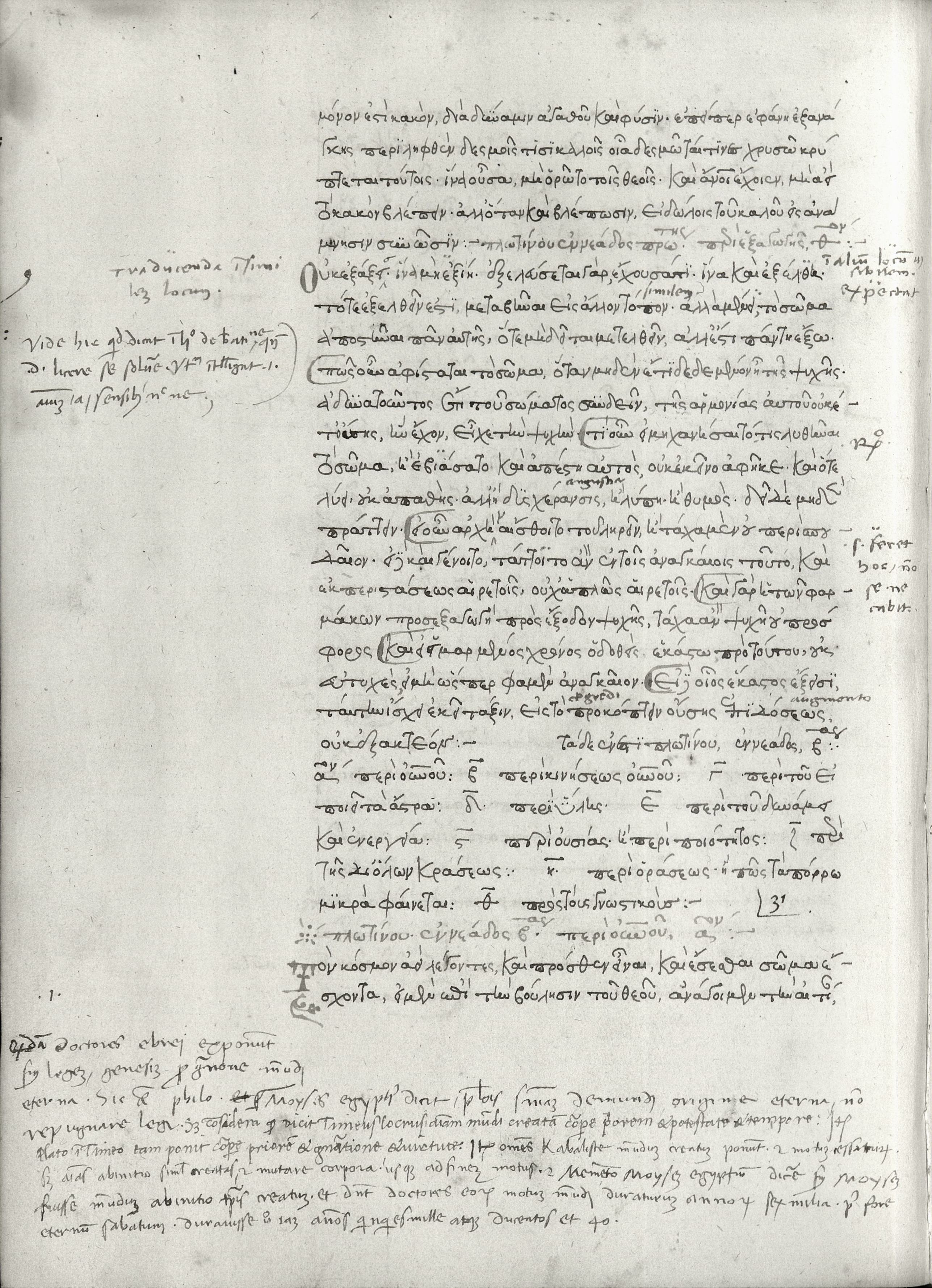
The life, as Porphyry tells it, is sparse and a little legendary. Plotinus was born around 204 or 205 CE in Lycopolis, in Roman Egypt. At twenty-eight, hungry for philosophy, he found his teacher in Alexandria, a near-mythical figure named Ammonius Saccas, who wrote nothing and taught a circle of important students for some eleven years. Wanting to learn the philosophy of Persia and India, Plotinus joined a Roman military campaign heading east in 243; it collapsed when the emperor was murdered, and Plotinus made his way instead to Rome, arriving around 245. There he stayed for the rest of his life, teaching for roughly twenty-five years to a circle that included senators and even the emperor. He wrote nothing for his first decade in Rome, then produced fifty-four treatises in his last seventeen years. He died around 270. His pupil Porphyry later collected and edited those treatises into six books of nine each, which is why they are called the Enneads, from the Greek ennea, nine.
The system rests on three fundamental levels of reality, which Plotinus calls hypostases (hy-PAH-stuh-seez), a Greek word for a genuine, substantial level of being, not a metaphor or a way of speaking but an actual rung reality is built out of. There are three, each flowing from the one above it. At the top is the One, the single most important and most-mangled point in the chapter. The image that holds it is the sun: the One pours reality out the way the sun pours light, without deciding to, simply because of what it is. It is the absolutely simple source of everything, and it is beyond being, beyond mind, beyond any quality that could be named. There is no saying what it is, only what it is not, because to attribute anything to it positively would already be to make it more than perfectly one. It does not think; thinking needs a thinker and a thing thought, which is two, and the One is not two. It does not will, does not plan, does not love the world. It is tempting to call it God, and the temptation is a trap: this is not a personal deity in any theistic sense, not a being who knows or cares about anyone. It is the impersonal ground of all being, the radicalized Form of the Good, no longer the highest Form within reality, but the source of reality itself.
Below the One is Intellect, or Nous (rhymes with "house"), the divine Mind, the first thing that overflows from the One. This is the level of the Forms. Here, finally, is where Plato's Forms have ended up in Plotinus's architecture: not at the top, but one rung down, as the objects of a divine intellect that thinks them and, in thinking them, is them. The Nous is where Being and Thinking are one and the same. And one rung below that is Soul, which overflows from Intellect in turn, Soul with a higher face turned up in contemplation of the Nous and a lower face turned down toward the material world, which it animates. Individual human souls are pieces of this. The body is the bottom rung, not a prison exactly but a dimming, a darkening of the soul's original light.
The key word for how reality descends through these levels is emanation, and it is deliberately not creation. The One does not decide to make anything; it does not choose, because choosing would be an act and the One is beyond acts. Reality overflows from it the way light radiates from the sun or heat from a fire, not as a deliberate gift but as the natural overflow of something so full it cannot help but spill. Plotinus's own image is that the One, in its superabundance, overflows, and its excess begets something other than itself. And the overflow is not a story about a moment in time. There was no point when the One existed alone and then started emanating; the three levels depend on one another timelessly, the way a conclusion depends on its premises. The "descent" from the One into matter is a relationship between levels of reality, not an event in history.
What makes this a religion as much as a metaphysics is that the hierarchy runs both ways. If the soul flowed down from the One through Intellect, it can also climb back up. This is the famous ascent: the soul turning away from the scattered, sensible world, withdrawing into itself, rising through contemplation toward Intellect and the Forms, and finally, in rare moments Plotinus claims to have reached only a handful of times, beyond even Intellect, to a wordless union with the One. The Enneads end on that note. In Stephen MacKenna's translation, the life of the godlike is "a flight of the Alone to the Alone," the solitary soul rising to the solitary source, every intermediary stripped away. (The line circulates in a shortened, garbled form online; the real sentence is the fuller one in the epigraph.) Plotinus also wrote with unusual feeling about beauty as the first rung of that ladder: beauty reaches us first through the eyes, he says, but there is beauty for the hearing too, in music and in words, and beauty in conduct and character and the pursuits of the mind, and "all the loveliness of this world comes by communion in Ideal-Form." Beautiful things are beautiful because the Form has entered them. The ascent begins by following beauty home to its source.
Plotinus's successors pushed the tradition further into religion. Porphyry, besides saving the Enneads, wrote an introduction to Aristotle's that became the standard textbook of the Latin Middle Ages and launched a thousand years of debate about universals. Iamblichus, a generation later, made a fateful turn: he argued that contemplation alone could not lift a soul that had fallen so far into matter, and that ritual (theurgy, literally "god-work": prescribed rites, invocations, and the use of consecrated symbols and objects, believed to draw divine power down and lift the soul up) was necessary to begin the ascent from below. Platonism, with Iamblichus, becomes inseparable from religious practice. And Proclus, in the fifth century, the last great pagan systematizer and head of the Athenian school for nearly fifty years, refined the whole emanation scheme into hundreds of rigorously proved propositions and gave it the triple rhythm that everything in reality follows: it remains in its source, proceeds out from it, and returns toward it. Proclus matters enormously for what comes next, because his Neoplatonism is about to be smuggled, almost wholesale, into Christianity by a forger.
Chapter 4
Plato baptized
"...we prefer these to all other philosophers, and confess that they approach nearest to us."
In the fourth and fifth centuries CE the tradition crosses a line it never fully recrosses: pagan Platonism becomes the intellectual scaffolding of Christianity. The figure at the center of that crossing is Augustine of Hippo (354 to 430), who has his own deep read elsewhere in this collection, so here he gets only the beat that belongs to this story, which is what he did with Plotinus. As a young, brilliant, restless man casting about for a philosophy he could respect, Augustine was handed, in his own words, "certain books of the Platonists, translated from Greek into Latin," almost certainly the Enneads of Plotinus and works of Porphyry, as scholars have argued. They cracked him open. They taught him the one thing his materialist imagination had never been able to grasp: that something can be supremely real without being made of any stuff, that God need not be a body, that there is a level of reality the senses cannot touch.
What Augustine did next is the move that defines Christian Platonism. He took the intelligible order (the realm of the Forms, the divine ideas) and re-described it as the interior of God and, crucially, as something the soul reaches by turning inward rather than gazing outward and upward. The Forms become the eternal reasons, the rational patterns of creation, held in the mind of God. They are not independent of God, and they are not Plotinus's Intellect sitting one rung below an impersonal One. They are the very content of the personal God's own thought. And the climb to them is turned around. Where Plato had sent the mind out of the cave and up toward an external realm, Augustine says: go in. The truth is found in the interior of the soul, where God's light illuminates it. The Platonic ascent to the Forms becomes the Christian soul's ascent to God, run inward instead of upward.
Augustine was clear-eyed about how much he owed the pagans and exactly where they stopped short. In the City of God he says of the Platonists that "we prefer these to all other philosophers, and confess that they approach nearest to us," and that Plato "defined the wise man as one who imitates, knows, loves this God, and who is rendered blessed through fellowship with Him." That is as warm an endorsement as a Church father ever gave a pagan. But he also marked the wall. Reading the Platonists, he found the eternal Word, God as the source of all things, what philosophy could reach by intellect. What he did not find in them was the Word made flesh, God descending into matter and a particular human life. Philosophy, even at its best, could climb toward the divine; it could not, in his view, reach the Incarnation. The Platonists showed him the country from a distance and could not bring him into it.
Two more figures complete the Christianization, and the first is one of the great impostures in the history of ideas. Around the year 500, a Syrian monk wrote a body of mystical theology under the name Dionysius the Areopagite, presenting himself as the Athenian convert of Saint Paul mentioned in the Book of Acts, an eyewitness to the apostolic age. He was nothing of the kind; he was writing four and a half centuries later. But the false signature gave his work enormous, near-scriptural authority for a thousand years, and into Christian theology under that authority he poured Proclus: the pagan Neoplatonism of the previous chapter, translated almost directly into Christian vocabulary. From this pseudonymous monk, whom later scholars would call Pseudo-Dionysius, the medieval West got its doctrine of a God beyond all names, beyond even "being" and "good," approached through a via negativa (the by-negation route of chapter two) that climbs by stripping away until the soul arrives at what he called a luminous darkness beyond knowledge. Renaissance scholars eventually exposed the forgery on grounds of anachronism, but by then Proclus's metaphysics was woven permanently into Christian mysticism, feeding Aquinas's negative theology, Meister Eckhart, and the whole later mystical tradition. A pagan system reached the Christian Middle Ages wearing an apostle's borrowed name.
The last figure is the bridge to the long medieval silence: Boethius (around 480 to 524), the last great Roman intellectual, a Christian statesman who served an Ostrogothic king and was executed for treason. Awaiting death in prison, he wrote the Consolation of Philosophy, which after the Bible became the most widely read book of the Middle Ages. It is thoroughly Platonist (fortune's wheel is not the real order of things; the truly good is unchanging; appearance deceives and the wise soul ascends past it toward a higher intelligible order) and yet, strikingly, it contains no mention of Christ or the Incarnation at all, only the consolations philosophy itself can offer. Boethius matters for what came after him more than for any single doctrine. He translated some of Aristotle's logic and Porphyry's introduction into Latin, and through those translations and the Consolation, a thin but living current of Platonic thought trickled into the early Middle Ages. Plato's actual dialogues, though, were about to vanish from the Latin West for five hundred years. The tradition was about to go nearly dark.
What Augustine did to Platonism is sometimes summed up in a later phrase: that he baptized Plato. The phrase is not his; he never said it, and it is a modern characterization of the absorption he carried out. But it names the thing exactly. The pagan metaphysics of the intelligible order, the soul's ascent, the God beyond being, all of it was taken up into Christian theology, given a Christian voice, and made the grammar of the Western religious mind for the next thousand years. The Forms did not survive the fall of the pagan world as themselves. They survived as the thoughts of the Christian God.
Chapter 5
The thousand-year silence
"All the loveliness of this world comes by communion in Ideal-Form."
Two events in a single year, 529 CE, mark the hinge of this story, and historians have never stopped finding the coincidence apt. In the East, the emperor Justinian issued edicts that prohibited pagans from teaching and effectively ended the Neoplatonic school at Athens, the last institutional descendant of Plato's Academy, by then a revived school re-established a century earlier rather than an unbroken continuation of the original (which had been destroyed when Sulla sacked Athens in 86 BCE). Scholars debate exactly what the 529 edict did; it may have struck at the school's endowments rather than ordering its doors shut. The effect was the same. The school stopped functioning, and several of its philosophers reportedly fled east to the court of the Persian king. The thread of organized pagan Platonism, running back nine centuries to the grove of Academus, was cut.
In the West, that same year, Benedict of Nursia founded the monastery at Monte Cassino, the seed of Western monasticism, the institution that would carry literate culture through the centuries ahead. The pagan philosophical school closes its doors and the Christian monastic school opens its own in the same turn of the calendar, and both dates are solid, not legend. It is as good a marker as any for the moment the ancient world hands its inheritance to the medieval one. The trouble, for Platonism specifically, is what got handed on and what did not.
For roughly the next thousand years, the Latin-reading West had almost no direct access to Plato. His complete works existed, in Greek, in the libraries of the Byzantine East, but Western Europe could not read Greek and had only a handful of his texts in Latin: a portion of one dialogue, the Timaeus, in an old partial translation; fragments of one or two others added later; and that was nearly all. What the West knew of Plato, it knew at second and third hand, through Augustine, through Boethius, through Pseudo-Dionysius. The actual dialogues, the cave and the divided line and the ladder of love, the texts themselves, were effectively gone from the Latin world for fifty generations.
This stretch is easy to get wrong by making it sound like total darkness, and it was not. Platonism survived the silence, not as a library of Plato's books, but as a sensibility threaded through Christian theology. The conviction that the visible world is the lesser one, that the soul ascends toward an unchanging intelligible order, that God is beyond being and approached by stripping away: all of that was alive and load-bearing in medieval thought, because it had been built into Christianity itself in the previous chapter. When a medieval monk read that the loveliness of this world is only a communion in a higher Form, he was reading Platonism, even if he had never seen a page of Plato and thought he was simply reading his faith. The idea persisted by hiding inside the religion that had absorbed it.
But the texts were missing, and a tradition cut off from its sources can only repeat what it has already absorbed. The medieval West could deepen its inherited Platonism; it could not refresh it from the well. What was needed, if the full tradition was ever going to live again as itself rather than as a Christian undertone, was for Plato's actual words to come back, all of them, in a language Western scholars could read. That return, when it finally came, did not happen by accident. It took a falling empire, a fleeing scholar, a banker's fortune, and one man's entire working life.
Chapter 6
The return of the texts
"What is Plato but Moses speaking Attic Greek?"
The spark came from a falling city. In 1438 and 1439, a great council met at Florence to attempt a reunion of the Eastern and Western churches, and among the Byzantine delegation was an aged scholar who had taken the name Plethon, a pen name evoking Plato's own. He was one of the last living heirs of the Byzantine Neoplatonic tradition, which, unlike the Latin West, had never lost contact with the Greek texts. At Florence, Plethon lectured on the differences between Plato and Aristotle and argued for Plato's superiority, and among those who heard him was Cosimo de' Medici, the banker whose family effectively ruled Florence. As the tradition has it, Cosimo came away from those lectures determined to sponsor a revival of Plato in the Latin West. The mechanism rests on later accounts, but the context is firm: the living Greek tradition, carried west by Byzantine scholars as Constantinople tottered toward its fall in 1453, lit a fire in Medici Florence.
The man who turned that fire into a thousand pages was Marsilio Ficino (1433 to 1499). In 1462 Cosimo gave Ficino a villa at Careggi outside Florence, a collection of Greek manuscripts, and a commission: translate the complete works of Plato into Latin. No one had ever done it. Ficino spent years on it (a first complete draft around 1468, the finished Latin Plato published in 1484) and then kept going, translating the Enneads of Plotinus and publishing the Latin Plotinus in 1492. With those two projects, a single scholar handed the West something it had not possessed in roughly a thousand years: all of Plato, and the fullest Neoplatonism, readable at last by anyone with Latin. It is hard to overstate the impact. The texts that had been ghosts behind Christian theology for a thousand years were suddenly on the desk, entire.
Ficino's own project was synthesis, and it revived an idea from chapter two. He set out to show that Plato, Plotinus, and Christianity were fundamentally one, that a single ancient theology, the prisca theologia (the idea that one true wisdom was handed down from the earliest sages), ran like a buried cable from the mists of legendary antiquity through Plato through Plotinus and on into the Christian Platonists, all of them describing the same divine order. This is the Numenian thesis returned: the philosophers and the religious tradition are saying the same thing, converging on the same intelligible source. Numenius had recognized Plato in Moses; Ficino built a whole genealogy of wisdom on the same conviction, and it powered the Platonic revival that ran through Renaissance art, poetry, and thought. Raphael's School of Athens is a product of exactly this moment, the tradition celebrating its own recovered ancestors.
One precision is owed, because it is repeated wrongly everywhere. Ficino's circle of scholars at the Medici villa is routinely called the "Platonic Academy" of Florence, as if he had refounded Plato's institution. He had not. The circle had no statutes, no formal membership, no records, and there is no evidence it was even called an "Academy" in its own time; it was an informal gathering of friends and scholars around Ficino and Medici patronage. The grand name is a later romance. What was real was the work, the translations, and the brilliant company they drew, among them a prodigy who pushed the synthesis to its most ambitious extreme.
That prodigy was Pico della Mirandola (1463 to 1494), who died at thirty-one. In 1486 Pico proposed to defend nine hundred theses drawn from every tradition he could reach (Platonic, Aristotelian, Stoic, Jewish Kabbalistic, Islamic, and Hermetic) and wrote, as a preface to the planned disputation, the famous Oration on the Dignity of Man. The Oration is usually taught as a Renaissance hymn to human potential, and that theme is in it. But its actual purpose was to justify the nine-hundred-thesis project: to argue that it is legitimate, even obligatory, to draw on all the philosophical and religious traditions at once, because they all flow from one source and converge on one truth. The Platonist conviction is the premise underneath the whole enterprise, the same idea Numenius and Ficino held, now declared as a program for all of human wisdom. The Renaissance got its Plato back, and the first thing it did with him was insist, once more, that he and everyone else were describing the same hidden order.
Chapter 7
Reason's defenders and the numbers that are real
"...the good is not essence, but far exceeds essence in dignity and power."
After the Renaissance, Platonism stops being the main current of Western thought and becomes a recurring option, a position serious thinkers return to whenever the alternatives start to look impoverished. The first such return came in the seventeenth century, at Cambridge. A loose group of theologians and philosophers there (among them Henry More and Ralph Cudworth, active from the 1630s into the 1680s) used Platonic resources to fight a two-front war. On one side stood a hard Calvinist theology of predestination they found morally intolerable; on the other, the new materialist philosophy of Hobbes, which reduced everything to matter in motion and left no room for the reality of mind, morality, or God. The Cambridge Platonists answered both with the old conviction: that the intelligible realm is more real than matter, that the mind has innate access to eternal truths, and that divine reason is the ground of moral truth. Even in the age of the Scientific Revolution, Platonism remained a live intellectual option for first-rate minds, a place to stand against a reductive that seemed to leave out the most important things.
Then the idea goes quiet again for two centuries, and resurfaces in the twentieth in the last place anyone would have predicted: the philosophy of mathematics. The position is called mathematical Platonism, and it is Plato's oldest claim in a completely new dialect. It holds that mathematical objects (numbers, sets, functions) are real abstract objects: they exist, but not in space or time, not in any mind and not made of any matter, and we discover them rather than invent them. The number 7 is not a thing in anyone's head; it has properties whether or not anyone ever thinks about it, the way a continent has a shape before anyone maps it. Stated that way, it is unmistakably the Forms again: a level of reality that is abstract, eternal, non-physical, and accessible only to the intellect, grounding the most certain knowledge we have.
Two figures gave the position its modern force. Gottlob Frege (1848 to 1925), the founder of modern logic, argued in his 1884 Foundations of Arithmetic that numbers are objective, abstract logical objects, not mental constructs and not marks on paper, but entities we genuinely refer to and make true or false statements about. And Kurt Gödel (1906 to 1978), one of the greatest logicians who ever lived, went further and made the Platonism explicit. In a 1947 paper he defended the view that mathematical objects exist independently of us and that we grasp them through a faculty of mathematical intuition, a kind of perception, but aimed at abstract objects rather than physical ones, the way the eye is aimed at colors. The mind, on this view, perceives the realm of number the way the senses perceive the realm of things. Plato's two worlds, two and a half millennia later, in the vocabulary of set theory.
Two cautions keep this honest. First, mathematical Platonism is a contested position, not the settled view of mathematicians. It has serious rivals (formalists who treat mathematics as a game with rules and no external reference, intuitionists who treat it as mental construction, nominalists who deny abstract objects exist at all) and the strong philosophical thesis, that numbers are really real mind-independent objects, is a minority view even among those who feel mathematical truth as something discovered. Many working mathematicians call themselves "Platonists" meaning only that math feels found rather than made, which is a mood, not the full doctrine. And second, Gödel defended Platonism as a philosophical stance; he did not prove it. His famous incompleteness theorems are mathematical results about the limits of formal systems; his Platonism is a separate conviction about what those results mean. The two should not be run together. What matters for this story is narrower and more remarkable: the deepest, most reliable knowledge human beings possess, mathematics, keeps looking, to some of its most careful students, like knowledge of something that is not physical and not invented. That is Plato's puzzle, unsolved, sitting in the foundations of the most exact science we have.
Chapter 8
Footnotes to Plato
"The safest general characterization of the European philosophical tradition is that it consists of a series of footnotes to Plato."
Twenty-four centuries after the grove outside Athens, the man who wrote the line that sums up the whole tradition was himself a mathematician turned philosopher. Alfred North Whitehead (1861 to 1947) had co-written, with Bertrand Russell, the monumental Principia Mathematica, an attempt to derive all of mathematics from logic, before turning in his later years to metaphysics. In his 1929 book Process and Reality he set down the most-quoted single sentence in the history of philosophy: "The safest general characterization of the European philosophical tradition is that it consists of a series of footnotes to Plato."
What he meant is the opposite of the usual reading, which takes the line to mean Plato had all the answers. In the sentences that follow he is explicit: he does not mean the systematic doctrines that scholars have "doubtfully extracted" from the dialogues, as if all of philosophy were a commentary on the Republic. He means the wealth of general ideas scattered through Plato's writings, the questions Plato raised. Plato, on Whitehead's reading, got the agenda right. He posed, first and most richly, the problems that European thought has been working on ever since, so that the later tradition reads like a long series of responses to questions he opened. The line is a tribute to Plato's range, not an endorsement of his answers, and the irony is sharp, because Whitehead's own philosophy was a process philosophy, built partly as a critique of exactly the static, eternal, unchanging Forms that Plato had made the truest things in the world. The man paying the greatest compliment to Plato was, on the central point, arguing against him.
That is the right note to end on, because it is the whole tradition in miniature. For twenty-four centuries, the people carrying Platonism forward did it by arguing: with Plato, with each other, with the vocabulary they had inherited. The Skeptical Academy denied the Forms could be known. Middle Platonism moved them into God's mind. Plotinus dropped them a rung below an impersonal One. Augustine turned the ascent inward and made it Christian. The medieval West kept the conviction and lost the texts; the Renaissance got the texts back and rebuilt the synthesis. The mathematicians re-described the Forms as numbers, and the man who crowned Plato as the source of it all spent his life disputing him.
Through every one of those turns, the costume changed and the body underneath did not. Forms, then thoughts in the mind of God, then the One beyond being, then divine ideas and eternal reasons, then abstract mathematical objects: a dozen vocabularies for one conviction, that the truest level of reality is not the world the senses report but an intelligible order behind it, reachable only by the mind. The idea kept dying. Its school turned on it, its texts vanished for a thousand years, its central commitment is a minority view among philosophers even now. And it kept coming back, because the question under it has never been closed. What is really real: the changing world the senses report, or some unchanging order it only points at? Plato asked it first and most fully. Twenty-four centuries later, in the philosophy of mathematics and everywhere the question of abstract truth comes up, we are still answering him. That is what Whitehead's line really says: not that Plato was right, but that he is still, after all this time, the one we are arguing with.