
For roughly a century and a half, the most ambitious philosophy in Europe ran on a single conviction: that the mind, working carefully and on its own, can reach truths the senses could never deliver. Not opinions, not probabilities, but knowledge as solid as a proof in geometry, about the largest questions there are. Whether God exists. What the self is. Whether the world is one thing or many. The thinkers who held this conviction are called the rationalists, and the strange thing about them is how completely they disagreed. They shared a method and built three incompatible universes out of it.
The wager is best stated bare before the three versions of it begin. A rationalist holds that reason, not sense experience, is the primary route to knowledge of reality. The mind is not a blank surface that experience writes on; it arrives already holding certain ideas, called innate ideas (concepts and truths the mind possesses by its own nature rather than learning from the world, such as the idea of God, of substance, of a triangle's properties). From those ideas, by careful reasoning alone, the rationalist claims to derive conclusions that hold necessarily and could not be otherwise. The senses report a shifting, deceptive surface. Reason reaches the structure underneath it.
Three men made that wager in the seventeenth century, each in his own direction. René Descartes (1596 to 1650) tore everything down to one thing he could not doubt and tried to rebuild the world from it. Baruch Spinoza (1632 to 1677) took Descartes' method, refused to stop where Descartes stopped, and proved his way to a single infinite substance he called God, or Nature. Gottfried Wilhelm Leibniz (1646 to 1716) took the same inheritance and reached the opposite conclusion: not one substance but infinitely many, each a sealed point of perception, all running in a harmony arranged in advance by God. Same method, three worlds.
And the whole time, a rival was forming. Across the Channel, a different camp held that the rationalists had it backwards, that the mind has no innate ideas at all and every scrap of knowledge enters through the senses. That camp, the empiricists, is the other half of the era's story, and the collision between the two is the argument that organized European philosophy until a man in Königsberg decided both sides were half right. The story of rationalism is the story of how far reason alone was pushed, what it delivered, and where it finally met its limit.
The break
For the thousand years before Descartes, the framework of knowledge was given before the thinking started. Faith set the questions and bounded the answers; philosophy was, in the medieval phrase, the servant of theology. The starting point of inquiry was the formula the era before this one had perfected, that one believes in order to understand. A thinker reasoned within a structure scripture had already settled. The senses, meanwhile, were trusted to report the ordinary world as it is. The break rationalism makes is to refuse both supports at once and to start from nothing it has not personally verified.
The concrete move is Descartes' method of doubt, and it is not for its own sake but a procedure for finding what cannot be doubted. He set out to reject as false anything he could doubt even slightly, until either nothing was left or something survived that no doubt could touch. The senses go first, since they sometimes deceive. Then waking life itself, since a vivid dream can pass for it. Then even mathematics, against the strongest doubt he could build: the possibility of an all-powerful deceiver arranging for him to be wrong about everything, the evil genius. Almost nothing survives that storm. One thing does. Whatever else is uncertain, the doubting itself is going on, and a doubt requires a doubter. That single survivor becomes the foundation, and the new program is to rebuild the whole of knowledge outward from it by reason alone, owing nothing to scripture as a premise and nothing to the senses until reason has licensed them.
The rationalist tradition is a series of moves made on one board. The break is a reversal of the source of certainty: away from revelation and the senses, toward the mind reasoning from ideas it finds within itself. Once that move is made, the rest of the tradition is a quarrel over how far to push it. Descartes uses it to recover God, the soul, and a material world, the medieval furniture, by a new route. Spinoza uses it to dissolve that furniture into a single substance. Leibniz uses it to multiply substance into infinity. The board stays the same. What changes, from thinker to thinker, is how much of the inherited world reason is allowed to keep.
Chapter 1
Rebuilding on certainty
"I think, therefore I am (COGITO ERGO SUM), was so certain and of such evidence that no ground of doubt, however extravagant, could be alleged by the sceptics capable of shaking it."
Rationalism is a child of the Scientific Revolution, and the timing is the key to it. In 1543 Copernicus had moved the earth out of the center of the cosmos. By the 1630s Galileo's telescope and his law of falling bodies had broken the physics that had stood since Aristotle, and a new picture was taking its place: a universe running not on purposes and natural places but on matter, motion, and mathematics. The exhilaration came with vertigo. If the senses and the textbooks could be that wrong about something as basic as whether the earth moves, what else that everyone knew was false? The old certainties looked like rubble. The question that defines the era is what could be built on the cleared ground, and whether anything could be made as certain as the new mathematical physics seemed to be.
Descartes' answer was to rebuild knowledge the way a mathematician builds a proof: from foundations so secure that everything resting on them inherits their certainty. As he tells it in the Discourse on the Method, the idea came to him as a young man during a winter campaign, shut up alone for a day in a stove-heated room, turning over how a single mind might reconstruct all of knowledge if it trusted nothing it had merely been taught. (A later biographer, writing seventy years after, added three vivid dreams to that same night; those belong to legend, the stove-room to Descartes' own account.) The method that came out of it was the doubt described already: strip away everything dubitable, find the indubitable residue, build outward.
What survives the doubt is the cogito, from the Latin cogito ergo sum, "I think, therefore I am." The reasoning is exact. Suppose an evil genius is deceiving the thinker about everything. The deception still requires someone being deceived. The very act of doubting one's own existence proves a doubter exists. So long as the thought is happening, the thinker cannot fail to be. Descartes calls this the first principle of his philosophy, the one certainty no doubt can reach. (A note on where the famous slogan lives, since it is constantly misplaced: the Latin cogito ergo sum as an explicit axiom is from the later Principles of Philosophy of 1644; in the Meditations of 1641 the same insight appears not as the slogan but as the bare statement "I am, I exist.")
From that one point Descartes reasons outward, and the next stones are the controversial ones. Examining the contents of his own mind, he finds an idea of God, of an infinite and perfect being, and argues that a finite, imperfect mind could not have manufactured such an idea on its own; only an actually infinite being could have placed it there. So God exists. And a perfect God would not be a deceiver. That conclusion is the engine of the whole reconstruction, because it licenses a general rule: whatever the mind grasps clearly and distinctly must be true, since a non-deceiving God would not let a clear and distinct perception be false. With that rule in hand, Descartes readmits mathematics, the external world, and the rest. The objection came fast and never fully cleared: the proof that clear and distinct ideas are reliable leans on God, but the proof of God leans on a clear and distinct idea, a circle his critics pressed and he never squarely escaped.
The idea of God is the era's first innate idea at work, a concept the mind holds by its own nature rather than reading off the world, and it shows what the rationalist wager actually buys. Reason, working on materials it finds within itself, reaches all the way to the existence of God and the reliability of knowledge, without once consulting the senses. Two more pieces of the system matter here. The first is the wax: a piece of beeswax has a taste, a smell, a color, a shape; hold it to the fire and every one of those sensed qualities changes or vanishes, yet the mind judges it the same wax, which means the wax is grasped by intellect, not by the senses that reported all the qualities now gone. The second is substance , the claim that mind and body are two completely different kinds of thing (a substance is what can exist in its own right, the basic stuff of which reality is made). The thinking thing is unextended and indivisible; the body is extended, divisible, a machine. They are utterly distinct.
That last claim, which is supposed to be the system's triumph, is where its sharpest critic struck, and she was a correspondent the textbooks long left out. Princess Elisabeth of Bohemia, in letters to Descartes beginning in 1643, asked the question his dualism could not answer: if mind and body are entirely different kinds of substance, with nothing in common, how does the unextended mind move the extended body at all? In Descartes' own physics, one thing moves another only by contact and push, and a mind has neither surface nor location. His replies fell back on the analogy of heaviness pulling a body down, and Elisabeth caught it at once: heaviness was exactly the kind of occult quality his mechanical physics was built to abolish. He never gave her a satisfactory answer. The interaction of mind and body, the place where his two substances were supposed to meet, was the unrepaired crack in the foundation, and the two rationalists who came after him each built a system designed, in part, to avoid it. (One contemporary, Nicolas Malebranche, took a third route, holding that mind and body never truly act on each other at all and that God is the real cause of every apparent interaction.)
Chapter 2
God or Nature
"...the eternal and infinite Being, which we call God or Nature, acts by the same necessity as that whereby it exists."
Spinoza took Descartes' method and refused to stop where Descartes stopped. The result is the most uncompromising system in the tradition, and it cost him his community. Born in 1632 into Amsterdam's Sephardic Jewish community, he was excommunicated in 1656, at twenty-three, by the harshest ban the community had ever issued, never afterward lifted. The document accuses him of monstrous deeds and abominable heresies and names not one of them, so the specific charge is unknown to this day. He took the Latin name Benedict, ground optical lenses for a living, declined a university chair to keep his freedom, and let his masterwork be published only after his death. He died in 1677 of a lung disease, likely worsened by the glass dust of his trade.
The masterwork is the Ethics, and its form is the boldest statement of the rationalist wager ever attempted. Spinoza wrote it like Euclid's geometry: definitions, then axioms, then numbered propositions, each proved from what came before and closed with a quod erat demonstrandum, the geometer's "which was to be demonstrated." The claim implicit in that form is staggering. If , the nature of God, the structure of the mind, and the path to human freedom can be set out as theorems, then the deepest truths really are reachable by reason in the way a proof is, with no appeal to experience and no room for doubt at any step. It is rationalism with the volume turned to maximum.
What the proofs deliver is one substance and only one. Descartes had counted at least three kinds of substance: mind, body, and God. Spinoza pressed the definition of substance (that which exists in its own right and depends on nothing else) and concluded that there can be exactly one such thing, since anything truly independent cannot be limited by anything outside it, and two unlimited things are a contradiction. His fourteenth proposition states it flat: "Besides God no substance can be granted or conceived." There is one infinite substance, and everything else, every mind, every body, every event, is not a separate thing alongside it but a mode, a particular way that one substance expresses itself, the way a wave is not a thing apart from the sea but the sea behaving in a certain way.
And that one substance is God, who is identical with Nature: God, or Nature, the two words naming one thing. Spinoza's God is not a person above the world who made it and watches it. God is the world, considered as the single infinite system that everything belongs to and follows from. The move horrified his contemporaries and made him, for a century, the most notorious name in philosophy. Later thinkers reached for a label and called him a pantheist (one who identifies God with the totality of nature), though the term was coined only in 1705, after his death, and fits him imperfectly. He was called an atheist by people who could not see a God in his Nature, and "God-intoxicated" by Romantics who could see nothing but God in it. The careful description is that he refused the choice: God and Nature are one substance under two names.
The one-substance move also dissolves the crack that Elisabeth had found in Descartes. There is no problem of how mind acts on body, because mind and body are not two things. They are the one substance grasped under two of its attributes (the fundamental aspects under which the one substance can be known; humans know two of the infinitely many, namely thought and extension). A decision to raise an arm and the bodily motion of the arm are not cause and effect across a gap; they are a single event described once as thought and once as extension. Mind and body run in perfect parallel because they are the same thing twice told. The interaction problem does not get solved so much as deleted.
Two consequences follow that make Spinoza's universe feel cold to some readers and serene to others. The first is thoroughgoing determinism: in a single infinite substance, everything that happens follows necessarily from the nature of that substance, as a triangle's angles follow from its definition. There is no free will in the sense of an undetermined choice, because nothing in such a system is undetermined. Yet Spinoza salvages a real freedom, redefined: to be free is to act from the necessity of one's own nature rather than to be pushed around by external causes, and the way to that freedom is understanding. The second consequence is where the Ethics ends, in a strange and almost mystical place. The highest human good is to see things, in Elwes' rendering, "under the form of eternity," the Latin sub specie aeternitatis: to grasp particular things as necessary expressions of the one eternal substance, and in that understanding to arrive at a steady joy he calls the intellectual love of God. The most rigorous geometry in philosophy ends in something close to peace.
Chapter 3
Windowless points in harmony
"The monads have no windows through which anything may come in or go out."
Leibniz inherited the same problem as Spinoza and reached the opposite world. Where Spinoza dissolved everything into one substance, Leibniz multiplied substance into infinity. He was the most universally gifted mind of the age, a diplomat, a historian, a court librarian, and a mathematician who developed the calculus independently of Newton and gave it the notation still used today. He met Spinoza once, at The Hague in 1676, and almost certainly read the Ethics in manuscript; his own system can be read as the great alternative to it, built by a man who saw exactly where led and refused to go there. He published only one book in his lifetime, the Theodicy of 1710; the short summary of his that became his most famous text, the Monadology, appeared only after his death in 1716. By tradition he died nearly forgotten, with few mourners from a court that had stopped paying him much attention.
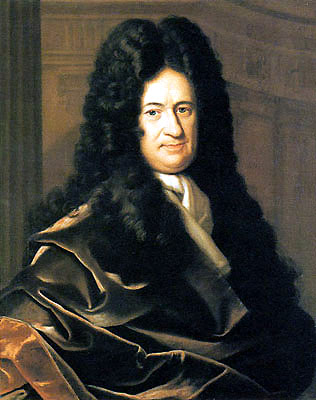
The building blocks of Leibniz's reality are the monads. The reasoning starts from a simple worry about matter: anything extended in space can be divided, and anything divided has parts, and parts have parts, with no end. So extended matter cannot be the ultimate stuff of reality, because it never bottoms out in anything genuinely basic. The truly basic things must therefore be unextended, indivisible, simple. A monad is exactly that: a simple substance with no parts, not a tiny speck of matter but a point of perception, a unit of mental activity. Everything that looks like solid matter is in truth a vast aggregate of monads. The universe is built, all the way down, not of atoms but of these mind-like points.
Monads "have no windows through which anything may come in or go out." Nothing enters a monad from outside and nothing leaves; no monad pushes, touches, or causally affects any other. Each unfolds entirely from its own internal nature, like a story playing out from a script written into it from the start. Yet each monad, from its own point of view, perceives the entire universe, more or less clearly, so that every monad is, in Latta's phrase, "a perpetual living mirror of the universe." Reality is infinitely many sealed perspectives, each reflecting the whole from where it stands.
If no monad affects any other, why does the world hang together? Why, when a mind decides to raise an arm, does the arm go up, if mind and body are separate windowless monads that cannot touch? The answer is pre-established harmony. God, at creation, wound up every monad so that their independent unfoldings would match perfectly forever after, the way two clocks built and set by the same expert craftsman will keep the same time without any wire running between them. The soul follows its own laws and the body follows its own laws, and they agree, in Latta's words, "in virtue of the preestablished harmony between all substances." Mind and body never interact, the problem Descartes left open and Elisabeth pressed. They were synchronized in advance and have run in step ever since.
Underneath the whole edifice sits the principle that is Leibniz's deepest commitment and his sharpest tool, the principle of sufficient reason: nothing is the case without a reason it is so rather than otherwise. In his words, "no fact can be real or existing and no statement true unless it has a sufficient reason why it should be thus and not otherwise." Nothing just happens to be; everything has an explanation, if only God can see all of it. Turned on the largest question, why does anything exist, and why this world rather than some other, the principle forces an answer, and that answer is the most caricatured idea in the tradition.
Leibniz argues that this is the best of all possible worlds. The argument is not the cheerful slogan it became. God, being perfectly rational, perfectly good, and all-powerful, surveyed every possible world in his understanding and, by sufficient reason, could only choose the best one to make actual. As the Monadology puts it, among the infinity of possible universes in the ideas of God, "there must be a sufficient reason for the choice of God which determines him to select one rather than another." The best world is not the one with the least suffering; it is the one that achieves the greatest richness and order through the simplest laws, and such a world may contain real evil as the price of greater goods, much as a great painting needs its shadows. Voltaire would savage this in Candide (1759), written after the Lisbon earthquake of 1755 had killed tens of thousands, putting the doctrine in the mouth of the absurd Dr. Pangloss, who insists all is for the best while disaster piles on disaster. The parody stuck so hard it replaced the argument in the popular mind. But the parody is Voltaire's; the actual theodicy is a serious attempt to square a good God with a world that contains evil, and the gap Voltaire mocked, between the proof on paper and the evidence underfoot, is exactly the gap the empiricists were sharpening their knives on.
Chapter 4
What they shared, where they split
"...no fact can be real or existing and no statement true unless it has a sufficient reason why it should be thus and not otherwise."
Set the three systems side by side and the family resemblance is unmistakable, even though no two of them describe the same universe. All three are answers to the post-Galilean question of what reason can establish with certainty, and all three give the same shape of answer: a great deal, far more than the senses could ever supply. They are siblings, not strangers, and naming what they share is the way to see why they count as one tradition.
First, all three hold that the mind carries innate ideas, concepts and truths it possesses by its own nature rather than reading off experience. Descartes' idea of God and of the self, Spinoza's definitions from which the whole Ethics unrolls, Leibniz's principle of sufficient reason: none of these is the kind of thing the eyes or ears could ever deliver, and each is supposed to be available to any mind that reasons carefully enough. The senses, for all three, are at best a prompt and at worst a liar. The real work of knowing is done from within. This is the thesis that the rival camp would deny outright.
Second, all three are substance metaphysicians, taking the central question of philosophy to be what genuinely exists in its own right, the basic stuff of which reality is made, and answering it by pure reasoning about what substance must be like. They differ on the count, one substance or three or infinitely many, but they agree that the answer is settled by thought, not by observation. And third, all three trust reason to reach conclusions that hold a priori, the term for what is known independently of experience, by thinking alone, as opposed to a posteriori, what is known only through the senses. That a triangle's angles sum to two right angles is known a priori; that the stove is hot is known a posteriori. The rationalist bet is that the most important truths, about God, the soul, the structure of the world, are a priori truths, reachable the way the triangle's property is, without going out to look.
Where they split is on the world that reasoning delivers, and the splits trace back to a single disagreement about substance. Descartes kept the everyday plurality, mind and matter as distinct substances, and paid for it with the interaction problem he could not solve. Spinoza, pressing the definition of substance harder, found that strictly there can be only one, and dissolved Descartes' minds and bodies into modes of that single God-or-Nature, buying determinism and the deletion of the mind-body gap. Leibniz, refusing both the gap and the monism, multiplied substance into infinitely many windowless monads and bought pre-established harmony and the best of all possible worlds. One method, pushed by three temperaments, yields a dualist world, a monist world, and a pluralist world. That spread is itself the strongest evidence for the empiricist complaint: that reason, cut loose from experience, will prove whatever the reasoner sets it going toward, and has no way to settle which of three confident systems is the true one.
There is one more figure to place in the rationalist family before the rivalry, because the canon long misfiled her as a footnote. Princess Elisabeth of Bohemia put the load-bearing objection to Descartes, the interaction problem in its permanent form, and her pressure is part of why Spinoza and Leibniz built the systems they did. A generation later Émilie du Châtelet, working in France, would defend the Leibnizian side of an open physics dispute against the prevailing view and turn out to be right about which quantity nature conserves. Neither was a fan or a transcriber. Both were thinkers inside the tradition, and the tradition reads more truthfully with them in it.
Chapter 5
The rival camp
"Besides God no substance can be granted or conceived."
Rationalism does not stand alone in its century; it has an opposite number, and the two define each other. While the continental rationalists were proving their way to God and substance from ideas the mind supposedly holds on its own, a British line of thinkers was insisting that the mind holds no such ideas at all. They are the empiricists (from the Greek for experience), and their founding claim is the exact negation of the rationalist wager: that all knowledge comes from sense experience, and that nothing is in the intellect that was not first in the senses.
The clearest statement of the case is John Locke's. Against the doctrine of innate ideas, Locke argued that the mind at birth is like blank paper, holding no characters and no ideas, furnished entirely by what experience writes on it, through sensation (the report of the outer world) and reflection (the mind observing its own workings). If there were innate ideas, he reasoned, everyone would have them from the start, and infants and the untaught would already know the supposed innate truths, which they plainly do not. Where the rationalist says the idea of God is stamped on the soul, the empiricist says it is assembled, like every other idea, from the raw materials experience provides. The disagreement could hardly be sharper: one camp says the mind comes furnished, the other says it comes empty.
The empiricist line ran from Locke through George Berkeley and reached its sharpest edge in David Hume, and it is Hume who turned the rivalry into a crisis. Taking the empiricist principle seriously, that every legitimate idea must trace back to some experience, Hume examined the concept the new science leaned on most heavily: cause and effect. We say fire causes heat, that one billiard ball striking another causes the second to move. But what do we actually observe? Only that one event is followed by the other, again and again. We never see the necessary connection itself, the supposed power by which the first produces the second. "Motion in the second Billiard-ball," Hume wrote, "is a quite distinct event from motion in the first; nor is there anything in the one to suggest the smallest hint of the other." Our conviction that causes necessitate their effects is not read off the world; it is a habit of expectation built up by repetition. The necessary connection the rationalists took as a foundation of knowledge turns out, on inspection, to be a feeling produced by custom.
That conclusion is the empiricist torpedo aimed straight at the rationalist hull. If even causation cannot be established by reason, then the grand a priori proofs, Descartes deriving God and the world, Spinoza deducing one substance, Leibniz reasoning to pre-established harmony, are claims reason has no right to make. Hume divided all genuine knowledge into two kinds, relations of ideas (mathematics and , true by the meaning of their terms but telling us nothing about what exists) and matters of fact (known only through experience, and never with necessity). The rationalists' boldest results fit neither box. They are not true by definition, and they are not established by observation. Hume's verdict on any book that claimed to prove substantial truths by neither route was merciless: "Commit it then to the flames: for it can contain nothing but sophistry and illusion." The wager that pure reason could reach the deepest truths had met an argument it could not answer on its own terms.
Chapter 6
Kant's settlement
"I openly confess [that] the suggestion of David Hume was the very thing which many years ago first interrupted my dogmatic slumber."
The standoff did not last, and the man who broke it had been raised inside rationalism. Immanuel Kant (1724 to 1804), in Königsberg, had been trained in the Leibnizian school and had taken the power of pure reason for granted. Then he read Hume, and as he later put it, the encounter "interrupted my dogmatic slumber" and gave his thinking a new direction. (The line is Kant's, written about himself; it is endlessly misquoted as something Hume did to Kant, but it is Kant's own confession in the Prolegomena.) The dogmatism it woke him from was precisely the rationalist confidence that reason, on its own, could deliver knowledge of God, the soul, and the world. Hume had shown that confidence was unearned. The question Kant set himself was whether anything could be salvaged from it.
His answer was to declare both camps half right and to give each its territory. The rationalists were correct that the mind brings something of its own to knowledge, something not derived from experience; they were wrong to think that something gave them access to reality as it is in itself. The empiricists were correct that all knowledge of the world begins with experience; they were wrong to think experience is simply received, a blank page taking dictation. Kant's settlement is that knowledge has two sources that must work together. Experience supplies the raw sensory material; the mind supplies the forms and concepts that organize it, including space, time, and causation itself. Cause and effect is not, as Hume feared, a mere habit with no warrant; it is one of the structures the mind necessarily imposes on experience, which is why it holds with necessity. But it holds only for the world as experienced, never for any reality beyond all possible experience.
His image of the fusion: concepts without sensation are empty, and sensation without concepts is blind. Reason supplying its forms with no sensory content to organize spins in a void and reaches nothing real, the rationalists' error; the senses delivering content with no concepts to organize it would be an unintelligible blur, the empiricists' blind spot. Knowledge happens only where the two meet. This preserves the rationalist insight, that there are necessary, a priori truths the mind contributes, while accepting the empiricist limit, that those truths govern only the world we can experience and cannot reach beyond it. The grand proofs of the rationalists, of God's existence, of the soul's nature, of the universe as a whole, are exposed as reason overstepping its bounds, applying to a reality beyond experience the concepts that have meaning only within it.
That settlement is the real end of rationalism as a standalone program. Its central wager, that pure reason unaided by experience could prove substantial truths about God, the self, and the world, did not so much fail as get redrawn. Kant kept the part that could be defended (the mind's own a priori contribution to knowledge) and surrendered the part that could not (reason's reach past all experience to reality in itself). The three great systems remain among the most ambitious structures ever built by thought: Descartes' single certainty, Spinoza's one substance proved like geometry, Leibniz's infinity of harmonized points. They were the high-water mark of confidence in what reason alone can do, and the tide they marked is still the question every later philosophy has had to take a position on. How much can the mind know by thinking, and how much only by looking? The rationalists answered, as boldly as anyone ever has, that thinking goes almost all the way down.