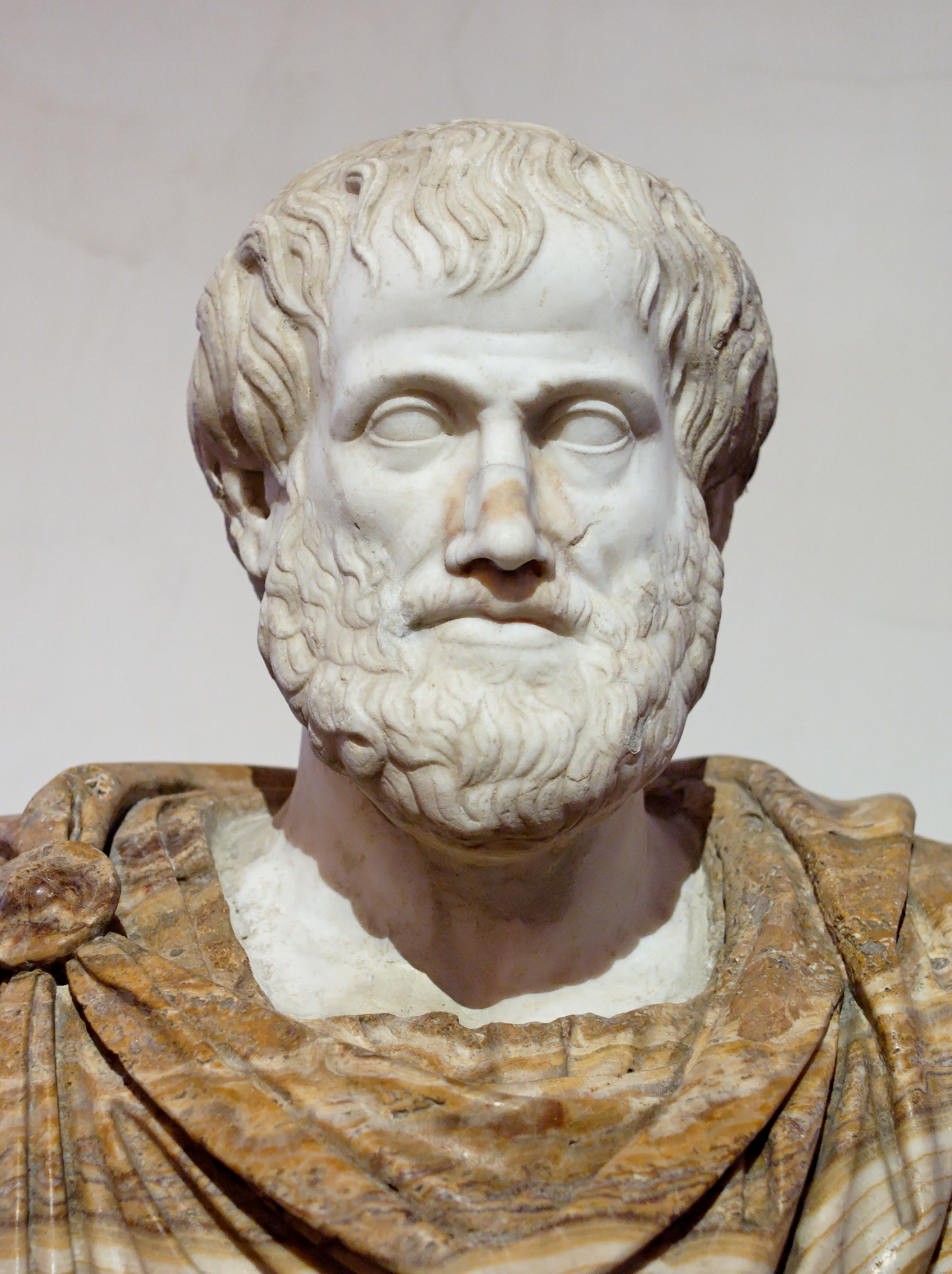
Most great philosophers pick a corner of the subject and dig. Aristotle tried to catalogue everything. He wrote on and on the weather, on the parts of animals and the structure of tragedy, on friendship, memory, dreams, the motion of the heavens, the best form of government, the soul, the right way to feel anger, and what happens inside a developing chick's egg cracked open day by day (he did that, and described it). He dissected animals, collected the constitutions of one hundred and fifty-eight Greek city-states, and built the first system of formal logic in Western history more or less from scratch. No one before him, and arguably no one since, attempted to bring that much of the world under a single net of explanation.
What we actually have of him is almost the opposite of what made him famous. The works that made Aristotle famous in the ancient world are gone. He wrote polished dialogues for a general audience, in the manner of Plato, and they were so admired that Cicero, reading them centuries later, called Aristotle's style "a flowing river of gold." That river is lost; those dialogues survive only as scraps quoted by other writers. What came down to us instead is the opposite kind of thing: his working notes. Lecture records, research drafts, in-house compilations meant for the inner circle of students at his school, never polished for publication. The Aristotle we read is not the elegant published author antiquity praised; it is the man at his desk, mid-investigation, thinking on paper.
That is not a loss to apologize for. It is a window. A sentence that feels abrupt, compressed, like a note awaiting its final revision, is exactly that, and it lets us watch how one of the most relentless minds in history actually worked. He was Plato's student for twenty years and loved him; he also thought his teacher had made one enormous mistake, and almost everything Aristotle built was a sustained, respectful, unmistakable correction of it. This is the story of the student who pointed back at the earth.
The break
The view Aristotle broke from deserves a fair statement, because it was his own teacher's and he treated it with respect his whole life. Plato had argued that the changing, visible world the senses report on cannot be the source of real knowledge, because it never holds still (the Plato chapter). Real knowledge needs a stable object, so the really real must be something else: a separate, timeless realm of perfect, changeless Forms (the Beautiful itself, the Equal itself, Justice itself) of which the beautiful and equal and just things around us are only shifting, second-rate copies. Philosophy's job, on this view, is to climb out of the sensory world and grasp that higher realm through pure reason. The body is a distraction; the senses mislead; the truth lives above. This is not a strawman. It is a serious answer to a real problem, and it dominated the Academy where Aristotle spent half his life.
Aristotle's break is to bring the really real back down. The form of a horse, he says, is not floating in some separate Platonic heaven; it is in the horse. What makes a thing the kind of thing it is, its form, is not a distant perfect original the thing copies, but a principle present right there in the matter, the two of them inseparable, together making up the one real individual thing itself. There is no second world. There is this world, studied carefully: its matter, its form, its origins, its purposes. Philosophy does not escape the world to find the truth. It explains the world it is standing in.
He had a concrete objection to drive it home, one that has worried defenders of the Forms ever since: the argument later nicknamed the Third Man. If many large things are large by sharing in one Form, Largeness itself, then Largeness itself is also, presumably, large. So now there is a new collection of large things (the originals plus the Form), and by the theory's own rule that collection needs yet another Form of Largeness over them to explain their shared largeness, which is itself large, which demands a fourth, and so on forever. (The nickname comes from Aristotle's own version run on the example of man: the men plus the Form "Man" require a third "Man" to explain what they share, and that third one keeps generating a fourth, a fifth, on up the chain.) The single master Form explodes into infinitely many. (Plato had already staged a version of this objection against himself in his late dialogue the Parmenides, the Plato chapter, using the example of greatness; Aristotle took the crack his teacher had exposed and made it the center of his break.) Worse, Aristotle thought, even setting the regress aside, separating the Form from the thing breaks the very link it was needed for: a Form of Circularity sitting off in another realm does nothing to explain why this particular coin is round. The number of worlds to account for has doubled and nothing has been explained.
The move can be stated as concretely as Raphael painted it. When Plato's Socrates wants to know what justice is, he builds an ideal city in his imagination and reads the answer off it. When Aristotle wants to know what justice is, he collects one hundred and fifty-eight actual Greek constitutions and analyzes them. One looks up, away from the world, toward a perfect pattern; the other looks down, into the world, at the messy real cases. Raphael caught it on a Vatican wall fifteen hundred years later: Plato's finger raised toward the heavens, Aristotle's palm turned down toward the earth. The whole break is that turn of the hand.
Chapter 1
The man who catalogued everything
"a flowing river of gold."
Aristotle was born in 384 BC in Stagira, a small town on the northern Aegean coast, today part of Chalkidiki, in Greece. The detail that matters most about his origins is his father's job. Nicomachus was a physician, and not just any physician: he served the court of Amyntas II of Macedon, the grandfather of Alexander the Great. So Aristotle grew up around the Macedonian royal house, and grew up around medicine, around the practice of looking closely at bodies and parts and causes, of diagnosing by careful observation. It is not a stretch to hear the physician's son in the man who would spend his life dissecting animals and sorting the natural world into kinds. His father died when Aristotle was still a child, and a guardian, Proxenus of Atarneus, raised him.
At seventeen, around 367 BC, he went to Athens and joined Plato's Academy (the most important center of philosophical thought in the Greek world) and he stayed for twenty years, until around the time Plato died in 348 or 347 BC. Twenty years: it is the key to everything that follows. Aristotle was not a casual visitor to who wandered off and disagreed. He was inside it for two decades, from late adolescence to middle age, absorbing the system at its source, under its founder. When he breaks with the theory of Forms, he is breaking with the air he breathed for half his life. That is what makes the break serious, and it is why he never breaks rudely. There is a famous Latin tag for the disagreement, "Plato is my friend, but truth is a greater friend", but Aristotle never wrote that sentence. The snappy Latin is a much later, medieval paraphrase. What he actually wrote, in his Nicomachean Ethics, is more conflicted and more human: that it is hard to criticize the theory of Forms because it was put forward by friends, but that piety requires us to honor the truth above even our friends. The real Aristotle is visibly torn about turning on his teacher's central idea. The slick Latin tag makes it sound easy; it cost him something.
When Plato died, Aristotle left Athens. He went first to Assos, on the coast of Asia Minor, with a ruler named Hermias of Atarneus, and then to the island of Lesbos, where he did much of his pioneering work in marine biology alongside a brilliant younger colleague, Theophrastus, who would become his closest collaborator. Then, around 343 BC, came the assignment that history never lets him live down: Philip II of Macedon invited Aristotle to tutor his son Alexander, then about thirteen. The lessons happened at a sanctuary garden called the Temple of the Nymphs, at Mieza. The most systematic mind in Greek history tutored the boy who would conquer the known world. Almost no reliable record survives of what passed between them, but the connection is real, and it cut both ways. Aristotle's father had served the Macedonian court; Aristotle tutored its king. That thread runs under his whole life: it brought him patronage and protection, and at the very end it nearly got him killed.
In 335 BC Aristotle returned to Athens and founded his own school, the Lyceum, in rented buildings near a public gymnasium of that name. His students came to be called the Peripatetics, from the Greek peripatein, "to walk about" (supposedly because Aristotle taught while strolling the covered walkways with them, though the name may simply come from the walkway itself). Whichever it is, the picture is right: a school built around moving, looking, collecting, sorting. The Lyceum was a research institution as much as a place of instruction; it amassed manuscripts, specimens, and the great collection of constitutions. For about a dozen years it was the most active center of empirical inquiry in the ancient world.
Then Alexander died, in 323 BC, and Athens turned. Anti-Macedonian feeling boiled up, and every Macedonian connection (Aristotle's most of all) became politically poisonous. A charge of impiety was brought against him, the same charge that had killed Socrates seventy-six years earlier, this one hung on a poem Aristotle had written in honor of his old patron Hermias. He did not stay to fight it. By Diogenes Laertius's much later account (the line is too good and too perfectly placed to take as confirmed fact) Aristotle left so as not to let the Athenians "sin against philosophy a second time." Whether or not he ever said it, he fled, to Chalcis on the island of Euboea, his mother's homeland. He died there the next year, in 322 BC, around sixty-two or sixty-three, of a digestive ailment. Socrates stayed and drank the hemlock and became a martyr; Aristotle left and lived, and the difference is its own small commentary on the two temperaments.
The problem that shapes every quotation in this book is genuinely strange: what we have of Aristotle is almost the opposite of what made him famous. He wrote two very different bodies of work. There were the exoteric works (polished, published dialogues for a general educated audience, written in the elegant manner of Plato). These won a real literary reputation; Cicero, reading them long after Aristotle's death, reached for that phrase, "a flowing river of gold," to describe the style. And those are the ones we lost. They survive only in fragments and secondhand summaries. What came down to us instead are the esoteric works: the in-house texts, the lecture notes and research drafts and ongoing records of investigation, meant for the inner circle at the Lyceum and never smoothed for publication. The standard scholarly description is exactly that: texts that read like what they very probably are, lecture notes, drafts written and reworked, ongoing records of continuing investigations.
So a passage that feels abrupt ("Virtue, then, being of two kinds…") is not a flaw to wince at. It is what working notes feel like. This is not an essay polished for publication; it is access to the actual workshop. And it is a small miracle we have even that. According to an ancient account (reported by Strabo and Plutarch, much later, and treated with caution by scholars) Aristotle left his library to Theophrastus, who left it to a man named Neleus of Scepsis, whose heirs hid the manuscripts in a cellar to keep them from being confiscated, where they sat for generations. They were eventually recovered by a book-collector, Apellicon of Teos, around the first century BC, carried to Rome after Sulla sacked Athens, and finally edited into order around 60 BC by Andronicus of Rhodes. The corpus we inherit is largely Andronicus's arrangement. Even the word metaphysics is his bookkeeping, not Aristotle's; it means roughly "the [books] that come after the Physics," the editorial label for the treatises Andronicus shelved next. The most influential body of work in Western intellectual history reached us by way of a damp cellar and a Roman librarian's filing system.
What kind of mind do these notes reveal? An empirical one, in the deepest sense. Aristotle's instinct, again and again, is to start from the cases: to collect the observations, the reputable opinions, the actual examples, and only then to reason toward the principle. He counts the legs and stomachs of animals; he gathers the constitutions; he asks what people actually call courage before he tries to define it. This is the physician's son and the marine biologist of Lesbos, and it is the deepest thing that separates him from Plato. For Plato, the senses are a distraction the philosopher should climb past. For Aristotle, the senses are where inquiry begins. Everything that follows is what he built on that foundation.
Chapter 2
How things work: the four causes
"the bronze of a statue."
Aristotle's whole way of explaining the world rests on one tool, because he uses it on everything. He noticed that the little word "why?" is hiding four different questions, and that a complete explanation of anything has to answer all four. He called them the four causes, though the word is slightly misleading to modern ears, because we hear "cause" and think only of the thing that triggers an event. Aristotle means something broader: the four kinds of answer to "why is this thing the way it is, and how did it come to be?" All four run through a single worked example, the one Aristotle himself reaches for: a bronze statue.
The material cause: what is it made of? The answer for the statue is "the bronze," the stuff, the raw material out of which the thing is formed. Every physical object has one. The material cause of the statue is bronze; of a wooden table, wood; of a person, flesh and bone. It is the most obvious of the four, and by itself it explains almost nothing (a heap of bronze is not a statue), but no complete account can leave it out.
The formal cause: what makes it that kind of thing rather than a shapeless lump? The answer is "the shape of the statue," the form, the pattern, the structure that organizes the bronze into a horse-and-rider rather than a doorstop. This is the key idea, and the formal cause is where Aristotle's whole break with Plato lives. For Plato, the form of a thing is a separate, perfect original in another realm, which the thing copies. For Aristotle, the formal cause is in the bronze. The shape is not floating in Platonic heaven; it is right here, the form this particular bronze has taken. Same word, opposite address.
The efficient cause: what brought it about, what was the source of the change? "The craftsman who made the statue," or more precisely the art of sculpting working through him. This is the closest of the four to what ordinary usage means by "cause": the sculptor's hands and chisel, the agent that did the work and set the change going. The bronze did not pour itself into a horse; someone made it happen.
The final cause: what is it for? What is the end, the purpose, the point for the sake of which it exists? "To honor a general," say, or to beautify a temple. This is the fourth and most controversial cause, because it answers a question modern science mostly stopped asking. The final cause (the Greek is telos, from which we get "teleology," the study of ends and purposes) is the goal that the whole process was aiming at. For Aristotle, the final cause is often the most explanatory of the four. To understand why the bronze is shaped exactly this way, why the sculptor moved his chisel exactly there, the deepest answer is because the statue is meant to honor a general. The purpose explains the form, which guides the craftsman, who shapes the material. The end pulls the whole thing into being. To fully explain anything, Aristotle says, one has to know what it's made of, what shape or structure makes it the thing it is, what brought it about, and, above all, what it's for.
The steelman, and the dangerous extension. For artifacts like statues, all of this is easy to accept: of course a statue has a purpose; somebody had one in mind. The radical move, the one that got Aristotle in trouble with the modern world, is that he extends final causes into nature itself. The eye, he says, is for seeing. A tree's roots are for drawing up water. The acorn grows toward becoming an oak. Nature, for Aristotle, is shot through with ends: things genuinely have purposes, genuinely aim at completions, the way the statue aims at honoring the general. The acorn is the clearest example. Why does it sprout, root, thicken, branch, in just this sequence? Because it is the nature of an acorn to become an oak; the mature oak is the end the whole process was reaching for, present in the acorn as its goal from the start. The oak is the final cause of everything the acorn does.
One crucial guardrail: his natural teleology is not creationism. He is not saying a divine designer planned the eye for seeing the way the sculptor planned the statue. The purpose is not imposed from outside by a planner; it is immanent, built into the nature of the thing itself. The eye is for seeing not because anyone intended it, but because the kind of creature that has an eye is the kind of creature whose nature it is to see. The end lives inside the organism as part of what it is, not in the mind of some external maker. This is a genuinely different idea from "God designed it," and conflating the two (reading the Christian watchmaker back into Aristotle) is one of the classic errors about him. (The medieval thinkers would later fuse Aristotle's teleology with a creator God, but that was their move, made fifteen centuries later, not his.) Aristotle's universe is full of purposes with nobody behind them, a strange idea, and one that modern science, which learned to explain nature by mechanism alone, would spend a long time trying to do without, and which is, interestingly, still argued over in the philosophy of biology today.
Chapter 3
Form, matter, and the soul
"That is why the soul is the first grade of actuality of a natural body having life potentially in it."
The four causes already established that for Aristotle the form of a thing is in the thing, not in another realm. This chapter is that idea worked all the way out, because it is the deepest level of his break from Plato, and the place where the break has its sharpest single consequence: what happens to the soul at death. The doctrine has a forbidding name (hylomorphism, from the Greek hyle (matter) and morphe (form)) but the idea underneath it is clean. Every ordinary physical object is a compound of matter and form, and neither one alone is a complete, real thing.
Consider the bronze sphere from Chapter 2. What is actually there? Not just bronze; a lump of bronze is not yet any particular thing, it is raw potential, stuff that could be made into a sphere or a sword or a coin. And not just the spherical shape; a shape with no material isn't a physical object at all, it's a geometer's abstraction. What is real, what can be picked up and rolled across a table, is the composite: this bronze, taken into this shape, the two inseparable, together constituting one real thing, the sphere. Matter without form is bare possibility, no particular thing at all. Form without matter is pure abstraction, not a physical entity. Only the union is an actual substance one can point at, and substance here, ousia in Greek, is the load-bearing word in all of Aristotle's . It does not mean "stuff" the way we use it; it means the primary real thing, the individual that bears properties rather than being a property of something else. This sphere is a substance; its roundness is not (roundness is just a property the sphere has). The really real, for Aristotle, is precisely the individual composite substance, and that is the deepest sense in which he points back at the earth. Plato's reality was up in the changeless Forms; Aristotle's reality is this sphere, this horse, this man.
Bolted onto this is a second pair of ideas that runs through Aristotle's entire system: potentiality and actuality. The acorn is a potential oak; the grown oak is the actual oak. The lump of bronze is a potential sphere; the finished sphere is the actual sphere. Change, for Aristotle, is always this: some matter moving from potentiality to actuality, guided by a form. The acorn isn't an oak yet, but it has it in it as a potential, and the whole drama of its growth is that potential becoming actual. This single pair does an astonishing amount of work for him. Virtue (Chapter 5) is the actualizing of a human being's potential. The soul, in a moment, is the actuality of a living body. And at the summit of his metaphysics sits a being of pure actuality with no unrealized potential at all. The pair (potential and actual, what-could-be and what-is) runs through a huge amount of Aristotle.
The payoff of hylomorphism, where it does its most surprising work: the soul. Plato had taught that the soul is a separate thing, immortal, that pre-exists the body and survives it (a passenger temporarily lodged in, and somewhat imprisoned by, the flesh; the Plato chapter, where the soul knew the Forms before birth and is released at death). Aristotle says: no. Apply hylomorphism. A living body is a compound of matter and form, like everything else. The matter is the physical body, the flesh, the organs. And the form, the organizing principle that makes this particular body be alive, capable of nourishing itself, sensing, and (in us) thinking, that is the soul. The soul is the form of the body. In his own words, in J. A. Smith's translation of the De Anima: "That is why the soul is the first grade of actuality of a natural body having life potentially in it." The body has life potentially; the soul is the actuality of that life, the way the shape is the actuality of the bronze.
The plain-language version, with the comparison Aristotle invites: the soul is to the body roughly as the shape is to the wax, or the sharpness to the axe. If an axe were a living thing, he says, its "soul" would be its capacity to cut, and that capacity can no more be separated from the axe and survive on its own than the shape can be peeled off a ball of wax and kept floating around afterward. The soul is not a thing riding inside the body; it is what the body does, the organizing actuality that makes a heap of flesh into a living animal.
Before the consequence, the potentiality-actuality pair leads to the strangest single thing in Aristotle's system: what he calls the unmoved mover, and what the whole structure of his metaphysics was quietly building toward (the argument lives in Book Lambda of the Metaphysics, the twelfth book of that compilation). Things in the world move: they change, grow, fall, heat, rot. And every motion, Aristotle holds, is something being moved by something else: the cart by the horse, the horse by its hunger, on and on. But the chain cannot run backward forever; an infinite line of movers, each waiting on the one behind it, never gets the first push and so explains nothing. There has to be a first mover that starts the whole thing, and the twist that makes it unmoved: it cannot itself be in motion, or it would just be one more link needing a mover behind it. So it must be pure actuality, with no unrealized potential left in it at all (in the terms of the pair, potential is what can still change; a thing with zero potential cannot change, cannot move, is complete). Eternal, immaterial, perfect, finished.
Then the genuinely odd part. If the first mover never moves, how does it move anything? Aristotle's answer is beautiful and easy to miss: it moves things the way a goal draws a person, or the way something beloved draws a lover across a room, by being desired, not by pushing. It is the final cause of all motion (Chapter 2), the perfection toward which everything else is reaching, the way the oak is what the acorn reaches toward. The whole cosmos is in motion because it is, so to speak, in love with the unmoved mover, drawn toward a completeness it imitates by moving. And what does this perfect being do, eternally? It thinks. But it cannot think about the changing world below it without depending on something lesser than itself, so it thinks about the only object worthy of it: itself. Aristotle's phrase is noesis noeseos ("thought thinking itself," thinking about thinking), an eternal mind perfectly contemplating its own perfect activity. One last guardrail, the same one from Chapter 2: this is not the personal God of later religion. The unmoved mover did not create the world, does not know anyone exists, answers no prayers, and intervenes in nothing. It is the eternal terminus where explanation finally stops. Sixteen centuries later Thomas Aquinas would seize this argument, fuse it with the God of the Bible, and make it the first of his famous proofs, but that re-pointing toward a caring creator was Aquinas's move, not Aristotle's.
Then the sharp consequence, one of the most radical breaks in the whole corpus. If the soul is the form of the body, then it cannot pre-exist the body (there is no body for it to organize before there is a body) and it cannot survive the body's destruction, because the form of a thing that has been taken apart simply ceases to be the form of that thing, the way the shape of a melted statue is just gone. The soul does not float free; it does not transmigrate into a new body; it does not go on to remember the Forms in some afterlife. When the living thing dies, its soul ends with it. This is the flat opposite of Plato's immortal, traveling soul, and it follows inexorably from the hylomorphic move. (Aristotle does leave one small, much-debated opening: he hints that the nous, the highest intellect, might be in some way separable. Scholars argue about it endlessly, and it will preoccupy the great Arabic commentator Averroes centuries later. But the hylomorphic soul in general is mortal, and that was Aristotle's clearest break from his teacher.) The man who learned from Plato that the soul outlives the body concluded, after twenty years, that it doesn't.
Chapter 4
The good life: virtue, habit, and the mean
"human good turns out to be activity of soul in accordance with virtue, and if there are more than one virtue, in accordance with the best and most complete."
Aristotle's begins with a question so simple it's almost embarrassing: what is the good life for? What is a human being ultimately aiming at? His Greek word for the answer is eudaimonia, and there is a translation trap at the threshold, because getting it wrong wrecks the whole theory. Eudaimonia is traditionally rendered "happiness," and that is badly misleading. To us, "happiness" means a feeling: a pleasant mood, contentment, the warm glow of a good day. That is not what Aristotle means. Eudaimonia is not a feeling at all. It is an objective, whole-life assessment of whether a person is living and acting excellently, flourishing, in the way a healthy plant in full bloom is flourishing. The better translations are "flourishing" or "living well." It is about what a person does over a lifetime, not what they feel on a Tuesday. A person could feel cheerful and still not have eudaimonia, and a person undergoing real hardship while living with great excellence has more of it than a comfortable fool. Flourishing, not happiness: that distinction is the key into everything that follows.
So how does Aristotle figure out what human flourishing consists in? With a famous and slightly startling argument, the function argument. His reasoning: for anything that has a characteristic job, a distinctive activity it's for, being a good one means doing that activity well. A good knife cuts well; a good flautist plays well; a good eye sees well. So, Aristotle asks: what is the characteristic activity, the ergon, of a human being? Not nutrition or growth (plants do that). Not sensation and movement (animals do that). The distinctive thing, the activity humans and only humans do, is reasoning, the activity of a soul that follows a rational principle. Put together, the conclusion comes in his own words, in the Ross translation: "human good turns out to be activity of soul in accordance with virtue, and if there are more than one virtue, in accordance with the best and most complete."
That sentence is the foundation of everything else in the Ethics. The human good is not a feeling and not a prize collected at the end; it is an activity, "activity of soul in accordance with virtue." The good life is the living of it, the excellent exercise of our distinctively human capacity, reason, over a whole life. A good human, like a good flautist, is one who performs the characteristic human activity excellently. "Good" here doesn't mean "nice" or "pleasant"; it means excellent at the function that makes a thing the kind of thing it is. The flourishing life is the life of excellent rational activity, done well, all the way through. The activity itself, performed excellently, is the good, not a means to some further reward.
Which raises the practical question the rest of the Ethics answers: how does a person get the virtues (the excellences of character) that this excellent activity requires? And here Aristotle's most quoted line is also his most fake line, the single most misattributed sentence in all of philosophy. It turns up on posters and in graduation speeches: "We are what we repeatedly do. Excellence, then, is not an act but a habit." It is attributed to Aristotle everywhere. Aristotle never wrote it. It appears nowhere in his corpus. The sentence is from Will Durant, in his 1926 popular book The Story of Philosophy, where Durant was summarizing Aristotle's ethics in his own words. Durant's actual passage paraphrases Aristotle and then adds, as Durant's own neat capstone: "we are what we repeatedly do. Excellence, then, is not an act but a habit." Over the decades the capstone got snipped loose from the paragraph and re-stamped "Aristotle." In fairness to Durant, it's a good summary; even a leading Aristotle scholar grants it's an accurate, succinct way of conveying what Aristotle says in a more complicated way. But it is Durant's bumper sticker, not Aristotle's text.
And the real text is more interesting than the bumper sticker. What Aristotle actually writes, in the Nicomachean Ethics II.1, in W. D. Ross's translation: "Virtue, then, being of two kinds, intellectual and moral, intellectual virtue in the main owes both its birth and its growth to teaching (for which reason it requires experience and time), while moral virtue comes about as a result of habit, whence also its name (ethike) is one that is formed by a slight variation from the word ethos (habit)." There are two kinds of excellence, acquired in different ways. Intellectual virtue (being a good reasoner) can be got by teaching. But moral virtue, good character, cannot be taught into a person; it "comes about as a result of habit." And he points at the very word for it: the Greek for moral virtue, ethike (the root of our "ethics"), is a near-cousin of ethos, the word for habit. The name itself signals that good character is a thing one does until it sticks. As Aristotle puts it a few lines on: "we become just by doing just acts, temperate by doing temperate acts, brave by doing brave acts."
One refinement saves Aristotle from sounding shallow. The Greek word usually translated "habit" is hexis, and "habit" undersells it. A hexis is not a mindless rut, like nail-biting. It is an active state, a settled disposition one has to actively hold oneself in, a trained, stable readiness to respond well. Becoming brave isn't like wearing a groove in a record; it's like a musician's trained command of an instrument, a cultivated capacity that's genuinely yours and exercised on purpose. Virtue, for Aristotle, is a hexis: a stable condition of character, built by repeated practice, that disposes one to respond rightly. It is acquired, not innate; cultivated, not given. (This is another quiet break from Plato. For Plato, to truly know the good was automatically to do it; virtue was a kind of knowledge. Aristotle says no: knowing the good is necessary but not nearly enough. Trained dispositions are also required, and those take time and repetition. That's why children can't yet be virtuous, and why moral education is mostly about forming good habits, not teaching good doctrines.)
Then the part everyone half-remembers and usually mangles: the golden mean. The popular version is "everything in moderation" or "the middle path," and that is a real distortion of what Aristotle says. His actual doctrine, in Ross's translation of Nicomachean Ethics II.6: "Virtue, then, is a state of character concerned with choice, lying in a mean, i.e. the mean relative to us, this being determined by a rational principle, and by that principle by which the man of practical wisdom would determine it." Each moral virtue, he argues, sits between two vices, one of excess, one of deficiency. Courage is the clearest example. Too little response to danger is cowardice (fleeing what one shouldn't). Too much (charging at everything, fearing nothing one ought to fear) is recklessness (or rashness). Courage is the trained disposition to feel and act rightly in the face of danger: to stand firm against the things one should stand firm against, in the right way, at the right time, for the right reason. Cowardice and recklessness are the two ways to miss; courage is the excellence that hits. Generosity works the same way; it sits between stinginess and reckless extravagance. The virtue is the well-aimed middle; the vices are the overshoot and the undershoot.
But two cautions, because the lazy "moderation in all things" version gets both wrong, and Aristotle is careful about both. First: the mean is "relative to us," not an arithmetic midpoint. The right amount of courage for a trained soldier facing a known enemy is not the same as the right amount for a frightened child; the mean is calibrated to the person and the situation, not computed as the average of two extremes. And what does the calibrating is phronesis (practical wisdom, the "man of practical wisdom" in Ross's phrase), the cultivated judgment that reads a particular situation and finds the appropriate response in it. Aristotle's ethics cannot be reduced to a formula precisely because the whole thing rests on judgment that has to be developed, not a rule that can be applied. Second: the mean does not apply to everything. Some actions, Aristotle insists, have no virtuous middle amount; they are wrong in any quantity. There is no "right amount" of murder, or theft, or adultery; they are not committed "in moderation." "Everything in moderation" is a caricature. Aristotle's real claim is sharper and harder: become the kind of person whose trained judgment reliably hits the response a situation actually calls for, which is sometimes the middle, and is sometimes no amount at all.
Chapter 5
Man is by nature a political animal
"man is by nature a political animal."
The flourishing life (Chapter 5) cannot be lived alone, and that is the bridge into Aristotle's politics. A human being reaching full eudaimonia needs not only trained virtue but a place to exercise it: friends, fellow citizens, shared institutions, a community. This is the meaning of his single most quoted political line, in H. Rackham's translation of the Politics: "man is by nature a political animal." The Greek is zōon politikon, literally an "animal of the polis," the city-state. And the precise wording matters, because the phrase gets softened in English to "social animal," which loses the point. Aristotle does not just mean humans like company. He means something stronger: that human nature is completed only within a political community (a city, with its laws and shared life) and that a person living wholly outside such a community is, in his striking phrase, "either a beast or a god," something less than fully human or something more, but not a human being living a human life.
Why does he think the city is natural rather than just a useful arrangement people invent? Because he traces it as a growth. The male-and-female pair is natural, for the sake of reproduction. From the pair grows the household; from several households grows the village; from several villages grows the city-state, which is the first community large enough to be genuinely self-sufficient, able to supply not just life but the good life. So the polis isn't a contract that clever individuals signed for mutual advantage; it is the natural completion of a sequence rooted in human nature itself, the final cause (Chapter 2) toward which human social development was aiming all along. This is a direct push-back on any view of the state as merely conventional, a useful fiction, and it is a thread that runs straight through the history of , all the way to the social-contract theorists who would later dispute it head-on.
So what does Aristotle think a good city actually looks like? Here the empirical temper pays off again: he doesn't read the answer off an ideal, he sorts the real cases. A constitution, he argues, can be classified by two questions: who rules (one person, a few, or the many), and for whose benefit (the common good, or the rulers' own). Cross the two and six forms result. Rule by one for the common good is monarchy; by a few of the best, aristocracy; by the many for the common good, polity (his name for a well-mixed citizen government). Each has a corrupt twin that rules for itself instead: monarchy curdles into tyranny, aristocracy into oligarchy (the rich ruling for the rich), and polity into democracy, which for Aristotle is a deviant form, the poor majority ruling in their own interest rather than the whole city's. His own preference, for most real cities, is the polity: a mixed constitution anchored in a broad middle class, stable because no single faction can capture it. But there is a sharp limit on the word citizen in all of this. The polis Aristotle calls the natural completion of human life was one that excluded slaves, women, and manual laborers from citizenship altogether, the very people whose natural inferiority he is about to argue for. The "political animal" is, in his actual city, a narrow slice of the men in it.
The same Politics that gives us the political animal also gives us two of the most indefensible arguments in the canon. The first is Aristotle's defense of natural slavery. He argues that some human beings are slaves by nature, defining the natural slave, in Rackham's translation, as "a human being belonging by nature not to himself but to another." His argument runs by analogy with the structure he sees everywhere: just as the soul naturally rules the body, and reason naturally rules appetite, so (he claims) those with fuller rational capacity naturally rule those with less. The natural slave, on his account, has enough reason to follow orders but not enough to direct a life of his own, and is therefore (Aristotle insists) better off being governed by someone more rational. This is not an incidental slip. It is structurally woven into how he explains natural hierarchy throughout the Politics. Aristotle does grant that conventional slavery (enslaving war captives) can be unjust; natural slavery, he insists, is not. Modern scholarship is unanimous that the "natural slave" has no empirical basis whatever and that the argument served to rationalize the slavery Athens already practiced. It is a documented position of one of history's greatest minds, and it is wrong.
The second is his account of women. Aristotle holds women to be naturally inferior in deliberative capacity. In Rackham's translation: "the male is by nature superior, and the female inferior; and the one rules, and the other is ruled." He spells out the supposed mechanism elsewhere in the Politics: "the slave has not got the deliberative part at all, and the female has it, but without full authority, while the child has it, but in an undeveloped form." A woman, on this view, can reason but her reason is "without full authority" (it cannot be decisive, cannot direct) so, he concludes, the courage of a man is the courage "of command, and the other that of subordination." The contrast with Plato cuts the other way from how the two are usually ranked. Plato, in the Republic, had argued that women of the guardian class could rule and fight alongside men, on the ground that what qualifies a person is the soul, not the sex, a genuinely radical opening for its time (the Plato chapter). Aristotle explicitly closes that door. On the question of women, the student is more confining than the teacher. Both passages are part of Aristotle, fully on the record; skip them and what is left is a flattering edit.
Chapter 6
What it changed, and who answered
"The Philosopher."
Before the afterlife, one achievement that outlived everything else he did, arguably the most durable thing any philosopher has ever built: Aristotle invented formal logic. Not improved it; there was nothing there to improve. Before him, people of course reasoned and argued well or badly, but no one had pulled back to ask what makes an argument valid in its bare structure, independent of what it happens to be about. Aristotle did, in the cluster of works later editors bundled as the Organon (Greek for "instrument": logic as the tool used before any other thinking). His central discovery is the syllogism: an argument where, once the premises are granted, the conclusion is forced by form alone. The textbook example is the cleanest thing in philosophy: All men are mortal. Socrates is a man. Therefore Socrates is mortal. (Aristotle himself wrote his syllogisms with bare letters, every B is A, every C is B, so every C is A, to make exactly the point that the content doesn't matter; the homely "Socrates is mortal" dress is a later teacher's illustration of that same form.) The point is that the conclusion cannot escape: nothing about Socrates or mortality needs to be known in advance. Grant the two premises and the third is locked. Swap in any terms (all whales are mammals, this is a whale, therefore it's a mammal) and the same skeleton holds. Aristotle was the first to see that the skeleton is the thing: that validity lives in the shape of the argument, not its subject. He mapped the valid shapes systematically, and in a companion work argued that real science is exactly this: true conclusions demonstrated step by step from first principles. That framework held up so well that Kant, two thousand years later in 1781, could say logic had not had to take a single backward step since Aristotle. (Modern mathematical logic eventually extended it far beyond what he imagined, but it extended him; it never caught him in an error.)
The afterlife begins where it began, in Aristotle's own school. His closest colleague and successor at the Lyceum was Theophrastus, who carried on the empirical project (he is, among much else, a founder of botany) and under whom the Peripatetic school had its most productive years. The collection of specimens and constitutions, the dissections, the cataloguing temper: Theophrastus kept the lights on. But the corpus itself, as the last chapter of the man's own life showed, then nearly vanished into a cellar for generations before Andronicus of Rhodes edited it into the form we have. Aristotle's survival was, for a while, a near thing.
The most important link in the chain is the part of the story most people have never heard, and the usual one-line version of it is wrong. The standard potted summary says "the Arabs translated Aristotle and passed him to Europe," and that flattens the real achievement into a clerical errand. Translations of Aristotle into Arabic did exist, made from Greek and Syriac. But the figures who matter here were not translators. They were philosophers who studied those translations and wrote their own original commentaries and syntheses, who thought with Aristotle and extended him. The distinction makes them visible. Al-Fārābī (c. 872–950) worked to harmonize Aristotle with Plato and with Islamic political thought; he was honored as "the Second Teacher" (Aristotle being the First), a measure of how seriously his world took both the master and the commentator. Avicenna (Ibn Sīnā, 980–1037) extended Aristotle's metaphysics and natural philosophy in his vast Book of Healing, reworking Aristotle's arguments into a system of his own that would shape philosophy in both the Islamic world and Christian Europe.
And above all Averroes (Ibn Rushd, 1126–1198), who wrote three layers of commentary on Aristotle (short, middle, and long) with such care and completeness that his Long Commentaries became the doorway through which Latin scholars finally accessed a full Aristotle. He earned a one-word title in the medieval West: "the Commentator." Just as Aristotle himself, by then, was so dominant that Aquinas could call him simply "the Philosopher," with no name needed, Averroes was "the Commentator," no name needed: a naming convention that captures, in two words, the entire architecture of medieval thought. There was the Philosopher, and there was his Commentator, and everyone knew exactly who was meant. (Note what these men were not: not mere translators, and not the personal God's spokesmen. They were thinkers working in a long tradition of Aristotle reception, and the Latin West received Aristotle largely through their reading of him.)
Through that doorway, in the thirteenth century, Aristotle hit Christian Europe like a tide, and the man who channeled it was Thomas Aquinas, who set himself the enormous task of fusing Aristotle's philosophy with Christian theology in his Summa Theologiae. Aquinas took the four causes, the form-and-matter analysis, the account of the soul, the ethics of virtue, the natural-law politics, and the argument for a first mover, and built them into the scaffolding of Catholic thought. This is where the guardrail from Chapter 2 pays off: Aristotle's first mover and his immanent natural teleology were not the personal, creating, caring God of Christianity, but Aquinas re-pointed them toward that God, borrowing the arguments and redirecting them. The synthesis was so total that for centuries afterward, when someone said "Aristotle" in a European university, they often half-meant the whole Thomistic edifice built on him. So complete was the fusion that, when later thinkers came to attack "Aristotle," they were frequently attacking the medieval cathedral built on his foundations rather than the Greek lecture-notes underneath.
His dominance was so great it began to look, in places, like a threat. In 1277 the Bishop of Paris condemned 219 propositions, many of them Aristotelian, including the eternity of the world and the denial that God attends to each individual: a high-water mark where Aristotle's authority had grown large enough to alarm the very church that had absorbed him. For roughly fifteen hundred years his system was simply the framework: his logic structured how arguments were judged, his physics described how the world moved, his biology classified the living, his ethics defined the virtues. To study was, in large part, to study Aristotle.
And then, finally, the world pushed back, but selectively, and the pattern of what survived and what didn't is the most revealing thing about him. The scientific revolution of the sixteenth and seventeenth centuries came for his physics and won. Aristotle had explained motion by the natures and purposes of things: heavy things fall because it is their nature to seek their proper place; the heavens move in perfect circles because that is their perfection. The new science of Galileo and Newton explained motion by mechanism, force, and law, with no purposes anywhere, and on that battlefield Aristotle's physics simply lost. The immanent teleology that had organized his whole picture of nature was pushed out of the physical sciences. Yet his logic and his ethics did not fall with his physics. The syllogism remained the backbone of formal logic for more than two millennia, never refuted, only extended. And his ethics never died at all: the framework of virtue, character, habit, and flourishing came roaring back in the twentieth century. In 1958 the British philosopher G. E. M. Anscombe's essay "Modern Moral Philosophy" reopened the Aristotelian alternative to the dominant rule-based theories, and the Scottish-American philosopher Alasdair MacIntyre's 1981 After Virtue turned it into a major movement. The acorn-and-oak physics is a museum piece. The man who told us that we become brave by doing brave acts is, twenty-four centuries later, being read as if he wrote it yesterday.
What Aristotle actually changed, in sum, runs as follows. He took a philosophy that his own teacher had pointed up, toward a separate realm of perfect Forms, and pointed it back down, at the individual things of this world, and insisted that the truth is found by observing and sorting them, not by escaping them. He gave the West its first tool for systematic explanation (the four causes), its first formal logic (the syllogism), a model of the good life built on cultivated character rather than other-worldly knowledge (virtue as trained habit, flourishing as excellent activity), and an account of the human being as a creature completed in community. He was wrong about a great deal (the physics, the slaves, the women), and those failures sit in the same hand as the achievements, neither sanitized nor erasing the rest. But the deepest thing he left was a posture: the conviction that to understand anything is to study it (its matter, its form, its origins, its end) patiently, in detail, eyes open. Raphael painted it as a hand turned down toward the earth. That gesture, more than any single doctrine, is what the student left to everyone who came after.