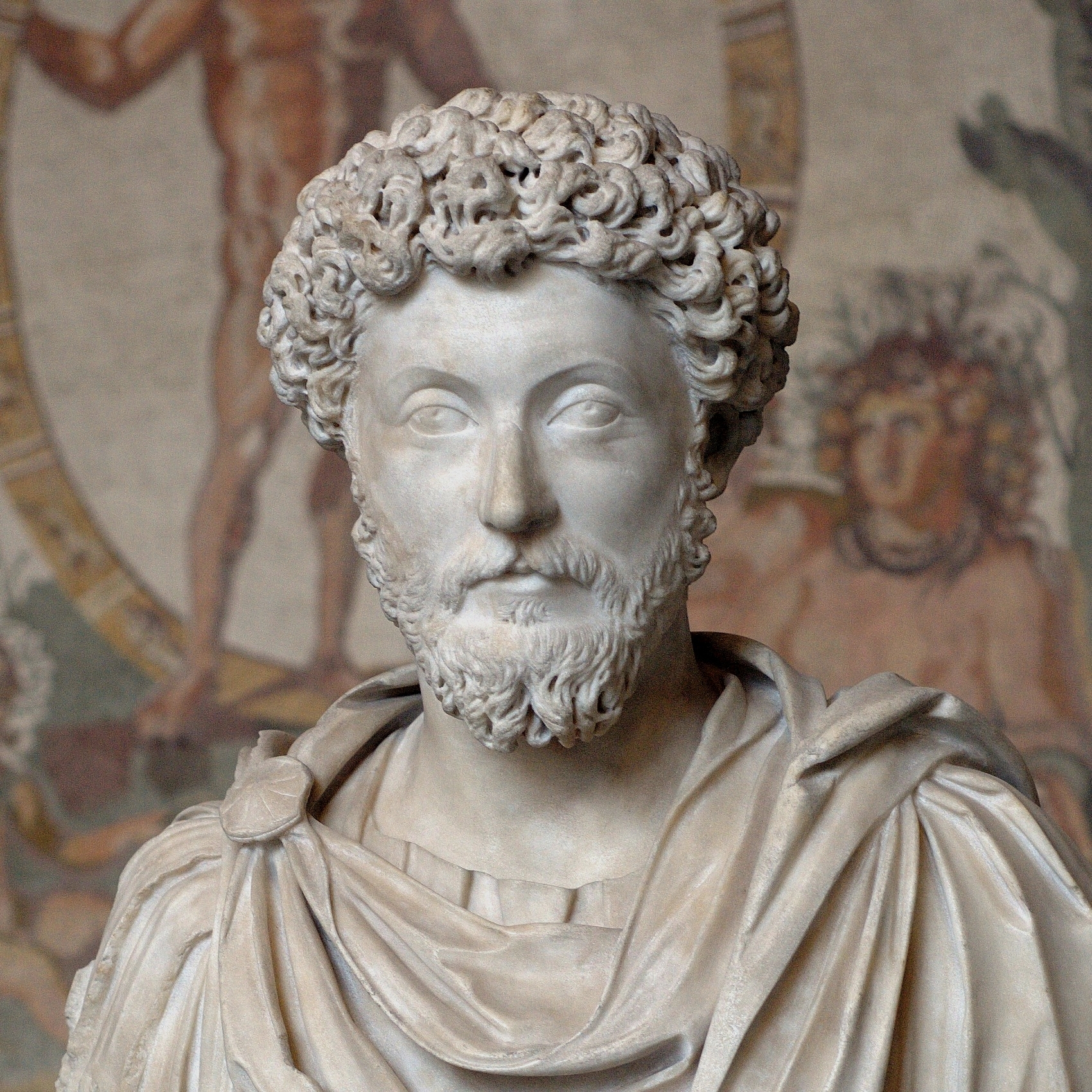
The strangest fact about the most famous Stoic who ever lived is this. The book that made Marcus Aurelius immortal is a book he never wrote, not in the sense that someone else wrote it, but in the sense that he never wrote a book at all. What survives is a notebook. Private entries, jotted down for no one, in no order, with no argument running through them, never titled, never published, never meant to leave his own hands. The man was the emperor of Rome, master of an empire of something like seventy million people, and the most lasting thing he produced was a stack of notes he was talking to himself.
He wrote them in Greek, which was not his first language. Latin was the tongue of Rome and of his government, and Greek was the language of philosophy, the language one reached for to think rather than to rule. He wrote much of it on military campaign, in army camps along the Danube, on a frontier so cold and so far from Rome that the writing has the feel of a man steadying himself in the dark. One of the books is headed, in the manuscripts, "among the Quadi" (the Quadi being a Germanic tribe on the far side of the Danube, in roughly what is now the Czech Republic); that is, the book was written in enemy country, in the field, between a war and a plague.
The address tells the story. The Greek title later attached to the notebook is Ta eis heauton ("to himself"). Not On Ethics, not To the Roman People, not Letters to a Friend. To himself. The grammar of the entries is second-person command: do this, remember that, stop doing the other. He is the writer and he is the reader and he is the one being ordered around, all at once. These are a man's private instructions to himself, recovered by accident, and the accident is most of why they hit so hard.
So this is not a life of the emperor. The wars, the borders, the plague, the succession are here, but as the weather the philosophy was practiced in, not the subject. The subject is the practice. The thing that makes Marcus matter in the history of thought is not that he founded a school or solved a problem. He didn't. He took a four-hundred-year-old Greek philosophy he had been handed by his teachers and he ran it on himself, every night, against real grief and real betrayal and real fear of death, and he wrote down the running. That is a different kind of philosophical document, and the chapters that follow take it as the thing it is.
The break
Almost everyone in this book breaks something by thinking a new thought. Plato split reality in two; Aristotle pulled the Forms back down into things; Hume took apart cause and effect. Marcus Aurelius breaks nothing of the kind. He invents no doctrine, refutes no rival, builds no system. By the time he picks up a pen the Stoic system is four centuries old and finished. (Stoicism, in one line: the Greek school that held the universe to be a single rational order, that a good human life means living in agreement with that order through virtue, and that everything else people chase, things like wealth, health, and status, is, next to virtue, not really good at all.) Zeno of Citium founded it in Athens around 300 BC (that's Zeno of Citium, the school's founder, not the earlier Zeno of Elea who dreamed up the paradoxes about motion, two different men, the Greeks chapter). Then Chrysippus (c. 280–206 BC), the school's third head and its great systematizer, built it a and a physics so complete the ancient saying went that without Chrysippus there would have been no Stoa. The architecture was done. Marcus adds not one room to it.
So if there is a break here it is of a wholly different kind, and naming it correctly matters. Before Marcus, Stoicism reaches us mostly as a thing taught and theorized: a structure of claims about the rational order of the universe (the logos), about virtue being the only real good, about the passions being errors of judgment, delivered in lectures and treatises. Even Epictetus, the freed slave whose teaching Marcus revered, comes to us as Discourses: a teacher in a classroom, his lessons written down by a student (the Greeks chapter). It is philosophy in the second person plural (here is how one ought to live), addressed to a room.
After Marcus (or rather, in Marcus, because he is the clearest specimen of it we possess from the ancient world), Stoicism is something else: a private daily discipline, philosophy as a thing done to oneself rather than a thing known. The Meditations are not a teacher addressing a room. They are a man at the end of a hard day, applying the school's tools to his own actual irritation, his own actual grief, his own actual fear of dying tomorrow on the frontier, writing down the application so it will be there, ready to hand, the next time he needs it. The move is from doctrine to exercise; from "this is what a good man is" to the order he gives himself: stop talking about it and be one (his exact words come later). He is not the architect of the building. He is the man who actually lives in it, and whose own handwriting records what it costs and what it is for to live there. That distinction holds the whole way down: he is the practitioner, not the founder, and the practice is the thing that is new on the page.
Chapter 1
The reluctant emperor
"From Rusticus I received the impression that my character required improvement and discipline; [...] and I am indebted to him for being acquainted with the discourses of Epictetus, which he communicated to me out of his own collection."
The strangest thing about how he got the job shapes everything after: nobody in Marcus's chain of succession was anybody's son. For most of the second century AD, Rome had been governed by what later historians call the Five Good Emperors, and they ran on a deliberate trick. Instead of leaving the empire to a biological heir (the road that produces a Caligula or a Nero, a man who inherits absolute power because of who his father was), each emperor adopted the ablest man he could find and made him the heir. Choose the best man, not the nearest blood. It worked, for the better part of a century, and Marcus is its product.
Marcus Aurelius Antoninus was born in Rome in AD 121, into a prominent family. ("AD" counts the years forward from the conventional date of Christ's birth, the way "BC" counts backward toward it; the Greek philosophers of the earlier chapters all lived BC, and we have now crossed the line.) The emperor Hadrian (who ruled AD 117–138, the same Hadrian who built the famous wall across northern Britain) seems to have spotted the boy early. When Hadrian arranged his own succession in AD 138, he did it in two stages with a condition baked in: he adopted a reliable senator, Antoninus Pius, as his heir, but on the condition that Antoninus in turn adopt two boys, Marcus and a younger child named Lucius Verus. It was a succession plan two generations deep. Hadrian was reaching past his own heir to pick the heir's heirs. When Antoninus Pius died in AD 161, the plan paid out exactly as designed: Marcus and Lucius Verus acceded together, as co-emperors: the first time Rome had two emperors at once. (Lucius Verus died of illness on campaign in AD 169, leaving Marcus to rule alone.)
So Marcus did not seize the throne, did not scheme for it, was not born screaming into it. It was arranged for him, over decades, by men reading him for fitness the way one reads a horse. And by every account the fit was uneasy. This was a man whose temperament pointed at the study, not the battlefield or the throne room, and who would spend the bulk of his reign at war on the empire's frozen northern edge, exactly where he least wanted to be. The phrase people reach for is philosopher-king, the figure Plato dreamed up in the Republic four hundred years earlier: the ruler whose authority comes from having actually understood the good (see the Plato chapter, Chapter 5). Marcus is history's closest real-world approach to it: a genuine student of philosophy who ended up holding genuine supreme power. But the label belongs at arm's length, because he never claimed it. "Philosopher-king" is what later admirers call him, looking back; it is a retrospective honor, and a slightly ironic one, as Chapter 6 makes clear. He would have been embarrassed by it.
The moment that made him a Stoic is a small, almost domestic scene. Marcus had many teachers; the entire first book of the Meditations is a roll call of them, a long list of debts and gratitudes, which is itself a striking way for an emperor to open a book. But the one who mattered most was a Stoic philosopher named Junius Rusticus (Quintus Junius Rusticus, roughly AD 100 to 170), a serious man, twice consul, later the prefect who ran the city of Rome. What Marcus credits him with is two things, and they go together. First, Rusticus taught him "that my character required improvement and discipline"; he was the teacher who told the future emperor, to his face, that he was not yet good enough, and needed work. And second, Rusticus handed him a book.
The book was the Discourses of Epictetus, and Rusticus lent it to Marcus, in Marcus's own words, "out of his own collection," his personal copy. Who Epictetus was matters here, because the handoff is the whole Stoic lineage in one gesture. Epictetus (around AD 50 to 135) had been born a slave (the Greeks chapter); he was lame, freed at some point, and became the most influential Stoic teacher of the Roman world. Like Socrates before him, he wrote nothing himself; the Discourses and the little handbook called the Enchiridion (Greek for "handbook," literally a thing kept ready at hand) are his lectures as taken down by a student named Arrian. A philosophy is built by Greeks centuries dead. It is taught, in Marcus's own century, by a man born into slavery, whose words survive only because a pupil wrote them down. That pupil's notes pass into the private library of a Roman senator. And the senator hands them to a young man who will become the absolute master of the Roman world, who reads them, is reshaped by them, and spends the rest of his life trying to live by the teaching of a dead slave. The same philosophy, running with the same voice from the bottom of Roman society to the very top. That is not a coincidence the Stoics would have found surprising. It is the thing they most believed about human beings: that the part of a person that matters is the part a throne can't buy and a chain can't take.
Chapter 2
The notebook
"Constantly then give to thyself this retreat, and renew thyself; and let thy principles be brief and fundamental, which, as soon as thou shalt recur to them, will be sufficient to cleanse the soul completely."
What the Meditations even is takes care to state, because almost everyone meets it as the wrong kind of object. It is not a treatise. It is not a memoir. It is not a book of advice for others, like Seneca's letters. It has no thesis, no chapters that build, no argument that arrives anywhere. It is twelve short books of disconnected entries (some a single line, some a paragraph or two) written down by Marcus for Marcus, in no settled order, with no audience in view and no intention of publication. The closest modern thing is a private journal kept by someone doing a daily mental discipline: not a record of events (Marcus almost never mentions the actual war he's fighting) but a record of reminders, the same handful of principles rehearsed over and over because rehearsing them is the point.
The strangeness of that comes through when Marcus is set beside the Stoic who came just before him in the Roman line. Stoicism had crossed from Greece to Rome a century earlier, and its great Roman voice was Seneca (c. 1 BC to AD 65), the philosopher, playwright, and political insider who served as the young emperor Nero's tutor and advisor before Nero ordered him to kill himself. Seneca, like Marcus, wrote about Stoic discipline: facing death, taming anger, living rightly. But Seneca wrote out, to an audience: polished moral essays and a famous series of letters addressed to a friend, crafted as literature, plainly meant to be read and to last. They are some of the most elegant prose in Latin, and the elegance is the tell, a man choosing his words because someone will weigh them. Marcus is the exact opposite. He writes in, to himself, for nobody, choosing his words because they have to work on him by tomorrow morning and not because anyone will admire them. Same philosophy, opposite document: Seneca is Stoicism performed for readers; the Meditations are Stoicism with the audience removed. That removal is the whole reason the notebook hits the way it does.
Even the title isn't his. Marcus gave the thing no name. The Greek title it travels under, Ta eis heauton ("to himself," or "to his own self"), comes from the manuscript tradition, not from Marcus. In fact the text's survival is so thin it's almost frightening: the earliest certain mention of it anywhere is around AD 900, when a Byzantine bishop and great manuscript-collector named Arethas of Caesarea wrote to an archbishop about an old copy he had, "so old it is altogether falling to pieces." That falling-apart copy is the first solid trace we have of the book, seven centuries after Marcus's death. The Meditations nearly didn't reach us at all. The familiar English title is just convention; George Long, whose 1862 translation is quoted throughout below, called it The Thoughts of the Emperor M. Aurelius Antoninus.

Why does the privateness matter so much? Because it is the source of the book's peculiar authority. Most philosophy is written to persuade: there is a reader to win, a rival to beat, a reputation to build, and the prose is shaped, consciously or not, by all of that. The Meditations have none of those pressures on them, because Marcus is the only reader he expects ever to have. He is not performing wisdom for an audience; he is trying to manage himself, and the difference is palpable on the page. He repeats himself, because a true thing has to be heard many times before it sticks. He scolds himself for getting out of bed late and not wanting to do his work. He talks himself down from anger at people who have wronged him. The man running the largest empire on earth writes, to no one, a note reminding himself not to be a coward about dying. There is no posture in it because there is no one to posture for. It is closer to a person's inner discipline caught on the page than any other famous book in philosophy.
And that pins down exactly what kind of thinker Marcus is. He is not adding to the system. The epigraph above catches it: "let thy principles be brief and fundamental, which, as soon as thou shalt recur to them, will be sufficient to cleanse the soul." That is a man describing his own practice. The principles are already settled; Zeno and Chrysippus and Epictetus settled them. Marcus's work is not to discover them but to keep them "ready to hand," worn smooth with use, so that when grief or fury or fear hits, the right thought is already there, reachable in a second. The Meditations are the smoothing. Each entry is a Stoic principle being picked up, turned over, and put back in its place, so it will be findable next time. A treatise teaches the principle once. This notebook is a record of a man maintaining it, daily, for years, the way one maintains a tool a life is staked on. That is the practitioner's break, and the next three chapters are the practice itself.
Chapter 3
The dichotomy of control
"things do not touch the soul, for they are external and remain immovable; but our perturbations come only from the opinion which is within."
The single idea which, once genuinely taken in, changes how a person lives the next day: the dichotomy of control. Everything else in Stoicism (the cosmic stuff, the talk of the logos, the rehearsals of death) is in service to this one move, and Marcus returns to it more than to anything else. It did not start with Marcus. He inherited it, whole, from Epictetus, whose handbook opens with it. Epictetus's statement of it is the thing Marcus is forever applying.
The Enchiridion begins, in the standard Elizabeth Carter translation (Carter, who lived 1717–1806, was an English scholar whose eighteenth-century rendering is still the standard public-domain English text of Epictetus, the same wording met in the Greeks chapter): "Some things are in our control and others not. Things in our control are opinion, pursuit, desire, aversion, and, in a word, whatever are our own actions. Things not in our control are body, property, reputation, command, and, in one word, whatever are not our own actions." The list on each side is doing precise work. On the up-to-us side: a person's judgments, desires and aversions, choices, own actions, the operations of the mind. On the not-up-to-us side: the body (it can be struck, can sicken, can die), property, reputation (what others think of someone lives in their minds, not his), position, and the outcomes of any action once it leaves the hands. The line runs right down the middle of a human life. Almost everything people pour their anguish into (Will I get it? Will they love me? Will I be remembered?) falls on the not-up-to-us side.
The discipline is brutally simple to state and a lifetime's work to do: spend energy and peace only on the up-to-us side, and accept whatever lands on the other side. Not because outcomes don't matter, but because they are not one's to command, and to stake serenity on something that can't be commanded is to hand that serenity to chance. A person prepares well (up to them); whether they succeed (not up to them). They act justly (up to them); whether they're thanked for it (not up to them). Everything goes into the part that is actually theirs, and the rest is let fall where it falls. That is the whole machine.
Marcus applies the machine to himself, and this is the difference between knowing the rule and using it. The line from the epigraph, from Meditations IV.3, is the move: "things do not touch the soul, for they are external and remain immovable; but our perturbations come only from the opinion which is within." That is the dichotomy of control restated as a piece of self-surgery. Marcus is reminding himself that the thing that happened to him (the insult, the loss, the setback) never actually reached the part of him that suffers. The thing is "external" and just sits there, inert. What reaches him, what does the wounding, is the opinion which is within: his own judgment that the thing is a disaster. The event is on the not-up-to-us side; the verdict he passes on the event is on the up-to-us side. And the verdict is the only part that hurts. Change the verdict and the suffering changes, because the suffering was never in the event to begin with.
A real case, the kind Marcus actually faced, shows the idea biting. In a betrayal, a person trusted someone, who does them a genuine wrong. The ordinary response is that the wrong itself wounds, and the wound justifies the rage. The Stoic move is to sort the situation across the line. The other person's act is on the not-up-to-us side: someone did a thing, it's done, it sits there external and immovable, and no amount of fury reaches back and unmakes it. What is on the up-to-us side is exactly two things: the judgment about what the act means for the one wronged, and that person's own response to it. Marcus, in the full text of IV.3, even hands himself the consolation to reach for: that "rational animals exist for one another," that "to endure is a part of justice," and "that men do wrong involuntarily," meaning that people who wrong others almost always do it because they have mistaken what is good, the way anyone sometimes does, and that meeting their error with hatred just adds a second wrong to the first. The betrayal can't be undone. The story a person tells himself about it, and what he becomes in response: those are his. That is where all the effort goes.
The most common objection comes first: this is just a recipe for passivity. Sort everything into "not up to me" and shrug, do nothing, let the world roll over. But that is precisely backwards. The dichotomy doesn't say to stop acting; it says where action actually has purchase. Marcus fought wars, governed an empire, judged law cases, raised children, none of it abandoned. What the discipline removes is not effort but anguish over results that aren't controlled, the wasted, corrosive energy spent on the part of the situation that was never going to obey. The Stoic is not the man who does nothing. He is the man who works as hard as anyone on the part that is his, and is un-deceived about the rest, who has stopped paying interest on outcomes he was never going to own. Far from breeding passivity, it frees up enormous energy by ceasing to spill it on the uncontrollable. It is the opposite of a shrug. It is a way of pointing all one's force at the one place force does anything.
The surprising part is a real piece of intellectual history: this idea, hammered out by a slave and a Roman emperor eighteen centuries ago, is the documented ancestor of one of the most successful psychological treatments of the modern world. When Albert Ellis and Aaron Beck independently built cognitive behavioral therapy in the twentieth century (the now-standard treatment for depression and anxiety), they explicitly credited the Stoics. Beck wrote that "the philosophical underpinnings" of cognitive therapy "go back thousands of years, certainly to the time of the Stoics, who considered man's conceptions (or misconceptions) of events rather than the events themselves as the key to his emotional upsets." The hinge line they kept pointing back to was Epictetus's: men are disturbed not by things, but by their judgments about things. CBT's central technique (catch the automatic catastrophic thought, examine it, find it false or overblown, and the feeling loses its grip) is the dichotomy of control turned into a clinical method. Marcus, in IV.3, had already written the whole principle: "our perturbations come only from the opinion which is within." Examine the opinion and the perturbation has nowhere to stand. The notebook on the frozen frontier and the therapist's office are running the same move.
Compressed to a single line, this is the idea that does work in an actual life: almost nothing that happens to a person is in their control, and almost all of their suffering comes not from what happens but from the verdict they pass on what happens. The line between the two gets drawn ruthlessly. Everything goes into the side that's theirs (judgments, choices, effort), and the other side, the side that was never theirs, is met with as much steadiness as can be managed. That's it. That's the move the emperor practiced in the dark, and it's why people who have never read a word of Greek philosophy still read this one.
Chapter 4
The view from above, and the practice of death
"The universe is transformation: life is opinion."
The dichotomy of control is the engine. Marcus runs it by means of two great exercises, two mental tricks he plays on himself, over and over, to make the principle actually feel true rather than merely known. The difficulty with the dichotomy of control is that knowing intellectually that one's reputation isn't up to oneself does very little when that reputation is being torn apart and the stomach is in knots. The principle needs support to bite. Marcus's two main forms of support are a zoom-out in space and a zoom-out in time: roughly, the view from above, and the steady rehearsal of death.
The view from above is exactly what it sounds like: a deliberate act of imagination in which Marcus lifts himself up and away and looks down on human life from a great height, until the things tormenting him shrink to their real size. He does it in Meditations IX.30: "Look down from above on the countless herds of men and their countless solemnities, and the infinitely varied voyagings in storms and calms, and the differences among those who are born, who live together, and die." From up there, the quarrel that eats at a person, the slight he can't forgive, the honor he's desperate to win, all of it is a flicker in an ant heap. He pushes it further in the same passage, and it gets bracing: consider, he tells himself, "how many know not even thy name, and how many will soon forget it, and how they who perhaps now are praising thee will very soon blame thee, and that neither a posthumous name is of any value, nor reputation, nor anything else." This is the emperor of Rome reminding himself that his fame is worth nothing, that the people cheering him now will turn, and that within a few generations almost no one will know he existed. He is not being morbid. He is cutting reputation (that classic not-up-to-us item) down to a size where he can stop bleeding peace onto it.
The view from above isn't only a zoom in space; it's a zoom in time, and the time dimension joins it to Marcus's other great exercise. In the same family of passages he reminds himself that "the whole earth is a point," a speck, and that all the generations who lived before him faced exactly what he faces and are gone, and all who come after will face it and go in their turn. Any one crisis, set against the whole sweep of human time, stops looking like the center of the universe. Everyone before bore it. Everyone after will. A person is one of the countless herd, and there is, strange to say, enormous relief in that. The cure for taking oneself too seriously is true scale.
The practice of death is the second exercise, and it's the one most likely to be misread as gloom. Marcus rehearses his own death constantly, not because he's depressed, but because he's training. The Stoic idea, which runs all the way back to Socrates calling philosophy "the practice of dying" in Plato's Phaedo (the Plato chapter, Chapter 3), is that a loss already faced in the imagination, many times over, can't ambush a person when it actually comes. He has been there before. So Marcus keeps the fact of his own death close, deliberately. Meditations II.11 opens: "Since it is possible that thou mayest depart from life this very moment, regulate every act and thought accordingly." Death could come within the hour, so the thing in front of him gets done now, the way a person does who has no time to waste on pettiness. Death is not introduced to frighten him; it's introduced to focus him, to burn off the trivial.
And II.11 does more than memento-mori; it carries the hard Stoic reasoning underneath, the part that makes death not just urgent but un-frightening. The argument runs to a single conclusion: death, along with pain, dishonor, wealth, and the rest, are indifferents (the Stoics' technical term was adiaphoron, literally "a thing that makes no difference," meaning no difference to whether a life is good or bad), things that "make us neither better nor worse" and so are "neither good nor evil." Marcus's logic: "that which does not make a man worse, how can it make a man's life worse?" A person's character (whether they are just, brave, honest) is the only thing that determines whether their life is good or bad. Death takes a life but it cannot make the person who lives it worse; therefore it cannot make that life a worse life; therefore it is not, in the Stoic accounting, an evil at all. It is simply a natural event, like the leaves turning, that happens equally to the good and the bad and so can't be the measure of either. Convincing or not, the argument has a clear purpose: it is a man systematically dismantling, plank by plank, the thing most human beings fear most, so that on the morning it comes he will meet it without his judgments collapsing.
"The universe is transformation: life is opinion." Long's wording, landing at the very end of Meditations IV.3, after the long passage about retreating into oneself. Six words doing enormous work. "The universe is transformation" is the view from above and the practice of death in a phrase: everything outside a person, the whole cosmos, is in ceaseless change, nothing stays, nothing can be clung to, the person included. (That's the old insight of Heraclitus, that everything flows, met in the Greeks chapter; the Stoics took it over wholesale.) And "life is opinion" is the dichotomy of control in a phrase: a life, as it is actually lived and suffered and enjoyed, is constituted by judgments, by opinions about the transforming things, not by the things themselves. The word "opinion" carries weight here: Marcus doesn't mean a casual viewpoint. He means the verdict the mind passes on a situation, and his claim is that that verdict is where a life actually happens. The world transforms, indifferent and immovable; a person supplies the meaning; and so the one place where power lies is the one place that was doing the suffering. The cosmology and the self-discipline are the same thought, said once from the outside and once from the inside. The section ends there because it is the whole philosophy in six words.
Chapter 5
Living according to nature
"No longer talk at all about the kind of man that a good man ought to be, but be such."
The discipline (sort the world by control) and the exercises that power it (zoom out, rehearse death) rest on a cosmology: the picture of the universe that makes the whole discipline make sense rather than seem like a mere coping trick. The Stoic isn't just managing his feelings; he believes something specific about reality, and the management follows from the belief. The Stoic slogan for the goal of life is "living according to nature," and understanding it takes the one Greek word the whole system hangs on: the logos.
The logos (we met it with Heraclitus in the Greeks chapter) is the Stoic name for the rational order running through the entire universe: at once the logic of the cosmos, the law of nature, and something the Stoics were willing to call divine reason. Their universe is not a heap of dead matter pushed around by chance; it is a single rational, ordered, living whole, and everything that happens in it happens according to that order. The move that makes the fall out of the physics is this: a human being's mind, the rational faculty, is a fragment of that same cosmic reason. The logic in a person's head is a chip off the logic of the whole. So "living according to nature" means two things at once that are really one thing: live according to one's own nature, which is to be rational, and live according to the universe's nature, which is also rational. Align the little reason inside with the great reason outside, stop fighting the order of things, and cooperate with it. The dichotomy of control is what this looks like in practice: the universe's order includes the fact that most things aren't up to any one person, so accepting that is just accepting reality, and virtue (a good, rational character) is the one thing that is fully one's own and so the only thing that is genuinely good.
That word, virtue, is doing technical work. The Stoics didn't mean something vague and old-fashioned by it; they meant a specific set of four, inherited from Socrates and Plato (the Plato chapter, Chapter 4): wisdom (knowing what's actually good and what isn't), justice (giving people their due, treating them fairly), courage (holding steady in the face of fear and pain), and temperance (self-command, not being run by one's appetites). Between them, the Stoics held, those four cover every genuine excellence a human being can have, every way there is of being good. And their famous claim is that this (virtue, a good and rational character) is the only good, full stop. Everything else people chase or flee is, in the precise Stoic term, an indifferent: not what makes a life good or bad.
"Indifferent" is the word that makes people recoil, because it sounds inhuman, as if a Stoic genuinely shouldn't care whether he's healthy or sick, rich or starving. That is not the claim, and the Stoics had a precise tool to head it off: the preferred indifferent. Health, wealth, comfort, a good reputation: these are preferred indifferents. It is rational to go after them, and one should; other things equal, health is to be chosen over sickness, money over poverty, and only a fanatic would pretend otherwise. The single point is narrower than it sounds: these things are not good in the way virtue is good, because they don't make a person good and no one controls whether they keep them. So they are worth pursuing, just not worth staking one's character or peace on. Work for the raise, by all means; the trap is becoming a worse person to get it, or coming apart when it doesn't come. That distinction is the whole answer to "but surely money matters." Of course it matters. It just isn't the good.
A concrete case shows what the doctrine costs. Imagine a person up for a promotion they've earned, and a rival lies about them to get it instead. "Living according to nature" (aligning one's reason with the larger reason) doesn't mean shrugging and walking away; the promotion is a preferred indifferent and it's entirely rational to want it and to compete hard for it. What it means is this: the person's honesty, fairness, and refusal to lie back are up to them and are the good, so they guard them no matter what; the outcome, and the rival's choices, are not up to them and are indifferents, so they don't let them touch their character or wreck their sleep. To lie in return to win is to trade the one thing that was actually good (one's justice) for a thing that was never more than preferred (the title), a catastrophic deal by the Stoic accounting, even in victory. That is what living according to nature asks: pour into the part that is one's own and genuinely good, treat the rest as worth having but not worth self-corruption. Stated plainly, living according to nature means lining one's own reason up with the reason running through everything, doing the one thing that's truly one's own (being of good character), and meeting everything else, win or lose, as weather. A man can be tortured and remain good; a man can be crowned emperor and be a wretch. The throne and the chain are both, in the final accounting, indifferents. That is the same thought that let the same philosophy speak to a slave and to Marcus.
The logos has a political consequence Marcus returns to often, one of antiquity's most expansive ideas: the cosmopolis, the "world-city." If every human being carries a fragment of the one cosmic reason, then in the deepest sense all rational beings are fellow citizens of a single community that runs underneath and across every tribe, nation, and city. A person's real citizenship isn't Roman or Greek or barbarian; it's membership in the universal community of all rational creatures. Marcus puts the practical edge of it in Meditations IV.3, in the line met earlier: "rational animals exist for one another." Human beings are built for each other, the way the parts of a body are built for the body; to harm another rational being, or even to be coldly indifferent to them, is to act against one's own nature. The man who governed an empire by force kept reminding himself that the people on the other end of that force (including the barbarians across the river he was at war with) were, at bottom, citizens of the same cosmic city as he was. (How well that squared with running an empire and fighting those wars is a real tension that Chapter 6 takes up directly.)
One phrase often pinned on Marcus is a trap. People love to attach amor fati (Latin for "love of fate") to the Meditations, as if it were his motto. It wasn't. "Amor fati" is Nietzsche's coinage, from the nineteenth century, a deliberately provocative tag Nietzsche minted some seventeen centuries after Marcus. Marcus wrote in Greek, not Latin, and never used the phrase. The concept (accepting, even welcoming, whatever fate brings, because it flows from the rational order of the whole) really is in the Meditations; it's a natural consequence of living according to the logos, and Marcus has passages about embracing what fate assigns. So the idea is fair to credit to him. The catchy Latin label is not. It is better called Stoic acceptance of fate, with the slogan left to Nietzsche.
The line in the epigraph is the whole discipline compressed to a command. Meditations X.16: "No longer talk at all about the kind of man that a good man ought to be, but be such." That is the practitioner's creed in a sentence, and it is a sentence against theorizing virtue. Marcus, who has filled a notebook with reminders about the good, rounds on his own notebook and says: enough describing it, enough talking about what a good man is, be one. (This line circulates everywhere in a punchier form, "Waste no more time arguing about what a good man should be. Be one." That snappier version is the modern Gregory Hays translation, which is excellent and also under copyright; the words above are George Long's public-domain wording, the ones safe to quote.) The line answers the question the whole arc of Marcus's biography has been circling. What does it mean that the emperor applied Stoicism rather than built it? It means exactly this: he had stopped, by the end, even wanting to talk about virtue. He wanted to do it. The notebook is a record of a man trying, every night, to close the gap between describing the good man and being him, and X.16 is him catching himself in the act of describing again, and ordering himself to stop.
Chapter 6
The cost, and the afterlife
"how they who perhaps now are praising thee will very soon blame thee, and that neither a posthumous name is of any value, nor reputation, nor anything else."
The warm version ends here: the wise emperor, the timeless notebook, the philosophy that outlived the empire. But a philosophy is tested by what it failed to prevent as much as by what it achieved, and Marcus's reign has three shadows over it that the admiring version skips. Each deserves a direct look.
The first shadow is the persecution of Christians. In AD 177, in the Roman city of Lugdunum (modern Lyon, in France), a group of Christians was hunted down, tortured, and killed; the sources name around forty-eight victims, among them an enslaved woman named Blandina whose endurance under torture became famous in Christian memory. This happened during Marcus's reign, on his watch as emperor. How much of it was his is contested, and not resolvable. The persecution at Lyon was carried out by the local Roman governor, and in this period the standard imperial practice was precisely to leave the handling of Christians to local authorities under general policy, not to issue specific kill-orders from the center. There is no surviving evidence of a direct command from Marcus for the Lyon killings. There is one passage in the notebook (Meditations XI.3) that is often read as a swipe at Christians: it praises a soul ready to die when its time comes, but only if that readiness comes from reasoned judgment, "not from mere obstinacy, as with the Christians," done "with dignity" and without "tragic show." Here, though, a real caution belongs, because the line is shakier than the admiring-or-damning versions both assume. The phrase "as with the Christians" is in the manuscript that the translator George Long worked from, but many modern scholars, including the introduction to Gregory Hays's standard translation, judge it to be almost certainly a later interpolation: a margin note jotted by some later reader that drifted into the body of the text over centuries of hand-copying, rather than Marcus's own words. If they are right, Marcus may never have mentioned Christians here at all. So the fair statement is this: Christians were persecuted and killed under his reign; whether that reflected his personal orders or local officials acting under general Roman policy is genuinely debated by historians; and the one note that seems to show him sneering at Christian martyrs may be his, or may be a stranger's words wearing his name; the textual evidence won't settle it. What can be said is that nothing in his philosophy of the universal cosmopolis, where all rational beings are fellow citizens, produced any special warmth toward these particular ones. All of that holds at once, and resolving it artificially in either direction is the one move to avoid.
A related limit: Marcus's cosmopolis (all rational beings, one community) was a genuinely expansive idea, and it produced no social reform whatever. He does not, in the Meditations, question slavery, though Epictetus, who had been enslaved himself, had dramatized its moral absurdity from the inside. The Stoic teaching that no master can enslave the soul, that the inner citadel is always free, was profound comfort as a private philosophy and left the institution of slavery entirely untouched as a social fact. The world-city of all rational beings coexisted, in the mind of its most powerful ancient exponent, with an actual empire built on bondage, and he seems never to have felt the contradiction as one. That is not a reason to dismiss the idea; the cosmopolis would feed real moral expansions much later. It is a reason not to pretend the philosophy did work in the world that it did not do.
The second shadow is his son. Marcus is, as Chapter 1 said, history's nearest thing to Plato's philosopher-king, and he broke the very system that had produced him. For almost a century the good emperors had passed power by adoption, choosing the ablest successor rather than the nearest blood. Marcus had a biological son, Commodus, and he named him heir (made him co-emperor in AD 177), breaking the adoptive chain for the first time in generations. Commodus would prove, in the judgment of ancient and modern historians alike, one of Rome's worst emperors: indulgent, cruel, detached from the work of governing, eventually convinced of his own near-divinity. The irony is exact and brutal, and Marcus apparently couldn't see it coming or couldn't act on it: the man who most fully lived the examined Stoic life in power handed that power to a son who would squander it, and his philosophy (all those nights of self-correction) produced no philosopher-heir, indeed no decent heir at all. The most disciplined self-ruler of the ancient world could not transmit one ounce of the discipline to the one successor he chose by blood. Whatever else the Meditations are, they are not a parenting manual that worked.
Marcus died in AD 180, near the Danube frontier where he'd spent so much of his reign; the exact place is disputed in the sources, either Vindobona (modern Vienna) or Sirmium (in modern Serbia). He had also lived through, and the army had been gutted by, the Antonine Plague, a vast epidemic (probably smallpox) carried back from the eastern wars around AD 165 that killed millions across the empire over the following years, the kind of mass, uncontrollable catastrophe that the dichotomy of control was built to be practiced against. He wrote his notes to himself amid war and plague and a frontier that never fully held, and then he left it all to Commodus, and the long experiment of the good emperors ended with him.
And then the afterlife: the third shadow's reversal into light. This is where the throughline pays off. The Meditations were a private notebook, never published, never meant for a reader, surviving by a thread (one bishop's crumbling copy around AD 900, first printed only in 1558). By every reasonable expectation the book should have vanished, as the man's reputation faded exactly the way he kept telling himself it would; the epigraph above says it: "neither a posthumous name is of any value, nor reputation, nor anything else." He was right that the empire and the fame and the wars would dissolve. He was completely wrong about the notebook. The thing he valued least, the private jottings he never meant anyone to see, is the one thing that made him immortal. Today the Meditations are among the most widely read works of philosophy on earth, picked up on trains and in hospitals and in prisons by people steadying themselves exactly as he was. The twenty-first century has seen a full Stoic revival built largely on this book. And, as Chapter 3 showed, the discipline at its core (examine the judgment, not the event) runs directly into modern cognitive behavioral therapy, credited by its founders to the Stoics by name.
So end where the hook began, with the gap. The most powerful man in the world wrote private notes to himself, at night, on a frozen frontier, in a borrowed language, trying to talk himself into being good, and reminding himself, all the while, that none of it would be remembered. The reminding was wrong; the goodness was the point; and the record of the trying outlived the empire it was written in. Marcus founded no school and solved no problem. He did something rarer and harder, and harder still to do where everyone is watching and nothing compels it: he took a finished philosophy and actually used it, on himself, against real fear and real grief, every day, and let us watch over his shoulder. "No longer talk at all about the kind of man that a good man ought to be, but be such." He was talking to himself. We just happened to read it.