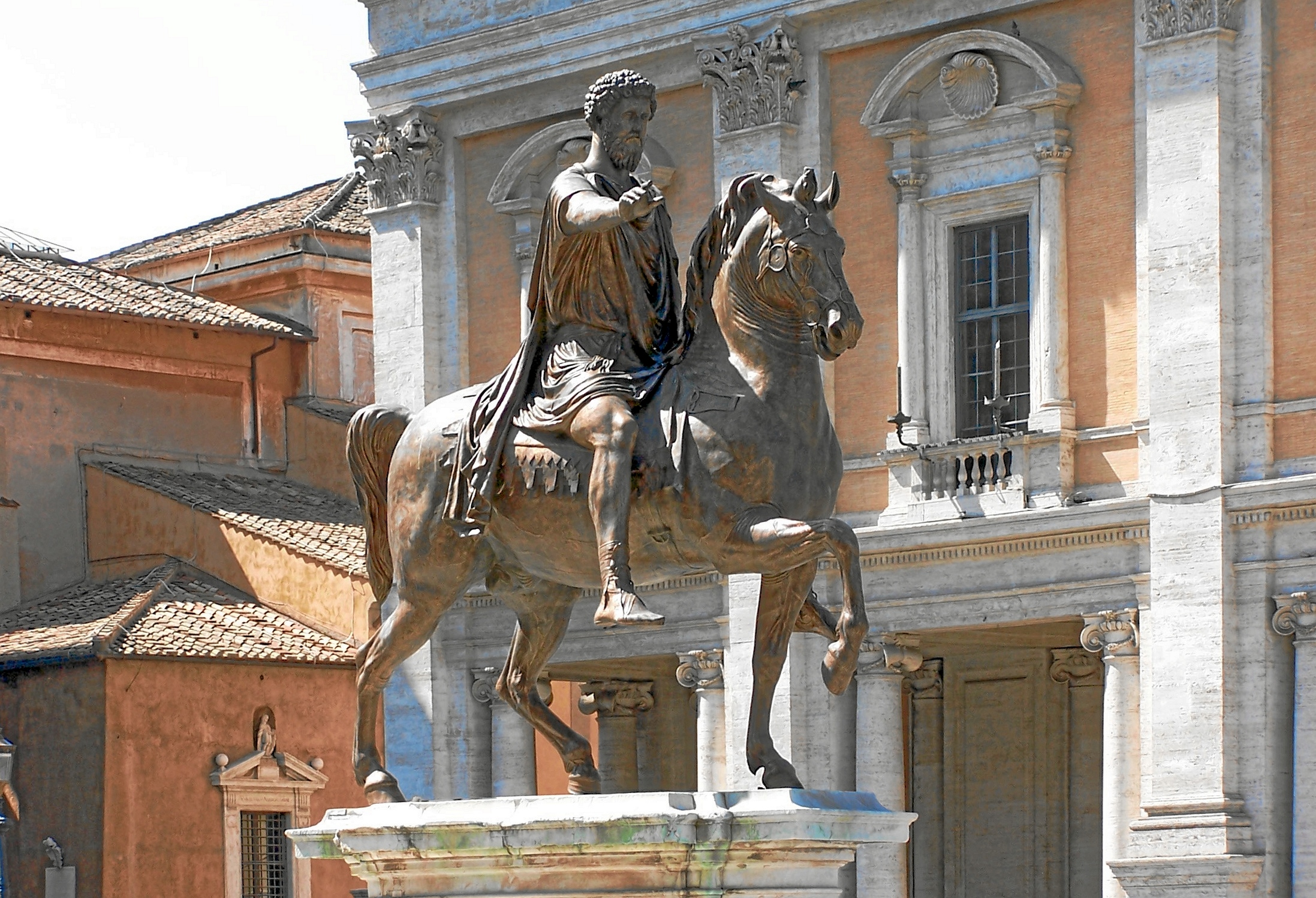
Marcus Aurelius (121 to 180 CE) ruled Rome for nineteen years, fought long wars on the Danube frontier against the Quadi and the Marcomanni, and somewhere in the middle of all of it kept a notebook. He wrote it in Greek, by hand, for no reader at all. He gave it no title; the Greek headings that survive amount to ta eis heauton, roughly "things to himself." The book that comes down to us as the Meditations is that notebook: twelve short books of jotted reminders, repetitions, and self-corrections, never edited for publication, possibly never intended to outlive him. That it survived is close to an accident. That it became one of the most-read works of moral philosophy ever written is one of the odder facts in the history of the subject.
What it is not is a treatise. Aristotle's Ethics walks an argument from a first sentence to a conclusion. The Meditations does the opposite: it circles. The same few ideas come back in book after book, stated a little differently each time, because the point was never to prove them to anyone. The point was to drill them into the one person who wrote them, so that they would be available in the moment they were needed, which is exactly when they are hardest to remember. Reading it is less like following a lecture than like overhearing a man coach himself through grief, exhaustion, flattery, anger, and the certainty of his own death.
And the ideas are not original to him. Marcus is a Stoic, working a school of thought already four centuries old by his time, and his most important debt runs through one book. As a young man he was given the recorded teaching of Epictetus, a former slave turned Stoic teacher, by his tutor Quintus Junius Rusticus. Marcus names the gift in the very first book, in his catalogue of the people he owes: he is indebted to Rusticus, he writes, "for being acquainted with the discourses of Epictetus, which he communicated to me out of his own collection." Almost everything the notebook rehearses is Epictetus, turned inward and applied by a man with absolute power and very little time.
The break
Ancient philosophy left behind dialogues built to persuade (Plato), lecture courses built to teach (Aristotle), and systematic treatises built to defend a doctrine against rivals. All of them face outward, toward a reader or a listener or an enemy school. The Stoics in particular had a reputation as system-builders, with theories of , physics, and meant to lock together into one rigorous whole, defended in public against the Epicureans and the Skeptics. , on the page, was a case that could be won.
The Meditations is what Stoicism looks like with the audience removed. It is not trying to convince anyone, because no one was meant to see it. It carries no proofs, refutes no opponents, and is happy to repeat itself, because repetition is the whole method. The Stoics had always insisted that philosophy was not a body of doctrine to be admired but a practice to be lived, a daily training of judgment and attention. The notebook is that claim made visible: it is the training itself, the reps, written down. When Marcus tells himself for the fifth time that he will die soon, he is not informing himself of a fact he forgot. He is doing the exercise again because the exercise is never finished.
The concrete move is this. Before the Meditations, the surviving philosophy of the good life argues its case to the world. The notebook turns the same Stoic case entirely inward and shows what it costs to actually run it: a man rehearsing the dichotomy of what is and is not in his control, the nearness of death, and his duty to the common good, every day, because every day he can feel himself sliding off them. It is the rare philosophical classic whose subject is not an idea but the daily labor of holding onto one.
Chapter 1
A notebook, not a book: what the Meditations is
"From my grandfather Verus [I learned] good morals and the government of my temper."
The first thing to settle is the kind of object the Meditations is, because almost every wrong reading of it starts by treating it as a book that was written for someone. It was not. It is twelve books of private notes, in Greek, kept by Marcus during the last decade or so of his life, much of it during the frontier wars of the 170s CE. The standard text shows several books with notes placing them in the field, written "during the war with the Quadi," one of the Germanic peoples Rome was fighting on the Danube. There is no dedication, no introduction, no sign the author expected another pair of eyes. The Greek title that comes down with it, ta eis heauton, just means something like "things addressed to himself." The English title Meditations is a later editor's choice and slightly oversells it; "notes to self" would be closer.
That single fact reorganizes everything else. A treatise is judged on whether its argument works. A notebook is a different animal: it is judged on what it was for, and this one was for keeping its author steady. So the repetition that would be a flaw in a treatise is the feature here. The same handful of ideas return again and again because the notebook is a tool of rehearsal, not exposition. The Stoics called this kind of writing a spiritual exercise, a practice: the truth is written down not to discover it but to wear a groove for it, so that under stress the right thought is the one that comes first. The Meditations is a record of those exercises, which is why it reads like a man saying the same things to himself in slightly different words until they take.
Book 1 is the clue to how the rest should be read, and it is unlike anything that follows. Instead of doctrine it is a long list of debts: what Marcus learned, and from whom. "From my grandfather Verus [I learned] good morals and the government of my temper." From his mother, piety and plain living. From a string of teachers, specific habits of character, each one named. Among them is the entry that matters most for the whole book, the debt to his Stoic teacher Rusticus, who handed him Epictetus. Book 1 is gratitude turned into an inventory, and it does a quiet philosophical job: it states, before any argument, that a self is something assembled out of other people's examples. The man writing the reminders is showing where the reminders came from.
It also sets the voice for everything after it. There is no performance in Book 1, no claim to have invented anything, no audience to impress. A man is taking stock of who shaped him and what he owes them. That tone, sober, unshowy, addressed to no one, is the registration mark of the whole work. When the later books turn to death, anger, fame, and duty, they keep it. The Meditations never argues at the reader because it never knew there would be one. It only ever talks to the man holding the pen.
Chapter 2
The morning rehearsal: meeting other people
"Begin the morning by saying to thyself, I shall meet with the busybody, the ungrateful, arrogant, deceitful, envious, unsocial."
The most famous single passage in the Meditations is also the most practical, and it sits right at the head of Book 2. It is a morning exercise, a thing to say to yourself before the day starts. "Begin the morning by saying to thyself, I shall meet with the busybody, the ungrateful, arrogant, deceitful, envious, unsocial." An emperor's day was a procession of people wanting things and people behaving badly, and the rehearsal is a way of disarming the anger before it arrives. The trick is to expect the bad behavior in advance, so that when it comes it confirms a forecast instead of detonating a surprise. Resentment, on this view, is mostly the gap between what people are and what we keep insisting they should be. Close the gap in the morning and the day has less to throw.
But the passage does not stop at managing irritation, and the part that follows is the Stoic core of it. The reason these people act badly, Marcus tells himself, is "their ignorance of what is good and evil." They are not villains; they are mistaken about what actually matters, chasing money and status and revenge as if those were the good. And then the move that makes it Stoic rather than merely shrewd: the wrongdoer "is akin to me; not [only] of the same blood or seed, but that it participates in [the same] intelligence and [the same] portion of the divinity." Every rational being shares in the same reason that orders the universe, which makes them, literally, kin. "For we are made for co-operation, like feet, like hands, like eyelids." Hands do not resent hands. Parts of one body do not take offense at each other.
The conclusion he draws is hard and characteristic: "I can neither be injured by any of them, for no one can fix on me what is ugly, nor can I be angry with my kinsman, nor hate him." The claim that no one can injure a man sounds absurd until the Stoic premise behind it is in view, and that premise is the engine of the next chapter: the only thing that can truly harm a person is his own bad judgment, his own vice, and no other person can reach inside and install that. Another man can damage a reputation, seize property, ruin standing at court. He cannot make his victim unjust or cowardly or cruel. Only the person himself can do that. So the rude, the ungrateful, and the scheming are not a threat to the one thing that is actually his, and anger at them is misplaced.
This is also where the notebook's purpose shows plainly. Marcus comes back to anger constantly, across many books, with the same conclusion each time. A man who had truly absorbed "no one can injure me" would not need to write it down ten times. He writes it ten times because he is an emperor surrounded by flatterers and rivals and he keeps getting angry anyway, and the reminder is a tool he reaches for again because he keeps needing it. The repetition is not redundancy. It is the sound of a difficult practice being kept up by someone who has not mastered it and knows he never quite will.
Chapter 3
What is mine: the Epictetan inheritance
"I am indebted to him for being acquainted with the discourses of Epictetus, which he communicated to me out of his own collection."
Underneath every individual reminder in the Meditations runs one idea, and it is not Marcus's. He took it from Epictetus, the former slave whose recorded teaching he was handed as a young man, and he says so in Book 1: he is indebted to his teacher Rusticus "for being acquainted with the discourses of Epictetus, which he communicated to me out of his own collection." Epictetus had opened his own handbook with a single division that the whole of Stoic practice hangs on, usually called the dichotomy of control: some things are up to us, and some things are not. Up to us are our own judgments, choices, and desires, the workings of our own mind. Not up to us is everything else, including our body, our property, our reputation, and the actions of other people.
The force of the division is in how it sorts the world. Almost everything people lose sleep over, getting sick, being insulted, losing money, dying, being disliked, falls on the "not up to us" side. Those things genuinely happen and genuinely matter to the body and the circumstances, but none of them is the self. The self is the ruling part, the faculty that judges and chooses. Marcus states the inventory of what he actually is in Book 2, with deliberate plainness: "Whatever this is that I am, it is a little flesh and breath, and the ruling part." The flesh and breath are on loan from nature and will be reclaimed. The ruling part, the seat of judgment, is the only territory that is his to govern, and it is the only territory the whole notebook is really concerned with.
Take a concrete case to see the move at work. A man is slandered at court and his honor damaged. The instinct is to treat this as an injury done to him that demands a response. The Stoic correction runs in two steps. First, sort it: the slander itself, the words in other mouths and the opinion in other heads, is not up to him, so it is not where his effort belongs and not what can actually harm the only thing that is his. Second, find what is up to him: his own judgment about the slander, and his own conduct in response. He cannot control whether he is lied about. He can control whether he becomes bitter, whether he retaliates unjustly, whether he keeps doing his duty. The damage to reputation is real but external; the only damage that touches the self is the damage he would do to his own character by responding badly.
This is why the Stoic claim is not the cold indifference it is often mistaken for. It is not that nothing matters. It is that exactly one thing belongs to a person without reservation, the quality of his own choices, and that putting his peace at the mercy of anything else, things that other people and luck and the body control, is handing a life to forces that will not return it. Epictetus, who had been a literal slave, taught that this inner freedom was the one no master could confiscate. Marcus, who held more external power than almost anyone alive, was drilling himself in the same lesson from the opposite end: that all of it, the empire included, sat on the "not up to us" side, and that the only thing he truly ruled was the small sovereign space behind his own eyes.
Chapter 4
Death is close: impermanence and the use of it
"Time is like a river made up of the events which happen, and a violent stream; for as soon as a thing has been seen, it is carried away, and another comes in its place."
No theme returns in the Meditations more often than death, and none is more easily misread as morbid. Marcus reminds himself constantly that he is going to die, that everyone he knows is going to die, that everyone famous is already dead and mostly forgotten, that the present moment is the only thing anyone ever actually has. The reminders are not despair. They are a method, the oldest one in Stoic and Epicurean practice alike, of using the certainty of death to fix attention on how to live now. The point of remembering that the time is short is to stop wasting it on things that do not matter, which for Marcus means flattery, grudges, status, and the endless rehearsal of what other people think.
The picture underneath the death-reminders is a picture of total flux. Marcus sees the whole world as a single river of change in which nothing holds still. "Time is like a river made up of the events which happen, and a violent stream; for as soon as a thing has been seen, it is carried away, and another comes in its place, and this will be carried away too." Substance itself, he writes elsewhere, "is like a river in a continual flow." Bodies, reputations, empires, the men who built them, all of it streams past and dissolves and is replaced. To grip any of it tightly is to grip running water. The proper response is not grief but a kind of release: these things were always passing, and wanting them to stay is wanting the river to stop.
From the flux he draws a rule for action, stated as a memento mori in Book 2: "thou doest every act of thy life as if it were the last, laying aside all carelessness and passionate aversion from the commands of reason." Living each act as if it were the last is not a counsel of recklessness; the rest of the sentence makes it the opposite. It means doing each thing with full seriousness and no half-heartedness, because there may be no later in which to do it properly, and dropping the careless distraction and the resentment that no one would want as the last act. He sharpens it in the next book: "Since it is possible that thou mayest depart from life this very moment, regulate every act and thought accordingly." Death is not the enemy of the project. It is the deadline that gives the project its weight.
And the flux cuts fame down to size, which for a man at the summit of the world was probably the most necessary cut of all. Closing the great passage where he looks down on the whole human race, Marcus tells himself the verdict directly: "neither a posthumous name is of any value, nor reputation, nor anything else." The people praising a man now will soon blame him, and soon after that everyone who could have remembered his name will be dead too. An emperor stripping the value out of his own future glory is the notebook at its most clear-eyed. If reputation is worthless and time is a river, then the only thing left that carries any weight is the one thing that is actually his: doing right, now, while there is a now to do it in.
Chapter 5
The view from above: the whole, and a man's place in it
"Look down from above on the countless herds of men and their countless solemnities, and the infinitely varied voyagings in storms and calms."
Set against the close attention to the present moment is the opposite exercise, a deliberate pulling-back to the largest possible scale, and it is the most distinctive imaginative move in the book. The practitioner rises above his own life and takes it in from far off. "Look down from above on the countless herds of men and their countless solemnities, and the infinitely varied voyagings in storms and calms, and the differences among those who are born, who live together, and die." The exercise sets the whole earth in view, all the crowds, all the ceremonies people take so seriously, all the journeys and quarrels and ambitions, seen from a height where the individual figures blur into herds. Later readers came to call this the view from above, and it is a recurring practice in the notebook, not a one-off image.
The exercise does a specific thing: it shrinks the things that loom. From ground level, an insult or a setback or a court intrigue fills the whole field of vision. From the height Marcus is rehearsing, it is one tiny event among millions, lived by one mortal among countless mortals across all of time, most of whom will never know it happened and all of whom will soon be gone. Marcus borrows the same move directly from Plato in Book 7, quoting him: "The man who has an elevated mind and takes a view of all time and of all substance, dost thou suppose it possible for him to think that human life is anything great?" Seen against all time and all matter, no single human grievance is large. The width of the frame is the cure for the size of the grievance.
Behind the imaginative exercise sits the Stoic physics that makes it more than a mood. For the Stoics the universe is not a heap of separate things but a single living, rational whole, ordered through and through by what they called the logos, the reason or providence that runs the cosmos the way a mind runs a body. Everything that happens follows from that order, which means everything that happens is, in the largest view, part of one coherent process. Marcus's name for it is nature, and his attitude toward it is acceptance: what the whole sends him is his portion, fitted to him by the same nature that fitted the seasons to the year. This is the deep reason the view from above brings calm rather than dread. The practitioner is not a lost speck in a void but a part doing its part in a whole that is going somewhere, and the smallness is the smallness of a cell in a body, not of a stranger in the dark.
This providence is asserted in the notebook more than it is proved, and Marcus knows the alternative. He allows, in one passage, that the universe might be ordered providence or it might be mere atoms colliding by chance, and he tells himself that his task is the same either way: govern the one part that is his and do his duty. That open hand toward the deepest question is part of the book's seriousness. The view from above does not require certainty that the cosmos is kind. It requires only the discipline of stepping back far enough to see that one man's troubles are not the center of it, and the resolve to act well in that small corner regardless of which story about the whole turns out to be true.
Chapter 6
Do the work: duty, acceptance, and the obstacle
"that which is a hindrance is made a furtherance to an act; and that which is an obstacle on the road helps us on this road."
All the rehearsals point at one practical end, and it is the least mystical thing in the book: get up and do the work. The Stoic does not retreat from the world to find peace; the Stoic finds peace by doing his duty in the world, for the common good, as his nature and his role require. Marcus, who could have used philosophy as an excuse to withdraw from the grinding business of war and administration, uses it for the reverse. The reminders about death and flux and the smallness of fame are not arguments for stepping back. They clear away the distractions, the resentment and the vanity and the fear, that get between a man and the job in front of him. A rational being is made for action on behalf of the whole, the way a hand is made to grip, and a hand that refused to work would be failing at the one thing it is for.
The hard half of duty is accepting the conditions one is handed, which is where the Stoic idea later summed up as loving one's fate comes in. A man does not choose his circumstances; he only chooses how he meets them. So Marcus trains himself to take what the whole sends, illness, treachery, hard winters on the Danube, the deaths of his children, not as outrages against him but as material assigned to him to work with well. This is the deepest sense of the dichotomy of control from Chapter 3, run all the way out. What happens is not up to him. What he makes of it is entirely up to him. The events are raw material; virtue is what he builds out of them, and there is no event so bad that it cannot be the occasion for some right response.
That conviction produces the book's most quoted practical idea, in Book 5, about the very things that obstruct action. The mind, Marcus writes, "converts and changes every hindrance to its activity into an aid; and so that which is a hindrance is made a furtherance to an act; and that which is an obstacle on the road helps us on this road." The argument is precise. When the goal is some external outcome, an obstacle defeats it. But when the goal is to act with virtue, the obstacle becomes the exact occasion to do so: an injustice is the chance to be just, a hardship the chance to be brave, an interruption the chance to be patient. The thing blocking the road becomes the road, because the road was never really to the outcome. It was always to the right response, and the obstacle supplies one.
Modern readers know this passage through the slogan "the obstacle is the way," which became the title of a bestselling book in 2014 and is now stamped on Marcus's name everywhere. The slogan is a fair compression of the idea, but it is a recent paraphrase, not a line Marcus wrote. His own sentence is the longer, more careful one above, and the slogan loses its crucial qualifier. Marcus is not promising that every setback secretly works out for the best. He is making the narrower, tougher claim that no setback can stop a man from responding to it well, which is the only kind of success the notebook ever counts. That is the whole of the Meditations in one move: strip ambition down to the one thing fully in a person's power, the quality of his own action, and then nothing the world does can cancel the work, because the work was always his alone to do.