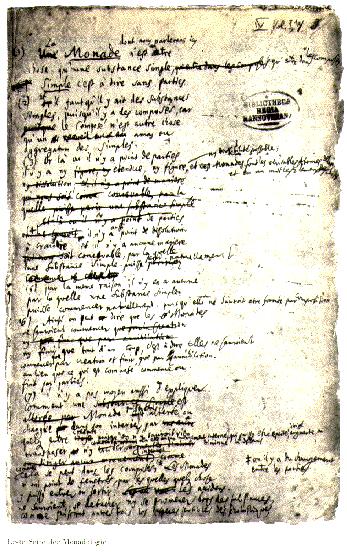
The book has no title because Leibniz never gave it one. He wrote it in French in 1714, during his last stay in Vienna, as a short condensation of his whole philosophy, ninety numbered paragraphs that a reader could work through slowly. He wrote it for Nicolas Remond, a philosopher and royal librarian in Paris who had read Leibniz's one big published book, the Theodicy, and wanted the system stated plainly and in brief. Then Leibniz set it aside. He died two years later, in 1716, with the manuscript unpublished. The name it now carries, The Monadology, was coined by a German translator, Heinrich Köhler, who published the first edition in 1720, four years after the author was in the ground. The original French text Leibniz actually wrote did not appear in print until 1840.
What the ninety paragraphs contain is the most compressed version Leibniz ever made of a picture of reality that almost no one has ever been able to half-believe and no one has ever quite been able to dismiss. The picture is that the universe is built out of simple substances with no parts, immaterial points he calls monads (immaterial meaning they take up no space and have no physical size), and that these monads are sealed: nothing goes into one and nothing comes out. On this account no two things in the world ever interact. A hand does not lift a cup. An argument does not change a mind. The whole spectacle of a world full of causes and collisions is real as it appears and false as a description of what is actually happening, which is infinitely many separate things each unfolding from inside itself, all of them arranged in advance to agree.
The Monadology is an argument, and a famously tight one, where each section is supposed to follow from the ones before it. It begins with a definition of the monad, derives that monads can have no windows, infers from that how change and perception must work inside them, lays down the two principles on which all reasoning rests, uses one of those principles to prove that God exists, and then shows how a perfect God, choosing among infinitely many possible worlds, would produce this one. The book is a staircase. The reward for climbing it in order is that the conclusions that sound maddest at the top, the best of all possible worlds, the soul and body that never touch, are seen to rest on premises that looked almost harmless at the bottom.
It is also the source of the single most famous caricature of any philosopher. Leibniz's claim that this is the best of all possible worlds was turned, by Voltaire's Candide in 1759, into Dr Pangloss, the tutor who beams through earthquakes and massacres insisting that all is for the best. The caricature has outlived the argument by two and a half centuries, to the point where Leibniz's name is shorthand for fatuous optimism. What he actually argued is harder and far less comfortable, and reading the book in order is the only way to see the difference between the position and the parody.
The break
The view the Monadology breaks from is the one the new science of the seventeenth century had made almost irresistible, and it deserves its strongest form. On that view the world is matter in motion. Reality is made of extended stuff, things that take up space, and what happens is that these things push and strike and deflect one another according to fixed laws. The triumph of the age, the physics of Galileo and Descartes and Newton, was built on exactly this picture, and it worked: the heavens and the tides and the fall of bodies all yielded to it. It is not a naive view. It is the most successful framework anyone had ever found, and its central idea is that to explain something is to find the matter that pushed it.
Leibniz attacks the picture at its foundation, with an argument about what extension is. Anything extended takes up space, and anything that takes up space has a left side and a right side, which means it has parts. Those parts are extended too, so they have parts, and there is no end to the division. So extended matter is never the bottom of anything; it is always a heap of smaller heaps, on and on. But a heap is real only because the things it is a heap of are real. If there were no genuine units anywhere, units with no parts, then there would be nothing for the heaps to be heaps of, and so nothing at all. The ultimate constituents of reality therefore cannot be bits of matter, because every bit of matter divides. They have to be simple, partless, and so unextended. These are the monads, and the first six sections of the book establish exactly this.
Once the basic things are partless and unextended, they cannot be pushed, because there is no surface to push and no inside for a push to enter. Section seven draws the conclusion that gives the system its signature: the monads have no windows. Nothing passes between them. And that single move dissolves the problem the matter-in-motion picture could never solve, the problem of how mind fits the machine. The mechanists had a world of colliding bodies and could not say how a thought, which has no size and exerts no force, could ever move an arm. Leibniz answers that it never does, and neither does anything move anything else; the appearance of one thing acting on another is the agreement of two sealed things running in parallel.
What replaces the machine is stranger than the machine, and the rest of the book is the working-out of it. If nothing acts on anything, then each monad must generate its entire stream of states from within itself, and yet all the monads must somehow add up to one shared world. Leibniz's solution is that each monad perceives the whole universe from its own point of view, that God fitted all these private perspectives together at the creation so they agree forever, and that this pre-arranged agreement, not any push or pull, is what a world is. The matter the physicists studied is not abandoned; it is demoted, recast as the well-grounded appearance that infinitely many perceiving monads present. The break is total: not a better account of matter in motion, but the claim that matter in motion was never the ground floor.
Mechanism was not the only rival answer Leibniz had to beat. The deepest competing system came from his own rationalist side of the field. Baruch Spinoza's Ethics, written in the same -first vein and circulated after Spinoza's death in 1677, gave the opposite answer to the same starting question. Where Leibniz would end with infinitely many genuine substances, Spinoza had argued there is only one substance, God or Nature, infinite and self-caused, of which every finite thing (every body, every mind) is not a substance at all but a passing mode, a temporary modification of the single whole. Leibniz had visited Spinoza in The Hague in 1676 and read the manuscript, and he spent the rest of his life explaining why the one-substance answer failed. The disagreement is not a footnote. It sets up the whole problem the later chapters solve: if reality is many separate substances rather than one, then their agreement has to be explained, because they cannot simply be aspects of a single thing the way Spinoza's modes are. The Monadology is, among other things, the tightest case Leibniz ever made for the many over the one.
Chapter 1
The book with no title
"The Monad, of which we shall here speak, is nothing but a simple substance, which enters into compounds. By 'simple' is meant 'without parts.'"
Leibniz wrote the Monadology in French in 1714, in Vienna, where he was spending his last long stretch away from his post at Hanover. He was sixty-eight, out of favor with his own employer, and entangled in the bitter dispute with Newton's supporters over who had invented the calculus, a fight that had already damaged his standing in England. The text was a piece of legacy-building by a man who knew his time was short. It was written for Nicolas Remond, a philosopher and royal librarian in Paris who had read Leibniz's Theodicy of 1710 (his one big published book, on why a good God allows evil) and written asking for a condensed account of the whole system. That is the documented occasion: a short, dense map of his philosophy, made for a correspondent in Paris.
A separate text is often confused with this one, and the ledger of facts keeps them apart. In the same Vienna summer Leibniz wrote a companion piece, the Principles of Nature and Grace, a more popular and accessible version of the same system, and that one was explicitly composed for Prince Eugene of Savoy, the great military commander. The two pieces were written side by side as parallel condensations, and the order in which they were drafted is not settled. The Prince Eugene connection belongs to the Principles of Nature and Grace. The Monadology itself was Remond's. Conflating the two, and crediting the Monadology to Prince Eugene, is a common slip.
The system the book condenses was not worked out in isolation, and the correspondents who shaped it were not all men. For more than three decades Leibniz had carried on an intensive correspondence with Sophia of Hanover, the Electress who was his primary patron, on exactly the metaphysical questions the Monadology settles. Her daughter Sophie Charlotte, Queen of Prussia, was a genuine intellectual interlocutor whom Leibniz had tutored and pressed on these same problems; the Theodicy grew directly out of their long conversations, and was published in 1710, five years after her early death in 1705. A third, Caroline of Ansbach, later Princess of Wales, was his most politically connected late-life ally and would soon serve as the intermediary for his bitter exchange with Newton's camp. Sophia died in June 1714, the same summer Leibniz wrote the Monadology, and the stability she had given him at Hanover died with her.
The book was never published in Leibniz's lifetime, and it had no title. He died in Hanover in November 1716, of gout, with the manuscript among his papers. The name Monadology was supplied by Heinrich Köhler, who brought out the first edition, a German translation, in 1720, calling it roughly Propositions on the Monadology. A Latin version followed in 1721. The French original that Leibniz actually wrote did not see print until 1840, in an anthology of his works, by which time the editor simply kept the title Köhler had invented. So the work universally known as The Monadology carries a name its author never chose, in a language he did not write it in, applied a century and more after his death.
There is a further wrinkle that the careful editions record. Köhler's 1720 German text seems to have been made not from the final manuscript but from an earlier draft he may have gotten from Leibniz directly in 1714. Three manuscripts of the final French text survive, one an autograph with the author's own corrections. So the German and Latin translations that the world first read predate the French original they purport to translate, and were made from a different copy of the text. None of this changes the argument. It is simply the strange afterlife of a private paper that became, against every accident of its publication, one of the most studied short works in philosophy.
The argument it makes begins where the system begins, with a definition. Section one states that the monad, the thing the whole book is about, is nothing but a simple substance that enters into compounds, and that by simple is meant without parts. Section two supplies the reason there must be such things: compounds are nothing but collections of simples, so if there were no simples there would be no collections and therefore nothing at all. The word monad comes from the Greek for unit, and the choice is exact. A monad is a true one, a genuine unit, in a world where everything ordinary thought of as a thing, a stone or a body or a star, turns out on inspection to be a heap. The book is the attempt to describe the genuine units beneath the heaps. This does not mean matter is an illusion to be thrown away. Leibniz keeps it, but demotes it: physical matter is a well-founded phenomenon, real as an appearance and reliable enough for physics to measure, but grounded in the perceptions of the monads underneath rather than being a basic substance in its own right. He is not denying that bodies exist; he is saying that what a body finally is, when traced to the bottom, is an aggregate of perceiving simples.
Chapter 2
No windows
"The Monads have no windows, through which anything could come in or go out."
Having established that the basic things are simple, sections three through six draw out what simplicity forbids. A monad has no parts, so it has no extension, no shape, and no divisibility; there is nothing in it to take apart. It cannot come into being or go out of being by natural means, because natural change is rearrangement of parts and a monad has none. It can begin only by creation and end only by annihilation, all at once, by the act of God. So the monads are not built up out of anything smaller and cannot wear down into anything smaller. They are the floor. Everything else in the universe is some arrangement of them, but they themselves are arranged out of nothing.
Section seven turns this into the move that names the system, and it runs to more than the famous phrase. Leibniz argues that there is no way to explain how one monad could be altered or internally changed by any other created thing, because there is nothing in a simple substance to rearrange. One cannot move a part of it, since it has no parts, nor set up any internal motion inside it, since there is nothing inside to move. From this he concludes, in the line that names the system: the monads have no windows, through which anything could come in or go out. Nothing can enter a monad from outside, and nothing can leak out of one to reach another. The sealed quality of the monad is not an extra mystical claim added on top. It is forced by simplicity. A thing with no parts has no opening, because an opening is a feature of something with an inside and an outside, and a partless point has neither.
The consequence is enormous and Leibniz states it without flinching. If no monad can be changed by any other, then no monad ever acts on any other. There is no causation between substances at all. What looks like one billiard ball driving another, or a fire warming a hand, or a spoken word changing a listener's mind, involves no transfer of anything from the first thing to the second, because there is nothing that could pass between two windowless points. The world's apparent traffic of causes is, at the level of the genuine units, a fiction. This is the price of section seven, and the rest of the book is in large part the project of paying for it: of showing how a universe with no internal causation can nonetheless look exactly like a universe full of it.
If nothing comes in from outside, then whatever change a monad undergoes must come entirely from inside, and Leibniz says so directly. Each monad has an internal principle that drives it from one state to the next. He gives the two states proper names. The momentary content of a monad, the way it represents at one instant the whole multiplicity of the universe within its own unity, he calls perception. The internal force that carries it from one perception on to the next he calls appetition, an inner drive, not a striving toward any outside object (it has no windows through which to reach one) but a tendency toward the next state that the monad's own nature produces, the way a wound spring tends toward its next position. So a monad is not an inert dot. It is a perpetual activity, a sequence of perceptions pushed along from within by appetition, generating its whole biography out of its own nature. Picture one monad that, on what looks from outside like Monday, has a dim perception of a tree, and on Tuesday a sharper one. Nothing about the tree reached in to sharpen it. The later perception unfolded from the earlier one by the monad's own appetition, the way a spring unwinds the next turn from the tension already coiled into it, owing nothing to anything around it.
It follows that no two monads can be exactly alike, which Leibniz also draws out in this stretch of the book. If two monads were identical in every respect, indistinguishable in every perception, there would be no fact that made them two rather than one, and nothing in the order of things to ground the difference. Every monad must therefore differ from every other in its perceptions, which is to say in the particular way it mirrors the universe. This is the seed of one of his most striking claims: nature never makes perfect duplicates (what philosophers call the identity of indiscernibles, the rule that if two things were alike in every single respect, down to every last perception, there would be no fact left over to make them two, so they would have to be one). The reason is already present here in the sealed point: since each monad is nothing but its own private stream of perceptions, two monads with the very same stream would not be two.
Chapter 3
From a sleeping stone to a knowing soul
"The passing condition, which involves and represents a multiplicity in the unit [unité] or in the simple substance, is nothing but what is called Perception, which is to be distinguished from Apperception or Consciousness, as will afterwards appear."
Every monad perceives, but it does not follow that every monad is aware of anything, and section fourteen draws the distinction the rest of the book leans on. Perception, Leibniz writes, is the passing condition that represents a multiplicity within the unity of the simple substance, and it is to be sharply distinguished from apperception, or consciousness. Perception is the having of a state that pictures the world. Apperception is the further thing of being aware that one is having it, the reflective notice a mind takes of its own contents. Put plainly: perception is having an inner picture of the world; apperception is noticing that you are having the picture. Most of the time a creature is not watching itself think; it just thinks. That watching-yourself-think is apperception. Most perception, on this account, is unconscious. A monad can be crowded with representations of the whole universe and aware of none of them, the way a person asleep is full of bodily states and notices nothing.
This lets Leibniz arrange all the monads on a single ladder of clarity, with no sharp line anywhere on it, only degrees. At the bottom are the bare monads, the ones that make up what looks like dead matter. They perceive, but dimly and confusedly, with no memory and no awareness, a kind of perpetual swoon. A stone is a colony of such sleeping perceivers. This is where Leibniz makes one of his most original moves: he holds that perception runs on continuously below the threshold of awareness, in tiny perceptions too faint to be noticed singly. The roar of the sea, he liked to point out, is the unconscious sum of the separate sounds of every wave, none of which one hears on its own, an illustration he worked out at length in the preface to his New Essays on Human Understanding. Conscious perception is only the bright, rare top of a spectrum that descends without a break into the dimmest monad. Higher up are the monads Leibniz is willing to call souls, the ones that have not only perception but memory, the lingering of past perceptions that lets an animal learn from experience. A dog that flinches at a raised stick is running on memory of this kind, an association of images, which Leibniz says imitates reasoning without being it.
At the top of the ladder are the monads he calls spirits (his term for rational, self-aware monads, the highest grade, which takes in human souls and God, not a supernatural or ghostly category but simply the clearest mirrors), and the difference that makes a spirit is apperception raised to reflection. A spirit does not merely perceive and remember; it can turn back on its own perceptions, know that it is perceiving, and so arrive at the knowledge of itself as a self. A man who burns his hand has a perception of pain, as a dog would. What the man can also do is notice that he is in pain, ask himself what caused it, and judge whether it will pass: that second loop, the mind catching itself in the act and reflecting on it, is apperception, and it is what the dog with its memory of the raised stick never reaches. From that reflective turn, Leibniz says, come the things only rational beings have: knowledge of necessary and eternal truths, and through them science, morality, and the knowledge of God. The whole of human reason is, on this picture, what perception becomes when a monad grows clear enough to perceive its own perceiving. Mind is not a different substance from matter. It is the same kind of thing, monadic perception, at the highest grade of clarity the ladder reaches.
The arrangement settles an old quarrel, and it cuts against a famous rival. Descartes, the French philosopher of the generation before Leibniz who is credited with the sharp division between thinking mind and mechanical body, had drawn a hard line through the living world: human minds think and are conscious, while animals are mere machines with nothing going on inside, no perception at all (the Descartes read; Leibniz's own version of the contrast runs through §§19-30). Leibniz replaces the line with a slope. There is no point on the ladder where perception switches on out of nothing. There is only confused perception shading by degrees toward clear, the sleeping monad toward the rational soul. The price of this is that perception goes all the way down, into the stone and the drop of water; the reward is that mind no longer has to be a miracle inserted into a dead world, because the world was never dead. It was perceiving, faintly, everywhere, all along, in a graduated hierarchy that later writers would name panpsychism, a label Leibniz himself never used and would have found too blunt for his carefully ranked degrees of perception.
Chapter 4
The two great principles
"…there can be no fact real or existing, no statement true, unless there be a sufficient reason, why it should be so and not otherwise, although these reasons usually cannot be known by us."
At the center of the book Leibniz names the two principles on which, he says, all reasoning rests, and the whole machinery of the system turns on the second of them. Section thirty-one gives the first: the principle of contradiction, in virtue of which one judges false whatever involves a contradiction, and true whatever is opposed to the false. A square circle is impossible; a thing cannot both be and not be the same way at once. Every philosopher grants this much, and it governs one whole class of truths, the necessary ones, true in every possible world, which Leibniz calls truths of reason. Their denial contradicts itself, and that is why they cannot fail to hold: a triangle has three sides, two and two make four, and the opposite is not merely false but unthinkable.
Section thirty-two gives the second principle, the one that is distinctively his and does nearly all the work to come: the principle of sufficient reason. There can be no fact that is real or existing, and no statement that is true, unless there is a sufficient reason why it is so and not otherwise, even though those reasons usually cannot be known to us. Nothing is ever simply the case for no reason. The strength of the principle shows in what denying it would cost: to give it up is to allow brute facts, things that are simply so for no reason at all, and with them a universe shot through with arbitrary gaps that no inquiry could ever close. Leibniz will have none of that. This governs the other class of truths, the contingent ones, true in this world but not in every possible world, which he calls truths of fact. That a particular person was born on a particular day, that the planets sit at the distances they do, none of this is necessary; the opposite involves no contradiction. Yet none of it is brute either. For every such fact there is a reason it fell this way rather than another.
Leibniz marks the difference between the two kinds of truth by how their analysis runs, and the point is sharper than it first sounds. A necessary truth can be resolved, by analysis, into identities, until one reaches the contradiction that its denial would involve; the analysis terminates. A contingent truth cannot be finished that way. Trace the reasons for any particular fact and one is led to a prior fact, and to a prior one, and the chain of reasons for a contingent truth runs on without end. No finite mind can ever reach the bottom of why this contingent thing is so. Only God, who sees the whole infinite series at once, can. The contingent is not unreasoned; it is infinitely reasoned, which for any creature amounts to a reason that cannot in practice be completed.
And here the principle of sufficient reason becomes a crowbar that pries open the existence of God. The reasons for any contingent fact lead only to further contingent facts, each of which is itself just one more thing that needed a reason. So the chain of contingent things, however far it runs, never contains its own sufficient reason; every link passes the demand for a reason on to the next. The total series of contingent things must therefore have its sufficient reason outside the series, in something that is not itself contingent, something that does not depend on anything else for its existence and that cannot fail to be. Necessary here is the exact opposite of contingent: not existing because of some prior cause that might have gone otherwise, but existing just because of what it is, so that its own nature is the reason it exists. Such a being needs no further reason because it is its own. Sections thirty-six and thirty-seven make exactly this move: the sufficient reason of the whole contingent world cannot lie within the world, so it must lie in a necessary being. The book has reached God not by faith but by the same principle it used on a falling stone.
Chapter 5
The necessary being
"Thus the final reason of things must be in a necessary substance, in which the variety of particular changes exists only eminently, as in its source; and this substance we call God."
The principle of sufficient reason, first put to work on why a stone falls, has by this point in the book run to the very edge of the contingent world, and section thirty-eight is where it steps off that edge into something the falling stone never promised. The final reason of things must lie in a necessary substance, in which the whole variety of particular changes is contained eminently, as in its source, and this substance, Leibniz writes, we call God. The word eminently is doing precise work. It does not mean God contains the changes the way a box contains its contents. It means God contains them in a higher and more concentrated form, the way an architect 'has' the whole building before a stone is laid, in a richer mode than the bricks ever hold it, the cause containing its effects above and beyond the way the effects contain themselves. The contingent world, with all its endless variety, has its ground in a single necessary being from which that variety issues.
From the bare necessity of this being Leibniz quickly derives its character. There is only one such being, since a single necessary substance is sufficient reason for everything and there is no work for a second. It must be without limits, containing as much reality as is possible, because there is nothing outside it to limit it and no reason for it to fall short of any perfection it could have; God is the source of all the possible essences there are. And in section forty-five Leibniz states the ontological argument almost in passing, as a thing that simply follows. The ontological argument is the attempt to prove God exists from the very concept of God alone, without looking at any evidence from the world (the name comes from the Greek for being). Leibniz's form of it is this: God alone has the privilege that, if such a being is possible, then it must exist, because its existence follows from its essence. What does it mean for existence to follow from essence? Consider how a triangle's three angles add up to two right angles purely because of what a triangle is: one cannot coherently describe a triangle and then deny that property. In the same way, the existence of a necessary being follows from what a necessary being is, since to describe it clearly is to see that it cannot merely happen to exist or happen not to. If it is so much as possible, it is actual. Leibniz thought this argument needed one repair, and the repair was his own contribution: Descartes had used the same move in his Meditations but had assumed too quickly that a perfect being is possible, and Leibniz insisted the argument is incomplete until one first shows that the concept of such a being contains no hidden contradiction.
God, then, is a monad, but not a monad among the others. The created monads are simple substances that perceive the universe confusedly or clearly and run their courses in time. God is the one substance whose existence is necessary, who stands outside the series as its reason, who is unlimited where every created monad is limited and partial. Leibniz sometimes describes the created monads as continual outflashings of the divine, produced moment by moment by God, as light is continually thrown off by its source. The created world is not a thing God made once and walked away from. It is a thing whose every monad depends at each instant on the necessary being for which the principle of sufficient reason had to reach.
It is worth seeing how much of this is the same instrument used over and over. The principle of sufficient reason explained why a particular fact falls one way; pressed harder, it explained why the whole contingent world exists; pressed to the end, it delivered a necessary being with the traditional attributes of God, unique, unlimited, the source of all essence and existence. Leibniz does not switch tools when he turns from physics to theology. The God of the Monadology is reached by the same demand for a reason that the book applies to everything, which is exactly why, in the sections that follow, the existence of this particular world will turn out to need a reason too, and the reason will be that it is the best.
Chapter 6
The best of all possible worlds
"Now, as in the Ideas of God there is an infinite number of possible universes, and as only one of them can be actual, there must be a sufficient reason for the choice of God, which leads Him to decide upon one rather than another."
With a necessary being in hand, the book reaches its most famous and most abused claim, and again it arrives by the principle of sufficient reason rather than by sentiment. Section fifty-three sets up the problem. In the ideas of God there is an infinite number of possible universes: not just the world that exists, but every other complete and internally consistent total history that could have existed in its place, every alternative that contains no contradiction. Only one of these can be made actual. So, by the principle that nothing happens without a sufficient reason, there must be a reason that leads God to decide on one universe rather than any of the others. The choice among possible worlds cannot be arbitrary, because for a perfect being an arbitrary choice would be a fact with no sufficient reason, which the principle forbids.
What reason could it be? Section fifty-four locates it in the fitness, or the degrees of perfection, that the possible worlds possess, since each possible thing has a claim to existence in proportion to the perfection it contains. A perfectly wise being knows which world is best; a perfectly good being wants the best; a perfectly powerful being can produce it. So the world that exists is the one a perfect chooser would select, the finest of the infinite candidates. Section fifty-five states the conclusion exactly: the actual existence of the best that wisdom makes known to God is due to this, that his goodness makes him choose it, and his power makes him produce it. The phrase the book is remembered by, the best of all possible worlds, belongs most prominently to Leibniz's earlier Theodicy of 1710; the Monadology states the same doctrine through section fifty-five's wisdom, goodness, and power.
Everything turns on what best means, and this is precisely where the popular picture goes wrong. Best does not mean that every event in the world is good, that no horror occurs, or that each separate thing is the finest it could be. It is a comparative claim about whole worlds, not an endorsement of any part. A possible world is a single total package, and its perfection is judged on the whole: Leibniz's measure, stated in this stretch of the book, is the greatest variety of things produced by the simplest and most general laws, the most reality reachable on the most economical rules. The best world is the most fruitful one runnable on the most elegant order. It is an optimization over the entire history, and a part of it taken alone says nothing about whether the whole was well chosen.
That distinction is what carries Leibniz's answer to the oldest problem in religion, the problem of evil. Why does a world chosen by a perfect God contain suffering, cruelty, and disaster? Because, he argues, the best total package cannot be had without some local evil. A world with genuinely free creatures is richer than a world of puppets, and free creatures can choose wrongly, so freedom imports the possibility of moral evil. A world running on simple, constant laws is more perfect than one God must keep interrupting, and constant laws mean that the fire which warms also burns. The evils are real, and Leibniz does not pretend they are secretly pleasures. He distinguishes three kinds: metaphysical evil, the mere limitation of any creature short of God; physical evil, suffering; and moral evil, sin. All three exist in the best world because they are the unavoidable cost of the features that make it best. This is a theodicy, an attempt to justify the ways of God in the face of evil, and it gave its name to the book of 1710 where he argued it at length.
Then came the demolition, and it was a novel rather than a refutation. In 1759, four years after the Lisbon earthquake of 1755 had killed tens of thousands on a church holiday and shaken Europe's confidence in a benevolent order, Voltaire published Candide. Its target was Leibnizian optimism, embodied in the tutor Dr Pangloss, who responds to war, plague, shipwreck, and the earthquake itself by serenely repeating that all is for the best in this best of all possible worlds. Pangloss became, and remains, the popular image of Leibniz: the fool who looks at catastrophe and pronounces it perfection. The book was banned at once and sold everywhere, and it fixed the caricature so firmly that Panglossian still means fatuous optimism.
The caricature inverts the actual argument, and the difference is the one already drawn, between the goodness of the whole and the goodness of the parts. Pangloss draws a moral conclusion, that since all is for the best one need do nothing about any particular evil. Leibniz's argument forbids that conclusion. His claim is about the comparative perfection of total world-histories, not about the goodness of individual events, and nothing in it says a person should accept a remediable suffering rather than relieve it. The theodicy is an explanation, an answer to why a good God's world contains evil at all; it is not a prescription to leave evil alone. Voltaire fused Leibniz's difficult metaphysical thesis with a lazy moral one and made the fusion ridiculous. The joke is brilliant and partial: it strips the metaphysical scaffolding away and holds the bare conclusion up to the light, and on its own that conclusion (this is the best world there could be) reads as permission to endure whatever happens. That objection is not nothing. Later critics have pressed it hard: whatever a theodicy's internal logic, its conclusion can function in the world as moral anesthesia, a reason to leave suffering alone, and Voltaire was registering a real danger in the doctrine, not only misreading it. Still, the joke has done what such jokes do, which is to replace the argument with the parody. The argument it buried says something far bleaker than complacency: that this world, with the Lisbon dead in it, is the best a perfect being could have made, because every other possible world was, on the whole, worse.
Chapter 7
Mirrors, two clocks, and the City of God
"And as the same town, looked at from various sides, appears quite different and becomes as it were numerous in aspects [perspectivement]…"
The book still owes an answer to the question section seven left hanging. If no monad has windows and none acts on any other, how is there one shared world rather than a swarm of disconnected private dreams? Section fifty-six gives the answer in an image: every simple substance has relations that express all the others, so that each monad is a perpetual living mirror of the universe. A monad, sealed though it is, perceives the entire universe within itself. It does not receive the universe through any window; it represents the universe out of its own nature, because God built into it, at the creation, a complete perception of the whole. There are not infinitely many little worlds. There is one universe, mirrored infinitely many times over, once in each monad.
Section fifty-seven gives the image that does the most to make this intelligible, and it is Leibniz's own. As the same town, looked at from various sides, appears quite different and becomes as it were numerous in aspects, so, because there are infinitely many simple substances, it is as if there were that many different universes; yet these are nothing but aspects of a single universe, seen from the special point of view of each monad. One town, seen from the hill to the east and from the river to the west and from the tower in its center, presents views so unlike that they could be mistaken for different towns. They are views of the one town. Each monad is a viewpoint, and the universe is the single thing that all the infinitely many viewpoints are views of. The monads share a world not by trading anything across windows they do not have, but by each independently picturing the same whole from its own angle. The best world, section fifty-eight adds, is precisely the one that secures the greatest variety together with the greatest order, the most points of view consistent with a single coherent thing for them all to be views of. That answers one question: how infinitely many sealed monads still amount to one shared world. A second question remains, and the next image is built to answer it: how the soul of a particular monad stays in step with its own body, given that it cannot act on it either.
This carries the system to its most distinctive doctrine, pre-established harmony (the claim that God synchronized every monad's internal script at the creation, so that soul and body, and indeed all monads, always agree without ever once affecting one another). It is just the windowless world seen from the angle of soul and body. Every monad, Leibniz holds, has an organic body, a colony of lower monads that it dominates, and the soul is the dominant monad of that colony. The soul and its body do not interact, because no monad interacts with any other. This is Leibniz's answer to the problem Descartes had left open and could not close. Descartes had held that an unextended, thinking mind acts on an extended, mechanical body, but he could never say how a thing with no size or location could push a thing that has both; Princess Elisabeth of Bohemia pressed him on exactly this in their letters, and he had no satisfying reply. Leibniz dissolves the problem rather than solving it: the mind never moves the body, because nothing moves anything. So how does the arm rise exactly when the will to raise it occurs? Section seventy-eight states the answer: the soul follows its own laws, and the body follows its own laws, and they agree with each other in virtue of the pre-established harmony between all substances, because they are all representations of one and the same universe. The match between will and motion is total, and the contact is zero.
Leibniz's own picture for this, used across his writings though the famous version sits in an earlier work and is paraphrased here rather than quoted, is two clocks. Two clocks can keep perfect time together in three ways. One can be linked to the other and drive it, which is ordinary causation and the thing monads cannot do. A clockmaker can stand by and reset each by hand whenever they drift, which is constant divine intervention. This was a live position, not a straw target: it was the occasionalism of Nicolas Malebranche, the leading French philosopher of Leibniz's day, who held that created things never truly cause anything and that God acts directly on every single occasion to make the soul's willing and the body's moving line up. Leibniz rejects it as making God a repairman who must work a perpetual miracle to keep the world aligned. The same instinct lay behind his quarrel with Newton's circle, carried on in the Leibniz-Clarke letters of 1715 and 1716, where Newton's side held that God must intervene now and then to keep the cosmic mechanism running and Leibniz answered that a perfect maker would never build a clock needing repair. Or the clocks can be made so perfectly at the start that they keep identical time on their own, forever, without ever being linked or touched again. Leibniz takes the third. God, in creating each monad, wrote into it the entire script of its perceptions, and fitted all the infinitely many private scripts together so that they correspond perfectly for all time. Section seventy-nine puts it in the language of causes: souls act by the laws of final causes, through their appetitions, ends, and means, and bodies act by the laws of efficient causes, through motions, and the two realms, that of efficient causes and that of final causes, are in harmony with one another. The two kinds of cause are an old distinction worth pausing on. A final cause is the goal or purpose a thing aims at, the 'in order to' kind of explanation (the hand rises in order to grasp the cup). An efficient cause is the push or mechanism that produces an effect, the 'because of' kind (the muscle contracts because a nerve fired). Leibniz's claim is that the soul runs entirely on the first sort of explanation and the body entirely on the second, and that the two stories, though neither touches the other, match at every point.
The last sections widen the harmony into a moral order. The rational souls, the spirits, are not merely the clearest mirrors of the universe; they are images of God himself, capable of knowing the system of things and so, in a small way, of acting as little creators within their own domains. Together they form what Leibniz calls, in section eighty-six, borrowing Augustine's own famous title, the City of God, a moral world within the natural world, a truly universal monarchy with God as its sovereign, the most exalted and most divine among the works of God. And the book closes on a final harmony, between the realm of nature, which runs by efficient causes and is the province of physics, and the realm of grace, which runs by final causes and is the province of spirits and morality. The two realms were synchronized at the creation along with everything else, so that the order of nature and the order of moral worth, though neither pushes the other, come out agreeing. The universe of sealed and solitary points turns out, on Leibniz's account, to be at once a perfect machine and a just kingdom, and to be both without any of its members ever once touching another. (For the man and the system at large, Leibniz.)