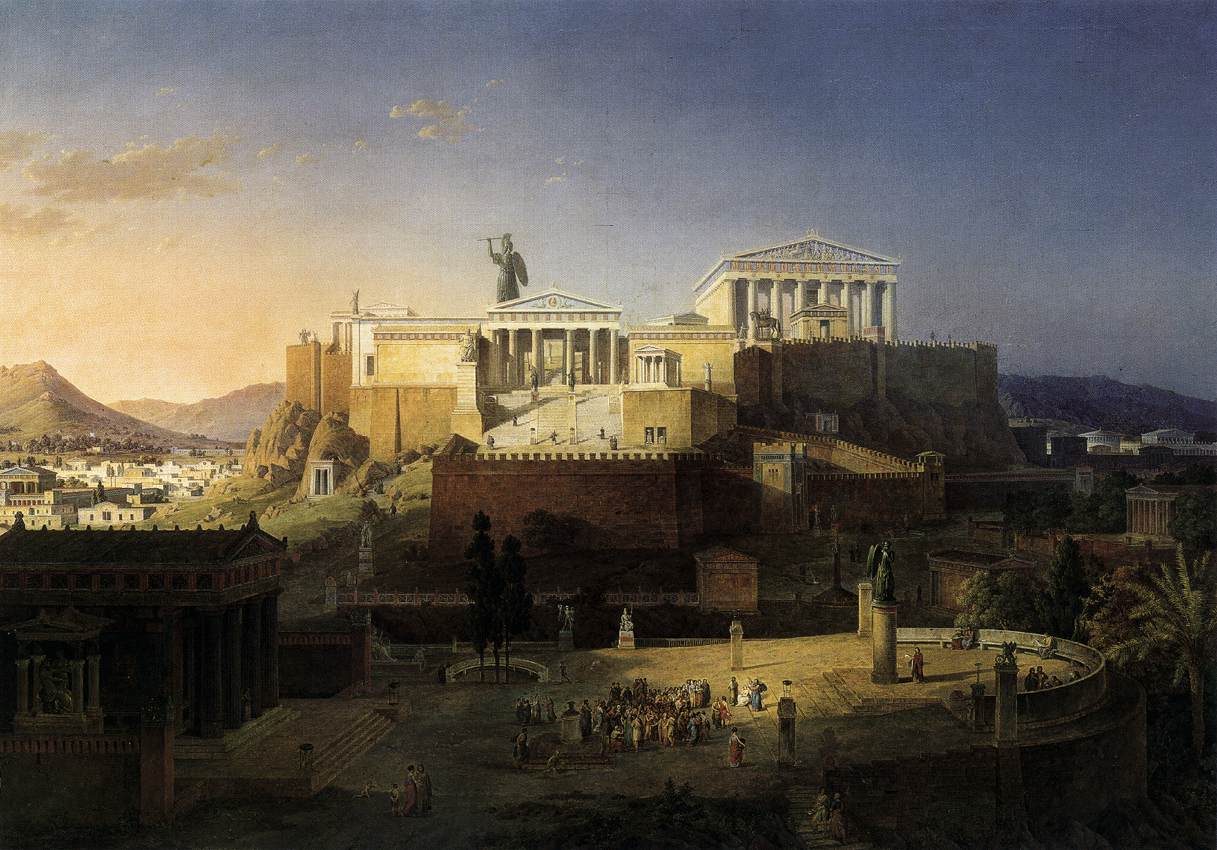
Aristotle's Politics, in Greek the Politika (the "matters of the city"), is eight books of lecture notes from his mature years teaching at the Lyceum, his school in Athens in the 4th century BCE. The title is a little misleading in English: it is not "politics" in the modern sense of parties and elections but the whole study of the polis (POH-lis), the self-governing Greek city-state: how people live together in one, what it is for, who should run it, and how it falls apart. And the book asks that question in a way no one had before. It opens with the smallest thing, a single household, and builds the city up out of it; it sorts every government there is into six types by two simple tests; it locates the most durable state in the people in the middle; and along the way it stops and argues, at length, that some human beings are slaves by nature. All of that is one continuous argument, from the family in Book I to the schooling of children in Book VIII, and it is the foundation of Western political thought.
The thing that sets the Politics apart from Plato's Republic, the great work it answers, is its method. Plato found the best city by looking up, away from the messy real ones, toward an ideal pattern, and put philosopher-kings in charge of it. Aristotle looked down, into the cases. He and his students collected and compared the constitutions of a hundred and fifty-eight real Greek city-states (the figure is the traditional one, reported in antiquity; only one of those studies, the Constitution of the Athenians, survives nearly whole), and reasoned out his conclusions from the actual evidence of how cities were governed and why they succeeded or failed. Where the Republic is the founding work of political , the Politics is the founding work of political science: the first attempt to study government the way a naturalist studies animals, by collecting the specimens and sorting them into kinds.
The break
The question on the table was old, and the towering answer to it was Plato's. Greek political thought asked: what is the best constitution? And Plato's Republic answered by building the ideal city in speech, ruled by philosopher-kings who had seen the Form of the Good, with the guardians' families and property abolished to kill private interest. It is idealist: the best city is found by looking away from the real ones, up toward a perfect model. And it was Aristotle's own teacher's, the view he lived inside for the twenty years he spent in Plato's Academy.
Aristotle inverts the method and answers the same question from the ground. He and his school collect a hundred and fifty-eight real constitutions and reason up from the cases. Three moves follow that no earlier work had welded together. First, the city is natural (the completion of a growth from household to village to polis), so "man is by nature a political animal," not a contract clever individuals invented. Second, constitutions sort into a clean two-axis scheme (who rules, crossed with for whose benefit), yielding six forms, three correct and three deviant: the first systematic taxonomy of government. Third, the best workable state is not a philosopher's utopia but a broad-middle-class "polity" (his good popular regime), stable precisely because it is moderate: the doctrine of the mean (virtue as the balance between two extremes) from his turned into political design. He even turns and critiques the Republic by name (Book II): forcing a city toward Plato's total unity does not perfect it; it dissolves it back into a household and then an individual.
Where Plato built one perfect city in his imagination and read justice off it, Aristotle collected a hundred and fifty-eight real ones and sorted them, and concluded that the best city for actual human beings is not ruled by philosopher-kings but anchored in a large, moderate middle class. That is 's first turn from the ideal to the empirical. The shadow on the break belongs in the same breath: the same treatise that gives us the political animal, the six constitutions, and the middle-class polity also gives the canon its most sustained defense of natural slavery and the natural subordination of women, woven into the very hierarchy that organizes the whole work. The achievement and the grave error stand together in one book.
Chapter 1
The city is natural: household, village, polis
"Every state is a community of some kind, and every community is established with a view to some good."
The Politics does not begin with the state. It begins with the smallest piece of one, the household (in Greek the oikos, pronounced OY-kos, the family unit of a Greek home, which to Aristotle includes not just husband, wife, and children but the property and the slaves attached to it), and builds the city up out of that, step by step. The opening sentence sets the frame for the whole book: "Every state is a community of some kind, and every community is established with a view to some good." Every grouping of people, from a household to a whole city, exists for the sake of some good its members are after; and the polis, the city-state, is the one that contains all the rest and aims at the highest good of all.
Aristotle's argument that the city is natural (not a useful arrangement people happened to invent, but something human nature grows into the way an acorn grows into an oak) runs as a sequence. The male-and-female pair comes first, for the sake of reproduction. The pair grows into the household. Several households cluster into a village. And when several villages join into a single community big enough to supply everything its people need, the city is born: "the state comes into existence, originating in the bare needs of life, and continuing in existence for the sake of a good life." That last clause is the hinge. The city starts up because people cannot survive alone, but it keeps going for something more than survival: for the good life, the chance to live well and not merely to live. The polis is where a human being is finally able to flourish, and that is why it is the natural completion of the sequence, not just its biggest link.
From the naturalness of the city comes the book's most quoted line: "man is by nature a political animal." The Greek is zōon politikon, an "animal of the polis," a creature made for the city-state. The phrase gets softened in English to "social animal," which loses the point and is not what Aristotle says. He does not just mean that people like company. He means that human nature is completed only inside a political community, a city with laws and shared life, that a person is not fully a person until they are a citizen. His proof is speech: of all the animals, man alone has language, logos, and language is for more than signalling pain and pleasure, which animals can do with cries. "The power of speech is intended to set forth the expedient and inexpedient, and therefore likewise the just and the unjust." Speech is what lets humans argue about what is useful and what is right, and that argument, conducted together, is exactly what a city is. The capacity for shared moral and political life is built into the one creature that can talk about justice.
The flip side is just as sharp: a human being who needs no city at all is not living a human life. "He who is unable to live in society, or who has no need because he is sufficient for himself, must be either a beast or a god." Below the human or above it, but not a human being, because a human being, by nature, is the kind of thing that lives in a polis. The man with no city is either too brutish for one or too self-sufficient to require one, and neither is one of us.
And then a line that has worried readers for two thousand years: "the state is by nature clearly prior to the family and to the individual, since the whole is of necessity prior to the part." Read carelessly, that sounds like the state outranking the person, the individual swallowed by the collective: the seed of every later argument that Aristotle is a proto-totalitarian. But "prior" here means prior by nature and completion, the way a living body is prior to a hand. A hand cut off from the body is a hand in name only; it cannot do what a hand does, because what makes it a hand is its place in the whole. Aristotle's claim is that an individual cut off from the city is human in name only, because what completes a human being is life in a polis. It is a claim about what makes us fully ourselves, not a license for the state to override our rights, and as the later books show, his actual proposals (private property, a broad middle class, the rule of law) cut hard against the concentration of power.
Chapter 2
The grave claim: slavery by nature
"It is clear, then, that some men are by nature free, and others slaves, and that for these latter slavery is both expedient and right."
Having built the city up out of the household, Aristotle turns to the relationships inside the household, and the first one he examines is the one between master and slave. What he argues there is the gravest thing in the book and one of the most indefensible arguments in the entire Western canon, and the only honest way to read the Politics is to state it plainly, where the text states it, in the foundation of Book I: Aristotle argues that some human beings are slaves by nature, that for certain people, being owned by another is not just legal but right. "It is clear, then, that some men are by nature free, and others slaves, and that for these latter slavery is both expedient and right."
His actual argument, not a caricature of it, reveals how deeply the claim is woven into the rest of the work. He defines the natural slave as a kind of living tool: "he who is by nature not his own but another's man, is by nature a slave; and he may be said to be another's man who, being a human being, is also a possession." A slave, on this account, is "a living possession," an instrument for living that happens to be a person. And the justification runs through the same hierarchy Aristotle sees everywhere in nature, soul over body, reason over appetite: "the rule of the soul over the body, and of the mind and the rational element over the passionate, is natural and expedient." From that he reasons that those with fuller rational capacity are meant to rule those with less. "That which can foresee by the exercise of mind is by nature intended to be lord and master, and that which can with its body give effect to such foresight is a subject, and by nature a slave." The natural slave, he claims, has enough reason to follow orders but not enough to direct a life, and is therefore better off being governed by someone who has it.
This is not an incidental lapse that can be quarantined and set aside. It is structural. The very hierarchy that grounds the natural slave (the rational ruling the less-rational because that is the natural order) is the same hierarchy Aristotle uses to explain natural rule throughout the Politics: in the household, in the city, between the parts of the soul. Pull the natural-slave argument out and the scaffolding of the whole work shifts. He does grant one nuance, and it should be recorded without being mistaken for a retreat: slavery by convention, such as enslaving the captives of a war, he allows can be unjust, and notes that some thinkers of his day attacked it as such. But that concession is about the legal accident of who gets enslaved, not about the doctrine itself. Natural slavery, he insists, is just.
There is no version of this that survives. Modern scholarship is unanimous that the "natural slave" has no empirical basis whatever (there is no class of human beings constituted to be owned), and that the argument functioned to rationalize the slavery the Athens around Aristotle already practiced and profited from. It is a documented position of one of the greatest minds in history, and it is wrong. A reader who skips past it, or who lets the achievements of the rest of the book launder it, is not reading Aristotle; they are reading a flattering edit. The right thing is to let it stand as what it is: a serious moral failure at the foundation of a great work.
The same Book I lays out the household's full structure, and a second grave claim sits inside it. "The first and fewest possible parts of a family are master and slave, husband and wife, father and children": three rule-relationships, each one a case of the more-rational governing the less. And on the second of them, husband and wife, Aristotle is explicit: "the male is by nature superior, and the female inferior; and the one rules, and the other is ruled." Women, he holds, can reason, but their reason lacks full authority and cannot be decisive, so they are naturally suited to be governed rather than to govern. The contrast with Plato cuts the opposite way from how the two are usually ranked. The Republic had let women of the guardian class rule and fight alongside men, on the ground that a soul, not a sex, qualifies a person. Aristotle explicitly closes that door. On the question of women, the student is more confining than the teacher; and, like the defense of slavery, it is fully on the record and part of what reading the Politics honestly means reckoning with.
Chapter 3
Answering Plato: why a city is a plurality
"the nature of a state is to be a plurality, and in tending to greater unity, from being a state, it becomes a family, and from being a family, an individual."
Book II turns from building the city to reviewing the best constitutions other people had proposed or actually run, and its centerpiece is a head-on critique of Plato's Republic, the book Aristotle had spent two decades arguing with inside the Academy. Plato had wanted the guardians, his ruling class, to hold wives, children, and property in common, with no private family and no private wealth, so that nothing would pull a ruler's loyalty away from the city as a whole. Maximum unity: the city should be as much like a single person as it could be made, all its members feeling each other's joys and pains as one. Aristotle thinks this is exactly backwards, and that the mistake is fundamental.
His objection is that a city is, by its very nature, a plurality (many different kinds of people doing many different jobs), and that the drive toward total unity does not perfect it but destroys it. "The nature of a state is to be a plurality, and in tending to greater unity, from being a state, it becomes a family, and from being a family, an individual." Push a city toward becoming one big undifferentiated unit and the result is not a better city but a family, and then a single person, and then no city at all. A city is made of its differences: farmer and soldier and ruler, each contributing something the others need. Erase the differences in the name of unity and the thing itself is erased.
He has a practical objection too, one that has been rediscovered many times since under other names: things owned by everyone are cared for by no one. "That which is common to the greatest number has the least care bestowed upon it. Every one thinks chiefly of his own, hardly at all of the common interest." Make the children common, Aristotle argues, and instead of every child having devoted parents, every child has a thousand half-hearted ones; make the property common and it is neglected rather than cherished. The communal arrangement Plato hoped would deepen people's care for the whole would in practice thin their care out until it vanished.
And underneath it is a claim about human nature: people care for, and take pleasure in, what is genuinely theirs. "How immeasurably greater is the pleasure, when a man feels a thing to be his own; for surely the love of self is a feeling implanted by nature." Aristotle's alternative to Plato is not communism and not pure private greed but a middle position: private ownership, common use. Let people own their property, so they care for it and take pleasure in it, but cultivate the habit and the laws that lead them to share its use generously. This is one of the most pointed disagreements in the history of political thought, between the two greatest works of ancient political philosophy, on whether killing private interest perfects a city or kills it. Plato abolishes the family and property to root out private interest; Aristotle answers that the very attempt unravels the city it was meant to save.
Chapter 4
What a citizen is, and the six constitutions
"He who has the power to take part in the deliberative or judicial administration of any state is said by us to be a citizen of that state."
Book III is the theoretical core of the Politics, and it begins by pinning down a word everyone uses and few define: citizen. A citizen, for Aristotle, is not simply someone who lives in a city or was born there. Resident foreigners live in a city and are not citizens; children and the very old are citizens only incompletely. What makes a citizen is participation in ruling. "He who has the power to take part in the deliberative or judicial administration of any state is said by us to be a citizen of that state": that is, someone entitled to a share in the city's decisions, whether by sitting in its assemblies (the deliberative part) or serving on its juries and courts (the judicial part). And the city is just the sum of these participants: "a state is composite, like any other whole made up of many parts; these are the citizens, who compose it."
This is a participatory definition, and it has a hard edge that has to be named. To be a citizen is to share in governing, and by that standard Aristotle's city excludes, as a matter of course, the slaves and women whose natural subordination Book I argued for, along with resident foreigners and, in his ideal state, the manual laborers whose lives leave no leisure for ruling. The "political animal," the creature completed in the polis, turns out in Aristotle's actual city to be a fairly narrow slice of the free adult men in it. The grandeur of the claim about human nature and the narrowness of who gets to live it out sit side by side in the text, and both are Aristotle.
Then comes the signature idea of the whole work, the first systematic taxonomy of government: the six constitutions. Aristotle sorts every possible constitution by two questions. First, who rules: one person, a few, or the many? Second, for whose benefit: the common good of the whole city, or the rulers' own private interest? A constitution that rules for the common good is a correct form; one that rules for the rulers' own advantage is a deviation, a corruption of the matching correct form. Cross the two axes and there are six types, three correct and three deviant. The correct forms: rule by one for the common good is monarchy or kingship; rule by a few of the genuinely best is aristocracy (literally "rule of the best"); and rule by the many for the common good Aristotle calls by the generic name of a constitution: "when the citizens at large administer the state for the common interest, the government is called by the generic name — a constitution." That last form is the one usually called polity (in Jowett's wording, "constitutional government").
Each correct form has a corrupt twin that rules for itself instead of the city: "of royalty, tyranny; of aristocracy, oligarchy; of constitutional government, democracy." Monarchy gone bad is tyranny, rule by one for himself. Aristocracy gone bad is oligarchy (OL-ih-gar-kee), rule by the wealthy few for the wealthy few. And polity gone bad is democracy. Aristotle states the benefit-test that divides them as cleanly as anyone ever has: "tyranny is a kind of monarchy which has in view the interest of the monarch only; oligarchy has in view the interest of the wealthy; democracy, of the needy: none of them the common good of all." The deviant trio is just the good trio gone selfish: the same number of rulers, governing for themselves instead of for everyone.
One word in that scheme is a trap for a modern reader: Aristotle's democracy is not what we mean by the word. For us, democracy is a system we live under and value, roughly self-government by all citizens with protected rights. For Aristotle, "democracy" is a deviant form, rule by the poor majority in their own class interest rather than the good of the whole city. His good form of popular rule, the many ruling for the common good, is the one he calls polity, not democracy. So the table inverts if his labels are read with modern meanings: modern liberal democracy actually maps closer to Aristotle's polity than to his "democracy." The same caution applies to his other terms. His "oligarchy" is specifically the rich ruling for the rich, and his "aristocracy" is rule by the genuinely best for the common good, not "the upper class." The two axes are the key to the whole scheme: who rules, and for whose benefit. Read his labels with modern meanings instead and the table inverts.
Chapter 5
The best workable city: the middle class
"the best political community is formed by citizens of the middle class…"
Books IV through VI turn from the ideal to the workable. Most cities cannot be governed by the truly best few, because most cities don't have philosopher-rulers lying around, so Aristotle asks a question Plato mostly didn't: what is the best constitution for an ordinary city, made of ordinary people? His answer is the most practically influential idea in the whole work, and it falls straight out of the empirical temper, out of having looked at how real cities actually held together or came apart. The most stable city is the one anchored in its middle class.
The argument starts from a simple observation about every city's makeup. "Now in all states there are three elements: one class is very rich, another very poor, and a third in a mean": the people in between the very rich and the very poor. The very rich tend toward arrogance and won't be governed; the very poor tend toward envy and resentment and are too easily led. Both extremes are sources of faction (the splitting of a city into hostile camps that fight rather than share rule). The middle, Aristotle argues, is the steadying weight: "the mean condition of states is clearly best, for no other is free from faction." People of moderate means are the readiest to listen to reason, the least likely to either grovel before power or grab at it. "the middle class is least likely to shrink from rule, or to be over-ambitious for it," and both shrinking and grabbing, he notes, are injuries to the state.
From that comes the headline thesis: "the best political community is formed by citizens of the middle class, and that those states are likely to be well-administered in which the middle class is large, and stronger if possible than both the other classes, or at any rate than either singly." A city is well-run when its middle is big, big enough to outweigh the rich and the poor together, or at least to outweigh either one alone, because then no single faction can capture the city for itself. "where the middle class is large, there are least likely to be factions and dissensions." A large, moderate middle is a city's best insurance against the civil war that destroys it.
This is the doctrine of the mean (the idea from Aristotle's ethics that virtue lies between two vices, courage between cowardice and recklessness) carried over into the design of states. The moderate middle is to a city what the well-aimed middle is to a character: the stable center that keeps the whole thing from tipping into one excess or the other. And it shapes Aristotle's recommendation for most real cities: not pure rule by the many and not pure rule by the rich, but a blend of the two. "Polity or constitutional government may be described generally as a fusion of oligarchy and democracy": a mixed constitution that borrows from the rich-few and the poor-many both, and rests on the broad middle that has a stake in keeping the peace between them. Not a utopia ruled by the wise, but a workable, moderate, mixed regime that ordinary cities can actually sustain.
Chapter 6
Why regimes fall: revolution and how to prevent it
"Inferiors revolt in order that they may be equal, and equals that they may be superior. Such is the state of mind which creates revolutions."
Book V is one of the earliest works of practical political science anywhere: a study of how constitutions change, what tears them apart, and how they can be held together. Aristotle states the subject directly. He will examine "the causes of revolution in states, how many, and of what nature they are; what modes of destruction apply to particular states… also what are the modes of preservation in states generally, or in a particular state, and by what means each state may be best preserved." The Greek word at the center of this is stasis (STAH-sis), not stillness, as the English cousin might suggest, but the opposite: civil strife, the factional conflict that flips a constitution from one form into another, often violently.
And the root cause, Aristotle argues, is a quarrel about equality: about who deserves what, and the gap between what people think they deserve and what they have. "The universal and chief cause of this revolutionary feeling… [is] the desire of equality, when men think that they are equal to others who have more than themselves; or, again, the desire of inequality and superiority, when conceiving themselves to be superior they think that they have not more but the same or less than their inferiors." Two engines, pulling in opposite directions. The poor and excluded feel they are as good as the people above them and revolt to close the gap. The rich and able feel they are better than everyone else and revolt because they are getting only as much as their inferiors. He compresses it into a maxim: "Inferiors revolt in order that they may be equal, and equals that they may be superior. Such is the state of mind which creates revolutions." Almost every overthrow, Aristotle thinks, is some version of one of those two grievances about equality.
The book's constructive half is its more original one: not just how regimes fall, but how to keep one standing, an early and systematic political how-to. The prescriptions are practical and recognizably modern. Don't push any one principle of the constitution to its extreme, because the extreme version of any regime breeds the faction that destroys it. Keep the law genuinely supreme, above the rulers as much as the ruled. Guard against small encroachments, the minor erosions that look harmless one at a time and add up to the loss of the constitution. And, true to Books IV–VI, keep the middle class strong, since it is the weight that holds the two extremes apart. The throughline of the preservation advice is the same as the diagnosis: a regime survives by staying moderate and lawful, and falls when one faction is allowed to grab everything for itself.
Read against the Republic, Book V is its own kind of answer to Plato. Plato's account of how regimes decay was a grand, almost moral allegory: each constitution corrupting into a worse one as its ruling principle rots, marching down to tyranny. Aristotle's is empirical and granular: he catalogues the actual triggers (a slighted officeholder, a marriage dispute among the powerful, a demagogue stirring the poor, a creeping change in who holds the offices) and reasons about cause and prevention from the cases. It is the difference between a parable of decline and a clinician's manual, and it is the same difference that runs through the whole work.
Chapter 7
The best state and the best life
"He who would duly inquire about the best form of a state ought first to determine which is the most eligible life."
Having spent the middle books on what works for ordinary cities, Aristotle turns in Books VII and VIII to his own picture of the genuinely best state, and he starts not with institutions but with a question about how a person should live. "He who would duly inquire about the best form of a state ought first to determine which is the most eligible life." There is no designing the best city without first knowing what it is for, and what it is for is to make the best human life possible. Politics, for Aristotle, is downstream of ethics: the city exists to enable good lives, so the good life is settled first and the city built to serve it.
And his answer to what the best life is connects the Politics straight back to his ethics. "the best life, both for individuals and states, is the life of virtue, when virtue has external goods enough for the performance of good actions." The best life is the life of virtue (of excellent activity, the cultivated good character his Nicomachean Ethics spends its length describing), provided a person has enough of the external goods (some health, some means, some security) to actually act on that virtue. Not wealth for its own sake, not power, not pleasure, but the active exercise of a good character, supported by enough to live on. The best state is the one that makes that life available to its citizens. This is the same thought from Book I (the city continues "for the sake of a good life") now made the explicit foundation of the ideal: the good city exists so that its people can flourish.
This bears on the worry, raised back in Book I, that Aristotle makes the state swallow the individual. The ideal state of Books VII–VIII is driven from beginning to end by the individual's good: the flourishing, virtuous life of the citizen. The communal-sounding machinery is in the service of that end, not the other way round. Aristotle's city is demanding, and his vision of a shared civic life is genuinely thick by modern liberal standards. But its purpose is the good life of the people who live in it, not the state as an idol to be served. The whole of VII–VIII flows from "the best life… is the life of virtue," the individual citizen's own flourishing.
Chapter 8
Educating the citizens
"No one will doubt that the legislator should direct his attention above all to the education of youth."
If the best state exists to make the good life possible, then its most important task is forming the people who will live it, and so the Politics ends, in Book VIII, on education. Aristotle is emphatic about its priority: "No one will doubt that the legislator should direct his attention above all to the education of youth." Above all. The single most important thing a lawgiver does is shape the upbringing of the young, because the character of the citizens is the character of the city. A constitution is only as good as the people raised to live under it, and people are not born ready-made; they are formed, by habit and training, into the kind of citizens a given constitution needs.
From that follows the most communal-sounding proposal in the whole work. Education, Aristotle argues, must be public and uniform, run by the city rather than left to each family: "education should be one and the same for all, and that it should be public, and not private." And he grounds it in a striking claim: "neither must we suppose that any one of the citizens belongs to himself, for they all belong to the state, and are each of them a part of the state, and the care of each part is inseparable from the care of the whole." No citizen belongs only to himself; each is part of the city, and so the city has a stake in how each is formed. This is the line readers most often reach for to cast Aristotle as a proto-totalitarian, and it should be read as it reads, not softened. But its purpose, set by the previous book, is the citizen's own virtue and flourishing: the shared schooling exists to make the individual good, not to dissolve the individual into the state. The end is still the best life of each citizen.
On the content of that education Aristotle is more concrete. The customary subjects, he reports, are "(1) reading and writing, (2) gymnastic exercises, (3) music, to which is sometimes added (4) drawing": basic literacy, physical training, music, and sometimes drawing. He spends his longest stretch on music, and on the idea that sits underneath the whole curriculum: education is not, at bottom, training for work. It is training for the right use of free time. "The first principle of all action is leisure." By leisure Aristotle does not mean idleness or rest from labor; he means the freedom from necessary work in which the highest human activities take place: thought, contemplation, the appreciation of music and beauty, the active exercise of virtue. We work in order to have leisure, not the other way round, and the good life is lived in the leisure, not in the labor. So education aims past usefulness, at forming people who can use their freedom well, which, for Aristotle, is where a human being is most fully alive.
And then the Politics simply stops. Book VIII breaks off in the middle of the discussion of musical education, mid-thought, unfinished: these are lecture notes, after all, reworked and assembled by later editors, not a book Aristotle polished and closed. So the great treatise that built the city up from a single household, sorted every government into six kinds, found stability in the middle class, and traced how regimes rise and fall, ends not with a grand conclusion but with the teacher cut off mid-sentence on how to teach children music. The most influential work of political philosophy ever written has no last page. What it leaves instead is the method that runs through all eight books: to understand how people should live together, study how they actually do, collecting the cases, sorting them, reasoning up from the ground. That turn, from the ideal city to the real ones, is what the Politics gave to everyone who came after.