They met in the front parlor of a brick house in the village belonging to a man named Wilmer McLean. By a coincidence almost too neat to be true, McLean had once lived near Manassas, where the first major battle of the war was fought in his fields in 1861, and had moved to this quiet corner of Virginia to get away from the fighting. The war ended in his living room.
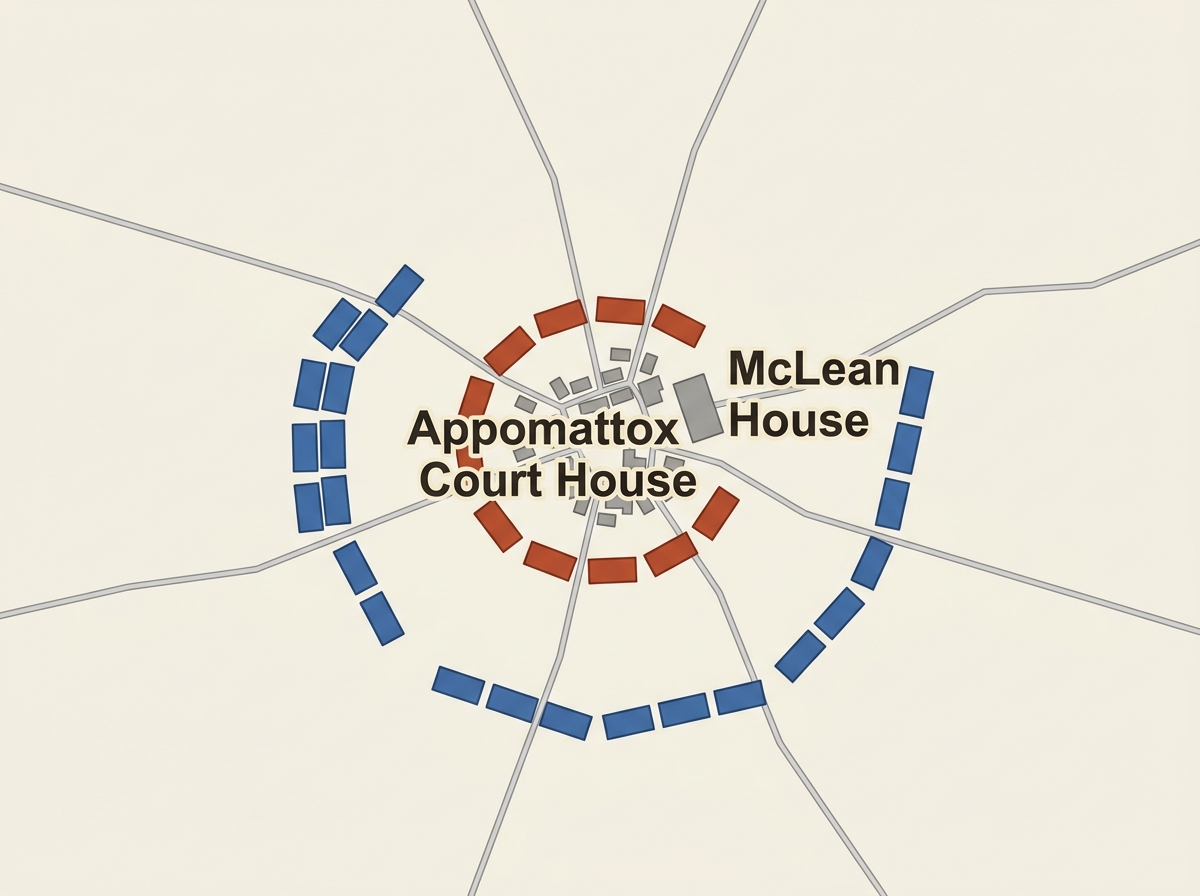
Lee arrived first, in a spotless dress uniform with a fine sword at his side, having put on his best in case he was taken prisoner. Grant came in from the field as he was, in a mud-spattered private’s coat with the three stars of a lieutenant general on the shoulders, no sword at all. Grant himself wrote afterward that he must have contrasted strangely with a man so handsomely dressed. The two had met once before, briefly, in the Mexican War nearly twenty years earlier, and for a while they talked about that, two soldiers putting off the thing they had come to do.
Then Lee brought him to the point and asked for the terms. Grant wrote them out on the spot, and they were far gentler than a surrendered rebel army had any right to expect. The men of the Army of Northern Virginia would lay down their arms and be paroled, free to go home so long as they did not take up arms again. Officers could keep their sidearms and their personal horses and baggage. There would be no imprisonment, no trials for treason, no marching the army off to captivity. When Lee mentioned that in his army the cavalrymen and artillerymen owned their own horses, Grant said they could keep them too, to put in a crop and get through the coming year. Lee said it would have a happy effect on his men.
Then Grant did one more thing. Told that Lee’s soldiers had been without real food for days, he ordered 25,000 rations sent over from his own supply trains to feed the army he had just defeated. The men who had been trying to kill each other that morning ate Union bread that afternoon.
General Orders, No. 9
The papers were signed in the McLean parlor in the afternoon of April 9. Lee rode back to his lines, where his ragged soldiers crowded around his horse and wept, and many of them reached out just to touch him as he passed. The next day he put his farewell to them on paper, the order known as General Orders, No. 9. He told them they had been beaten by overwhelming numbers and resources, not out-fought, and sent them home:
“After four years of arduous service marked by unsurpassed courage and fortitude, the Army of Northern Virginia has been compelled to yield to overwhelming numbers and resources.”
Honor answering honor
On April 12, the defeated army marched in to stack its arms for the last time. The Union officer chosen to receive the surrender of the infantry was Brevet Major General Joshua L. Chamberlain (North), the former college professor who had held the far left of the line at Gettysburg two years before. As the gray column came up the road, worn and silent, Chamberlain ordered his own men to come to attention and shift their muskets to the salute, soldier’s honor offered to soldiers. On the other side, Gordon caught the gesture, wheeled his horse, and ordered his men to answer it in kind. Chamberlain remembered it as honor answering honor. There were no cheers, by his account, and no taunts, only the two lines saluting each other in the morning quiet while one of them stacked its rifles and its torn flags and stopped being an army.
Appomattox did not end the entire war by itself. Other Confederate armies were still in the field, and Johnston would not surrender to Sherman in North Carolina for more than two weeks yet, with smaller commands holding out into May and June. But the Army of Northern Virginia had been the heart of the rebellion for four years, and once it was gone the rest was a matter of time and arithmetic. The thing that had cost more than six hundred thousand American lives was, in every way that mattered, over. The Union was preserved, and slavery, the cause the war had been fought over, was finished with it.
Off the fieldThe reckoning: what the surrender left to settle