By midday Major General Philip Sheridan (North) had a line again. He waited only until he was sure, around half past three, that no Confederate reinforcements were coming up from Front Royal, and then, just before four in the afternoon, with his army re-formed and steady, he launched a general counterattack, the whole line moving south, back down the ground it had lost at dawn. His XIX Corps under Major General William Emory (North) and his VI Corps formed the main infantry line. Brigadier General Wesley Merritt’s (North) cavalry took the left, southeast of the Pike; Brigadier General George Armstrong Custer’s (North) horsemen anchored the far right to the northwest, facing the Confederate cavalry under Major General Thomas Rosser (South); Brigadier General George Crook’s (North) battered Army of West Virginia waited in reserve.
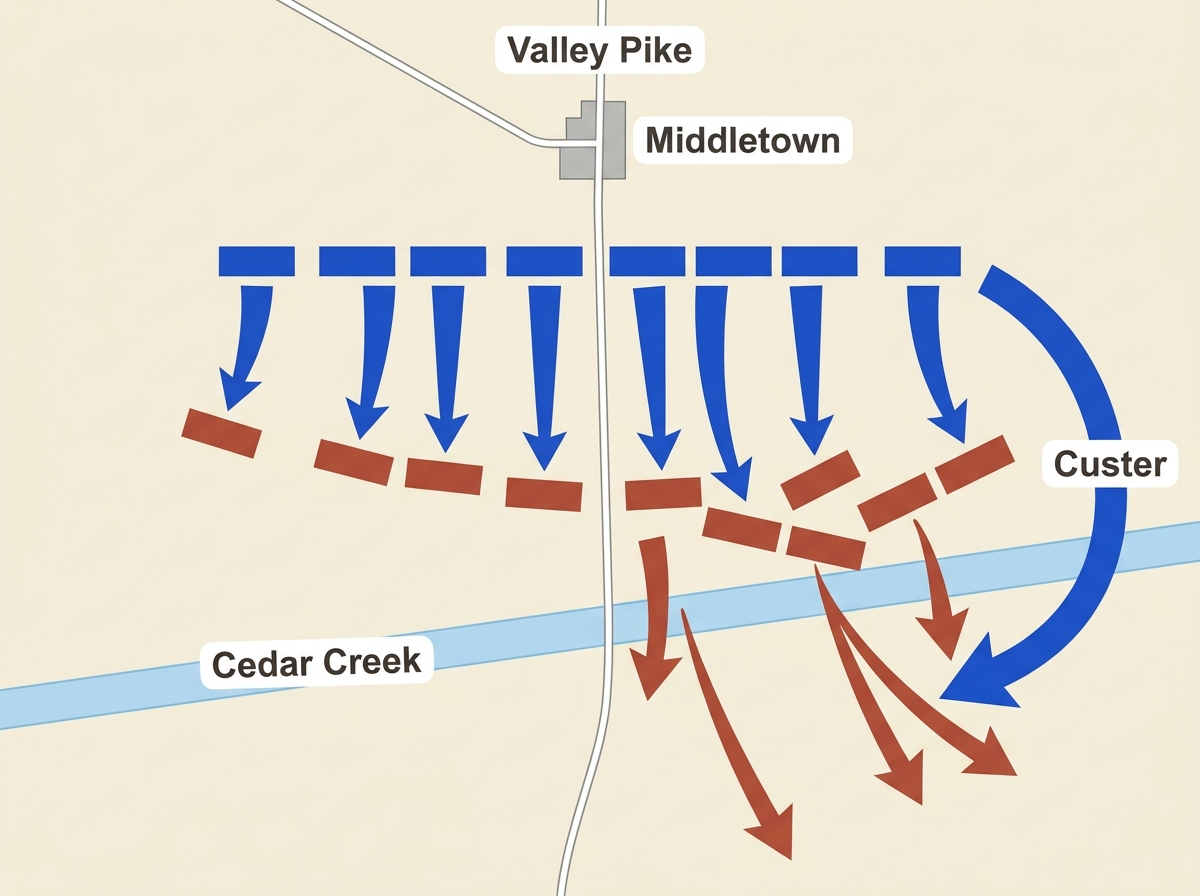
It did not break open at once. The infantry attack stalled against stone walls and Confederate artillery, the same hard arithmetic of frontal assault against a defended line that had cost both armies all war. The thing that cracked it was the cavalry. Merritt’s troopers made three charges; the first two were thrown back, and the third broke through, with the VI Corps pushing in behind it. The Confederate line, thinned and tired and a long way from the morning’s triumph, began to give.
The kill stroke was Custer’s. He drove his division around the Confederate left, the western end of their line, and made for the Cedar Creek bridge, the crossing on the Valley Pike that was Lieutenant General Jubal Early’s (South) line of retreat. When Confederate soldiers looked back toward their only escape route and saw Union cavalry already curling around it, the army’s nerve broke. Panic ran down the line the way it had run through the Union camps at dawn, only now it ran the other way. By about half past five the Army of the Valley simply disintegrated, abandoning everything: all the Union guns it had captured that morning, plus most of its own artillery and wagons. Union pursuit ran south until nightfall. The same army that had won a stunning victory before breakfast was a fleeing wreck by dark, on the same field, in a single day.
The reversal was paid for in blood on both sides of the line. The Union’s heaviest losses had come at dawn, but its afternoon dead included Brig. Gen. Daniel Bidwell (North), a brigade commander of the VI Corps killed leading his men, and Col. Charles Russell Lowell (North), a cavalry brigade commander already wounded in the chest earlier in the day, who refused to leave the field, whispered his orders through his aides because he could no longer raise his voice, led his brigade in the afternoon charge, was hit a second time and paralyzed, and died the next morning. Two of Sheridan’s men, one Union general and one Union colonel, fell making the counterattack that won the field.