It was Jackson’s own aggression that killed him, and the manner of it is one of the cruelest accidents in American military history. With the XI Corps shattered and night fallen, Lieutenant General Thomas "Stonewall" Jackson was not satisfied. He wanted to push on in the dark, to get between the broken Union army and its escape routes across the river and finish the job before morning. So he rode forward of his own lines on the Orange Plank Road with his staff, scouting the ground ahead for a night attack, out past the point where his own jumpy soldiers expected anyone friendly to be.
In the black confusion of the woods, his own men opened fire on him. The 18th North Carolina (South) heard horsemen coming back toward their line in the dark, took them for Union cavalry, and let go a volley. Three balls struck Jackson, shattering his left arm. He was carried off the field under fire, and the next day, May 3, surgeons amputated the arm. Robert E. Lee, when word reached him of the amputation, is said to have answered that Jackson had lost his left arm but the army had lost its right arm.
With Jackson down, command of the Second Corps fell to the most unlikely man on the field. Major General J.E.B. "Jeb" Stuart (South), Lee’s flamboyant cavalry chief, the plumed-hat scout whose horsemen had spent the war riding rings around Union armies, had never in his life commanded infantry in a pitched battle. He took over Jackson’s corps overnight and renewed the assault at first light on May 3, and he did it well, which was not at all guaranteed.
A Hilltop and a Blunder
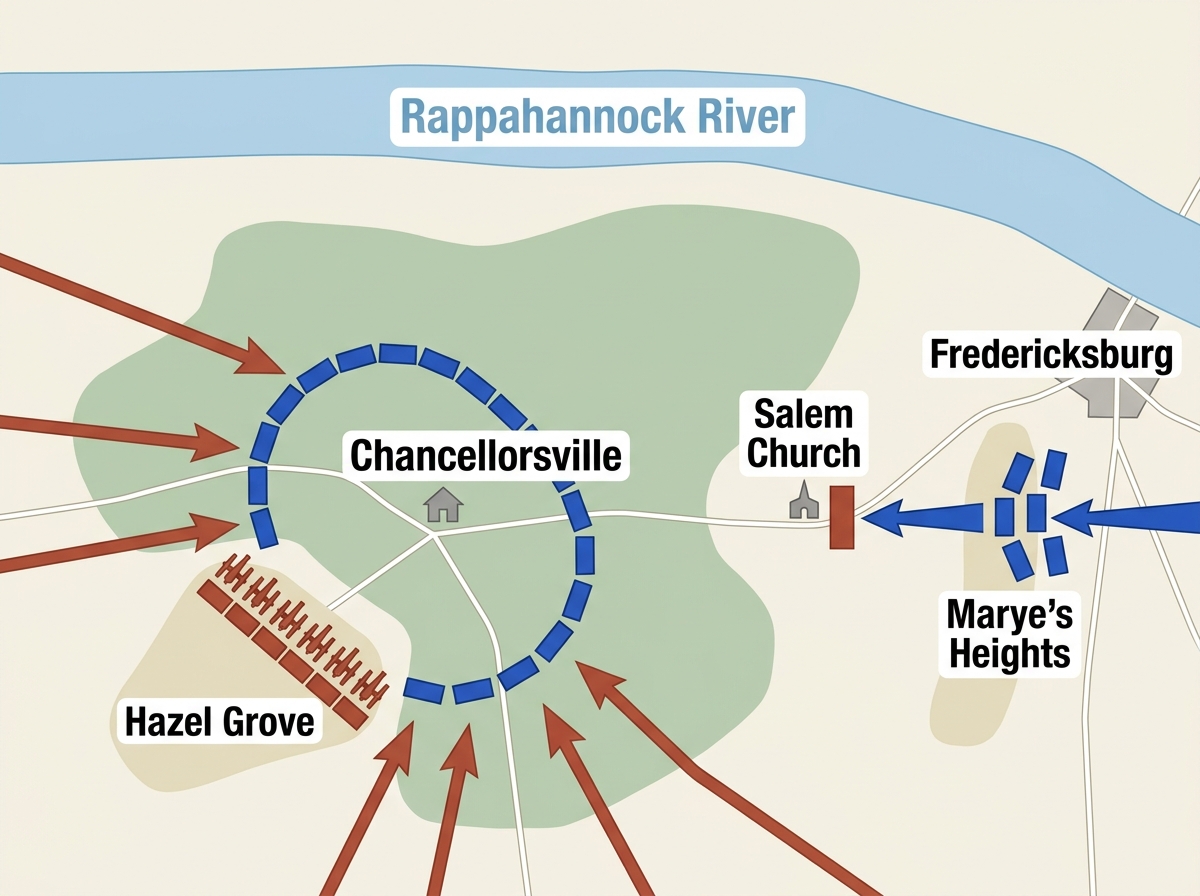
May 3 was decided by a hilltop and a blunder. Hazel Grove was commanding high open ground southwest of the crossroads, one of the few places in all that forest where cannons could see and be massed, and Sickles’s (North) men held it. On the morning of the third, Major General Joseph Hooker (North) ordered Major General Daniel Sickles (North) off it to tighten his line. It was a gift, and the Confederates took it instantly: Colonel E. Porter Alexander (South), Lee’s gifted young artillerist, rushed thirty-odd guns up onto Hazel Grove and pounded the Union position to pieces, and by half past nine the whole Union line around Chancellorsville was buckling inward.
In the middle of that collapse, the Union army effectively lost its commander. Around 9:15 that morning, at almost the same minute Alexander’s guns were taking Hazel Grove, Hooker was standing on the porch of the Chancellor house, leaning against one of its pillars, when a Confederate cannonball struck the pillar and knocked him senseless, very likely a concussion. At the exact moment one army was seizing the high ground and pressing its advantage, the other army’s commander was being carried off his own porch, dazed and incapacitated for over an hour. Even half-conscious, Hooker refused to hand command over to his senior subordinate, Major General Darius Couch (North). The 130,000-man army was paralyzed at the top while its line came apart.
Lee won the field on May 3, and paid for it with the one subordinate he could not replace.
The price of the night before was Stonewall Jackson, the most aggressive corps commander Lee had, the engine of the whole flank attack, now lying in a shattered ruin in a borrowed bed while Stuart finished the work he had started.