In the spring of 1863, the Army of the Potomac had a new commander, a fresh plan, and a swagger it had not earned in a long time. Major General Joseph Hooker (North) had taken over the largest army on the continent after a winter of disasters, rebuilt its morale, and now intended to do what none of his predecessors had managed: catch Robert E. Lee and his Army of Northern Virginia out in the open and crush them. He had the men to do it. By the best estimates Hooker fielded somewhere around 130,000 soldiers against Lee’s roughly 60,000, better than two to one, though exact engaged counts differ by source. Hooker is said to have called it the finest army on the planet, and on paper it was hard to argue.
The plan was genuinely excellent. Lee was dug in along the Rappahannock River (the broad east-west river line that the town of Fredericksburg sits on, where a Union army had been slaughtered head-on the previous December). Hooker had no intention of repeating that. Instead of hammering the front door, he would slip around the side, around the flank (the end of Lee’s line, where an army is weakest because it cannot easily turn to face a blow from the side). He sent three entire corps (a corps being one of the big self-contained chunks an army is built from, here anywhere from 10,000 to 30,000 men, several of which together make up the whole army) on a wide swing: cross both rivers far upstream to the west and come down behind Lee’s left, into the rear of his position. Meanwhile Major General John Sedgwick (North) would stay below Fredericksburg with the VI Corps and mount what soldiers call a demonstration, a loud, faked threat meant to look like the real attack, pinning Lee in place and convincing him the blow was still coming where it had come before.
Eastern TheatreFredericksburg: the head-on slaughter Hooker meant never to repeat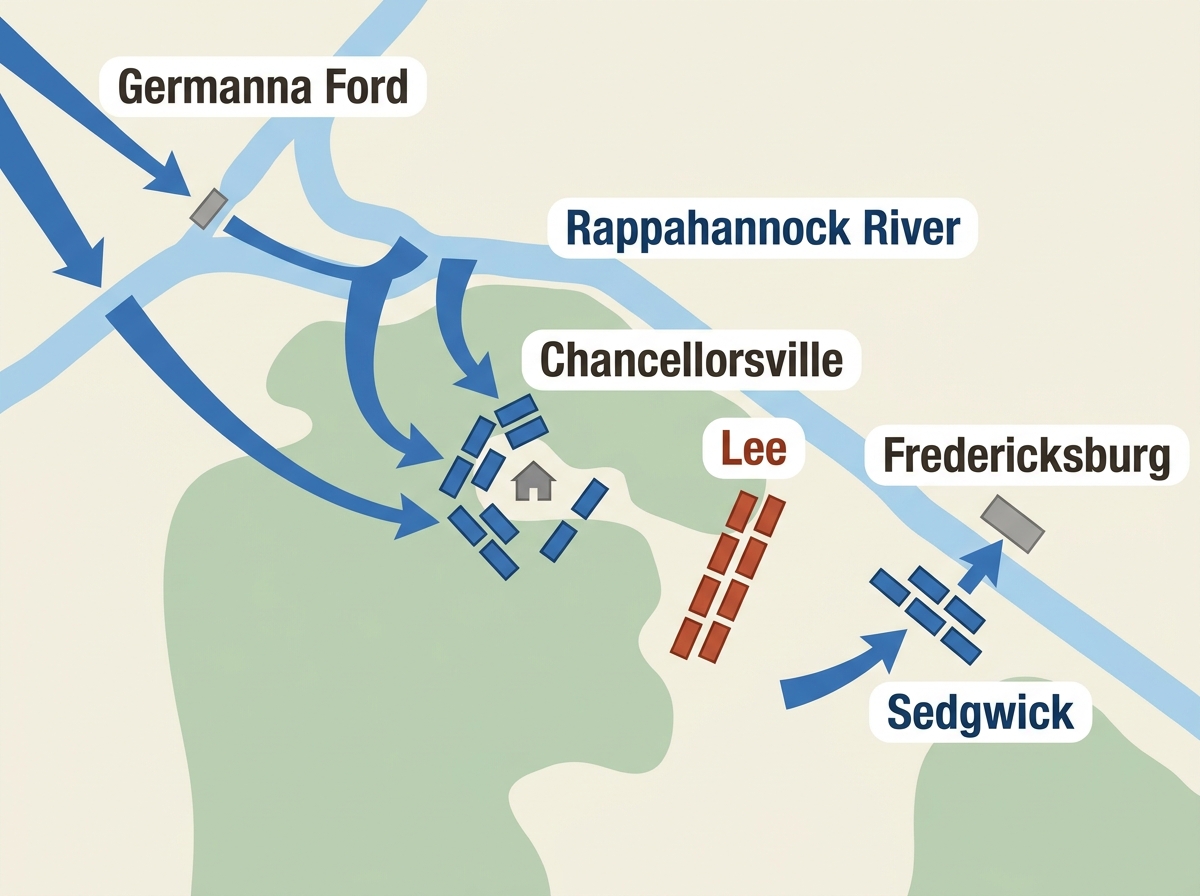
There was a third arm to the plan, and it mattered most by its absence. While the infantry swung around Lee’s flank, Hooker sent his entire cavalry corps, around 10,000 horsemen under Major General George Stoneman (North), on a deep raid far to the south, to get between Lee and the Confederate capital at Richmond and tear up the railroad at Gordonsville that fed Lee’s army. The idea was to panic Lee into retreating to protect his supply line, straight into Hooker’s waiting infantry. It went nowhere, and worse than nowhere: the raiders wrecked a little track, accomplished nothing that lasted, and meanwhile the army they had ridden away from was left with almost no cavalry of its own to scout and screen. An army without its horsemen is an army that cannot see. Hooker had sent away his eyes.
Lee Caught Between Two Fires
It worked, at first. By April 30 the flanking column had gathered at a place called Chancellorsville, not a town but a single large brick house at a road junction in the woods, owned by the Chancellor family. Hooker now had a powerful army planted squarely behind Lee’s position, with Sedgwick’s force still threatening the front. Lee was caught between two fires, enemies on two sides at once, outnumbered everywhere, on ground of Hooker’s choosing. In General Orders No. 47 on April 30, Hooker told the army that the enemy must now "ingloriously fly, or come out from behind his defences… where certain destruction awaits him." For about one day, the boast looked justified.
What Hooker had not reckoned with was the ground itself. The Chancellorsville crossroads sits in the middle of the Wilderness of Spotsylvania, a dense, tangled second-growth scrub forest grown up over abandoned charcoal and iron furnaces. It was the kind of country that swallows artillery (the heavy cannons that win battles in the open) and breaks up any large body of men trying to maneuver through it, the kind of country where you cannot see fifty yards and cannot bring your numbers to bear. Hooker’s two-to-one advantage was only an advantage in the open. In the Wilderness, the woods were about to do the work of an extra Confederate corps.
Hooker’s turning march was one of the best-conceived operations the Army of the Potomac ever attempted, and it set the table for the army’s most humiliating defeat, because it marched the bigger army into a forest that erased the very edge the plan was built to exploit.