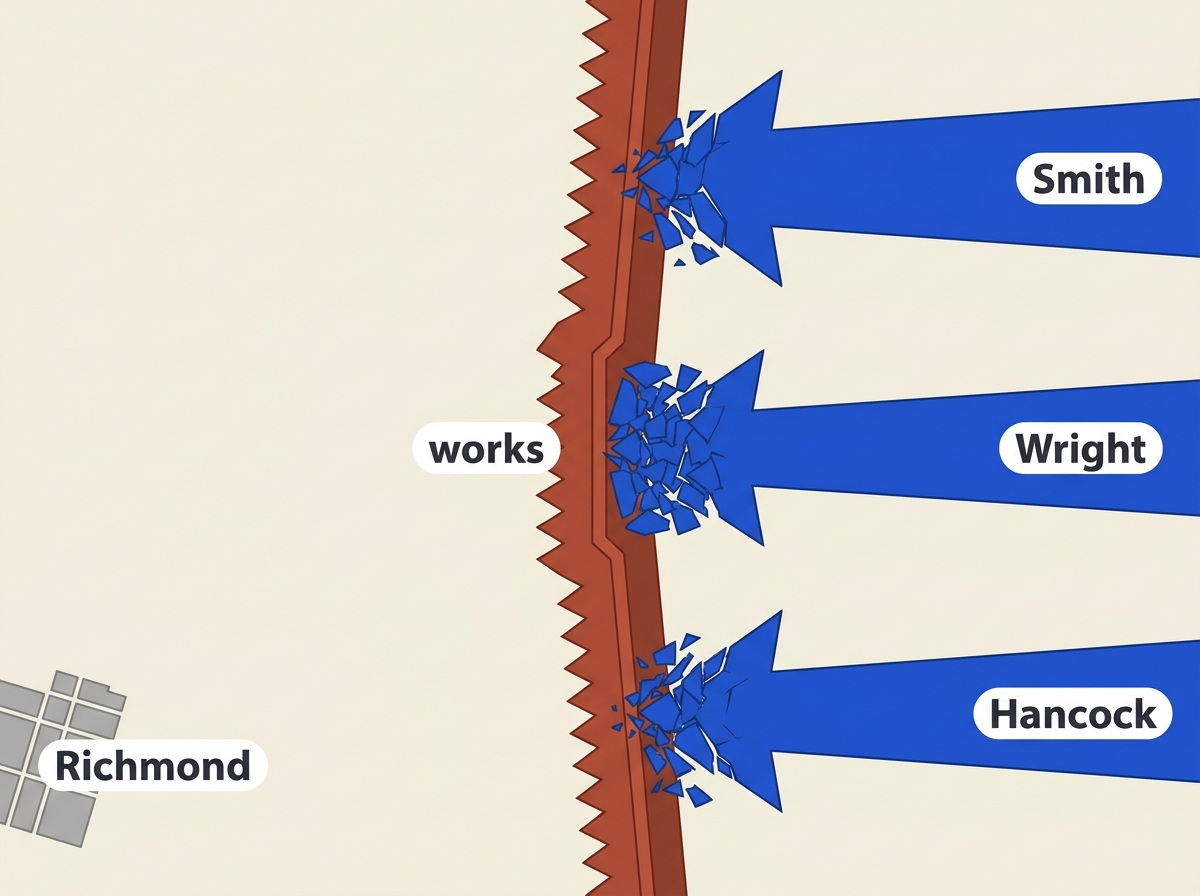
The grand assault opened around 4:30 in the morning on June 3, in thick ground fog, with three Union corps stepping off westward straight into Lee’s seven miles of finished trench. North to south the attacking corps were arrayed with Smith (XVIII) at the top, Wright (VI) in the center, and Hancock (II) at the bottom, all charging west into the works.
At the southern end it almost worked. Major General Winfield Scott Hancock’s (North) II Corps drove into the Confederate line on Major General John C. Breckinridge’s (South) front and broke clean through, Union soldiers physically inside the rebel trench, the only real lodgment (a foothold won inside the enemy’s own works) of the day. It lasted almost no time. A Confederate counterattack threw Hancock’s men back out with heavy loss, and the one doorway slammed shut.
In the center, Major General Horatio Wright’s (North) VI Corps advanced a short distance into the fire, took the measure of what was in front of it, and stopped to dig in rather than feed itself into the trench. To the north, Major General William F. “Baldy” Smith’s (North) XVIII Corps walked into the worst place on the field: a ravine, a low pocket of ground, swept from the sides by the enfilade musket and artillery fire described earlier, raking, sideways, and unanswerable. Smith’s men were cut down in that pocket. It was the deadliest sector of the battlefield, and it was deadly for the most mechanical of reasons: they were funneled into a hole that the works on either side could fire down the length of. Later in the morning, two more corps farther north, Major General Gouverneur K. Warren’s (North) V Corps and Major General Ambrose Burnside’s (North) IX Corps, made disjointed, uncoordinated attacks in their own sector and gained nothing for the trouble.
Then it was over. The assault broke down in roughly an hour, and around noon Grant called it off. No breakthrough. No advantage. Just the trench, still held, and the ground in front of it.
What the defenders saw
Along much of that trench, the Confederate defenders barely registered that a great attack had been made at all. The killing was real, but it was concentrated, packed into a few fire-swept pockets like Smith’s ravine, and across long stretches of Lee’s line the assault never came close enough to do much. From behind the rampart, much of June 3 looked less like the most famous slaughter of the war than like a morning of skirmishing that fizzled. That gap, between what the attackers suffered in a few places and what the defenders saw along the rest of the line, is where the legend grew.
Cold Harbor carries one of the most repeated numbers in all of Civil War lore, and the number is wrong. For more than a century the line was that the June 3 assault cost 7,000 Union casualties in the first twenty minutes, sometimes the first ten minutes, sometimes eight. Even reputable battlefield guides still print a version of it. But modern scholarship, most carefully the historian Gordon Rhea, has taken that legend apart. There was no single, massive, line-wide onslaught annihilated in eight minutes. The famous “7,000 in twenty minutes” is the legend, not the history. The killing was real, concentrated, and one-sided, with Union dead piling up at several times the Confederate rate. It just did not happen in eight minutes.
Set the myth aside and the arithmetic Rhea reconstructs is grim enough on its own. The June 3 morning assault cost something nearer 3,500 to 4,000 Union killed, wounded, and missing, not the legendary 7,000, but a one-sided butcher’s bill all the same. Counting the whole day of June 3, the Union lost about 6,000 men against perhaps 1,000 to 1,500 Confederate, roughly four to six dead and wounded in blue for every one in gray. That ratio, not the discredited twenty-minute figure, is the true horror of June 3.
The names pinned to their coats
One famous account holds that the night before the charge, Union veterans sat in the dark doing something unbearable: “calmly writing their names and home addresses on slips of paper, and pinning them on the backs of their coats, so that their dead bodies might be recognized upon the field.”
Those are the words of Lieutenant Colonel Horace Porter (North), Grant’s aide-de-camp, written decades later in his memoir: the image of men who had decided the attack was hopeless and were quietly arranging to be identified as corpses. It is the most haunting thing anyone says about Cold Harbor. It is also single-sourced. Porter’s postwar book is the only place the scene appears, with no soldier’s letter or diary or newspaper from the time to back it. The practice itself was real, since men are documented pinning identification on at Mine Run the previous November, so something like it surely happened somewhere. But the specific Cold Harbor scene rests on Porter alone, and it may well be a story polished by memory. It captures the dread in those ranks exactly, but it is not bedrock.