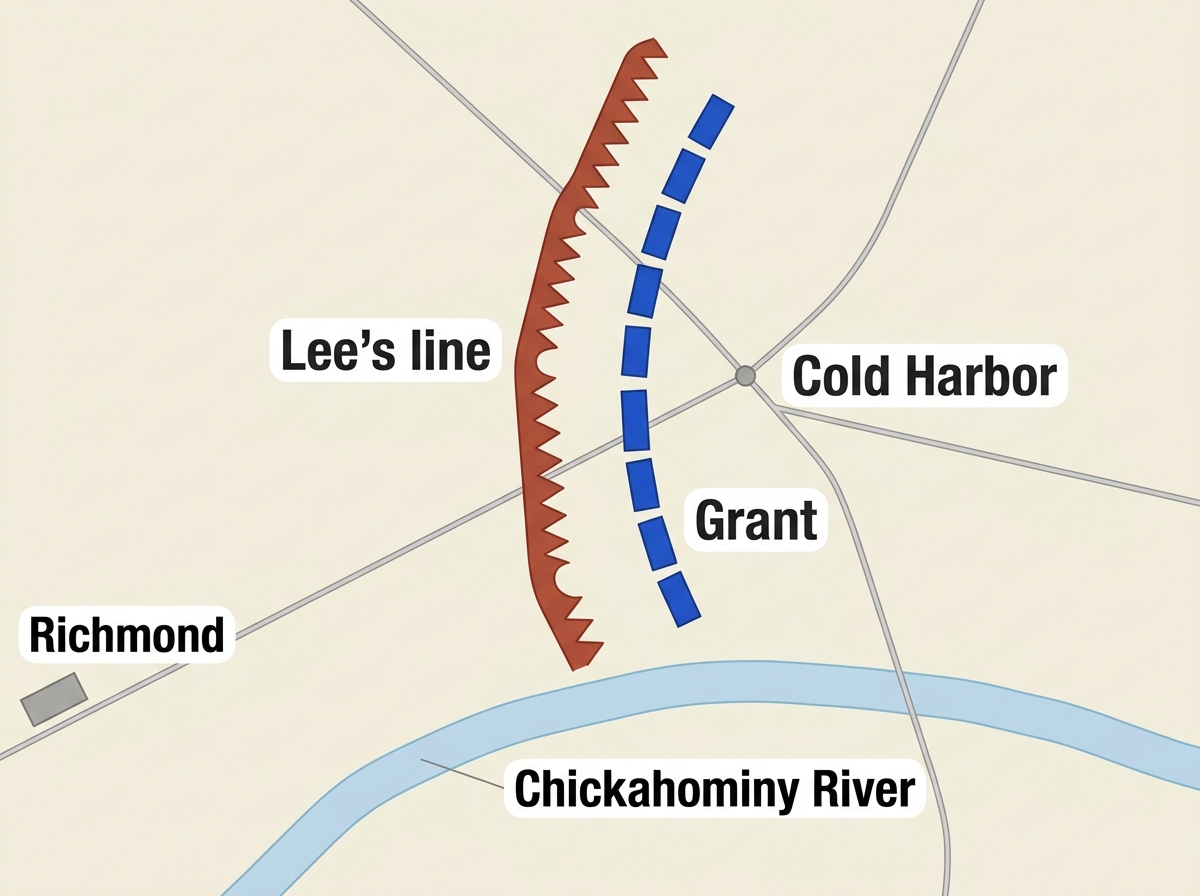
There is no harbor at Cold Harbor, and no water worth mentioning: no port, no bay, nothing a boat could reach. Cold Harbor was the name of a rural crossroads in Hanover County, Virginia, about 10 miles (16 km) northeast of Richmond, and it took that name from an old roadside tavern. In the period English the early settlers brought over, a cold harbour meant a place that gave you shelter (a harbor in the old sense of refuge) but no hot meal. You could sleep there. You could not get a cooked supper. So the junction was named for an inn that kept you cold, and two armies of roughly 170,000 men between them would spend twelve days bleeding for it.
There were actually two crossroads close together: Old Cold Harbor, the key junction, about two miles east of the old Gaines’s Mill battlefield, and New Cold Harbor, about a mile to the southeast. Several roads met at Old Cold Harbor, and that is why it mattered. A road junction in 1864 did the work a highway interchange does now: control it and you control how fast an army can move toward the thing it actually wants. And the thing both armies wanted was a few miles off to the southwest, Richmond, the capital of the Confederacy. Hold the Cold Harbor road net and you held the approach to the rebel capital. That is why the cavalry of both sides went tearing across the countryside for a tavern that could not cook a meal.
Eastern TheatreGaines’s Mill: the 1862 fight on the ground right beside this oneWhat the fight was for
The Confederacy existed to preserve and extend the enslavement of Black people. The army dug in west of these crossroads, Robert E. Lee’s Army of Northern Virginia, was the shield of a slaveholding republic, and Richmond behind it was that republic’s capital. The Union army grinding toward it had a war aim beyond a city: break the army that kept four million people in bondage. By the last section of this story that aim is standing on the field in human form, in Union blue.
By the end of May 1864, Cold Harbor was the last stop in a campaign that had not stopped for a month. Lieutenant General Ulysses S. Grant, general-in-chief of all the United States armies and riding with the Army of the Potomac to make its decisions, had crossed the Rapidan River in early May and gone straight at Lee. They had fought in the tangled woods of the Wilderness, then at Spotsylvania Court House, then along the North Anna River, three battles in a campaign of continuous contact, which was Grant’s whole new idea. Earlier Union generals had fought Lee, gotten mauled, and pulled back to lick their wounds. Grant fought Lee, got mauled, and instead of retreating slid his whole army southeast around Lee’s flank and came at him again, a few days later, a few miles closer to Richmond. Over and over. Cold Harbor was where the sliding ran out of room: the two armies racing one more time for one more crossroads, on the doorstep of Richmond, right beside the old killing ground of Gaines’s Mill where Lee had beaten the Federals back in 1862.
Eastern TheatreThe Wilderness: where the Overland Campaign openedEastern TheatreSpotsylvania Court House: the next slide southeast