How a stalled siege drove men underground
By the summer of 1864 the war in Virginia had stopped moving. Lieutenant General Ulysses S. Grant, general-in-chief of the Union armies, had spent the spring grinding south toward Richmond, the Confederate capital. His army and General Robert E. Lee’s Army of Northern Virginia had finally locked together at Petersburg, a rail hub about 25 miles (40 km) south of Richmond. Petersburg fed the capital: take its railroads and Richmond starves. So the armies dug in around it, and what had been a war of marches became a siege, a long investment of a fortified place, both sides burrowing into the earth. In spots the two sets of trenches sat only about 100 yards apart, a strip of churned no-man’s-land between them. Frontal assaults had already failed bloodily that June, and by the end of the month the stalemate had hardened with no obvious way through it.
The way under it came up from the ranks. Facing the Union line at one point was a Confederate strongpoint, a salient (an angle in the works that juts out toward the enemy), held by Confederate guns and infantry. Men of the 48th Pennsylvania Infantry (North), a regiment thick with former coal miners from Schuylkill County, looked across that gap and thought what coal miners think: they could dig under it. Their commander, Lieutenant Colonel Henry Pleasants (North), had been a civil and mining engineer in civilian life. He championed the idea, designed it, and drove it.
The plan was simple to say and brutal to execute. A mine, in siege warfare, is a tunnel dug under an enemy position and packed with explosives; the gallery is the tunnel itself. Pleasants’s men would dig a gallery west from behind their own line, run it under no-man’s-land, and stop it directly beneath the Confederate salient, more than 50 feet below the enemy battery. There they would branch left and right and pack the dead-end chambers with gunpowder. Blow the salient skyward, and Lee’s line opens like a torn seam.
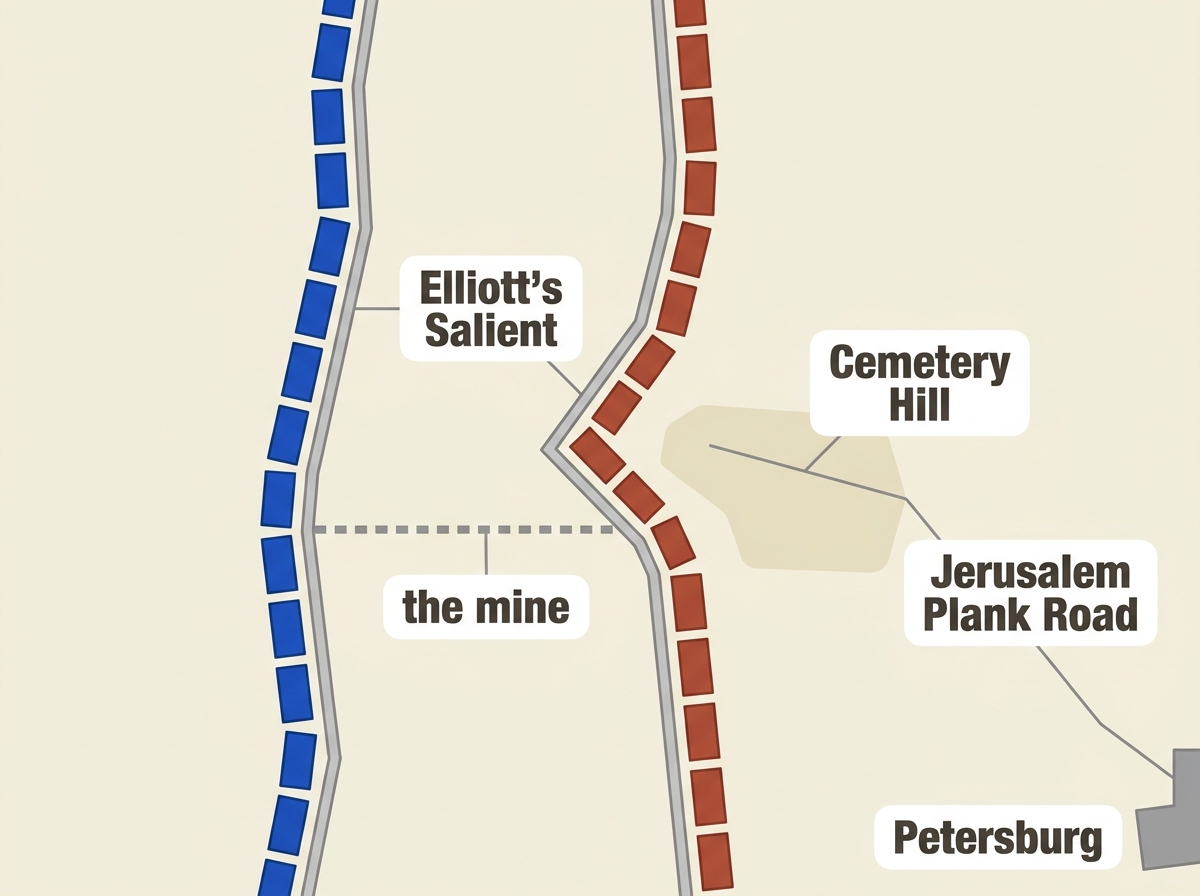
Between June 25 and July 17, 1864, the 48th Pennsylvania hand-dug a main gallery about 511 feet long, with a perpendicular “T” gallery of roughly 75 feet running left and right at the far end, under the Confederate works. They did it with improvised tools and one clever trick. A tunnel that long needs fresh air, but a ventilation shaft breaking the surface would have told the Confederates exactly what was happening. So Pleasants rigged a canvas partition and a wooden duct, and kept a fire burning at the tunnel mouth. The fire drew stale air out, which pulled fresh air in along the duct, a furnace-powered bellows with nothing showing above ground. Then they packed the chambers with 320 kegs of black powder, about 8,000 pounds (four tons), and tamped it tight so the blast would punch up, not back out the tunnel. The powder went in around July 27 and 28, and the mine sat loaded and waiting.