A perfect breach, thrown away by the hour
The fuse failed. At the appointed hour before dawn, the fuse was lit and the army waited for the explosion that did not come. The fire had died somewhere in the tunnel. Two volunteers, Lieutenant Jacob Douty (North) and Sergeant Harry Reese (North), crawled into the loaded mine, found the dead spot, relit it by hand, then crawled back out. Around 4:44 a.m. the four tons of powder went off.
The blast tore the salient out of the earth. It threw dirt, guns, and men hundreds of feet into the air and killed roughly 300 Confederates of the 18th and 22nd South Carolina (South) where they slept. When the dirt rained back down it left a pit, the Crater, about 170 feet long, 100 to 120 feet wide, and at least 30 feet deep. Lee’s line was simply gone for that stretch. For the first critical minutes the surviving Confederates on either side of the hole were too stunned to do much of anything. For about fifteen minutes there was almost no fire, and the gap stood wide open. This was the moment the whole scheme had been built for: a clear path through the breach to Cemetery Hill behind it, the high ground that, once taken, would put the Union army astride the road into Petersburg and behind Lee’s entire line.
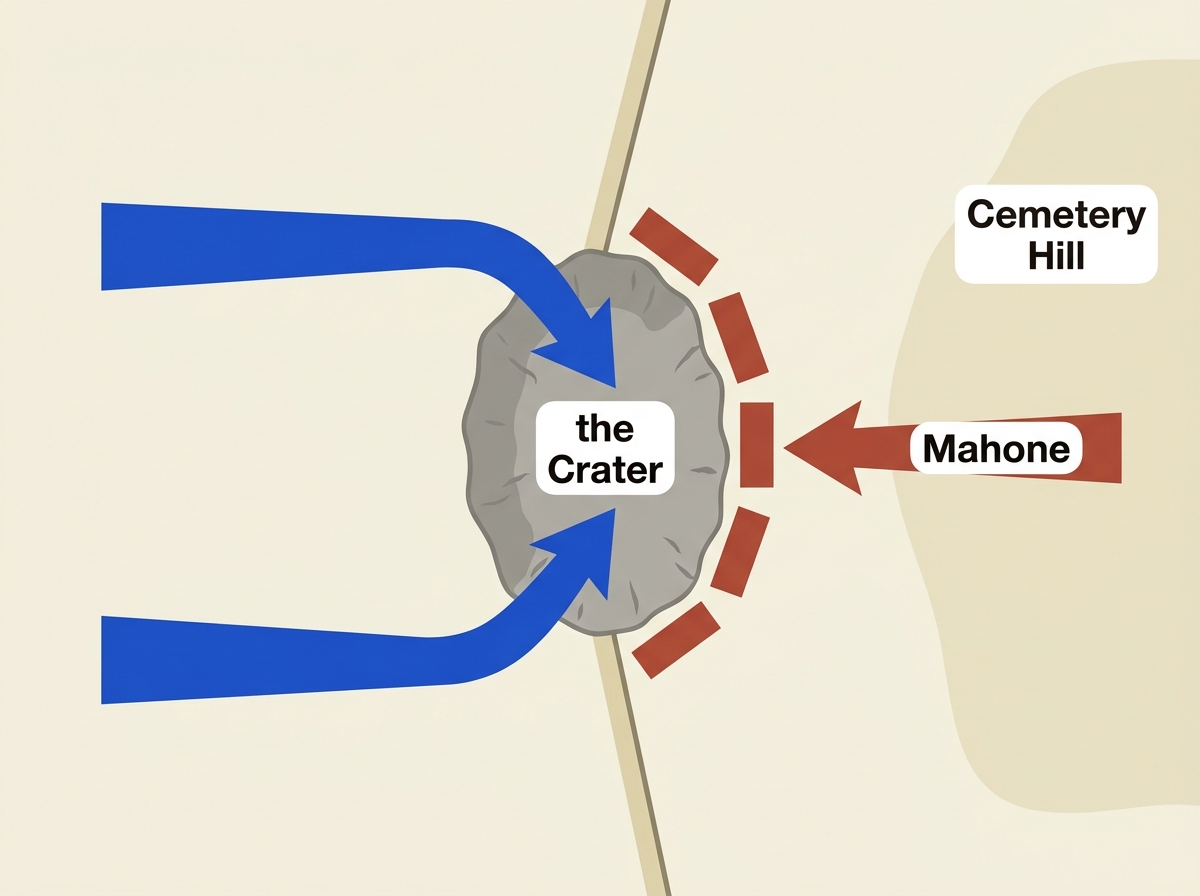
The Union threw it away. Ledlie’s (North) untrained division hesitated about ten minutes before going forward at all. Then, because no one had prepared the footbridges and ramps an assault needs to get a mass of men quickly up and over their own high-walled fortifications, they had to climb down into and back out of their own trenches to start the advance, bleeding away time and order in front of an open door. Then came the decisive blunder. Instead of going around the crater, as the sidelined USCT had been trained to do, Ledlie’s men poured into it, treating the pit as cover. It was a trap. A 30-foot hole with steep, crumbling walls is easy to fall into and nearly impossible to climb out of or fight from. The men packed the bottom, milling, while the following divisions piled in behind them and made it worse. The general who might have grabbed the attack and shoved it forward was a mile back in his bombproof.
Within about an hour the Confederates had their feet back under them. Brigadier General William Mahone (South) brought up infantry brigades, sealed the gap, and ringed the crater. His men, and those of Major General Bushrod Johnson (South), poured rifle fire down into the packed mass, and Confederate artillery dropped shells straight down into the pit. Contemporaries called it a turkey shoot. Mahone’s men got so close they hurled bayoneted muskets like spears down into the crowd below. What had been a breakthrough at 4:44 was, by mid-morning, a slaughter pen with the Union army at the bottom of it.