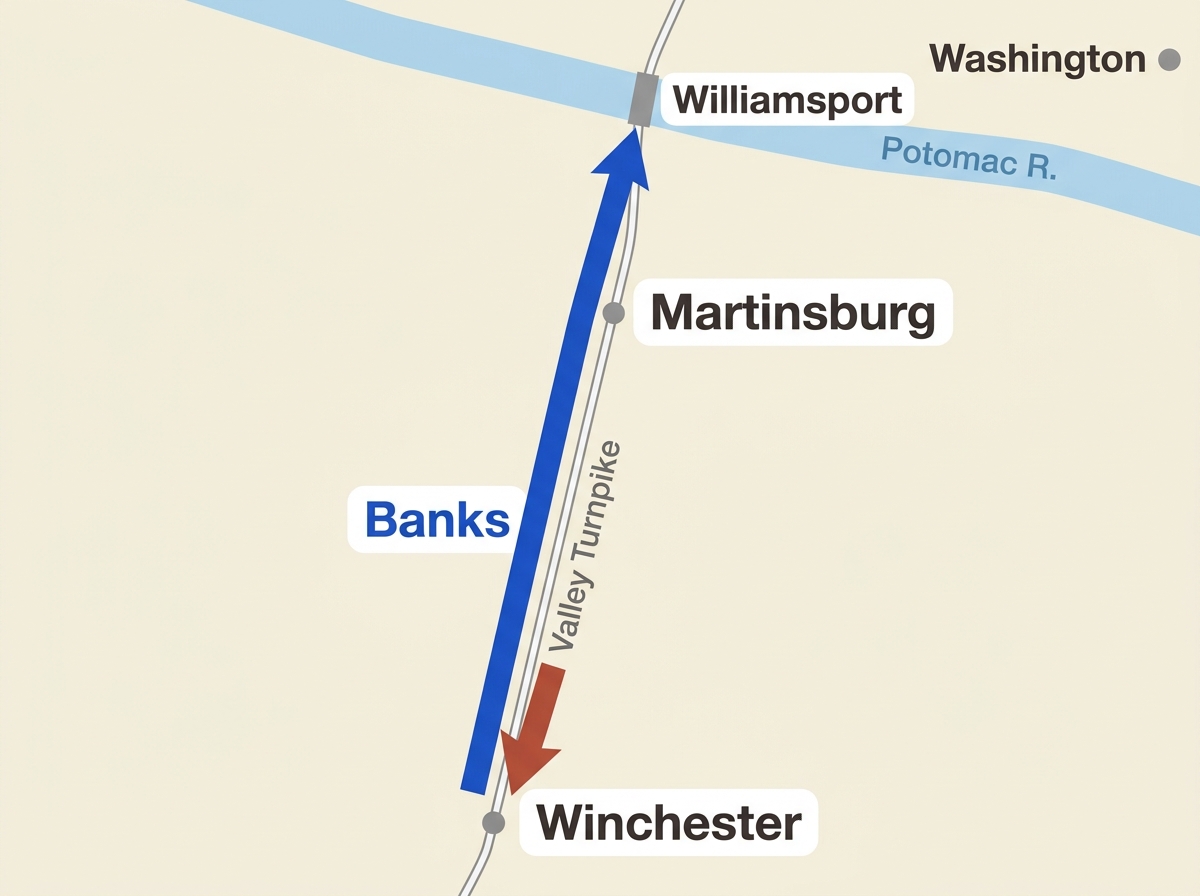
The chase north did not stop at the edge of Winchester. Major General Nathaniel Banks (North), his army shattered, kept his men moving up the Valley Turnpike all day on May 25. His lead elements reached Martinsburg, about 22 miles (35 km) north, by early afternoon; the rest came straggling in by around 5:00 p.m. And he did not stop even there. That same evening, still May 25, Banks pushed the remnants of his command across the Potomac River at Williamsport, Maryland, leaving Virginia behind entirely, roughly 35 miles (56 km) from Winchester to the far bank, covered in a single brutal day. He had lost nearly a third of his force, but the army, as an organized body, had survived the run, helped along by the fact that Jackson’s exhausted, cavalry-less pursuit never closed the trap.
The aftermath
What Banks left strewn behind him on the roads of the Shenandoah is the reason his name became a joke in the Confederate ranks. Picture the scene at the wagons: half-starved, half-shod Southern soldiers, weeks of forced marching in their legs and little but green corn in their stomachs, prying open a captured Union supply train and finding it stuffed: boxes of food, crates of new muskets, blankets, clothing, whole sutlers’ stores of small luxuries. It was Christmas morning in the middle of a war, and it kept happening, wagon after wagon, all the way back up the retreat.
The inventory, tallied across the running fight from Strasburg through Winchester, is its own kind of evidence: something like half a million rounds of ammunition (much of it destined to be fired right back at Union soldiers), more than 9,300 muskets and pistols, tens of thousands of pounds of food including some 15,000 pounds of bacon, over a hundred head of cattle, and wagonloads of clothing and blankets. To men who had nothing, a Union general who kept showing up to hand them everything they needed was almost too good to be true. So they gave him a name that stuck for the rest of the war and beyond: "Commissary Banks," the commissary being the officer in an army whose job is to keep the troops supplied with food and provisions. Banks, in their telling, was the best commissary the Confederate army had. It was a cruel joke, and he never lived it down.
The aftermath
The deeper damage was not measured in bacon. It was measured in the panic Jackson set off in Washington. Lincoln and Secretary of War Edwin Stanton (North) had spent days watching Jackson tear north toward the Potomac, and their worry was no longer just about Banks. It was that Jackson might be the leading edge of a Confederate thrust at Washington itself.
That alarm had already begun before Winchester. Lincoln had frozen McDowell’s reinforcement on May 24, the day after Front Royal; Winchester did not start that decision, it deepened it and seemed to confirm it. With Banks now routed and across the Potomac, Lincoln went further, scrambling to trap Jackson in the Valley. He redirected some 20,000 of McDowell’s troops away from the march on Richmond and toward the Shenandoah, set Major General John C. Frémont’s (North) army marching to converge from the west, and tried to spring a three-army pincer (a pincer being two or more forces converging from different directions to trap an enemy between them) to catch Jackson before he could escape south.
The pincer failed. Jackson, faster than all of them, slipped out of the trap and went on to win again at Cross Keys (June 8) and Port Republic (June 9) before vanishing east. But the failure almost did not matter, because the strategic damage to the Union was already done. With roughly 17,000 men, Jackson had tied down elements of three separate Union armies totaling more than 50,000 soldiers, by some counts over 60,000, all of them now committed to the Valley and the defense of Washington instead of to the one place it counted: the gates of Richmond.
That was the whole point. McDowell’s corps, the reinforcement Lincoln had promised McClellan for the final push, never came south, and McClellan would face the defense of Richmond without the 20,000 men Jackson had kept busy a hundred miles away. A month later, when Robert E. Lee struck McClellan outside Richmond in the Seven Days Battles (a week of brutal fighting east of the city in late June 1862) and drove the Union army back from the capital, he was fighting an enemy that Jackson, off in his valley, had quietly helped to weaken. The small campaign in the Shenandoah had reached all the way to the front gate of the Confederate capital and helped hold it.
For Jackson, Winchester was the high-water mark, the campaign’s signature victory, Taylor’s picture-perfect charge up Bowers Hill and Banks’s army in full flight across the Potomac. The Valley Campaign made Jackson the most celebrated soldier in the Confederacy and a name spoken with dread in the North, and it became a textbook study, taught for generations, in how a small, fast army can run rings around larger ones. Beneath the legend was the cause it served: slavery, and the Confederate state built to defend it.