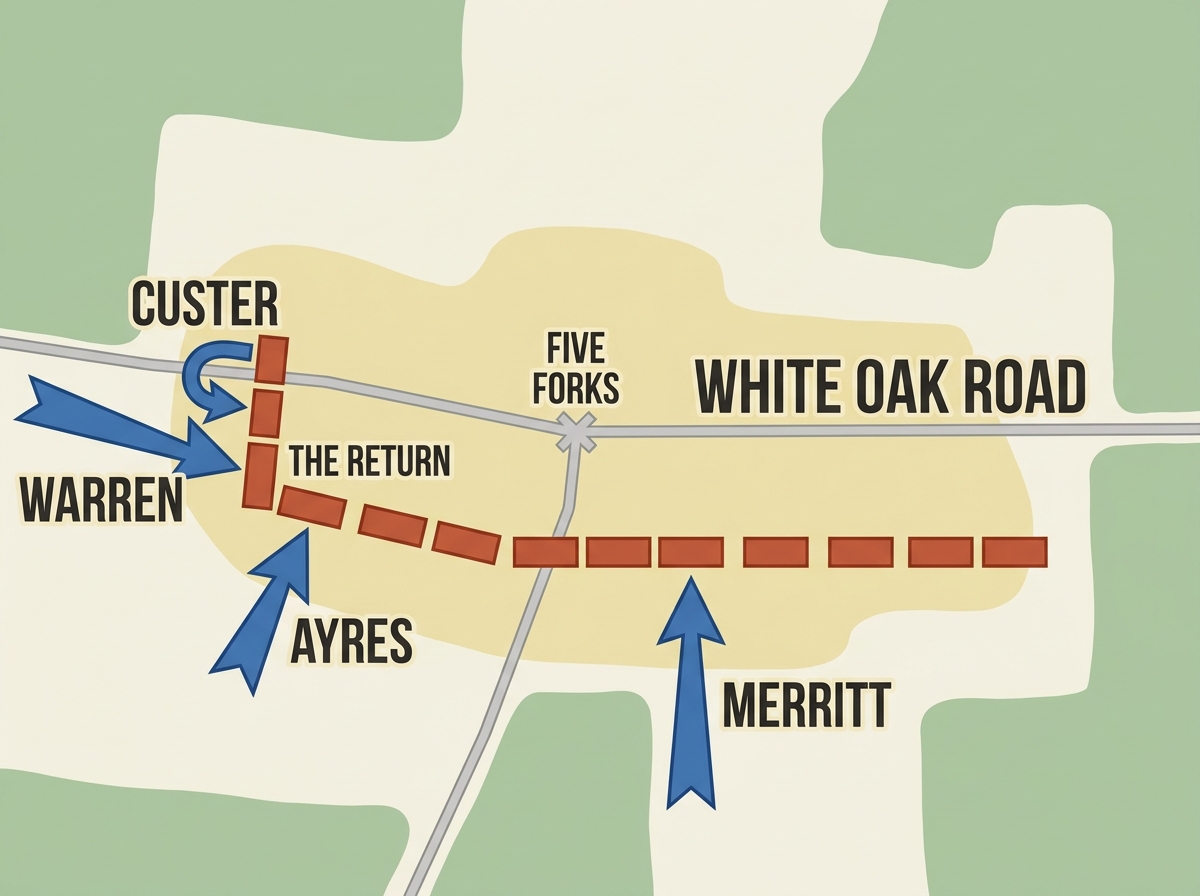
Around a quarter past four in the afternoon, Major General Philip Sheridan (North) threw the whole weight of his command forward at once. The plan was for the infantry of the V Corps to strike the bent-back western end of the Confederate line, the return, and roll it up, while the cavalry pressed the front so the defenders could not shift to meet the blow. It was a hammer aimed at the one weak hinge of the position.
It nearly missed. The maps were wrong about where the Confederate left actually ended, and the V Corps under Major General Gouverneur K. Warren (North) advanced past the angle instead of into it, the divisions of Brigadier General Samuel Crawford (North) and Brigadier General Charles Griffin (North) drifting off into empty woods. For a few minutes the great attack threatened to swing wide of the enemy entirely. Sheridan would not allow it. He rode straight into the confusion, in among the infantry, waving the battle flag, swearing, dragging the lines back by the sheer force of his presence until they faced the right way and went in. Brigadier General Romeyn Ayres (North) wheeled his division left and struck the return head-on.
It broke. Hit on the front and flank at once, with no senior commander present to steady it, the Confederate left folded. The cavalry under Major General Wesley Merritt (North), with Brigadier General George Custer (North) on the far flank, pressed in dismounted from the south, and Brigadier General Joshua Chamberlain (North), of Gettysburg fame, helped carry the works in the center. Pickett got back in time to see his command disintegrating and could do nothing to stop it. Whole regiments were surrounded in the woods and surrendered where they stood. By dark the Confederate force at Five Forks had been wrecked: out of around ten thousand men, close to three thousand were casualties, and most of those were prisoners, somewhere over two thousand captured along with the guns and flags.
Sheridan relieves Warren
In the middle of the greatest field success of his career, Sheridan turned on the man whose corps had largely won it for him. Convinced that Warren had been too slow on the approach and too far to the rear once the fight began, Sheridan relieved him of command of the V Corps that same evening and sent him away. It was a stunning blow to a general who had held the left at Gettysburg and just helped break Lee’s last line, and it followed Warren the rest of his life. He spent fourteen years demanding a hearing, and only in 1882, after a long court of inquiry that had finally convened back in 1879, was its finding published, after his death, that the relief had not been justified. The verdict cleared his name. It came too late for him to read it.
Eastern TheatreGettysburg: where Warren held the left and Pickett charged