It rained. For days at the end of March the rain came down on Dinwiddie County until the roads turned to soup and the fields became shallow lakes, and the great Union machine that was supposed to swing around Lee’s flank bogged down in the mud. Wagons sank to their axles. Artillery had to be corduroyed forward over logs laid in the muck. Major General Philip Sheridan (North), never a patient man, fumed at the delay while his troopers floundered.
Major General George E. Pickett (South) used the chance. On March 31 he pushed out from Five Forks and struck Sheridan’s cavalry near Dinwiddie Court House, a few miles to the south, and for an afternoon he drove them. The Union horsemen, fighting dismounted with their fast-firing carbines, gave ground slowly and made the Confederates pay for it, but they gave ground. By evening Sheridan’s line had been bent back almost to the courthouse, and on paper it looked like a Confederate success.
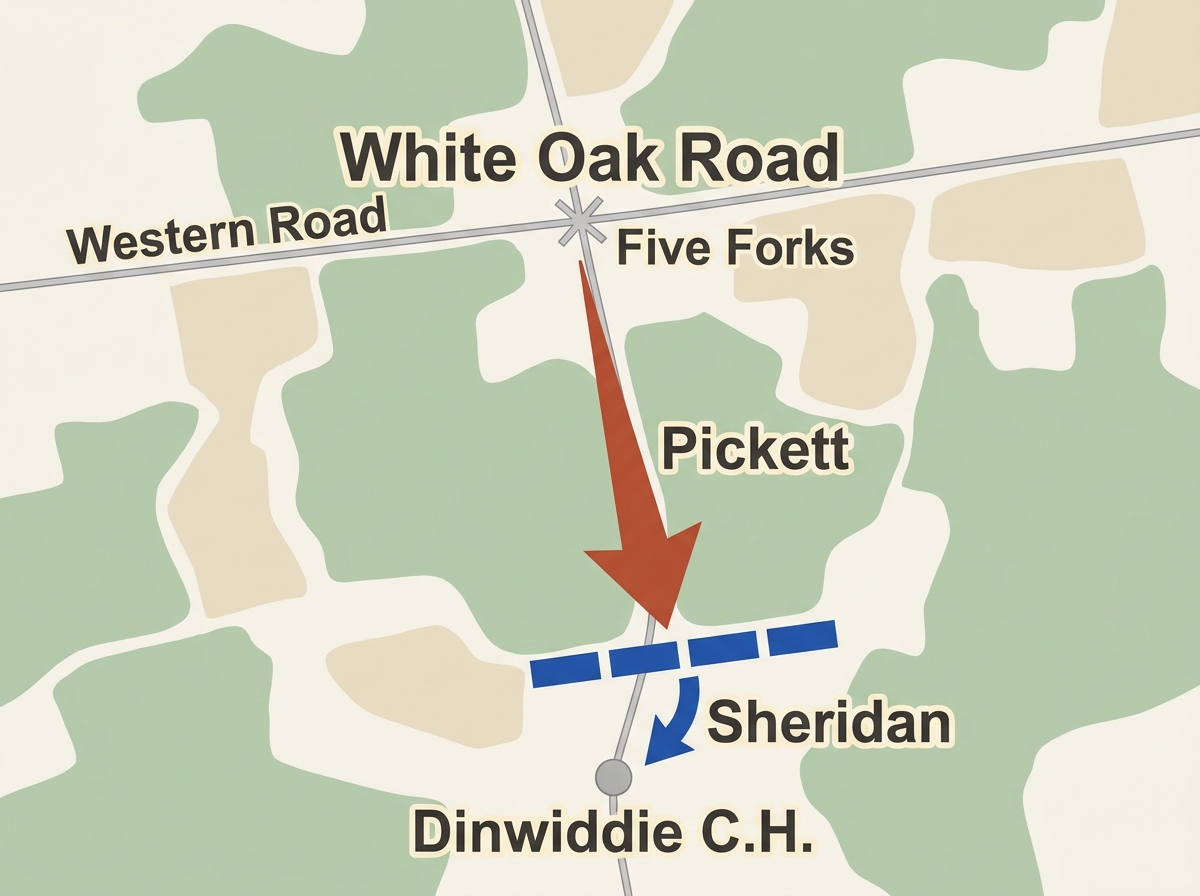
It was the opposite. By advancing, Pickett had pulled his command even further from the rest of Lee’s army and left the door open behind him. That night Sheridan saw it clearly. He did not despair at being pushed back; he asked for infantry, the V Corps under Major General Gouverneur K. Warren (North), so he could pin Pickett in place and crush him in the morning. As he put it to those around him, the Confederates were in a position from which they could not safely get away, and he meant to finish them there.
Pickett pulls back
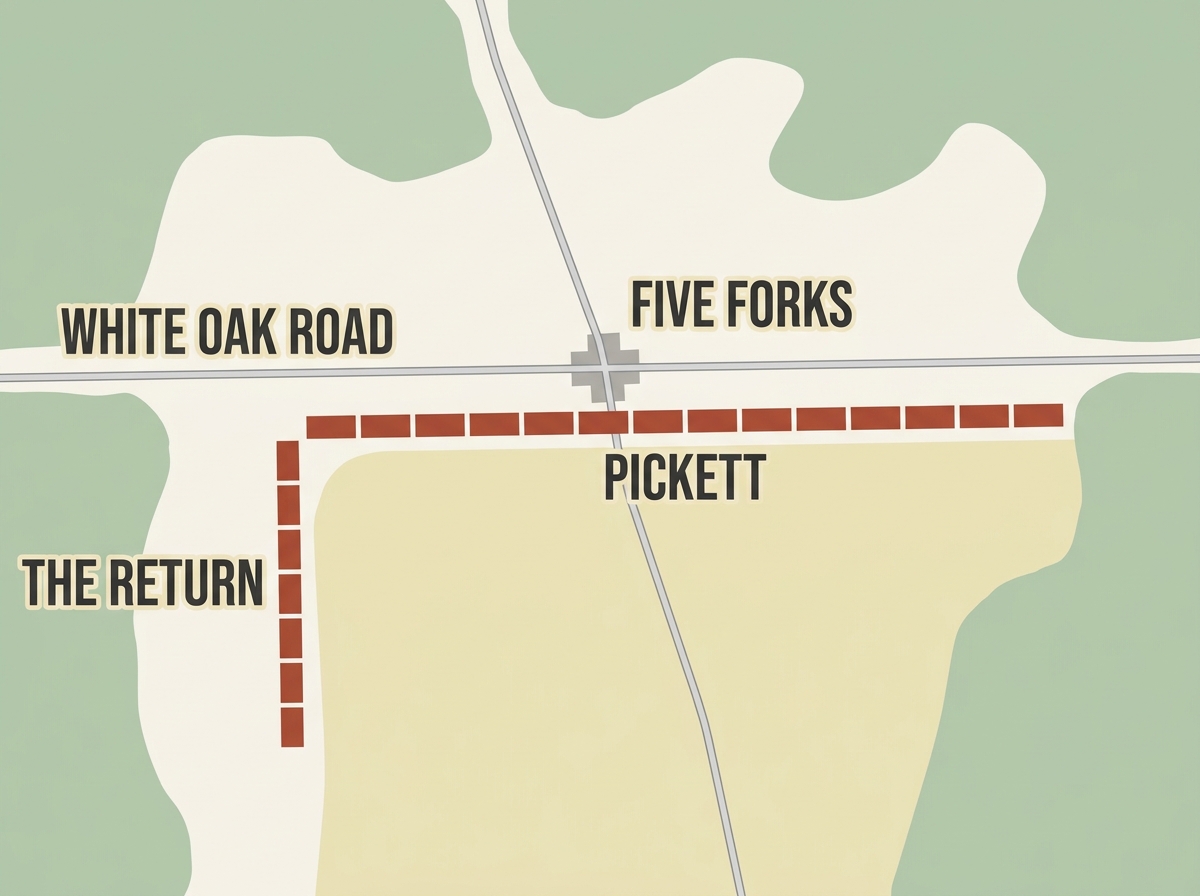
Pickett came to the same realization from the other side and did not like it. Learning that Union infantry was coming up on his flank and rear, he pulled his command back overnight to Five Forks itself and dug in along the White Oak Road, the east-west road that ran past the crossroads. His men threw up a low line of earthworks and log breastworks a little under two miles long, facing south. At the western end, where the line simply stopped in the woods, they bent the last stretch back at a right angle to guard against anyone coming around the open end. Soldiers called that bent-back piece the return. It was the hinge the whole position would turn on.