The attack opened in darkness, about 4:15 in the morning on March 25, and it opened with a trick. Major General John B. Gordon (South) sent out small parties of picked men ahead of the main column, some of them carrying axes. Their job was to slip up to the Union picket line, the thin screen of sentries out in front of the main works, and clear a path through the obstacles. Petersburg’s trenches were fronted by chevaux-de-frise, long timber frames bristling with sharpened stakes, meant to break up any charge. The axemen were there to hack gaps in them quietly, before anyone in the fort knew the assault was coming.
To get close, some of the lead men posed as deserters. Confederate soldiers had been crossing over to the Union lines in such numbers all winter that a few shadowy figures coming toward the works in the dark were nothing remarkable, and the ruse let the leading parties get right up among the startled Union pickets before the shooting started. One sentry was overpowered. The surprise held just long enough.
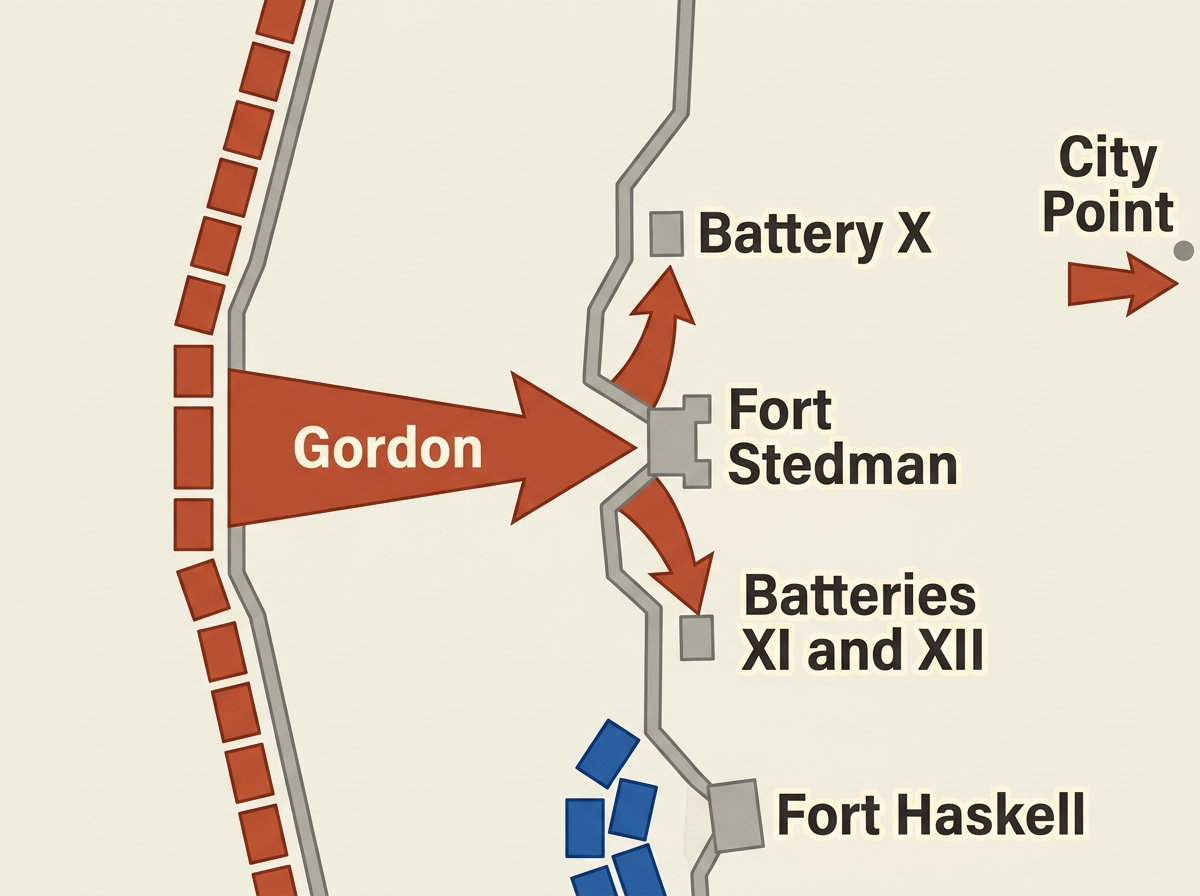
Then Gordon’s main body rushed forward in the dark, swarmed over the cleared obstacles, and was inside Fort Stedman almost before the garrison could turn its guns around. The defenders fired what they could, but the fort fell fast. The attackers also took the artillery batteries on either side of it, the line of guns the Union called Battery X to the north and Batteries XI and XII to the south. Confederate gunners swung some of the captured cannon around and fired down the length of the Union trenches in both directions. For a moment, in the first gray of the morning, Gordon had done exactly what he set out to do: he had punched a clean hole through Grant’s line.
The hole that led nowhere
The plan came apart in the next stage. Gordon had organized special detachments, columns of about a hundred men each, to push straight on past Fort Stedman, find three forts he believed stood in the Union rear, and seize them to widen the breach toward City Point. The trouble was that those rear forts did not exist as Gordon pictured them. His columns went forward into a confusing maze of trenches and camps in the half-light, looking for strongpoints that were not there, and got lost. The breakthrough had no second act.
On the flanks, the Union line bent but did not break. Just south of the captured ground stood Fort Haskell, and its garrison did not give way. Union gunners there poured canister, tin cans packed with iron balls that turned a cannon into an enormous shotgun, into every Confederate rush that came at them, and held. To the north, other Union troops formed up across the trenches and stopped the attackers from rolling up the line that way. Instead of a widening flood, Gordon’s breakthrough became a shallow bulge, jammed and stalled, with daylight coming on fast.
It was in this confused first hour that the Union sector commander rode into the trap. Brevet Brigadier General Napoleon B. McLaughlen (North), responsible for the stretch of line around Fort Stedman, came up in the dark, ordered a counterattack that briefly clawed back one of the captured batteries, then rode on into Fort Stedman believing the breach sealed. He began calmly giving orders to the men around him, only to realize that the soldiers he was directing were Confederates who had taken the fort. He was captured on the spot and gave up his sword to Gordon.