The famous slaughter in front of the town was never supposed to be the main event.
Burnside’s actual plan put the weight on the south. His biggest single force, the Left Grand Division under Major General William B. Franklin (North), nearly sixty thousand men (a “grand division” was Burnside’s own oversized name for a wing of the army, two corps stitched together, roughly a third of the whole force), was to smash Lee’s southern flank and roll the Confederate line up from the bottom. The attack in front of the town, against the heights behind Fredericksburg, was meant only as a diversion: a hard enough shove to pin Lee’s troops there in place so they could not rush south to help. The slaughter everyone remembers was designed to be the sideshow.
It became the main event because Burnside fumbled his own orders. He did not send the official attack orders out until nearly 6 a.m., late, and when they arrived the wording to both wings was nearly identical, seize the heights, vague where it most needed to be exact. Franklin, told to seize heights with no clear instruction to throw in his whole sixty thousand, committed a sliver. The diversion in front of town, told to seize heights, kept feeding men in long after a diversion’s job was done. So the day inverted: the planned main blow shrank to one division, and the planned distraction swelled into the worst killing ground of the war. Both halves of the disaster trace back to that one garbled 6 a.m. order, and to the general who wrote it.
The result was two completely different battles fought at the same time on the same field: one to the south, where the Union came terrifyingly close to winning, and one in front of the town, where it was simply slaughtered.
The Gap in Stonewall’s Line
A thick fog hid both armies through the early morning. When it lifted, around 10:30, the southern fight opened first. Down past the town, near Prospect Hill and Hamilton’s Crossing (the high ground at the southern end of the Confederate line), the Confederate right was held by Lieutenant General Thomas J. “Stonewall” Jackson (South). Against him, Franklin had that enormous wing and committed almost none of it. He sent forward a single division (a major chunk of an army, a few thousand men, several of which make up a wing) under Major General George G. Meade (North), about 4,500 men, supported by another Union division under Brigadier General John Gibbon (North), into the teeth of Jackson’s line. Tens of thousands of Franklin’s men stood and watched.
The advance had barely started when one Confederate gunner nearly stopped the whole thing by himself. Major John Pelham (South), a young artillery officer, ran a pair of guns out onto the flank of the advancing Union line and fired down its length, an enfilade (the most lethal angle there is, where a single shot can travel the whole line of a formation and hit man after man). His were horse-artillery, light field guns crewed by men on horseback and built to gallop, so every time Union batteries found his range he limbered up, dashed to a new spot, and opened again from somewhere they were not aimed. With just two guns, moving, Pelham held up the entire attack until he was finally ordered back. Lee, watching, is said to have remarked of him, “It is glorious to see such courage in one so young.”
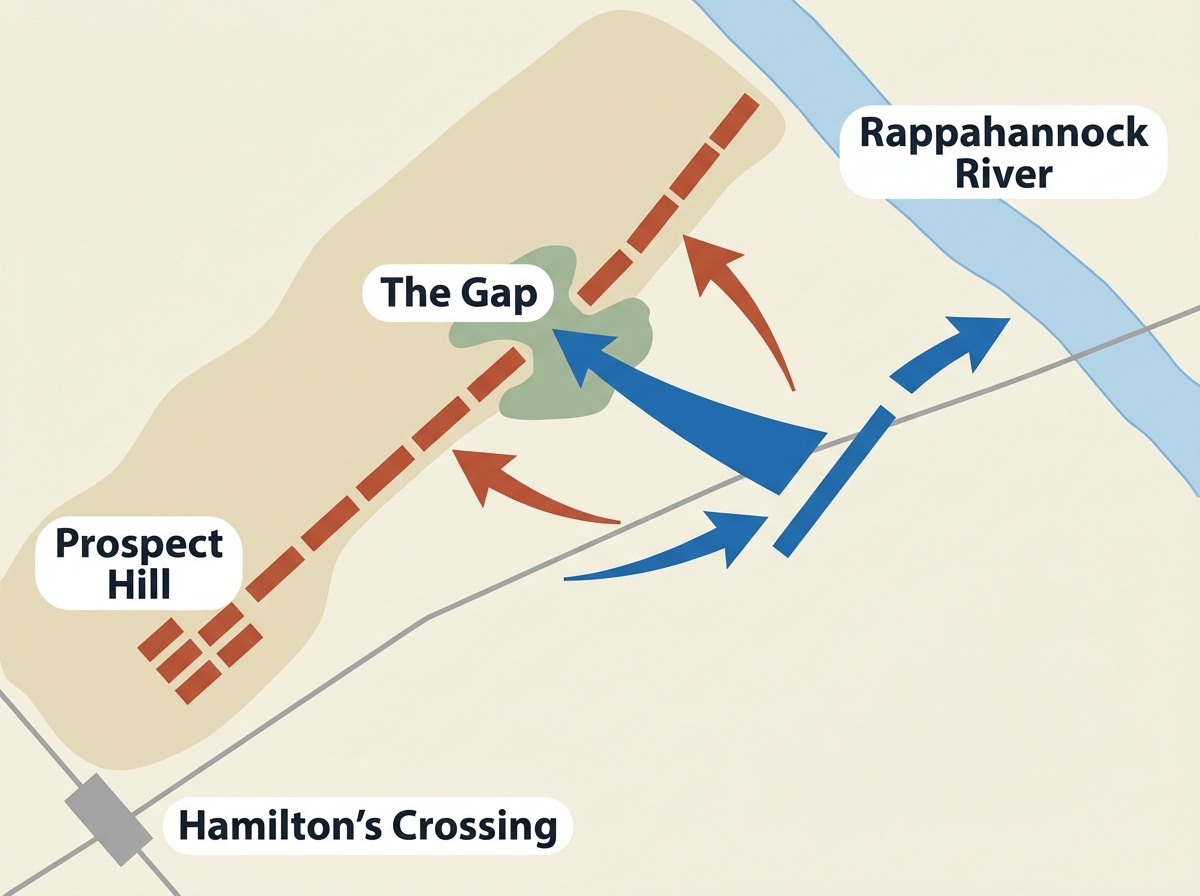
Then Meade’s men found the one flaw in Jackson’s line. In front of Confederate Major General A.P. Hill (South), a stretch of about six hundred yards had been left undefended: a swampy, wooded, triangular patch of boggy ground between two brigades, skipped because it looked too impassable to attack through. (A brigade is the next unit down from a division: a few regiments grouped together, roughly a couple thousand men.) The gap was not impassable. Meade’s division pushed straight into it, broke through, and turned on the Confederate brigades to either side, rolling up their flanks. For one wild stretch of the afternoon, the unbreakable Stonewall Jackson’s front had a hole punched clean through it, the only real breakthrough of the entire battle. Confederate Brigadier General Maxcy Gregg (South) was mortally wounded trying to rally his men against the rush.
And then it died for lack of help. Franklin, still sitting on the rest of his enormous wing, sent Meade no reinforcement. Confederate reserves under Jubal A. Early and William B. Taliaferro (South) counterattacked the unsupported breakthrough, drove Meade and Gibbon back across the railroad, and sealed the gap behind them. Meade, riding out of the wreck of his division, is supposed to have raged at his wing’s corps commander, Major General John F. Reynolds (North), “My God, General Reynolds, did they think my division could whip Lee’s whole army?” One division had done the impossible, and one division was all it had been given, because the man with sixty thousand men had been told only to seize the heights.
A Chicken Could Not Live on That Field
While that was happening to the south, the diversion that became the main event was unfolding in front of the town, and it was not really a battle at all.
Behind Fredericksburg rose Marye’s Heights, a ridge about six hundred yards west of the streets, lined along its crest with massed Confederate artillery. At the foot of the ridge ran a sunken farm lane, Telegraph Road, fronted by a stone wall about four feet high, and behind that wall, in the sunken road, stood Lieutenant General James Longstreet’s (South) infantry stacked multiple ranks deep, completely sheltered, with a clear field of fire across open, rising, muddy ground. A few thousand sheltered men, firing in rotating ranks so there was never a pause to load, against tens of thousands sent at them across bare ground. Before the battle, Longstreet’s artillerist, Lieutenant Colonel E. Porter Alexander (South), had looked over that ground and told him, “A chicken could not live on that field when we open on it.”
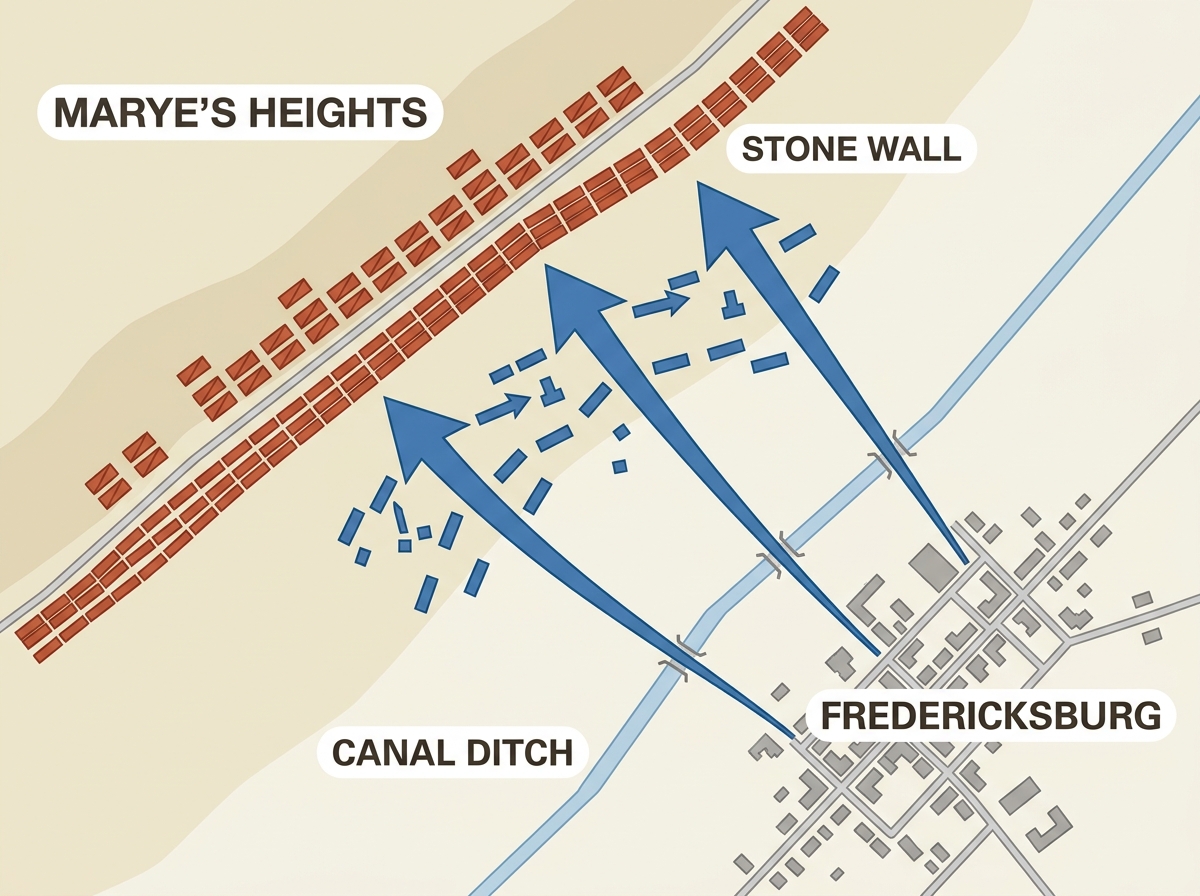
To reach the wall, a Union brigade first had to funnel across a canal ditch (a millrace running north to south about two hundred yards out of town, crossed only by a few narrow bridges), then re-form on the far side, under fire, and walk roughly six hundred yards up the open slope into the wall. Burnside ordered it anyway, around midday. Then he ordered it again, and again. Seven divisions went up that slope, generally one brigade at a time, in something like fourteen separate charges, and every single one of them failed.
Take just one of them, the Irish Brigade, under Brigadier General Thomas F. Meagher (North), many of its men Irish immigrants who had carried green regimental flags out of New York. They crossed the millrace bridges in a clot, re-formed under fire, and started up the slope into ground the men ahead of them were already dying on, stepping over the rank that had gone first, then becoming the rank the next men would step over. There was no cover and no rush; the wall was too far to reach at a run, so they walked into it. Somewhere short of the wall the front of the brigade simply came apart, men folding into the mud all along the line at once where the volley caught them, and the survivors lay down among the dead and kept firing at a stone wall they could not see anyone behind. They got perhaps to within fifty or sixty yards. Not one of them touched it. The Irish Brigade walked up that slope about twelve hundred strong and left roughly five hundred and forty-five of its men on it. And it was one charge of fourteen.
The men of a Union brigade under Brigadier General Nathan Kimball (North) were cut down about a hundred and twenty-five yards short of the wall. At dusk, when the slope was already carpeted, green regiments under Brigadier General Andrew A. Humphreys (North) were sent up with their rifles unloaded and bayonets fixed, ordered to take the wall with cold steel because there was no longer time for anything else, and were shredded about fifty yards out, having never fired a shot. Not one Union soldier, in any of the fourteen charges, reached the stone wall. Behind it, Confederate Brigadier General Thomas R.R. Cobb (South) was mortally wounded and Brigadier General Joseph B. Kershaw (South) took over the line and held it without strain.
By dark it was no longer a tactic. It was a massacre with a name, Marye’s Heights, and the failure was not of any one brigade but of the whole idea that men could cross that ground and live.