For most of an afternoon, Robert E. Lee’s army had thrown itself at Porter’s (North) wall and bounced off, division by division, each one alone. Late in the day, with less than an hour of daylight left, Lee finally did the thing he had been failing to do all afternoon: he hit the whole line at once.
Around 7 p.m. he launched a general, coordinated assault across his entire front, roughly 32,000 men in about 16 brigades, going forward together. On the right of the attack, the division of Major General James Longstreet (South) pressed in, Brigadier General George Pickett’s (South) brigade among the units driving against Porter’s line; in the center and left, Whiting’s, A.P. Hill’s, and the rest surged forward at the same moment. It was the largest single assault Lee would order in the whole war, and likely the largest Confederate assault of the Civil War, period. (For scale: the famous Pickett’s Charge at Gettysburg a year later used about 12,500 men; Hood’s later attack at Franklin, about 20,000.) After a day of piecemeal failure, all of it landed at once.
Eastern TheatreGettysburg: where Pickett’s Charge, half this size, became the more famous oneDusk | The Texas Brigade goes through
Brigadier General John Bell Hood (South), leading the Texas Brigade in the division of Major General William Whiting (South), found the crack in the wall as part of that coordinated front. He took the 4th Texas (the regiment he had commanded before he was handed the brigade) plus companies of the 18th Georgia, and angled toward a spot across the swamp where the ground looked just slightly more forgiving. Then he did something that took iron discipline: he sent his men forward without firing a shot. That was nearly unheard of, because the trained reflex under fire was to stop, load, and shoot back; ordering men to swallow that reflex and just run meant taking hits without being able to answer. But it also meant not losing momentum, no stopping, no clotting up halfway. Just fixed bayonets, the Rebel Yell (the high, howling war cry Confederate troops loosed when they charged, meant to unnerve the men waiting for them), and a flat-out rush down into the creek and up the deadly hillside that had swallowed assault after assault all day.
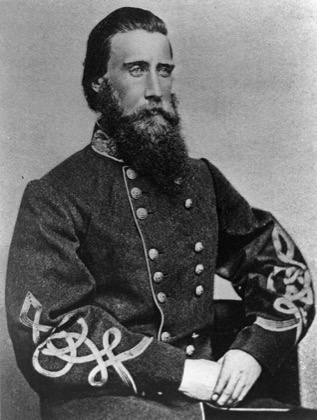
It cost them horribly on the way in. A 4th Texas private later described the fire pouring into them “with increasing fury, cutting down our ranks like wheat.” But the unfired rush carried them into and over Porter’s first line at the bottom of the ridge. And then the Union defense worked against itself: with their own retreating men streaming back in front of them, the Federal second and third lines could not shoot cleanly, and Hood’s Texans drove through all three tiers and onto the plateau, capturing 14 cannon at the crest. By the time the battle ended, the Confederates, fighting for the army that was defending slavery’s republic, had taken around 22 Union guns in all.
The Texans paid heavily for those guns. Hood’s and Law’s brigades together lost 1,018 men in the assault. The 4th Texas alone was cut roughly in half (regimental records put its losses near 250, though some accounts run far higher) and every one of its field-grade officers, the colonels and majors who led the regiment, became a casualty: its colonel killed, its lieutenant colonel mortally wounded, its major shot down. The wall came down, and the men who walked up that slope holding their fire walked into the same killing ground that had swallowed every charge before them; the difference this time was that enough of them lived to reach the top.
The collapse and the consequence | Porter retreats, McClellan quits Richmond
Once the line broke, Porter’s V Corps came apart in the dusk, men scattering back across open fields toward the Chickahominy. Two whole Union regiments were surrounded and surrendered. A Union cavalry countercharge, about 250 troopers of the 1st and 5th U.S. Cavalry under Brigadier General Philip St. George Cooke (North), who happened to be the father-in-law of Confederate cavalryman J.E.B. Stuart (South), one of Lee’s most famous officers, was thrown in to buy time and was driven back with roughly a quarter of its men cut down.
But darkness now did for Porter what Porter’s wall had done all afternoon: it stopped an advance cold. With night coming on, the Confederates could not press the pursuit that might have destroyed the V Corps outright. Through the night of June 27 to 28, with Sykes’s Regulars (the professional U.S. Army troops, the steadiest men in Porter’s corps) covering the rear, Porter pulled his battered corps south across the narrow Chickahominy bridges, and Union engineers burned the bridges behind them.
The casualty count tells which kind of victory this was. The two sides together lost roughly 15,000 men. The Union total ran about 6,800 to 7,300, but a large share of that, somewhere around 2,800, were captured, swept up when the line collapsed. The Confederate total was heavier, around 8,000, and far bloodier in killed and wounded (roughly 1,483 killed and 6,402 wounded, against just over 100 captured). By the morning of June 28, Gaines’ Mill stood as the second-bloodiest battle in American history to that point, behind only Shiloh that April; nine Union regimental commanders were killed or mortally wounded, and the 9th Massachusetts (a regiment of roughly 900 Massachusetts volunteers) lost 206 men, more than any other Northern regiment on the field. Lee had won, and he had won by spending more men than his enemy to do it, a pattern that would shadow his generalship for the rest of the war.
Western TheatreShiloh: the only American battle bloodier than this one, three months earlierAnd the retreat McClellan had already chosen before dawn now became permanent. More convinced than ever that he faced a vastly larger army, McClellan ordered his whole Army of the Potomac to “change base” (the army’s term for packing up and pulling out), abandoning the advance on Richmond and falling back southeast to Harrison’s Landing, a plantation on the James River about 20 miles (32 km) below Richmond where the navy’s gunboats could shell any Confederate who came near. The church spires he had come within a few miles of would stay Confederate. Lee had his first victory: costly, bloody, imperfectly run, and it worked. Gaines’ Mill saved Richmond for 1862 and handed the war in the East to the man who would carry it, against this same McClellan, across this same river country, three months later, at Antietam and the bloodiest single day in American history.
Eastern TheatreAntietam: Lee and McClellan meet again three months later, the bloodiest day