Lee thought he could still destroy this army. He had been chasing it for a week, and at Glendale the day before he had come close to splitting it open. One more hard blow, he believed, and McClellan’s retreating force might break apart entirely. A retreating army that loses its rearguard or gets cut in half stops being an army and becomes a rout, every man running for himself. So on July 1, looking up at the worst piece of ground he could possibly attack, Lee decided to attack it anyway.
July 1
Major General D.H. Hill (South), one of Lee’s division commanders (a division being a fighting force of roughly eight thousand men, the largest unit a single general usually led into battle), rode out to look at the hill before any of it began. He went forward that morning and studied the Union position with a soldier’s eye: the open fields running up to the crest, the cannon stacked tier on tier along the top, the bare ground a man would have to cross to reach them. He read it correctly. He told the others, in so many words, that if McClellan was up there in strength, the smart thing to do was to leave him alone. It was the right call. It was overridden.
The plan that overrode it was the problem before a single man stepped off. Lee meant to soften the Union position first with his own cannon: to plant Confederate batteries at separated spots, have them throw converging fire onto the Union guns (cannon aimed from several directions at one point, so the damage concentrates), and silence them. Only after the Union artillery was beaten down would the infantry go in. It was a sound idea on paper and a disaster in practice. The Confederate guns came into action one at a time instead of all together, never managed their crossfire, and Colonel Henry J. Hunt’s (North) massed batteries, firing first and firing from above, simply cut them to pieces. Of roughly forty-five Confederate guns brought to the field, only six or eight were ever firing at once on either flank; the rest sat useless while the few that engaged were smashed one by one. Hill called the whole Confederate artillery effort “most farcical.”
The plan for the infantry was worse. The orders, drafted by Lee’s staff, made the attack signal a yell: fifteen brigades (a brigade being a smaller unit of roughly 1,500 to 2,500 soldiers, the standard block of an attack; several brigades make a division) were supposed to charge the moment they heard one general’s men cheer, across miles of broken, wooded country. As a way to coordinate thousands of soldiers, it was hopeless, and it failed not with a clean signal but by accident, in stages. Around 3:30 in the afternoon, Brigadier General Lewis Armistead (South) saw Union skirmishers (scouts probing forward of the main line) creeping toward his guns and sent three regiments to shove them back. That was a small local push, not the signal, but garbled reports of it, plus a false report that the Union line was pulling out, convinced Lee to turn his discretionary attack loose. Just then Major General John B. Magruder (South), one of Lee’s generals assigned to lead the assault, finally arrived, hours late, because a bad map had mislabeled one of the key roads and sent him the wrong way. He saw the commotion and threw his own men forward around 5:30. And Hill’s soldiers, who had heard no yell for hours and had actually begun building bivouac shelters to sleep in, assuming there would be no battle that day, now heard the racket from Magruder’s sector, took that for the signal, and charged. The assault did not come as one great coordinated wave. It cascaded out of one misunderstanding stacked on another, brigade after brigade stepping off because the brigade beside it had, each one walking up that bare open slope alone into the teeth of the guns.
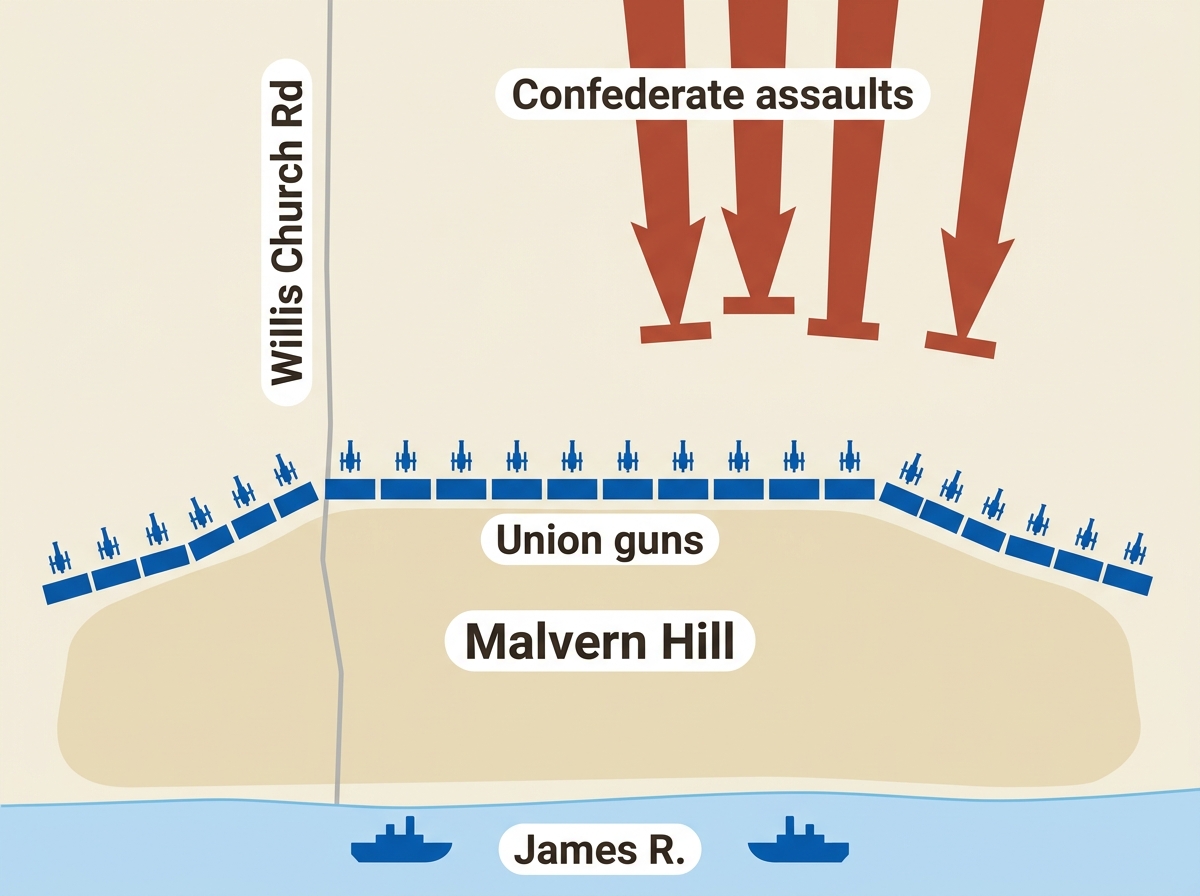
A frontal assault (marching infantry straight at a strong, fortified position head-on) is the costliest attack in war even when it works. A frontal assault uphill, across open ground, against massed artillery (many batteries concentrated to fire on the same killing zone), delivered one fragment at a time with no support, is not really an attack at all. From mid-afternoon on, the Confederate brigades came on and were torn apart. The guns fired canister (tin cans packed with iron balls that turned a cannon into a giant shotgun), and at close range a single blast could scythe down most of a company at a stroke, dropping a line of men where it stood. The charges stalled well short of the crest and were driven back down. Then another brigade tried, and was driven back. Then another; one of them, Kershaw’s, broke and ran after being raked by fire from its own confused supports. Around twenty separate Confederate brigades charged at different moments across the afternoon and into the evening; some divisions lost a quarter or more of their strength, individual brigades close to half. Not one Confederate soldier reached the top of the hill. A large share of those losses came from the artillery: Hunt’s gunners fired hundreds of rounds per battery and broke charge after charge before it could ever close to musket range, though no one has a precise accounting of how many men the cannon killed versus the rifles. The result is certain: the open field below the crest filled up with the dead and wounded of an army that never got to grips with its enemy.
Hill led one of the largest of those charges himself, five brigades, more than eight thousand men, sent up through the killing ground in uncoordinated waves, and he watched them get shot down on the very slope he had warned everyone to leave alone. More than twenty years later, writing his own account of the battle, he gave the day its verdict:
It was not war, it was murder.
He had seen it from the front: brigade after brigade walking up an open hill into massed guns that broke each one before it arrived.