It had to be done in the dark. Around half past four in the morning on May 12, delayed from four by darkness, mist, and a cold drizzle, Major General Winfield S. Hancock (North) sent his entire II Corps, somewhere between fifteen and twenty thousand men packed into a massive column, straight at the apex of the Mule Shoe. This was Upton’s tactic blown up to corps scale: a huge dense mass of men surging across the wet ground in the half-light, not stopping to shoot, aimed at the single most exposed point in Lee’s line.
With the cannon gone, there was almost nothing to stop them. The roughly four thousand defenders at the apex got off what fire they could in the rain and then the wave was on top of them. The division of Brigadier General Francis Barlow (North), the formation that would overrun the apex, poured over the works and the defense simply came apart. The Federals did not just take the trench, they took the people in it, scooping up most of the division as prisoners in one of the largest mass captures of the war. Major General Edward "Allegheny" Johnson (South) himself was taken, and so was one of his brigade commanders, Brigadier General George "Maryland" Steuart (South), along with thousands of their men and the guns that had arrived too late to fire. In the span of a few minutes a huge gap had been torn in the Army of Northern Virginia, and Union troops were pouring through it into the heart of Lee’s line.
This was the crisis of the battle, and possibly of Lee’s army. If the breach widened, the whole army could be cut in two.
Lee to the Rear
What sealed it was speed and desperation. Major General John B. Gordon (South) flung counterattacking brigades into the gap to plug it, feeding in everything within reach: the South Carolinians of Brigadier General Samuel McGowan (South), the men of Brigadier General Stephen Ramseur (South), brigade after brigade thrown straight into the breach. Lee himself rode forward to lead the counterattack in person, and his soldiers would not have it; they crowded around him and turned his horse back, shouting "Lee to the rear!" until he gave way. It was nearly a replay of a moment in the Wilderness days earlier, and the army would not spend its commander to buy back a trench. The counterattacks did not drive the Federals out so much as stop them, jamming them up along the inside of the west shoulder of the salient. And there, on that west-face ground just below the apex, the two armies locked together and could not let go.
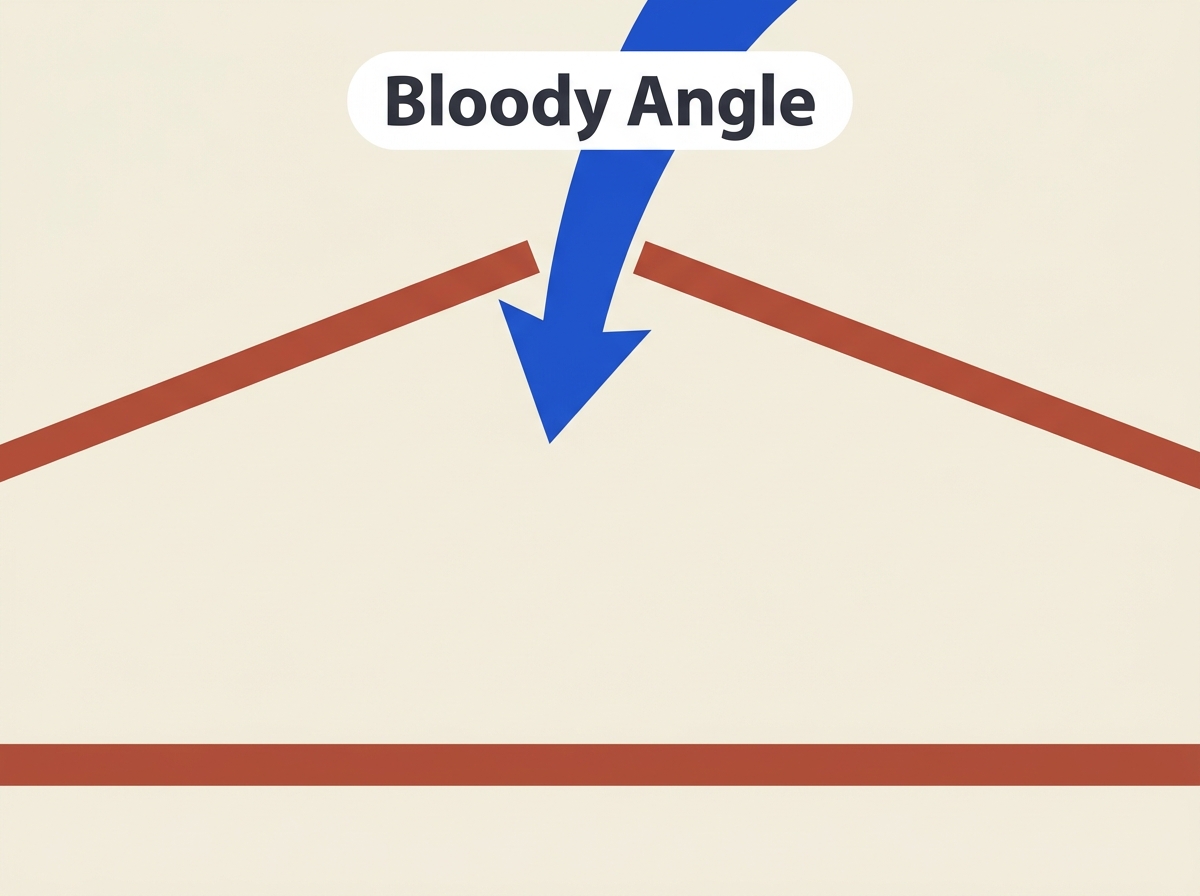
Twenty Hours at the Parapet
For something on the order of twenty hours, and many accounts say twenty to twenty-four, the two sides fought hand-to-hand across the same log parapet, in the rain, without either being able to break the other. This was not a battle line trading volleys at a hundred yards. This was men jammed muzzle-to-muzzle on opposite sides of the same wall of dirt and logs, firing point-blank into each other through the chinks, stabbing over the top with bayonets, swinging clubbed muskets like axes when there was no time to load. The rain that had delayed the dawn assault now soaked the gunpowder and ruined it, so that loaded weapons would not fire and the fight collapsed into the oldest kind of killing there is, close enough to grab the other man. Fresh men climbed up onto the parapet to shoot down into the trench and were shot down themselves and fell into it, and more climbed up over them. The ditch on the Confederate side filled with rain, mud, and the dead, layered where they fell. Soldiers on both sides who survived the war and saw everything else it had to offer still said they had never seen anything like the Bloody Angle, and never wanted to again.
Warren Attacks Laurel Hill. Again.
While the apex bled, Grant needed Lee pinned everywhere so he could not shift troops to the breach. The order went to Major General Gouverneur K. Warren (North) to throw his V Corps at Laurel Hill once more; Major General George G. Meade (North) told him to go in at once at all hazards. It failed once more, as it had every time, and worse, it drew off no Confederate reserves the way Grant had hoped. Some of Warren’s units were now making their fourth or fifth doomed charge at the same hill.
Sometime around three or four in the morning on May 13, it ended the only way it could. Lee’s men had spent the night building a fresh line of works straight across the base of the salient, a chord drawn across the bottom of the horseshoe, perhaps half a mile to three-quarters of a mile behind the apex, and now, regiment by regiment in the dark, the Confederates slipped back to it and abandoned the bloody tip of the Mule Shoe entirely. By dawn the apex belonged to the Union, and there was almost nothing there worth having.
Grant’s aide Lieutenant Colonel Horace Porter (North) walked the ground afterward and tried to describe it. By his account, the Union dead were scattered all across the area around the angle, while in front of the captured works the Confederate dead lay vastly more numerous, piled on top of one another several layers deep. In something like twenty-four hours, the fighting in and around the salient had cost on the order of nine thousand Union and eight thousand Confederate casualties, though the Confederate figure includes the roughly three thousand of Johnson’s division marched off as prisoners. Whichever way you count it, it was the bloodiest single day of the costliest battle of the campaign.
The Tree the Bullets Cut Down
The volume of rifle fire along that contested stretch was so unrelenting, so dense and so continuous over those hours, that it did something hard to believe until you see the proof: it cut down a living oak tree. Not knocked it over with a cannonball, but cut it down with rifle bullets, the way a saw would, the trunk gnawed clean through by an uncountable storm of small-arms fire until a tree nearly two feet thick simply fell. Conical minié balls, the soft lead rifle bullets of the war, are still embedded in the wood. The stump was dug up and sent to the Smithsonian in 1888, and it is on display today at the National Museum of American History, in an exhibition about the price of American freedom. You can stand in front of it. It is the single most concrete thing the Bloody Angle left behind: a tree killed by gunfire, because that is how much gunfire there was, in one spot, for the better part of a day.