For two days the Army of the Potomac had been chewed up in the Wilderness, a tangle of scrub oak and brush about ten miles (16 km) to the northwest, in a fight so confused that the brush caught fire and burned the wounded where they lay. It ended in a bloody stalemate. Every Union commander who had ever taken a punch like that from Robert E. Lee and his Army of Northern Virginia had done the same thing afterward: pulled back north, licked his wounds, and let Lee keep Virginia. The Confederate soldiers expected it. It was practically a ritual.
Ulysses S. Grant, the new general-in-chief of all the United States armies, was riding with the Army of the Potomac and running this campaign himself, and he did not pull back north. On the night of May 7 he turned the army the other way, southeast, toward a sleepy crossroads village called Spotsylvania Court House, about ten miles (16 km) below the Wilderness, set in the farm country between the Rapidan River to the north and the North Anna River to the south. A "court house" here just means the county seat, a few buildings around the place where the local roads happened to meet. But those roads were the point. The crossroads sat astride the direct route south toward Richmond, the Confederate capital. Grant meant to get the army around Lee’s right flank (the end of his line) and plant it between Lee and Richmond, forcing the Confederates to either attack him on his terms or fall back. Whoever reached the crossroads first and dug in would own the road south.
It became a race in the most literal sense: two armies marching through the dark for the same patch of ground, and the one that lost would have to attack the one that won.
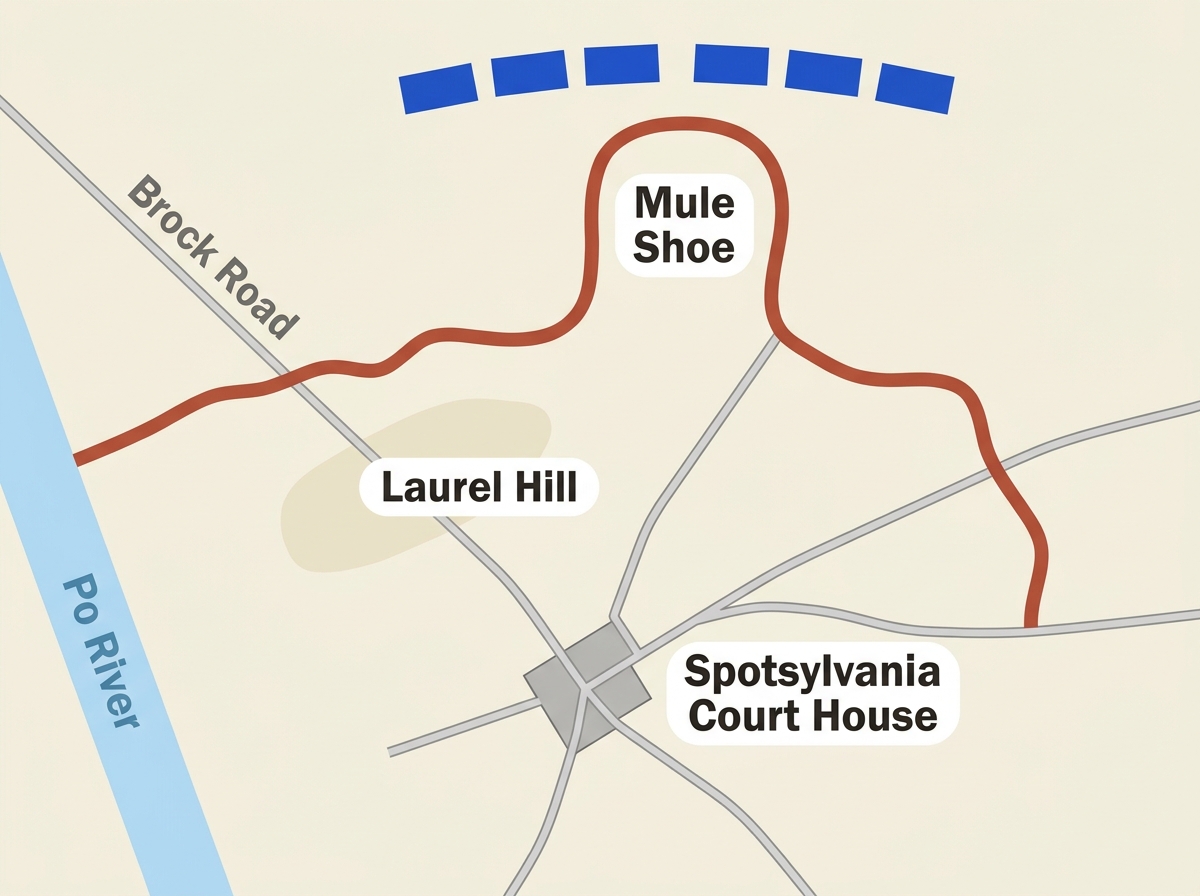
Lee read it almost at once. He sent his First Corps (a corps is the largest building block of a Civil War army, two or three divisions, tens of thousands of men; the Confederates numbered theirs in words, First and Second and Third, the Union in Roman numerals) pelting for the crossroads. It was led now by Major General Richard H. Anderson (South), who had just inherited the corps because its usual commander, Lieutenant General James Longstreet (South), had been shot by his own men in the Wilderness two days earlier. Anderson’s infantry, choking on the smoke of the burning woods and unable to sleep anyway, set off around ten at night down a forest road that had been freshly cut for the purpose, and marched all night without a real halt.
Meanwhile the Union infantry got tangled up on the Brock Road, the most direct route from the Wilderness down to Spotsylvania. Union cavalry under Major General Philip H. Sheridan (North) had been wrestling all day with the Confederate horsemen of Major General J.E.B. Stuart (South) for control of that very road, and the friction jammed the column. Every hour the Union foot soldiers lost on the Brock Road was an hour handed to Anderson.
Anderson Wins by Minutes
Anderson won. His men reached the high ground above the crossroads, a low rise called Laurel Hill, just south of the Brock Road, the last defensible ground north of the village, minutes ahead of the Union arrivals. When the Federals came up and attacked on May 8, the Confederates were already there, throwing up dirt. The race was over, and the Union had lost it by a margin you could measure on a watch.
That set the shape of everything that followed. For the next two weeks the pattern almost never varied: Grant attacks Lee’s entrenchments, Grant is bloodily repulsed, Grant slides southeast and tries again somewhere else. It was the template of the entire campaign, and it started here, with a few minutes’ difference on a forest road.