Through the afternoon Lee made his decision and sent it to Richmond. The telegram to President Jefferson Davis reached him during Sunday services at St. Paul’s Church: Petersburg and Richmond could no longer be held, and both must be evacuated that night. The government packed what records and treasury it could onto trains and fled south. Behind it, soldiers and mobs set fire to warehouses and bridges, and the fire spread until much of the business district of the Confederate capital burned. On the morning of April 3, Union troops, many of them United States Colored Troops, marched into Richmond and raised the United States flag over the capitol.
Petersburg fell the same morning. After dark on April 2, Lee pulled his army out of the works it had held for nine months and started west along the north bank of the Appomattox River, the four wings of his command converging toward Amelia Court House where he hoped to find rations and turn south to join the last Confederate army in North Carolina. The Army of Northern Virginia was on the road at last, in the open, exactly where Grant had spent a year trying to put it.
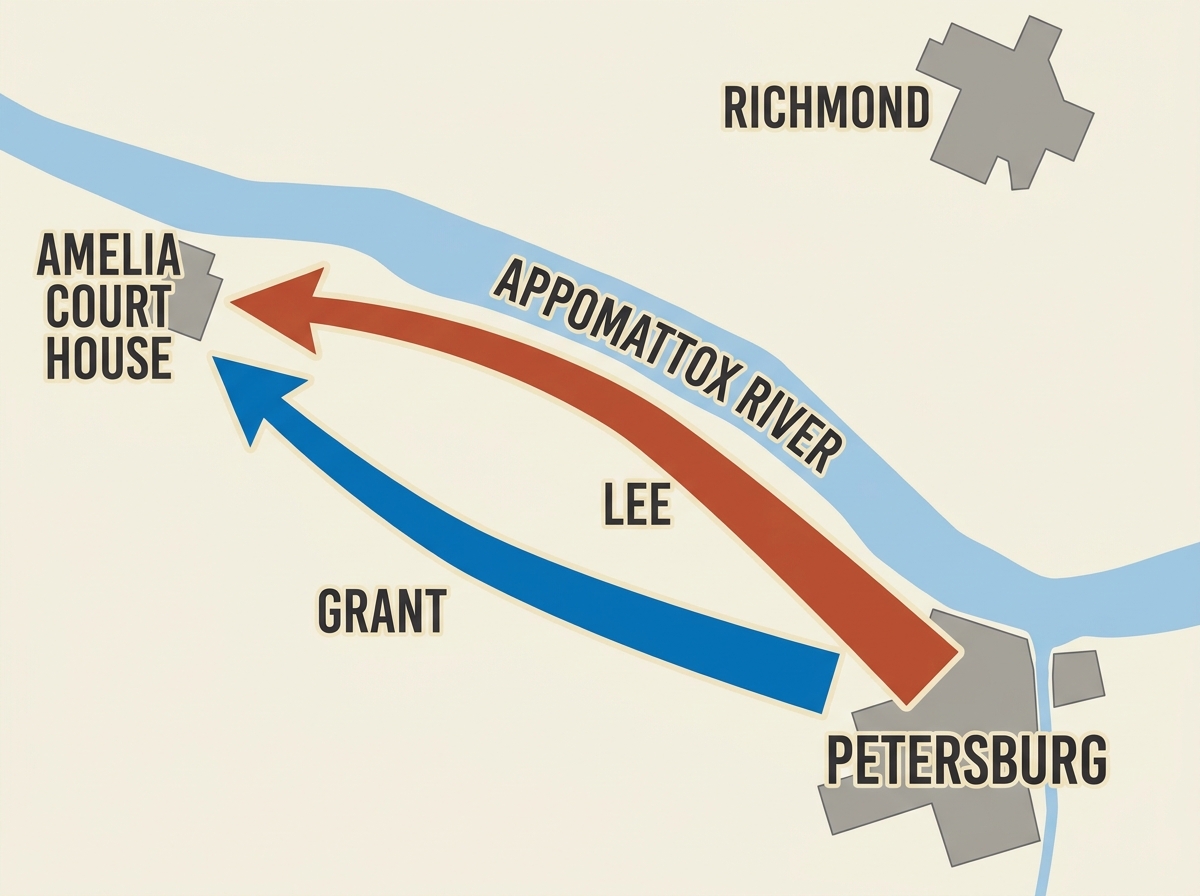
The fight at Petersburg cost the two armies something on the order of 7,700 men together over the day, with Union losses around 3,500 and Confederate losses around 4,250, many of the latter taken prisoner as the line collapsed. But the casualty count is almost beside the point. April 2 ended the siege, took the railroad town and the capital it fed, killed one of Lee’s ablest generals, and put the Army of Northern Virginia in flight with a stronger army at its heels.
That flight had one week to run. Grant’s columns pursued hard, racing along the railroads to get in front of the retreat. The promised rations never came, the roads turned to confusion, and at every river crossing the Union cavalry and infantry closed a little tighter. On April 9, surrounded and out of options near a village called Appomattox Court House, Lee surrendered the Army of Northern Virginia to Grant. The war in Virginia, and with it the cause of the slaveholding republic the Confederacy had been founded to defend, was over. The breakthrough at Petersburg was the blow that started the week that ended it.
Eastern TheatreAppomattox: the surrender, one week later