Why a general would choose to fight in a place nobody could see
One thing to fix in your head first, because the rest of the story leans on it. By 1864 the United States had split in two and was three years into a civil war. Eleven southern states had seceded (broken away) and formed their own country, the Confederacy (called here “the South”), and they were fighting the states that stayed loyal to the old United States, the Union (“the North”). Officers in this story are tagged with the side they fought for: (North) for the Union, (South) for the Confederacy.
The Wilderness was not a place you would pick for a battle. It was a place you would pick to get lost in. A few miles west of Fredericksburg, Virginia, in Spotsylvania and Orange counties, the land went bad in a particular way: a dense, second-growth thicket of scrub oak, pine, and tangled underbrush so thick that a man could not see more than a few yards in any direction. Whole armies would disappear into it. The National Park Service has a phrase for what the fighting there became, “bushwhacking on a grand scale,” isolated little knife-fights between small clumps of men who could not find the rest of their own army, all of them “confused by the bewildering forest.”
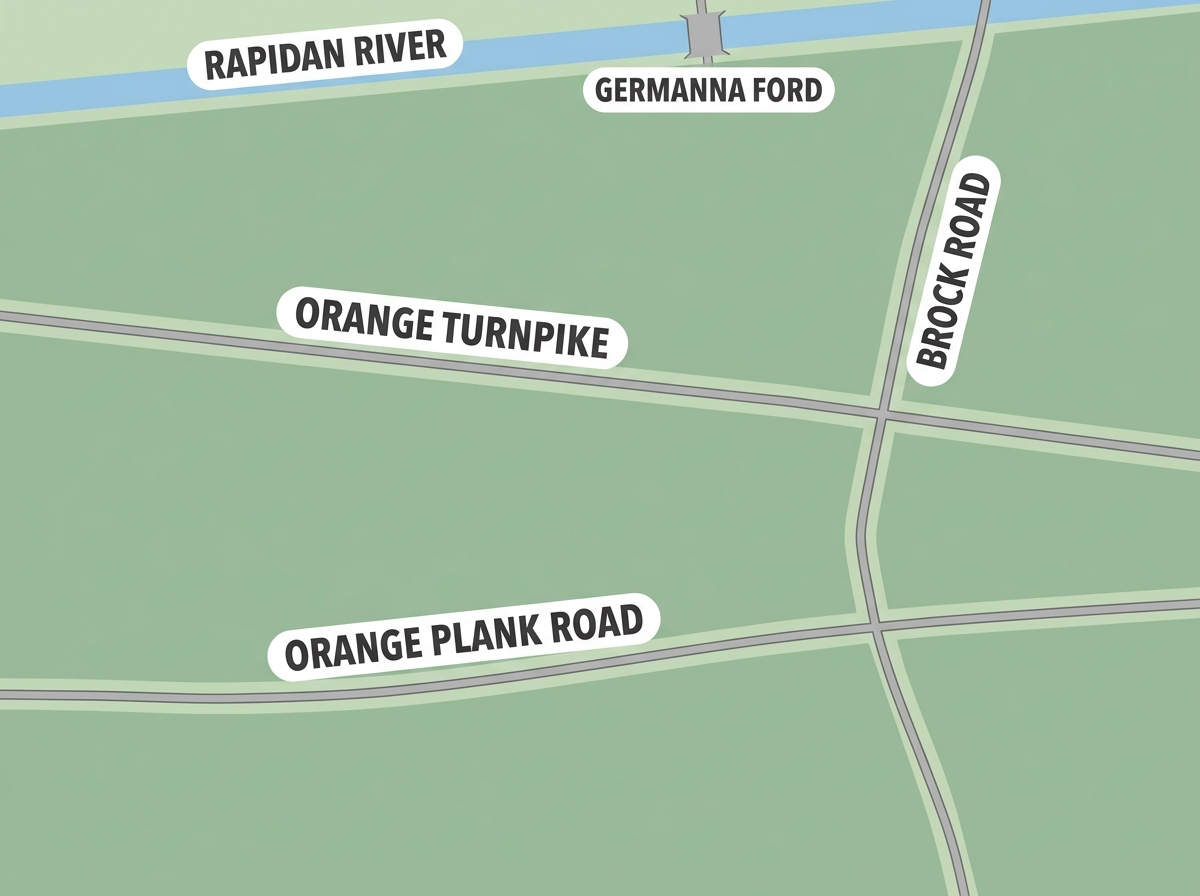
So why fight there? Because one man wanted exactly that. In early May 1864, Lieutenant General Ulysses S. Grant, newly made general-in-chief of all the United States armies, the top soldier in the country, had brought a very large army across the Rapidan (the river marking the northern edge of this country) and pushed it into the woods. His plan was to march through the thicket fast and out into open ground on the far side, where his numbers could tell. And his numbers were enormous: well over 100,000 men, against the roughly 60,000 to 66,000 that General Robert E. Lee had in his Army of Northern Virginia. Grant had nearly twice Lee’s strength.
Lee’s answer was to refuse Grant the open ground. He struck inside the thicket, while the Union army was still strung out crossing it, before it could clear the trees. In the open, Grant’s extra men and his roughly 316 cannon would have crushed him. But in the Wilderness, cannon could not be aimed (there was nothing to aim at but leaves) and a battle line dissolved into the brush the moment it moved. The terrain erased the difference between a big army and a small one. Lee chose to fight blind, because blind was the only way the math worked.
There was an extra ghost in these particular woods. Just one year earlier, on nearly this same ground, Lee had won the masterpiece of his career at Chancellorsville, and it was there that his great lieutenant, Thomas “Stonewall” Jackson, had been shot by his own men in the dark. The Wilderness was about to echo that story almost exactly.
Eastern TheatreChancellorsville: the victory a year before, on the same ground