The first time a Union army did not flinch
By the morning of May 7 the two armies sat in their trenches, glaring at each other across the smoking woods. Tactically, the Wilderness had been a draw with a Confederate edge: Lee had stopped a far larger army on ground he had chosen, and he had done it while losing only about half as many men. The arithmetic was lopsided. The Union had lost somewhere around 17,500 to 18,000 men, killed, wounded, and missing. Lee’s loss is genuinely uncertain in the records, somewhere in the range of roughly 11,000, with some accounts running as low as about 8,000. Either way, Grant had lost close to twice what Lee had. By every rule of the previous three years, this was a defeat, and the next move was a retreat back across the Rapidan.
Grant did not retreat.
He judged Lee’s earthworks too strong to storm head-on, so he chose to maneuver instead, and the direction he chose is the hinge of the entire war in the East. Rather than recross the river to safety, he ordered the pontoon bridges (the army’s portable floating bridges) at Germanna Ford, the Rapidan crossing the army had entered through, taken up, the unmistakable sign that he was not going back, and pointed the army southeast, around Lee’s right flank, toward Spotsylvania Court House about 10 miles (16 km) away. The point was to stay between Lee and Richmond and force the next fight on his own terms. It was the first time the Army of the Potomac had stayed on the offensive after an opening battle with Lee in Virginia.
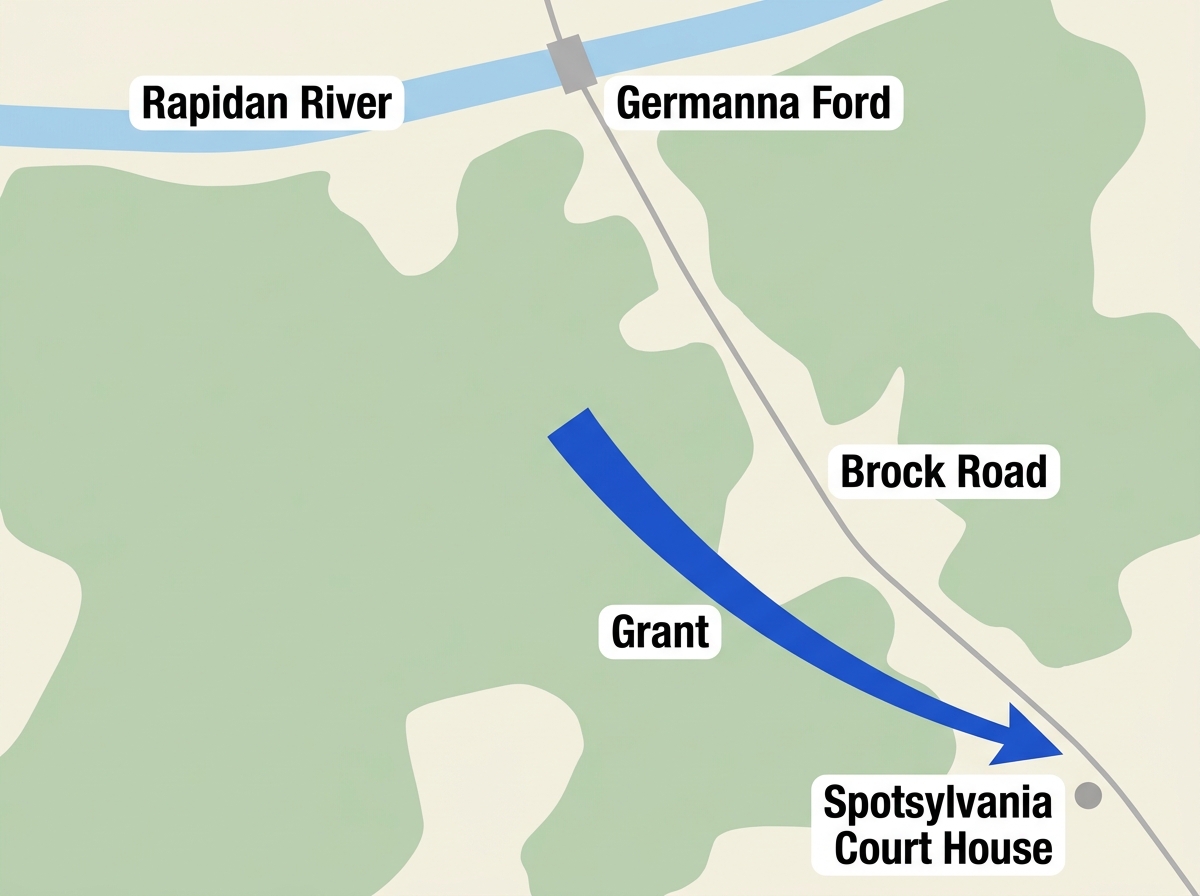
The soldiers felt it before they understood it. On the night of May 7 the exhausted army filed out of its trenches and marched, and at a certain fork in the road the men found the column turning south, toward the enemy, instead of north toward the river and home. As the realization rolled down the ranks that they were advancing and not retreating, the army broke into cheering, and on the dark road they sang. After three years of bleeding Lee and falling back, the Army of the Potomac finally had a commander who would not turn around. Lee read Grant exactly: he guessed Grant would make for Spotsylvania Court House, and he got there first and dug in, which opened the next battle.
Eastern TheatreSpotsylvania Court House: where the race south led next