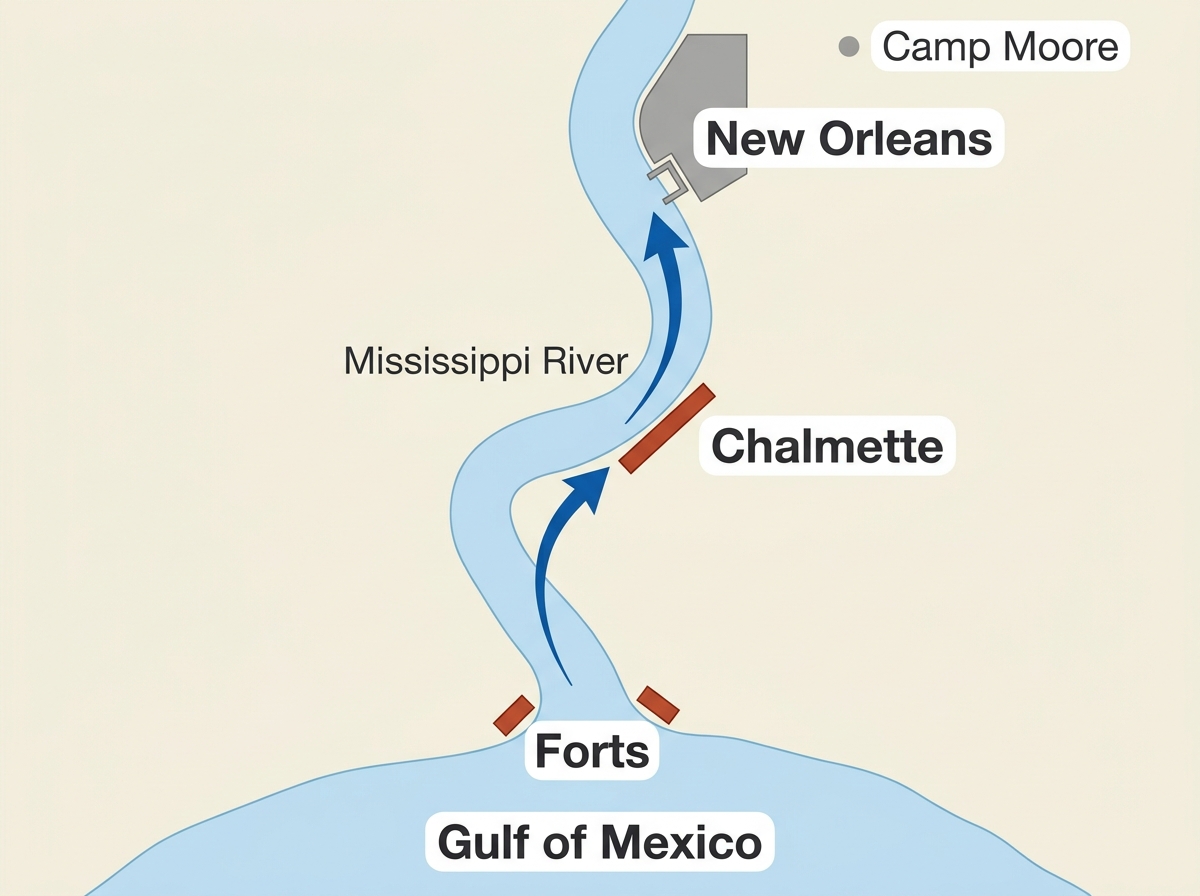
On April 25, 1862, the day after the run, Farragut steamed up the river and dropped anchor before New Orleans at noon and found a great city with nothing to defend it. (There had been one last line of guns, the Chalmette batteries a few miles below the city, but his big ships overwhelmed them in short order on the way up.) Maj. Gen. Lovell (South), with about 3,000 militia and no way to fight a fleet of warships in the streets, had made the only sane choice and pulled his troops out, marching them 78 miles (126 km) north toward Camp Moore rather than turn New Orleans into a slaughterhouse he was certain to lose. The largest city in the Confederacy had been left to its fate.
What greeted Farragut was less a surrender than a tantrum. The waterfront was on fire: citizens were burning cotton bales, sugar, and supplies along the wharves so the Union couldn’t take them, and the unfinished ironclad Mississippi, the dream-ship that never got her engines, was set ablaze and sent drifting downriver as a burning hulk. Mayor John Monroe (South) refused to formally surrender the city, insisting it was undefended and that Farragut could take it himself if he wanted it. The crowds lining the levee (the raised earthen riverbank that served as the city’s waterfront) were furious and helpless at once.
The flag and the forts
The fury found a focus on April 26. Marines went ashore to raise the United States flag over the New Orleans Mint, and a group of citizens promptly tore it down. One of them, a gambler named William Mumford (South), was part of the group that hauled the flag down and dragged it through the streets, where the crowd ripped it to shreds. It was a small act of defiance with an enormous price tag, though that bill would not come due for weeks.
Downriver, the forts were dying on the vine. Cut off, with the city already lost behind them, their boats destroyed and their supplies gone, the men inside Fort Jackson finally broke. On the night of April 27–28, around 300 of its soldiers mutinied, spiking their guns (jamming the cannon so they could never be fired again) and walking out. Fort St. Philip never mutinied, but the position was hopeless. General Duncan (South), a Pennsylvania-born engineer, a Northerner who had spent the war defending a Southern city and who would be dead of malaria before the year was out, was cut off and half-deserted, and he opened surrender talks. Both forts gave up on April 28. To the last, the South denied the Union its prizes: rather than let the great ironclad Louisiana be surrendered under the truce, Commander Mitchell (South) ordered her set afire, and she blew up as she drifted past Fort St. Philip, the blast killing one Confederate soldier in the fort.
Beast Butler takes the city
With the forts down, the army came up. On May 1, 1862, Maj. Gen. Benjamin Butler (North) marched his troops into New Orleans, and the occupation began. It would be one of the most hated in American history. Butler put the city under martial law (military rule, with the army replacing the civilian courts and police), demanded loyalty oaths, and confiscated weapons. When the women of New Orleans made a point of insulting his soldiers, he issued the notorious “Woman Order,” declaring that any woman who showed contempt for Union troops would be treated “as a woman of the town plying her avocation,” that is, as a prostitute. The order caused an international uproar; the British prime minister himself rose in Parliament to condemn it.
And then there was Mumford. Butler had the flag-tearer arrested, tried for treason, and hanged on June 7, 1862, at the very Mint where he had pulled the flag down, a deliberate, public execution meant to make an example of him, so pointed that the Confederate president declared Butler deserved to hang for it. Between the Woman Order, the hangings, and the iron rule, white New Orleans gave Butler the nickname history kept: “Beast” Butler.
But what white New Orleans mourned as occupation, a large share of the city’s people experienced as something else entirely. New Orleans was home to roughly 25,000 Black residents, about 14,000 of them enslaved and the rest free people of color, and for them the Union fleet on the river was not a tyrant arriving but a chance opening. Self-liberating people began streaming toward Union lines almost from the day Farragut anchored, walking out of bondage in the very city that had been the South’s largest slave market. Within months Butler was doing something no one in New Orleans had ever seen: he raised regiments of Black soldiers, the Louisiana Native Guards, drawing on the city’s free Black community and on men who had just freed themselves, until they numbered in the thousands and grew toward four full regiments. The same occupation that outraged the women on the balconies was, for tens of thousands of people in the same streets, the beginning of the end of the machinery this story opened on.
The occupation was harsh, and for some it was deliverance. Either way, the real blow had already landed elsewhere.
The city gone, and with it the river
What the Union had won was staggering. The Confederacy’s largest city, its biggest port, the place where most of the South’s cotton reached the world and where its second-greatest manufacturing base stood (the Leeds Foundry, the South’s most important ironworks after the great Tredegar works in Richmond) was gone, taken after only about fifteen months of Confederate control, the first major Southern city to fall. With it went the entire lower Mississippi: there was now no real Confederate force, on land or water, between the Gulf of Mexico and Memphis. Within weeks Farragut had Baton Rouge and Natchez too, and the great river was Union from the sea up to Vicksburg. And with the Louisiana blown up and the Mississippi burned, the Confederacy’s best hope for an ironclad navy on the river had died here in a single week.
The South understood at once what it had lost. The Confederate diarist Mary Chesnut, whose wartime journal would become the era’s most-read first-hand account of the Confederacy, took the news in despair, writing that with New Orleans gone, the Confederacy itself felt gone. The Anaconda was tightening. The hand was around the throat. The South had built its war to defend a slave economy that ran through New Orleans, and now New Orleans, and the river it sat on, belonged to the men who had come to end that economy. It was, by any measure, the great event of the war second only to the final surrender of Lee, and it had cost the Union, on the night that decided it, fewer than forty lives. (The man who had given up the city, Lovell, would spend the rest of the war under a cloud for it; a court of inquiry eventually cleared him of blame, and history has tended to lay the loss at Richmond’s door, where the city had been stripped of its defenders in the first place.)