Rear Admiral David G. Farragut (North), commander of the West Gulf Blockading Squadron, flew his flag in the steam sloop USS Hartford (a sloop-of-war being a single-deck warship, smaller than a frigate but still a serious gun platform). His plan was less clever than it was nervy. He would run the forts. "Running" a fort means exactly what it sounds like: instead of stopping to slug it out with the fort’s guns, you steam past at full speed, take your beating on the way through, and get into the water beyond before the fort can finish you. He would push his whole fleet through the channel, past Forts Morgan and Gaines, over the minefield, into the bay, then destroy the Confederate squadron waiting inside and seal the port. The forts themselves he meant to take the slow way, from both sides at once. Major General Gordon Granger (North) had already landed roughly two thousand army troops on Dauphin Island to besiege Forts Gaines and Morgan from the landward side, so that once the fleet was through, each fort would be squeezed between Granger’s infantry behind it and the navy’s guns in front of it.
The fleet had two parts. Leading on the starboard side, the right, the Fort Morgan side where the deep water ran, came a single column of four monitors. A monitor was a low, almost-submerged ironclad: a flat iron deck barely above the waterline, with the guns mounted in a revolving armored turret, presenting almost nothing for an enemy to hit. The four were Tecumseh, Manhattan, Winnebago, and Chickasaw, in that order, with Commander Tunis A. M. Craven (North) in the lead aboard Tecumseh.
To port came the wooden ships, the big steam sloops and frigates, and here Farragut did something that tells you how much he respected the forts. He lashed them in pairs. Each large wooden warship was tied alongside a smaller gunboat on its disengaged side (the port side, away from Fort Morgan), so the big ship’s hull shielded the little one from the fort’s fire, and if either was crippled the other could tow it clear. Hartford was lashed to the gunboat Metacomet under Lieutenant Commander James E. Jouett (North). At the head of the wooden column came USS Brooklyn, under Captain James Alden (North), with Farragut’s Hartford close behind it and a long line of paired sloops and gunboats trailing after.
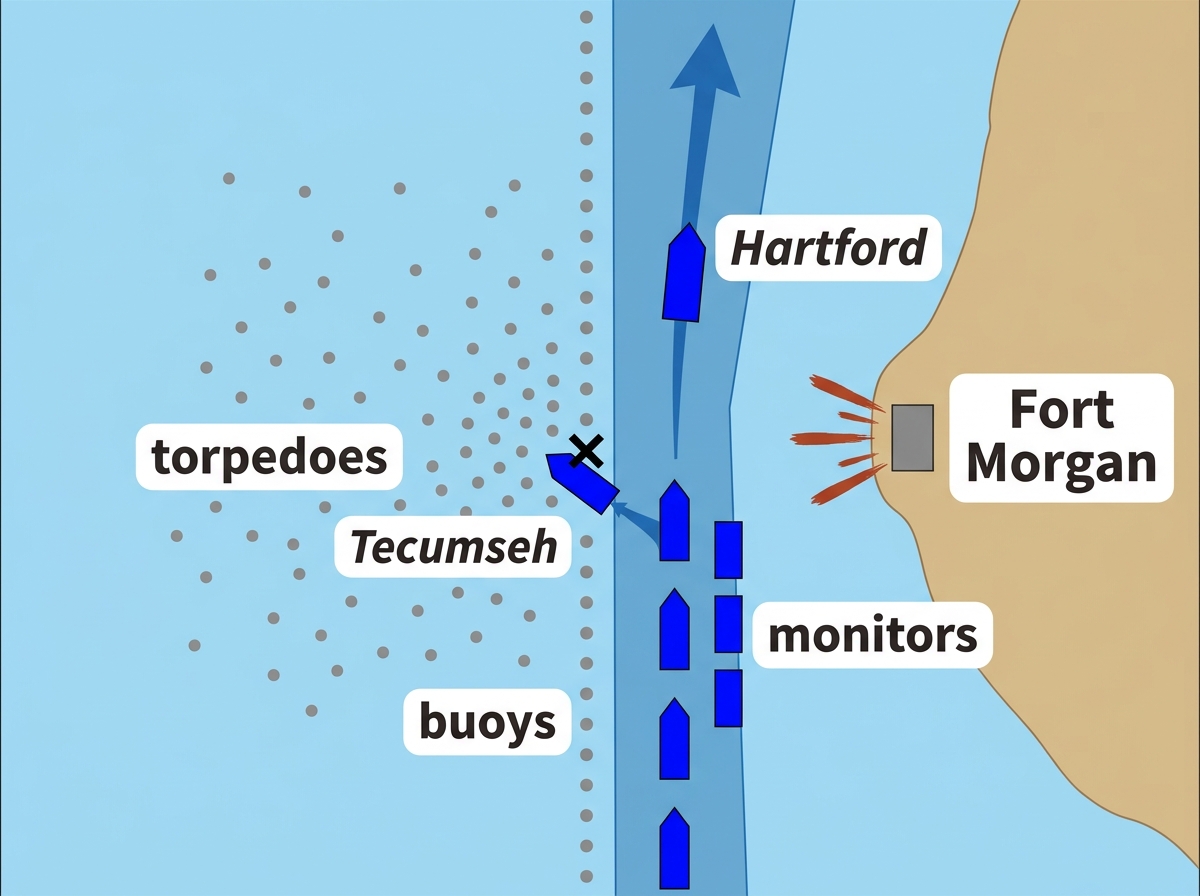
Just before dawn the fleet formed up, and around six to seven in the morning it stood in toward the channel, the monitors leading, Brooklyn at the head of the wooden line. Fort Morgan opened fire. The big wooden ships took the hammering on their starboard sides while the lashed gunboats sheltered to port, and the column pushed up the narrow lane, mines and their marker buoys on the left hand, Fort Morgan’s forty-six guns on the right. The fleet had to thread between the two, because the safe water was a tight strip hard up under the fort.
Then the lead monitor died in half a minute, and the whole attack nearly died with it.