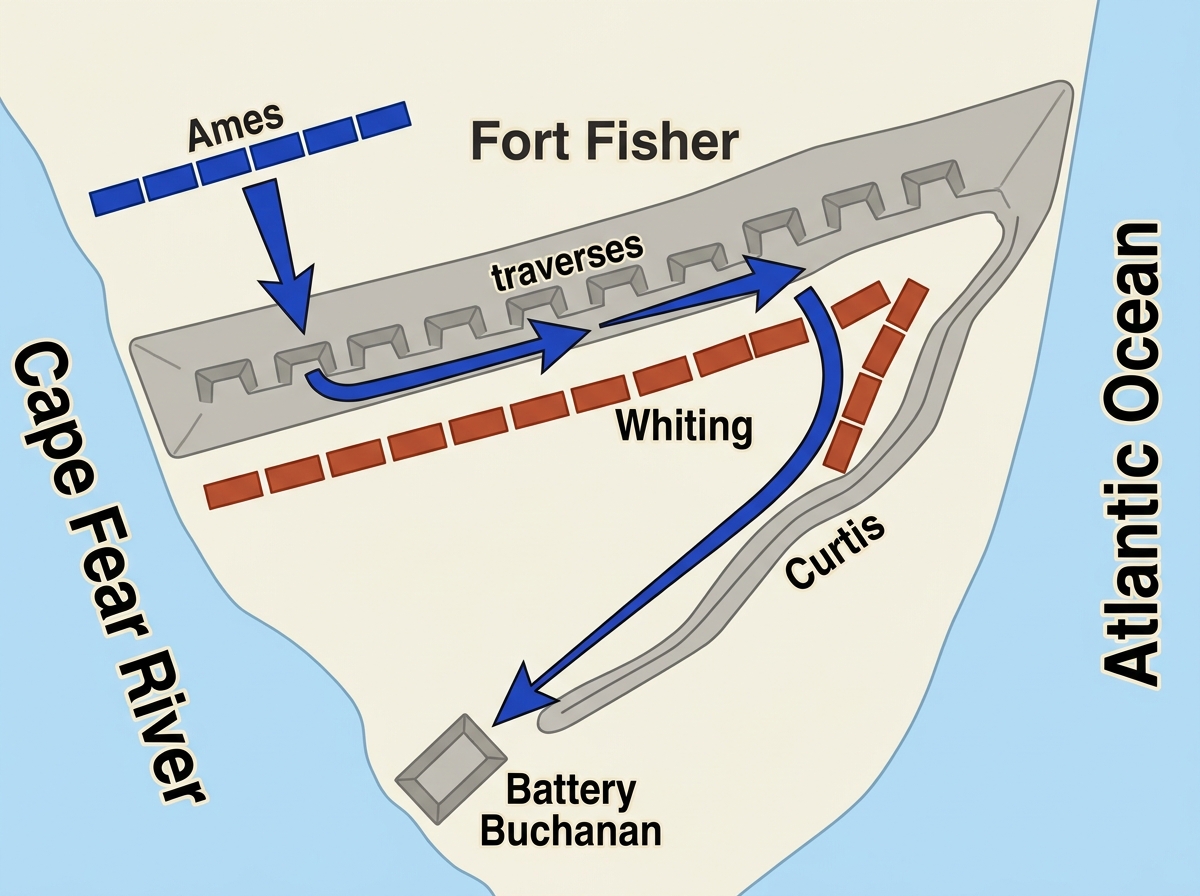
While the sailors were dying on the beach, the army went in at the other end. Brigadier General Adelbert Ames (North) sent his division against the western end of the land face, the corner nearest the river. Brevet Brigadier General Newton Martin Curtis’s (North) brigade led the way, with men running ahead to chop through the palisade, the fence of sharpened logs planted in front of the wall, and the abatis, the tangle of cut brush and branches laid down to snag attackers. They got through, swarmed up the sand, and took the first of the great mounds.
Then began the hardest kind of fighting there is. Fort Fisher’s land face was a row of traverses, those huge mounds of sand between the gun positions, and each one was its own little fortress. The Union troops had to take them one at a time, hand to hand, climbing one mound under fire, fighting across its top, dropping down the far side into the next gap, and starting again. Ames fed in brigade after brigade, Curtis, then Colonel Galusha Pennypacker’s (North), then Colonel Louis Bell’s (North), grinding forward traverse by traverse through the late afternoon and into the dark. The cost in officers was savage: all three of Ames’s brigade commanders fell, Bell killed and Curtis and Pennypacker badly wounded, and most of the regimental commanders went down with them.
The two generals in the hospital
The Confederate defense did not lack for courage at the top. Major General W.H.C. Whiting (South), the district commander, had come down to the fort to share its fate rather than watch from Wilmington, and he fought in the line with the men. Refusing demands to surrender, he was shot down and severely wounded in the close fighting on the traverses. Soon after, Colonel William Lamb (South), the fort’s builder and commander, fell badly wounded as well. The two men who had made Fort Fisher what it was ended the battle lying side by side in the fort’s hospital, both broken, while their men were pushed back mound by mound toward the tip of the peninsula.
The fighting ran on for hours after dark, longer than almost any assault of the war, the Union troops clawing across one traverse after another by the light of the fires and the muzzle flashes. With Whiting and Lamb down, command of the shrinking garrison passed to subordinates, and the survivors were finally driven all the way to the end of the point, where the fort met the river at a small earthwork called Battery Buchanan. There was nowhere left to go. Just before ten o’clock at night, a Confederate officer came forward under a white flag, and the fort that had held for three days gave up. Major General Alfred H. Terry (North) rode down to Battery Buchanan to take the surrender of the garrison in person.
The last door shuts
The whole garrison was captured, close to 1,900 men. The Union paid heavily for them: the army lost about 660 killed, wounded, and missing, and Porter’s naval landing force nearly 400 more, most of those in the failed charge along the beach. The Confederate dead and wounded ran into the hundreds before the survivors laid down their arms. For Whiting it was a death sentence on a delay: carried north as a prisoner, weakened by his wounds, he died on March 10, 1865, in the Union military hospital at Fort Columbus on Governors Island in New York Harbor.
The strategic result was exactly what Grant had wanted. With Fort Fisher gone, the Cape Fear River was closed, the blockade runners had nowhere left to run, and Wilmington itself fell a month later, on February 22, 1865. The Confederacy’s last great seaport was shut, and with it the last reliable line of supply to the armies still in the field. Robert E. Lee held on in the trenches at Petersburg for a few more weeks on dwindling rations, then broke out, ran west, and surrendered at Appomattox Court House in April. Fort Fisher did not end the war by itself, but it shut the last door, and after it closed there was no longer any way to keep the armies fed. The end came fast once the sea was sealed.
Eastern TheatreAppomattox: the surrender that came once the supplies stopped