For five days, it was the happiest week in the life of the United States.
On April 9, 1865, Robert E. Lee surrendered the Army of Northern Virginia (the South's main fighting force) to Ulysses S. Grant at a little crossroads in Virginia called Appomattox Court House. The Confederate capital at Richmond had already fallen. The war was not formally over (other Southern armies were still in the field), but everyone could feel which way it had gone. The thing the country had bled over for four years was finished, and it had ended the right way. Washington went a little out of its mind with relief: bonfires in the streets, candles in every window, brass bands, crowds that wanted to be sung to and shouted at and told it was real. After four years of casualty lists, the city was simply, hugely glad.
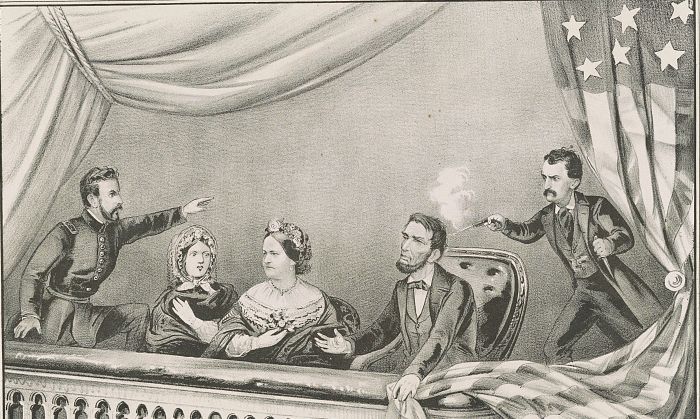
And then, on the night of Good Friday, April 14, 1865, five days after Appomattox, a man the whole country recognized, one of the most famous actors in America, walked up the stairs of a Washington theater, stepped into the President's private box, and shot Abraham Lincoln in the back of the head. By the next morning the President was dead, the first in American history to be murdered in office. It was not a lone gunman's outburst. It was the surviving piece of a coordinated plot to kill three men at once and decapitate the United States government in a single night.
The Last Speech
Three nights before he was killed, Lincoln gave a speech that, more than anything else, decided he would be.
On April 11, 1865, with the city still celebrating, Lincoln stood at a second-floor window of the White House and spoke to a crowd gathered below, in what turned out to be his last public address. Most of it was not a victory speech at all. It was about the hard, unglamorous problem that was about to consume the next decade: Reconstruction (the question of how to put the defeated Southern states back into the Union and on what terms). Specifically, he was defending the new free-state government being built in Louisiana. And buried in it was a line that made him the first U.S. president ever to publicly endorse voting rights for any Black Americans, a cautious, limited version, but a real one:
"It is also unsatisfactory to some that the elective franchise is not given to the colored man. I would myself prefer that it were now conferred on the very intelligent, and on those who serve our cause as soldiers."
In the crowd that night stood John Wilkes Booth (Confederate sympathizer), and beside him one of his fellow plotters, Lewis Powell (Booth conspirator). Booth was a fanatical supporter of the Southern cause and of slavery, and the suffrage line set him off. What exactly he muttered varies by the telling: the wording reported includes an ugly racist version (that this meant Black citizenship) and, most famously, a flat threat: "That is the last speech he will ever make." The precise words are uncertain, but historians accept Booth said something to that effect that night. The thing that lit the fuse, it's worth being clear, was Lincoln promising the vote to Black soldiers.
There is one more piece of the legend from these final days, and it is worth knowing only as legend. According to Ward Hill Lamon (Lincoln's friend, occasional bodyguard, and former law associate), the President had told a small group, including his wife Mary Todd Lincoln, about a dream of his own corpse lying on a funeral platform in the East Room, soldiers standing guard, mourners weeping. It is a chilling story and a doubtful one: Lamon's account was published in 1895, roughly thirty years after the fact and reconstructed from notes, and serious historians (the editors Don and Virginia Fehrenbacher among them) have flagged its inconsistencies and questioned whether it happened at all. The dread of those last days is real enough without it.
The Actor
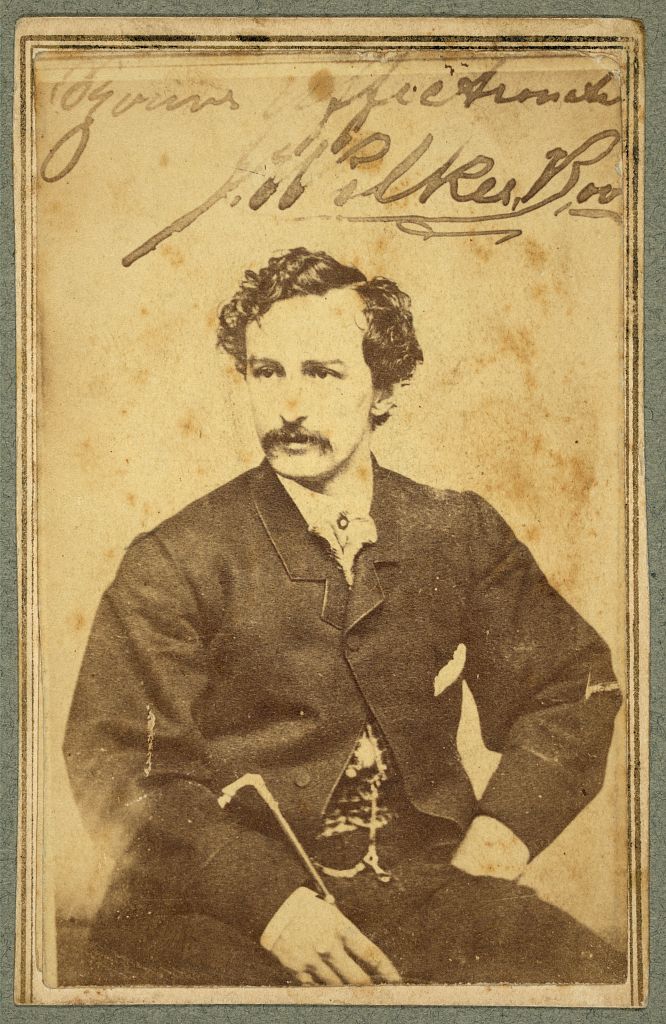
To understand how the killer got within arm's reach of the President without anyone stopping him, you have to understand that he was a celebrity.
Booth was born on May 10, 1838, near Bel Air, Maryland, into the most famous theatrical family in America. His father, Junius Brutus Booth, was a renowned Shakespearean actor; his brother Edwin Booth was one of the greatest actors of the age, and, unlike John, a loyal Unionist. John Wilkes Booth was a star in his own right: handsome, athletic, a matinee idol reportedly pulling in around $20,000 a year by the late 1850s. He performed often at Ford's Theatre in Washington and knew the building inside and out: its corridors, its backstage, the layout of the boxes. That familiarity would matter enormously.
His politics were not a secret. Booth was fiercely pro-Confederate and pro-slavery. In December 1859 he had talked his way into witnessing the execution of John Brown (the radical abolitionist, anti-slavery militant, who had tried to spark a slave uprising and been hanged for treason), borrowing a militia uniform to get close. As the war raged, he stayed in the North and kept acting. But he seethed, and as the Confederacy began to lose, the seething turned into a plan.
The plan, at first, was not murder. It was kidnapping. Through 1864 and into early 1865, Booth schemed to abduct Lincoln, smuggle him south to Richmond, and hold him hostage, ransomed for Confederate prisoners of war. (This had a cold logic to it: the Union had largely stopped exchanging prisoners, which slowly starved the South of manpower it couldn't replace. A captured president might force the exchanges back open.) Booth made a murky trip to Montreal in October 1864 and met with Confederate agents (Canada was neutral ground where Southern spies operated freely, beyond Union reach), and he recruited a small cell of men for the abduction. They tried it once, on March 17, 1865, planning to seize Lincoln in his carriage on the way back from a performance, but the President changed his schedule at the last minute and went somewhere else, and the whole thing dissolved. That was the last of it.
Then the bottom fell out of the scheme entirely. Richmond fell on April 3. Lee surrendered on April 9. There was no Confederacy left to ransom anyone to; kidnapping the President would accomplish nothing. So Booth pivoted, in the space of a few days, from kidnapping to killing. And he expanded the target list. He no longer wanted to capture one man; he wanted to behead the government.
Three Knives at Once
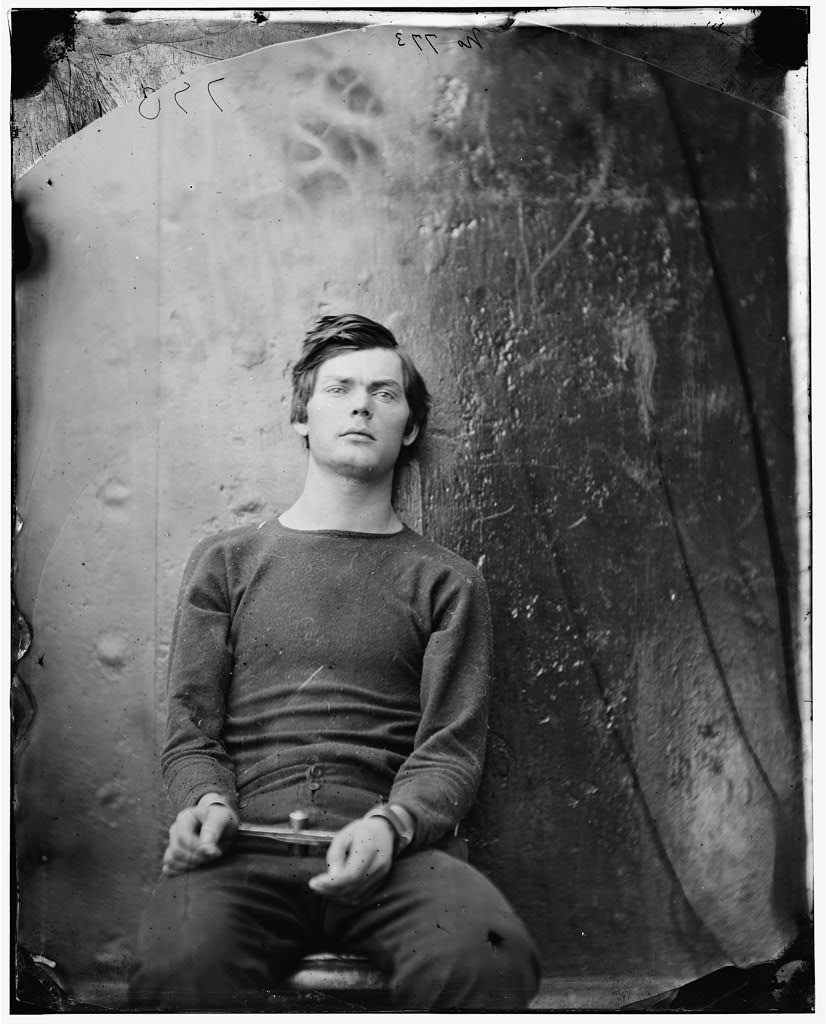
Here is the part that turns a shooting into a conspiracy. Booth's April 14 plan was not one murder but three, timed to land at the same moment.
The plot ran through a loose ring of conspirators, most of them recruited back when the scheme was still a kidnapping. The dangerous one was Lewis Powell (Booth conspirator), who also went by the aliases "Lewis Paine" or "Payne": a big, powerful Confederate veteran, the most physically frightening of the group. There was George Atzerodt (Booth conspirator), a German-born carriage painter; David Herold (Booth conspirator), a young pharmacist's assistant who knew the southern Maryland roads. The plotters met at a Washington boardinghouse run by Mary Surratt (Booth conspirator), whose son John Surratt was a Confederate courier (a spy carrying secret messages for the South) and was in deep on the kidnapping plan, though he had left Washington before the assassination. A few others (Samuel Arnold, Michael O'Laughlen, the Ford's Theatre stagehand Edman Spangler, and a southern Maryland doctor named Samuel Mudd) sat at the edges of it, with degrees of involvement that are still argued over.
At a meeting around 8:45 that night, Booth handed out the assignments. He would take the President himself, at Ford's Theatre. Powell would kill William H. Seward (the Secretary of State, the cabinet officer who runs foreign affairs), who was at home in bed; Herold, who knew the city, would guide him there. And Atzerodt would kill Andrew Johnson (the Vice President), who was staying at the Kirkwood House hotel. Target time: shortly after 10 p.m., all three at once. The point was chaos: to kill the three most visible men at the top of the United States government in a single stroke and leave the country leaderless and reeling.
It half-worked. And the half that failed is its own grim, almost absurd story.
Seward's House
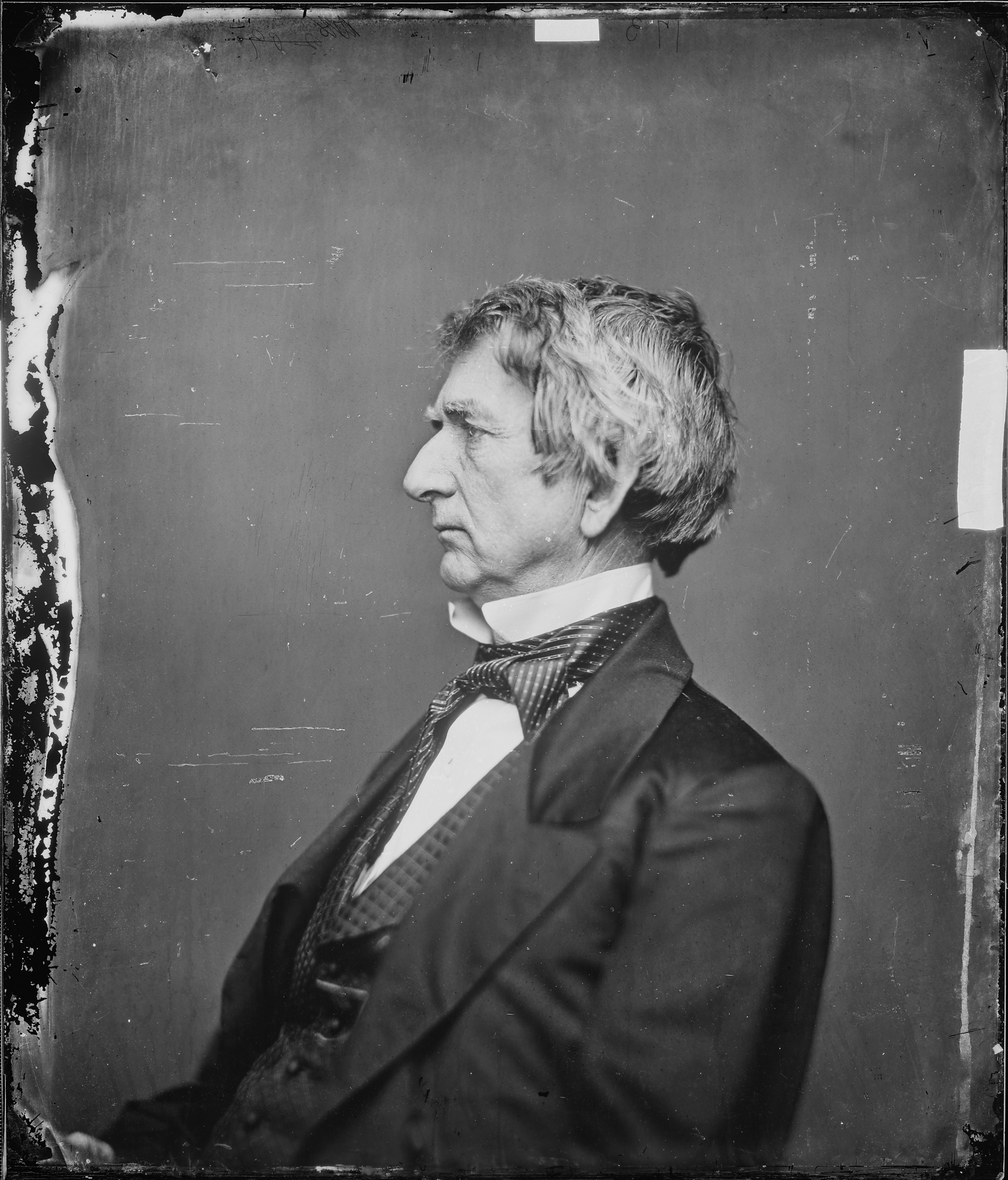
Powell's target, Secretary Seward, was already a wreck before anyone laid a hand on him. Days earlier Seward had been thrown from a carriage, fracturing his jaw and his arm; he lay bedridden, his broken jaw held together by a metal-and-leather splint. He was, in theory, the easy kill.
Around 10:10 p.m., Powell came to the door claiming he was delivering medicine from Seward's doctor. The servant William Bell let him as far as the stairs. There Seward's son Frederick Seward (the Assistant Secretary of State) blocked his way. Powell drew a revolver, pointed it at Frederick's head, and pulled the trigger. The gun misfired. So Powell beat Frederick unconscious with the pistol instead, forced his way into the bedroom, and went at the bedridden Secretary with a Bowie knife (a large, heavy fighting knife), stabbing him again and again in the face and neck and slashing his cheek open.
Seward lived. The splint holding his shattered jaw is widely credited with deflecting the blade away from his jugular; by the likeliest reading, the injury that had left him helpless in bed is the thing that saved his life. Powell wasn't finished cutting his way out: he wounded another of Seward's sons, Augustus Seward, an army nurse named George Robinson, and a State Department messenger, Emerick Hansell, whom he stabbed in the back as he fled. Powell had just carved through an entire household, and he ran from it shouting "I'm mad! I'm mad!" into the street. Herold, who was supposed to wait with the horses, had already bolted at the sound of the struggle, leaving Powell to escape alone through a city he didn't know. That abandonment is what got him caught a few days later.
The Vice President Who Was Never Touched
Atzerodt's job was the simplest of the three, and he did none of it.
He had a room at the Kirkwood House directly above Vice President Johnson's. He had a gun and a knife. And when the hour came, his nerve simply deserted him. He went down to the hotel bar, drank, asked the bartender a few questions about Johnson, and then wandered off into the night, threw his knife away, and did nothing at all. Andrew Johnson, the man whose rise to the presidency would shape the entire postwar era, was never so much as approached. (Strangely, Booth had stopped by the hotel earlier that day and left Johnson a card: "Don't wish to disturb you. Are you at home? J. Wilkes Booth." Nobody has ever fully settled what he meant by it, and for a while it deepened suspicions that Johnson himself might have been part of the plot, a theory that investigators looked into and dismissed.)
So of the three knives Booth set in motion, one man lost his nerve entirely and one was beaten back by a metal splint. Only Booth did exactly what he set out to do.
Ford's Theatre
The play that night was *Our American Cousin*, a popular comedy, and the Lincolns were there to relax in the long, strange glow of victory.
They sat in the box above the stage: the President and his wife, Mary Todd Lincoln, joined by a young army officer, Major Henry Rathbone, and his fiancée Clara Harris (daughter of a U.S. senator from New York). General Grant and his wife had been invited and had begged off, a near-miss the country would chew over for years.
The box should have been guarded. Lincoln's assigned bodyguard that night, a Metropolitan Police officer named John Parker, left his post during the show (reportedly slipping off to a tavern), and the door to the box was left unwatched. For Booth, who knew the theater as well as anyone alive and whose famous face let him move freely through it, that open door was everything.
Across town, the clock was running. By the time Booth slipped up the stairs, Powell was already inside the Seward house, halfway up the staircase toward the Secretary's bedroom; the three knives were meant to fall together. Booth eased into the dark passage behind the box, wedged the outer door shut behind him so it couldn't be opened from the other side, and waited there in the narrow black corridor while the play ran on below.
Some time around 10:15 p.m., deep in the last act, the house was laughing. A line had just landed, one of the broad, sure-fire jokes that bring a theater down, and the wave of laughter was still rolling when Booth stepped through the inner door, leveled a small pistol a few inches from the back of Lincoln's head, behind the left ear, and fired. The crack of it was nearly lost in the noise. For a moment nobody understood. Lincoln slumped forward in his chair, and the audience went on laughing at a play while the President bled, not yet knowing anything had happened at all.
Major Rathbone was the first to grasp it. He lunged at the figure behind the President; Booth slashed him deep across the left arm with a dagger, tore free, and vaulted over the railing of the box down toward the stage, a drop of about twelve feet. As he went, his spur (some say his boot) snagged on the flag bunting (the decorative cloth draped across the front of the box), and he came down hard and wrong, snapping the smaller bone in his left leg. Then, in front of a stunned theater, he got up and shouted the line that has echoed ever since:
"Sic semper tyrannis!"
That's Latin: "Thus always to tyrants," the state motto of Virginia. It is the standard account, but the witnesses didn't fully agree: some heard "The South is avenged!", and there's even argument over whether he shouted from the box or the stage. What's certain is that he limped out the back of the theater, climbed onto a waiting horse, and rode off into the dark.
The House Across the Street
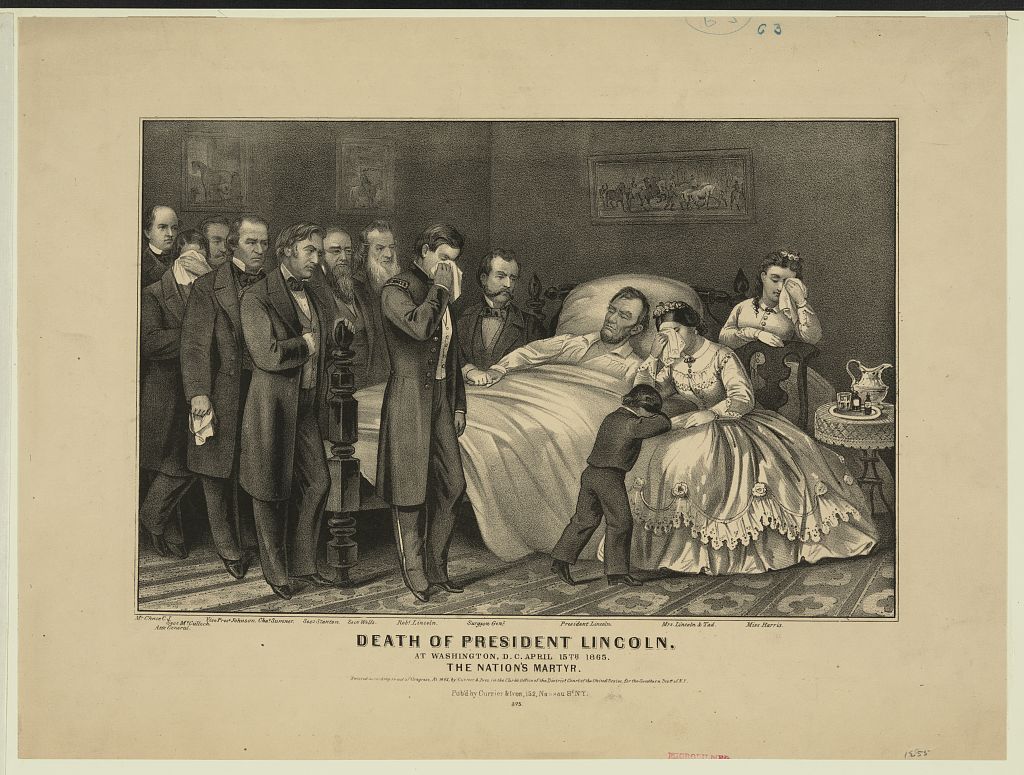
They could not move Lincoln far. A cluster of men carried the unconscious President out of the theater and across Tenth Street into a boardinghouse owned by a tailor named William Petersen, and laid him on a bed in a small back room. He was six foot four, too tall for the bed; they put him across it on a diagonal.
He never woke. Through the night a rotating crowd kept vigil. The first doctor to reach him had been a young army surgeon at the theater, Charles Leale, soon joined by the Surgeon General and Lincoln's own physician, along with cabinet members and family. In the back parlor, the Secretary of War, Edwin Stanton, took effective control of the government and began running the manhunt on the spot, firing off orders through the night while the President died down the hall.
Abraham Lincoln died at 7:22 a.m. on April 15, 1865. One doctor present described the end as no struggle at all: "no apparent suffering... a mere cessation of breathing." As it happened, Stanton is famously supposed to have said, "Now he belongs to the ages." Even that line is uncertain: it surfaces only decades later, some versions render it "the angels" rather than "the ages," and it's possible Stanton never said it at all. It's repeated here as the line tradition gave us, not as a verified quote.
Outside, the news was already running through the city. A Washington that five days earlier had been dancing in the streets now woke to flags at half-mast and crowds standing silent in a cold rain. Later that morning, between roughly 10 and 11 a.m., Vice President Andrew Johnson was sworn in as the seventeenth President of the United States. The whole apparatus of the government had passed, overnight, to a man Booth's plot had meant to kill, and missed.
Twelve Days
Booth got out of the city fast. Within about half an hour of the shooting he and Herold had crossed the Navy Yard Bridge (a bridge out of Washington into southern Maryland), where a sentry named Silas Cobb let them pass despite the nighttime curfew on civilians, and they disappeared into territory thick with Confederate sympathizers.
Around midnight they stopped at the country tavern in Surrattsville run by a tenant named John Lloyd (it was the tavern Mary Surratt owned). There they collected a pair of carbines (army rifles) and a field glass that had been stashed and made ready for them. That errand would later put a rope around Mary Surratt's neck: the prosecution would argue that she herself had ridden out to the tavern that very afternoon and told Lloyd to have the "shooting irons" ready, because men would be calling for them that night. Hold onto that detail; it comes back at the gallows.
In the early hours they reached the home of Dr. Samuel Mudd, who set and splinted Booth's broken leg and gave him crutches. Whether Mudd knew he was treating the assassin or was simply a country doctor mending a stranger's leg has been argued for more than a century and a half (his descendants spent generations trying to clear his name), and the honest answer is that it remains genuinely contested. From there a Confederate sympathizer named Thomas Jones hid the two men in a pine thicket in the Zekiah Swamp for about five days before helping them slip across the Potomac River into Virginia.
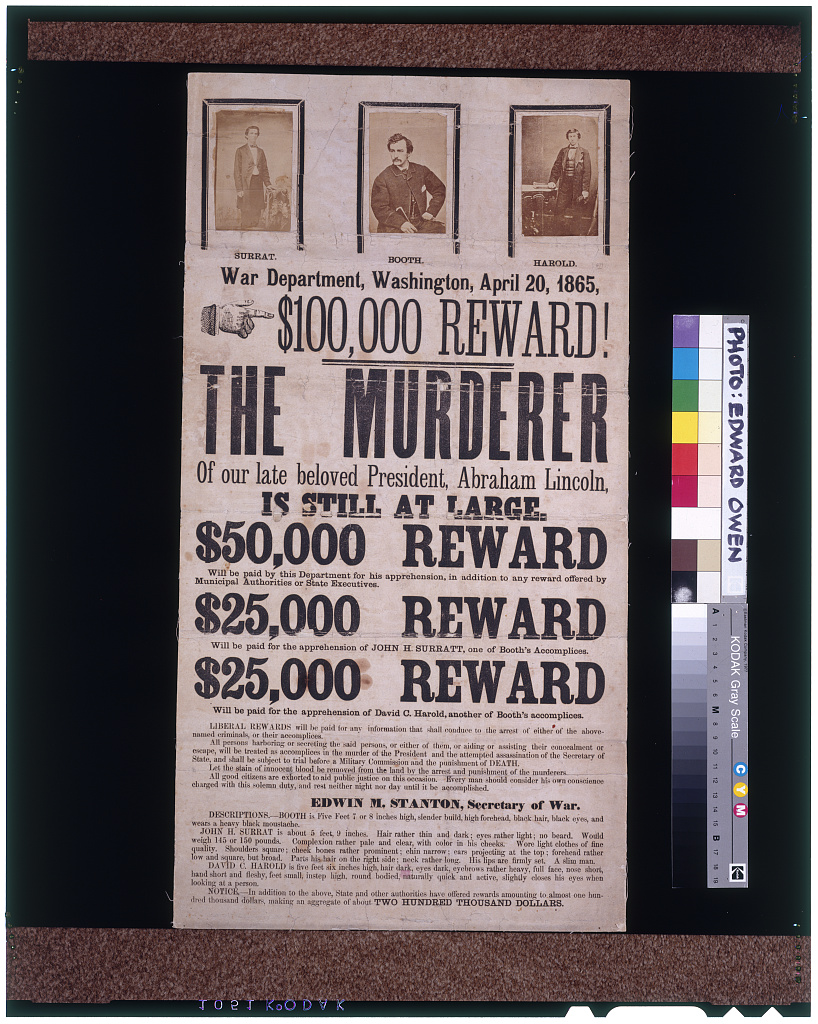
The country, meanwhile, mounted the largest manhunt it had ever seen. On April 20 the War Department posted a $100,000 reward ($50,000 for Booth, $25,000 each for John Surratt and David Herold), its broadside topped with the words "The murderer of our late beloved President, Abraham Lincoln, is still at large."
He didn't stay at large much longer. On the night of April 24 Booth and Herold turned up at the tobacco farm of Richard Garrett in rural Virginia, and on April 26 a detachment of the 16th New York Cavalry (a Union regiment of mounted soldiers) surrounded the barn where they were sleeping. Herold gave himself up. Booth refused, and the soldiers set the barn on fire to drive him out. As the barn burned, a sergeant named Boston Corbett fired through a gap in the wall and hit Booth in the back of the neck. The bullet entered the cervical spine, a couple of inches above the collarbone, severing his spinal cord and leaving him paralyzed. (There's a much-repeated legend that the shot struck almost exactly where Booth's own bullet had struck Lincoln; it doesn't really hold up. Lincoln was shot behind the left ear, higher and to the side, but the symmetry was too tidy for people not to reach for it. Corbett, for his part, said he fired against orders to take Booth alive.)
They carried him to the Garrett farmhouse porch, where he lived about three more hours. Unable to move his hands, he asked a soldier to lift them in front of his face, looked at them, and whispered, "Useless, useless." He died there on the morning of April 26. On his body they found a diary in which he had tried to justify the murder: "...Our country owed all her troubles to him," he wrote of Lincoln, "and God simply made me the instrument of his punishment."
The Gallows
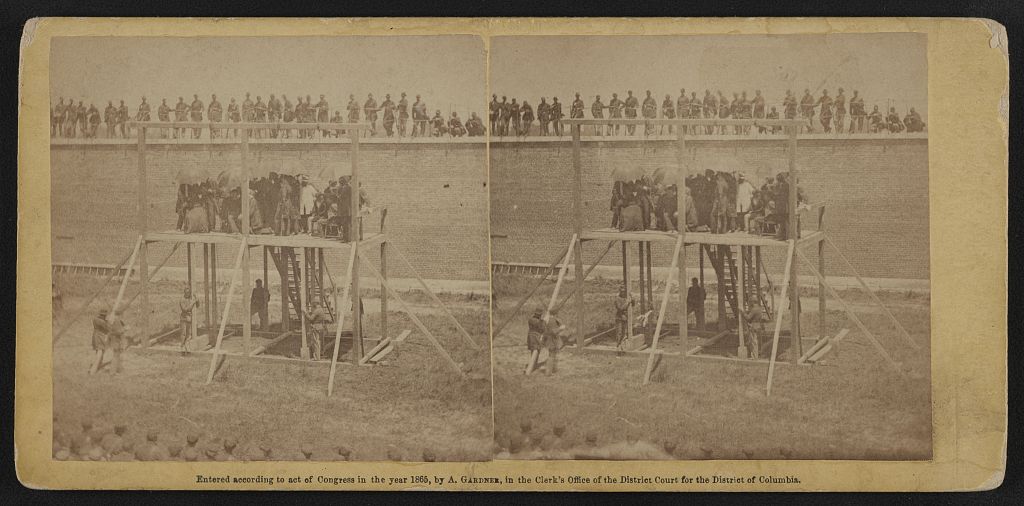
On a brutally hot July morning in Washington, four people climbed a scaffold together in front of a crowd of soldiers and reporters. Three of them were men. One of them was a woman, in a black dress and bonnet, who had to be half-supported up the steps. When the traps dropped, Mary Surratt became the first woman ever executed by the United States federal government.
How she came to be standing there is, itself, a source of bitter argument that has never gone quiet.
The accused conspirators had been tried not in a regular civilian court but before a military tribunal (a court run by army officers, under military rather than civilian law): a nine-officer commission, with Major General David Hunter presiding and Judge Advocate General Joseph Holt (the army's top lawyer) leading the prosecution. The choice was hugely controversial: the war was over and the civilian courts were open, and many argued that civilians had no business being tried by the army at all. The trial ran about seven weeks and heard something like 366 witnesses. On June 30, 1865, the commission convicted all of them. Four were sentenced to hang, and on July 7 they died together at the Old Arsenal Penitentiary: Powell, Herold, Atzerodt, and Surratt. Of the rest, Dr. Mudd, Samuel Arnold, and Michael O'Laughlen got life imprisonment, and Edman Spangler six years. O'Laughlen died in prison in 1867; Johnson pardoned Mudd, Arnold, and Spangler in 1869.
Mary Surratt's hanging is the one that has never stopped being argued about, and here is where that tavern errand comes back. The case that she knowingly took part (rather than merely owning the boardinghouse where the plot was hatched) leaned heavily on John Lloyd, the tavern-keeper, who testified that she had told him to have the "shooting irons" ready the afternoon of the murder, and on an informer named Louis Weichmann. Both were witnesses of doubtful reliability, and the case against her was otherwise circumstantial. Five of the nine commissioners signed a petition recommending she be spared the rope and given life instead, on account of her sex and age. Whether President Johnson ever saw that petition was a dispute that was never resolved: Holt insisted he delivered it; Johnson said he never laid eyes on it. She was hanged regardless. Whether she was guilty at all is still genuinely debated.
The contrast with her son sharpened all of it, in a way almost too strange to be true. John Surratt, who had been deep in the kidnapping plot, ran: to Canada, then England, then Italy, where he turned up serving under a false name in the Papal Zouaves (a volunteer army defending the Pope in Rome). While his mother was being hanged in Washington, in other words, her son was a soldier of the Pope on another continent. He was finally recognized, fled again, and was captured in Egypt in late 1866. And by the time he came home to trial in 1867, the legal ground had shifted under the whole affair. In a separate case, Ex parte Milligan (1866), the Supreme Court had ruled that civilians could not be tried by military courts in places where the ordinary civilian courts were open and working: exactly the objection people had raised about his mother's tribunal, now law. So John Surratt was tried by a civilian jury. The jury deadlocked, and he walked free, never reconvicted. His mother had been hanged by a military commission; he survived a civilian one. The same plot, two kinds of court, two opposite ends, and the second one fed the doubts about the first for good.
Father Abraham
The man who pulled the trigger wanted to wound the United States. What he actually did was hand it a saint.
Lincoln had been, in life, a deeply divisive figure: mocked, hated, blamed, narrowly reelected. He died on Good Friday, in the hour of total victory, shot down by a Confederate partisan, and the country's grief reshaped him almost overnight into a martyr, a "secular saint," a "Father Abraham" whose memory took on a near-religious weight it would carry for generations.
And it happened with extraordinary speed, because of where the death landed on the calendar. There's a concrete mechanism behind that, not just a coincidence of timing. Lincoln was shot on Good Friday, the day Christians mark the crucifixion. He died on Holy Saturday. The news reached most of the country on Easter Sunday morning, April 16, in church, from the pulpit, before the newspapers could shape it. Ministers across the North threw out the Resurrection sermons they had prepared and preached Lincoln instead: a man martyred on Good Friday, killed for his people, dying so the Union could live. One Hartford preacher told his congregation it was "meet that the martyrdom should occur on Good Friday... Jesus Christ died for the world; Abraham Lincoln died for his country." That was the first interpretation millions of Americans received of their dead president: not a politician's obituary but a Christ parallel, delivered as scripture. The funeral did the rest.
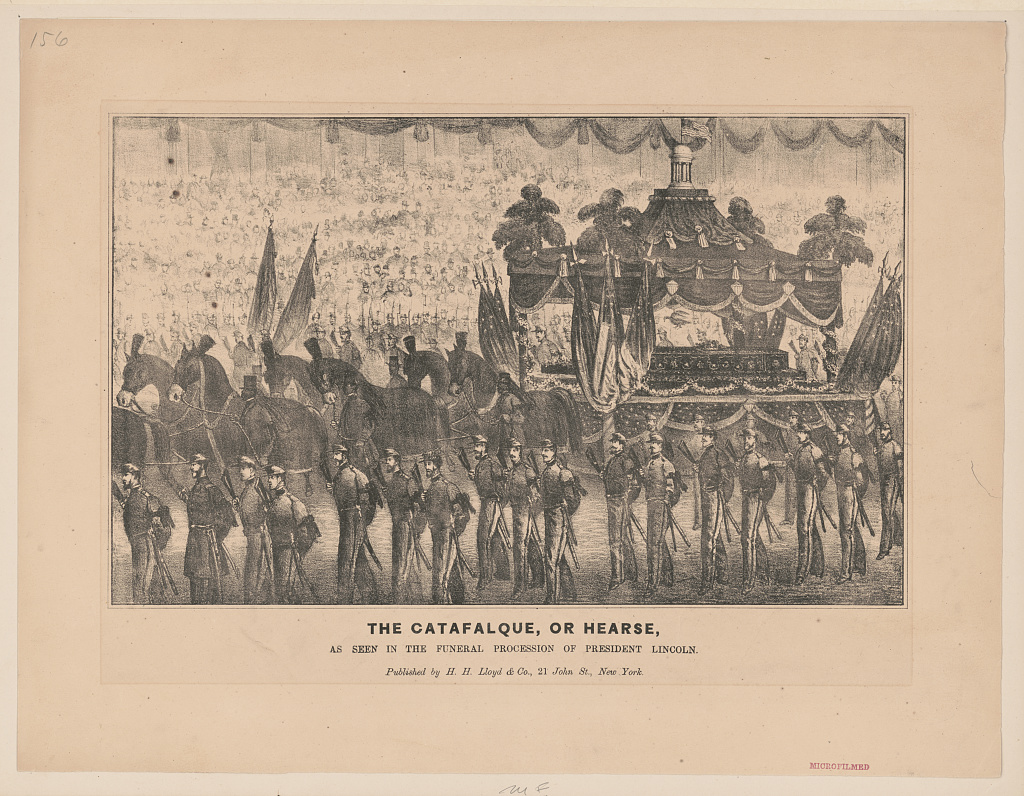
His body was embalmed (the era's new embalming techniques were what made a long public display possible at all), and on April 21 it left Washington aboard a special train, "The Lincoln Special," for a roughly 1,700-mile journey home to Springfield, Illinois, where he was buried on May 4. The route was deliberate: it retraced, in reverse, the very journey Lincoln had taken from Springfield to Washington for his first inauguration in 1861, winding back through some 180 cities across seven states. The coffin of his young son Willie, who had died in 1862, traveled on the train to be reburied with his father.
The mourning was on a scale the country had never seen. By common estimates something like 1.5 million people filed past the body where it lay in state at the major stops, and perhaps 7 million watched the train or the hearse pass (figures repeated everywhere but which are estimates, not exact counts). For days the nation did almost nothing but grieve, the length of half a continent. And in one community the grief carried a sharper edge of fear. For Black Americans, the man being mourned was the one who had signed away slavery, and his murder felt like personal exposure: Frederick Douglass, speaking in Rochester, called Lincoln's death "an unspeakable calamity" to the country's Black people specifically. The protector was struck down, the future under his unknown successor suddenly dark.
And in all that grief, one consequence sat heavy and unspoken: the man best positioned to make the peace gentle was gone. Lincoln had signaled mercy toward the beaten South, "with malice toward none" (the closing note of his second inaugural address, the speech that opened his second term), and now the leniency he'd hinted at went into the ground with him, while a Northern public, enraged that a Confederate sympathizer had murdered their President in his moment of triumph, hardened against any soft settlement. Historians have long argued (and this is an interpretation, the consensus reading rather than a hard fact) that the assassination poisoned the prospects of a gentle reunion and embittered everything that came after. It is worth holding that argument loosely, though: other historians point out that "gentle" and "just" were not the same thing, and that Lincoln's leniency toward the South might well have come at the expense of the four million people just freed, that a softer peace could have meant a harder life for them. What is past dispute is the smaller, sharper fact. The government Booth had tried to behead survived.
The peace Lincoln might have shaped did not.