There is a version of this story that almost everyone has heard, and it goes like this: a great moral wrong sat untouched in the American South for two hundred years, until a generation of white reformers (Garrison with his newspaper, Stowe with her novel, Lincoln with his pen) finally awakened the nation’s conscience and handed freedom down to a grateful, waiting people. It is a comforting story. It is also, in its bones, false. It gets the direction of the whole thing backward.
The truth is that the people the country spent thirty years arguing about were never silent in the argument. They were, from the beginning, its most eloquent, most organized, most morally clear-eyed voice, and they did not wait to be rescued. Enslaved and free Black Americans were the first abolitionists (people who wanted slavery destroyed outright, not reformed or slowly phased out), the fiercest abolitionists, and for the movement’s most important years its principal funders. They ran the newspapers and held the conventions. They stole themselves out of bondage and then went back for others. They wrote the books that made Northern readers weep. They forced a comfortable, profitable nation to keep looking at the thing it most wanted to ignore, and they kept it looking until looking away was no longer possible. This is the story of how the people slavery claimed to own helped drive the country to the war that ended it, not as victims of history, but as its authors.
The man in the used-clothing shop
Start in a used-clothing shop on Brattle Street in Boston, in the year 1829, with a man bent over a printing job that would get a price put on his head.
His name was David Walker. He had been born free around 1796 in Wilmington, North Carolina, free by a quirk of the law that worked, for once, in a Black child’s favor: status followed the mother, and his mother was a free woman even though his father was enslaved. (Slaveholders had built that rule for the opposite purpose: it meant a child born to an enslaved woman was born enslaved no matter who the father was, which conveniently turned the children white owners fathered on enslaved women into more property. Walker was one of the rare cases where it cut the other way.) But “free” in the slaveholding South was a thin and watchful kind of freedom, and Walker had seen enough of the system up close to hate it without reservation. He traveled, he read, and by the mid-1820s he had settled in Boston, opened his secondhand clothing store near the waterfront, and thrown himself into the city’s free Black community, the population of legally free Black people, born free or self- or owner-emancipated, who in the North formed their own churches, schools, lodges, and businesses while living hemmed in by law and prejudice on every side. And then he wrote something that no one in America had quite dared to write before.
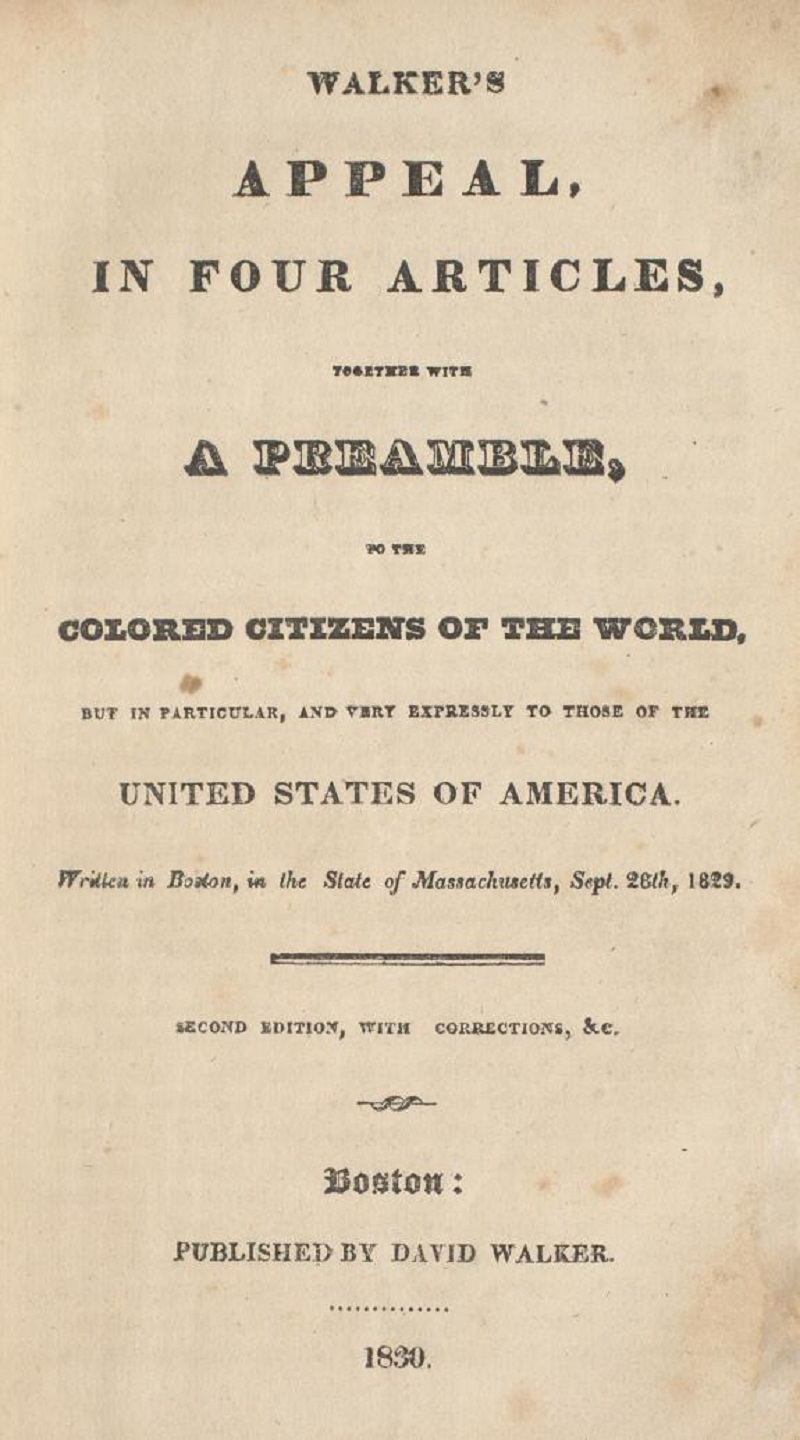
Its full title ran nearly to a paragraph, but everyone came to call it simply Walker’s Appeal: Walker’s Appeal, in Four Articles; Together with a Preamble, to the Coloured Citizens of the World, but in Particular, and Very Expressly, to Those of the United States of America. (The word “Coloured,” or “colored,” is the one Black Americans of the era chose for themselves; it was the dignified term of the day, and it runs through their own newspapers, conventions, and book titles.) He self-published it in September 1829 (a pamphlet: a cheap, unbound little booklet of a few dozen pages, the disposable mass medium of the age, easy to print, easy to pocket, easy to pass hand to hand) with help from the African Grand Lodge, the Black Masonic order in Boston also called the Prince Hall Masons (a Black branch of the secretive fraternal society, founded because the white lodges would not admit Black men). Then he put out two more editions in 1830, each one angrier than the last. It was not a polite petition. It was a thunderclap.
Walker did three things in the Appeal that terrified slaveholders. He named the suffering without flinching: Black Americans, he wrote, were “the most degraded, wretched, and abject set of beings that ever lived since the world began.” But he refused to leave it there as a lament. He turned it into an indictment of white America’s own hypocrisy, throwing the country’s revolutionary self-image back in its face. He reminded white readers that they had gone to war with Great Britain over far lighter grievances: “I ask you candidly,” he wrote, “was your sufferings under Great Britain, one hundredth part as cruel and tyranical as you have rendered ours under you?” And he laid claim to the country itself, rejecting the schemes to ship free Black people off to Africa: “America is more our country, than it is the whites — we have enriched it with our blood and tears.” That last point was not abstract. There was a powerful, well-funded organization devoted to exactly the removal Walker was rejecting: the American Colonization Society, founded in 1816, which proposed to send free Black Americans across the Atlantic to a West African colony that became Liberia. The Society drew in sympathetic whites who found it more comfortable to imagine Black people gone than free among them, and a few Black supporters who had despaired of ever being treated as equals here. But the great mass of free Black activists read it as deportation dressed up as charity, and they said so loudly: as far back as 1817 some three thousand Black Philadelphians had crowded into Mother Bethel church to denounce the scheme, one of the largest Black political gatherings the country had yet seen. Walker’s furious refusal to be removed was the radical edge of a fight the free Black North had already been waging for years. Then, beneath all of it, ran a warning. A nation built on this much cruelty, Walker promised, would face divine retribution for it, and the enslaved would, “under God, obtain our liberty,” with or without white permission.
This was incendiary in the most literal sense, and Walker knew it, so he did something audacious to spread it. He sewed copies of the Appeal into the linings of sailors’ clothes that passed through his shop and worked his maritime contacts so that the pamphlet rode the coastal ships down into Southern ports, smuggled, quite literally, into the heart of the slave country in the seams of a sailor’s coat. It worked well enough to cause panic. The mayor of Savannah, Georgia, wrote to Boston’s officials demanding that something be done about the man and his book. Several Southern states (Virginia, North Carolina, Georgia) rushed to pass or stiffen laws criminalizing the circulation of “incendiary” writings, statutes everyone understood were aimed squarely at the Appeal. There were rumors of a bounty on Walker’s life, a price for him dead or delivered south.
And then, in August 1830, within months of the third edition, David Walker was dead, at roughly thirty-three, and buried in an unmarked grave. The timing was so suspicious that his contemporaries whispered poison, assassination, a slaveholder’s revenge finally collected. It is an irresistible story. It is almost certainly not true. The documented cause was consumption, tuberculosis, the lung disease that tore through the crowded, poor neighborhoods of nineteenth-century cities and that had killed Walker’s own daughter around the same time. The murder rumor tells you something real about how frightening Walker had become; it does not tell you how he died. He died the way the poor of his city often died, with his great pamphlet barely a year old and already loose in the world beyond anyone’s power to recall it.
But notice the date. 1829. Walker did not write in response to a white-led abolition movement, because in 1829 there essentially wasn’t one: the organized white crusade that everyone remembers was still two years off. The most radical abolitionist document of the entire pre-war era came first, and it came from a free Black man in a secondhand-clothes shop. The freedom struggle did not begin when white reformers arrived. White reformers arrived to find it already underway.
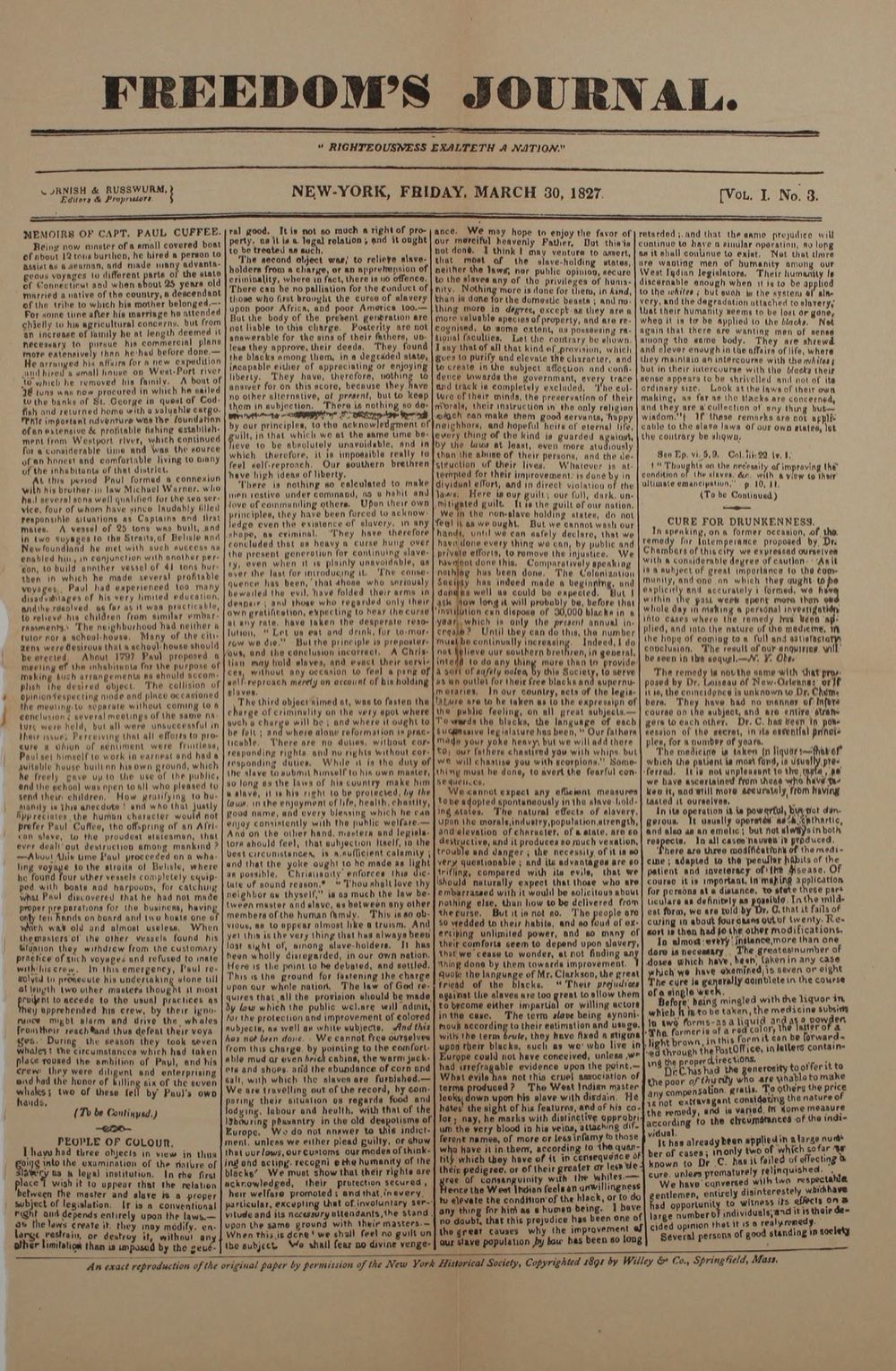
In fact, Walker had a platform before he had a pamphlet, and it too was Black-built. Two years before the Appeal, on March 16, 1827, the first Black-owned and Black-operated newspaper in the United States had rolled off a press in New York City. It was called Freedom’s Journal, founded by Samuel Cornish, a New York minister who served as senior editor, and John Brown Russwurm, his younger colleague. Their opening statement read like a manifesto for everything that would follow: “We wish to plead our own cause,” they wrote. “Too long have others spoken for us.” For years, white sympathizers and white slanderers alike had been the only voices the public heard on the subject of Black Americans. Freedom’s Journal announced that this was over. Black people would now speak for themselves, in print, every Friday, for three dollars a year, and the paper reached readers in eleven states and as far away as Haiti, Canada, and Europe. (Walker himself served as one of its agents, the man who collected subscriptions and handed the paper around Boston.) But its short life also exposed the deepest fracture running through the whole movement. After only a couple of years, Russwurm lost faith that Black people could ever be free in America and came around to the colonizationists’ position: that the answer was to leave for Africa. He would in fact emigrate to Liberia himself. Cornish was appalled; so were most of the paper’s readers, who heard in emigration not deliverance but surrender. The disagreement helped sink Freedom’s Journal in 1829. But the question it died on (stay and fight for this country, or build a future somewhere else) would not die with it. It would shadow the movement for the next thirty years, and it would surface again, sharper than ever, at the very moment the struggle reached its crisis. The paper’s model, at least, outlived the quarrel: Black journalism in America traces its lineage straight back to that office in New York.
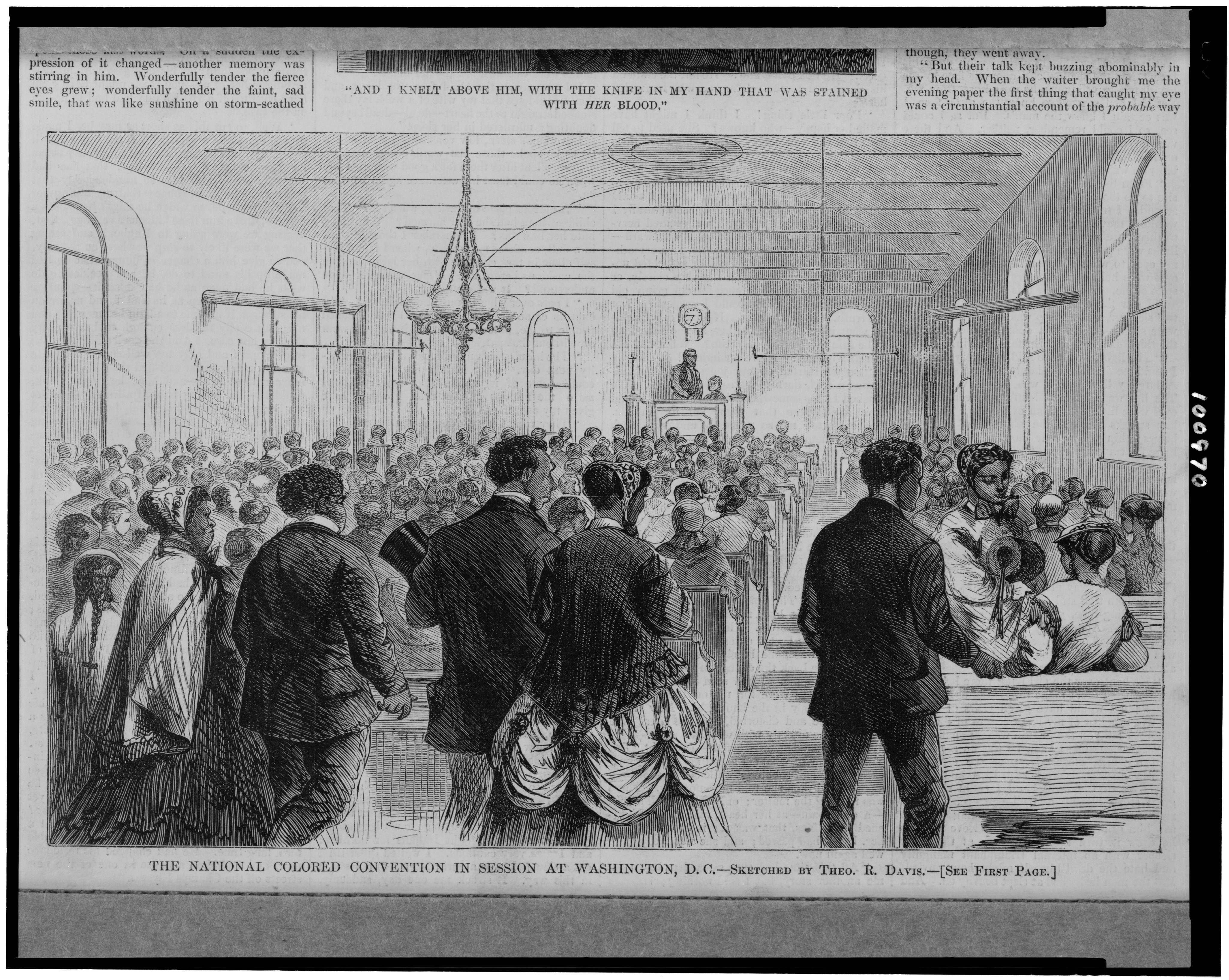
And there was a third front opening at the same time, this one not on paper but in person. In September 1830, the same season Walker died, forty Black delegates from nine states gathered at Mother Bethel A.M.E. Church in Philadelphia for what became the first national Black political convention in American history. It was no accident that they met there. Mother Bethel was the birthplace of the African Methodist Episcopal Church, the first independent Black denomination in the country (“independent” meaning free of white control, a church run by Black people for Black people). Its founder, Richard Allen, had built it after walking out of a white Philadelphia church, St. George’s, when its ushers tried to drag Black worshippers up off their knees and away from the white pews during prayer. Allen’s answer to that humiliation was to leave and build something no white usher could touch, and by 1830 the A.M.E. Church had become the institutional spine of free Black life in the North, its sanctuaries doubling as schoolhouses, meeting halls, and, before long, stations on the escape routes south to north. A Black political convention needed a roof that belonged to Black people. Mother Bethel was that roof.
The delegates were so afraid of white hostility that the first five days of meetings were held in secret. The call had gone out from Hezekiah Grice, a young freed man from Baltimore who had pushed for years for Black Americans to organize nationally rather than city by city. The delegates came to argue strategy: how to lift up free Black communities in the North, how to push the country toward abolition, whether to fight racist stereotypes by modeling education and thrift or to demand rights outright. The “Colored Conventions,” as they came to be called, would keep meeting for decades (more than sixty gatherings between 1830 and 1864), and their agenda always ran wider than slavery alone. They fought for the vote, for fair work, for schools, for an end to the daily indignities of Northern racism. They were, in effect, a Black national congress drafting a Black political platform, meeting in a country that gave Black people no voice in its actual one.
So before a single famous white name enters this story, the architecture of the freedom struggle is already standing: a newspaper, a manifesto, a movement, a martyr, and a live, unresolved argument about whether the fight was even worth having here. The Black voice was out, in print and in person, and it was not going to be silenced, not by a bounty, not by a sedition law, not by a country that would have vastly preferred it to be quiet.
The Prophet
And then, in the late summer of 1831, the South’s deepest fear walked out of the woods of Virginia with a hatchet in his hand.
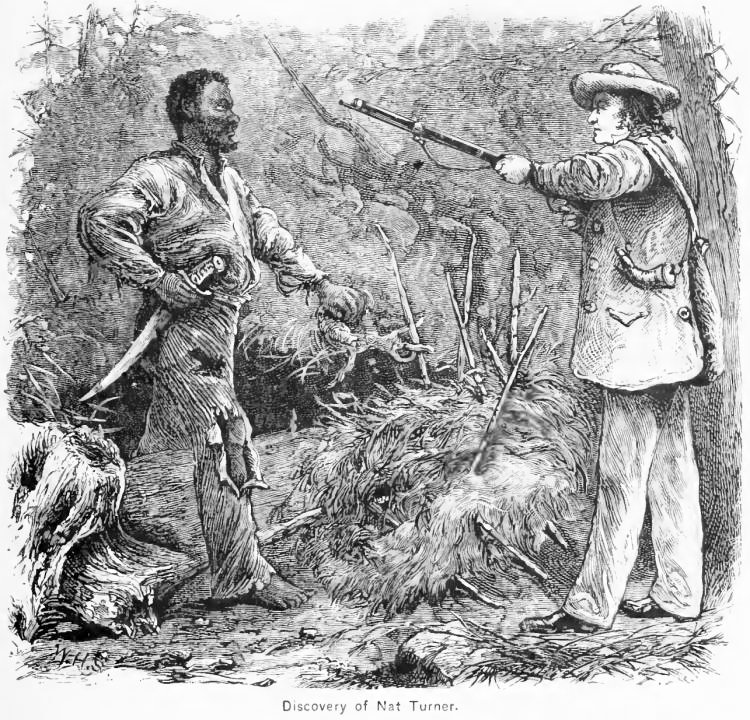
His name was Nat Turner. He was enslaved in Southampton County, in the southeastern corner of the state, literate, self-taught, intensely religious, a man his fellow slaves called “the Prophet” because he saw visions he believed were instructions from God. On the night of August 21, 1831, he and a handful of followers began moving from farm to farm. Over some thirty-six hours the band swelled to perhaps seventy enslaved and free Black men, and they killed roughly fifty-five to sixty white people (men, women, and children) across about a dozen households. It was the deadliest slave uprising in American history, and it was the thing every slaveholder in the South lay awake imagining. The rising was crushed within days by militia and armed whites, but Turner himself slipped away and hid in the Southampton woods for two months before he was finally caught. He was tried, convicted, and hanged on November 11, 1831. In the weeks of panic, mobs and militia killed scores of other Black people, most of whom had nothing to do with the revolt.
Turner could not have read a convention’s resolutions or a sailmaker’s subscription list; he had no newspaper, no organization, no conductor waiting in the next county. He had a Bible, a conviction, and a decision. That is exactly why he belongs in this story. He is the sharpest possible proof of its thesis: that the enslaved were not waiting to be acted upon but were, all along, deciding and acting for themselves, in the place the freedom struggle was supposedly most absent, deep in the slaveholding South. And the South understood the message perfectly. Its response was not soul-searching but a tightening of every screw. Virginia’s legislature held one last serious debate, in 1832, over whether to phase slavery out gradually, and voted it down, the final time any Southern slave state would seriously entertain emancipation from within. Then the slave states slammed the door. They hardened their slave codes, made it a crime to teach an enslaved person (and in many places a free Black person) to read or write, and clamped new restrictions on the movement and assembly of free Black people. The lesson the South drew from Nat Turner was that a literate, thinking, organizing Black population was a mortal threat. So it set out to forbid literacy, thought, and organization by law. The freedom struggle and the slave power had each just shown the other exactly how far it would go.
The movement and its Black engine
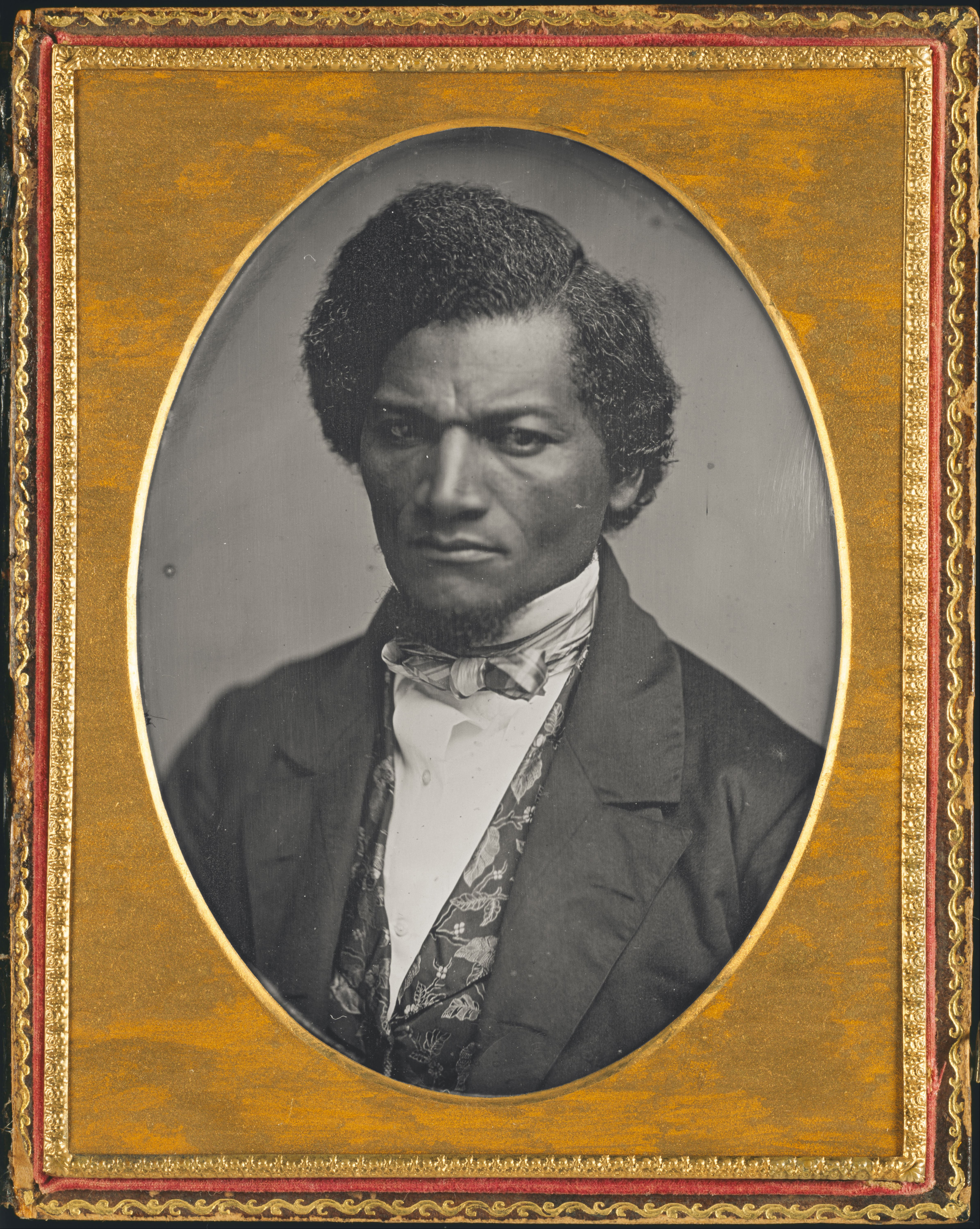
On January 1, 1831, the same year Walker’s Appeal was circulating through Southern ports and only months before Nat Turner’s rising would terrify the slave states, a twenty-five-year-old white printer in Boston named William Lloyd Garrison published the first issue of a newspaper called The Liberator, and announced his arrival in a sentence that has rung down the years: “I am in earnest. I will not equivocate. I will not excuse. I will not retreat a single inch. AND I WILL BE HEARD.” It is a magnificent line, and Garrison meant every word of it. He would publish The Liberator without missing a beat for thirty-four years, until the Thirteenth Amendment (the constitutional amendment that finally abolished slavery throughout the United States, ratified at the end of 1865) made it unnecessary. All that while he demanded the immediate, total, uncompensated end of slavery, at a moment when even most Northern whites found that idea dangerous and absurd. Garrison was real, and he was brave, and he matters.
But here is the part the standard story leaves out, and it is the whole point: in its first, fragile year, The Liberator had almost no white readers at all. As Garrison himself admitted, the paper “was supported by the colored people, and had not fifty white subscribers.” Roughly three out of four people who paid to keep that famous abolitionist newspaper alive were Black. Without them it would have folded inside a year and you would never have heard the name William Lloyd Garrison.
The single most important of those backers was a man named James Forten. Forten was a wealthy Philadelphia sailmaker, a Black businessman who had run his own sail loft for decades and who, as a teenager, had served aboard an American privateer in the Revolutionary War (a privateer being a privately owned ship licensed by the government to attack enemy vessels, a legal pirate, in effect, fighting for the Revolution). When Forten heard what Garrison was planning, he didn’t just subscribe; he put his money and his network behind it, funneling funds to the paper and recruiting subscribers across Philadelphia’s Black community. The most influential white abolitionist of the era was, in a real and unsentimental sense, financed by a Black sailmaker. Garrison did not hand down a movement to grateful Black followers. He stepped into a current Black Americans were already paying to keep running, and he amplified it.
The pattern repeats with the movement’s flagship organization. In December 1833, more than sixty abolitionists met in Philadelphia to found the American Anti-Slavery Society, the great organizing engine of the cause. We remember Garrison, who wrote its founding Declaration of Sentiments, the public statement of principles and aims, the document that told the world what the new society stood for. We tend to forget that James Forten was one of its founders, that the wealthy Black businessman Robert Purvis was another, and that the organizing meeting itself was held at Forten’s house. The American Anti-Slavery Society was not a white club that admitted a few Black members. Black men helped build it, fund it, and house it from day one. Reverse the usual framing and you have it right: white abolitionists joined and lent their voices to a movement that Black Americans had already created and were already paying for.
It is worth pausing here, before the most famous figure in this story arrives, to say plainly that he did not stand alone. Behind Forten and Purvis stretched a whole web of organizers most Americans have never heard of: the Black ministers, newspapermen, lodge brothers, and convention delegates who built the institutions the movement ran on, and the Black women who built and funded them too. One of them refused to wait even for the convention halls to admit her. In September 1832, in Franklin Hall in Boston, a free Black woman named Maria W. Stewart stood up and addressed an audience of men and women together, the first documented American woman of any race to deliver a public political lecture to a mixed crowd. She did it nineteen years before Sojourner Truth would famously do the same, and she did it in print as well, publishing her essays in The Liberator. She called on Black Americans to educate themselves, to organize, to claim their rights, and she called on Black women in particular to lead. The backlash was fierce, much of it from within her own community, where many thought a woman had no business on a public platform, and after barely a year she gave up lecturing and left Boston. But she had already proved the point that runs through this whole story: the people the country wanted silent kept finding new ways to speak, and the women among them were not waiting their turn.
And then there walks into the story the man who would become its towering figure, the man who embodied, in a single life, the whole argument that the enslaved were not objects of the debate but its most formidable participants.
He was born Frederick Augustus Washington Bailey around February 1818, enslaved, on a Maryland farm. He never knew the exact date of his own birth (he later picked February 14 for himself), barely knew his mother, who died when he was about ten, and was never told for certain who his father was, though it was widely believed to be a white man. By the rules of his world he was meant to remain property and to remain illiterate, since teaching an enslaved person to read was both illegal and, slaveholders rightly sensed, dangerous. He learned anyway, by trickery and sheer relentless will, and on September 3, 1838, he made his move. Dressed as a sailor and carrying the identification papers of a free Black seaman, he rode the train out of Baltimore, crossed into Delaware, took a steamboat to Philadelphia and a train on to New York, and in less than a day he was, for all practical purposes, free. To throw slave-catchers off his trail he took a new last name from a poem by Sir Walter Scott. The world would come to know him as Frederick Douglass.
Douglass turned his own life into the most effective weapon in the abolitionist arsenal. In May 1845 he published Narrative of the Life of Frederick Douglass, an American Slave, Written by Himself, and that last phrase, written by himself, was itself an argument, a flat rebuttal to every claim that Black people lacked the intellect for freedom. The book was unsparing, and it was specific: it named the people who had enslaved and beaten him and named the places it happened. That specificity made it devastating as testimony and dangerous to its author, because it told his former owners exactly where to find their legal property. To avoid being seized and dragged back south, Douglass spent the next two years lecturing across Britain and Ireland, where U.S. slave law simply did not reach and a slaveholder’s claim meant nothing, and admirers there eventually raised the money to purchase his legal freedom outright.
He came home and built his own platform. On December 3, 1847, in Rochester, New York, he launched a newspaper called The North Star, named for the star that guided escaping people toward freedom, under a masthead that announced his whole philosophy: “Right is of no Sex; Truth is of no Color; God is the Father of us all, and we are all brethren.” Owning his own paper made Douglass independent, and that independence soon carried him into a public break with Garrison, over a disagreement that turns out to be the strategic fault line at the heart of the whole movement. Garrison regarded the United States Constitution as hopelessly poisoned by slavery (“a covenant with death and an agreement with hell,” in the searing phrase Garrison himself used for it) and concluded that working within the political system was futile, even corrupting. Douglass came to the opposite view: that the Constitution, read rightly, was “a glorious liberty document” that could be turned into a legal weapon against slavery. Underneath the philosophy was something more personal. Douglass had grown tired of a quiet condescension in Garrison’s circle of white allies, a sense that they wanted him to be a moving piece of testimony, to show the scars, tell the story, and let the white men do the thinking. Douglass intended to do the thinking himself. The break was, in its way, the freedom struggle insisting once more that it would speak in its own voice.
That voice reached its highest pitch in a hall in Rochester on a summer day in 1852, in the speech that may be the single most withering thing ever said to the United States about itself. The Rochester Ladies’ Anti-Slavery Society had invited Douglass to give an Independence Day address. He agreed, and then made a pointed choice. He delivered it not on the Fourth of July but on the fifth, signaling before he said a word that the nation’s holiday was not his. The address is remembered as “What to the Slave Is the Fourth of July?” He opened almost gently, even bewildered: “Fellow-citizens, pardon me, allow me to ask, why am I called upon to speak here to-day?” He let the crowd sit in the gap between their celebration and his exclusion: “This Fourth July is yours, not mine. You may rejoice, I must mourn.” And then he warned them what was coming:
At a time like this, scorching irony, not convincing argument, is needed. O! had I the ability, and could reach the nation’s ear, I would, to-day, pour out a fiery stream of biting ridicule, blasting reproach, withering sarcasm, and stern rebuke. For it is not light that is needed, but fire; it is not the gentle shower, but thunder.
And then he brought the thunder, a single long sentence that takes every shining thing the nation said about itself and turns it to ash:
What, to the American slave, is your 4th of July? I answer; a day that reveals to him, more than all other days in the year, the gross injustice and cruelty to which he is the constant victim. To him, your celebration is a sham; your boasted liberty, an unholy license; your national greatness, swelling vanity; your sounds of rejoicing are empty and heartless; your denunciation of tyrants, brass fronted impudence; your shouts of liberty and equality, hollow mockery; your prayers and hymns, your sermons and thanksgivings, with all your religious parade and solemnity, are, to Him, mere bombast, fraud, deception, impiety, and hypocrisy — a thin veil to cover up crimes which would disgrace a nation of savages.
He saved special contempt for the white churches that blessed the whole arrangement: the church of the country, he said, “is not only indifferent to the wrongs of the slave, it actually takes sides with the oppressors. It has made itself the bulwark of American slavery, and the shield of American slave-hunters.” This was a formerly enslaved man, standing in a Northern hall on the day after the nation’s birthday, telling free white citizens to their faces that their liberty was a lie and their religion a fraud. And he was asked back. The freedom struggle had found a voice the country could not unhear.
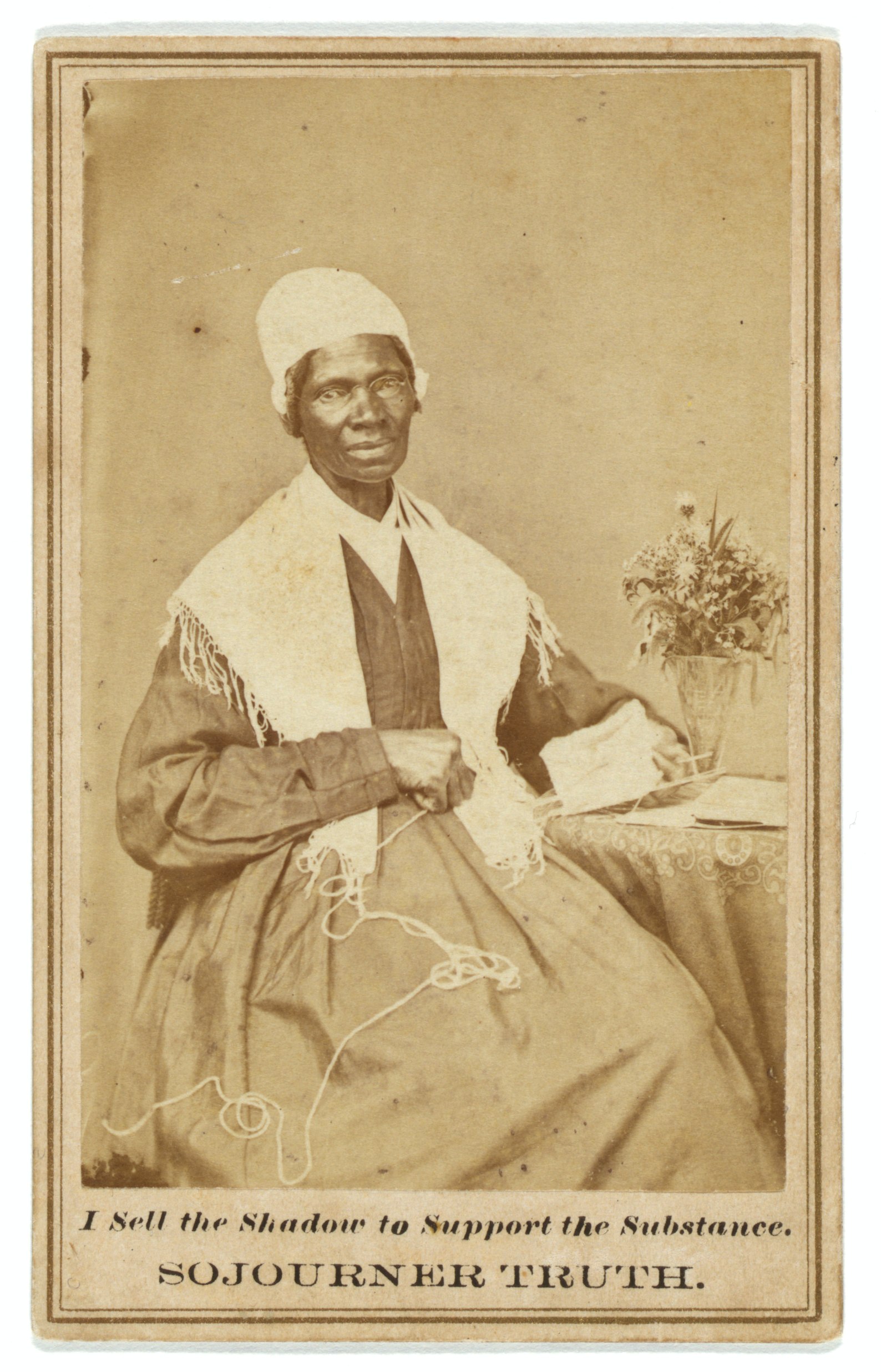
Douglass was the most famous, but he was not the only one finding that voice. In Akron, Ohio, in May 1851, a traveling preacher named Sojourner Truth rose at a women’s rights convention and delivered a speech that has become legendary, and whose legend is worth getting right, because the careless version actually shrinks her. Truth had been born enslaved in New York around 1797, in a Dutch-speaking household; she was freed when the state abolished slavery in 1827, and she could not read or write, but she could hold a room like few people alive. At Akron she made an argument from her own body: that she had plowed and reaped and labored like any man and was a woman still, and so the claim that women were too delicate for rights collapsed against the evidence of her own life.
Here honesty is required, and the honesty is part of the point. The version of this speech everyone half-remembers, the one studded with the refrain “Ain’t I a woman?” and written in a heavy Southern plantation dialect, is not what Truth said. It was composed by a white convention organizer named Frances Dana Gage and published twelve years later, in 1863, during the Civil War, and it is riddled with invention. Gage put a Deep-South dialect into the mouth of a woman who grew up speaking Dutch in New York. Gage claimed Truth had borne thirteen children when she had borne five. And Gage, not Truth, supplied the famous refrain. The transcript taken down at the time, in 1851, came from a journalist named Marius Robinson, a fellow abolitionist who was Truth’s friend, and who showed her his version before he printed it, which is exactly why historians trust it. It contains no dialect and no “Ain’t I a woman?” at all. In it Truth declares plainly, “I am a woman’s rights,” and grounds the claim in her labor: “I have plowed and reaped and husked and chopped and mowed, and can any man do more than that?” The substance of the two versions agrees (Truth using her own life as proof of women’s equality) but the iconic wording belongs to a white writer’s later reconstruction, not to Truth’s actual mouth. The real woman was a Dutch-accented former slave who could silence a hostile hall with the plain facts of her own existence. She did not need a put-on dialect to be unforgettable, and it does her no honor to remember her in someone else’s words.
But the deepest division inside the movement was not about whose words to trust. It was about what the movement should actually do, and it came to a head eight years before Akron, in a single dramatic vote. In August 1843, at a Black national convention in Buffalo, New York, a twenty-seven-year-old minister named Henry Highland Garnet (himself an escaped slave who had fled Maryland as a child) stood up and addressed not the abolitionists in the room but, across the miles, the enslaved themselves. His “Address to the Slaves of the United States” told them flatly that their bondage was not their cross to bear but a sin to be resisted, that they should refuse their labor en masse, and that they should, if it came to it, rise: “Brethren, arise, arise! Strike for your lives and liberties. Now is the day and the hour.” Submission, Garnet argued, was itself a kind of sin: “Neither god, nor angels, or just men, command you to suffer for a single moment.” And he reminded them of their numbers: “Rather die freemen than live to be slaves. Remember that you are FOUR MILLIONS!” It was a call to revolt, in plain words, in 1843, only twelve years after Nat Turner had shown what such a call could mean.
This was the fork in the road, and the man who blocked it was Frederick Douglass. Douglass rose to lead the opposition. At that point in his life he still held to moral suasion (the belief that slavery would be beaten by persuading the nation’s conscience through argument and witness, not by politics and not by force), and he warned that Garnet’s address invited a bloodbath the enslaved could not survive. The two positions were now nakedly on the table. Garnet said rise up: the enslaved have the right and the duty to win their freedom by force. Douglass said convert the country, change its laws, win with the word and the ballot. The convention had to choose, and it chose Douglass, but only barely, voting down any endorsement of Garnet’s address by a single vote, then by a wider margin on a second try. Garnet’s speech went unpublished for five years, until it finally appeared in print in 1848 bound together, fittingly, with Walker’s Appeal: the two most incendiary documents the movement had produced, between one set of covers at last.
That one-vote margin is one of the quiet hinges of American history. The movement looked at the two roads, patient moral and political pressure or armed revolt, and chose the first by the narrowest possible measure. Douglass himself would not stay where he stood that day; within a few years he had abandoned pure moral suasion for exactly the political road he’d once distrusted, and by the late 1850s he was edging toward the conviction that slavery might only end in blood. The country, in the end, did not have to choose between Garnet’s road and Douglass’s. It took both. The argument the convention settled by a single vote in 1843 the nation would settle by other means twenty years later. When it finally answered Garnet’s call to “strike for your lives and liberties,” it would do so the way the whole struggle had been pointing all along: it would put on a uniform and march.
Stealing themselves free
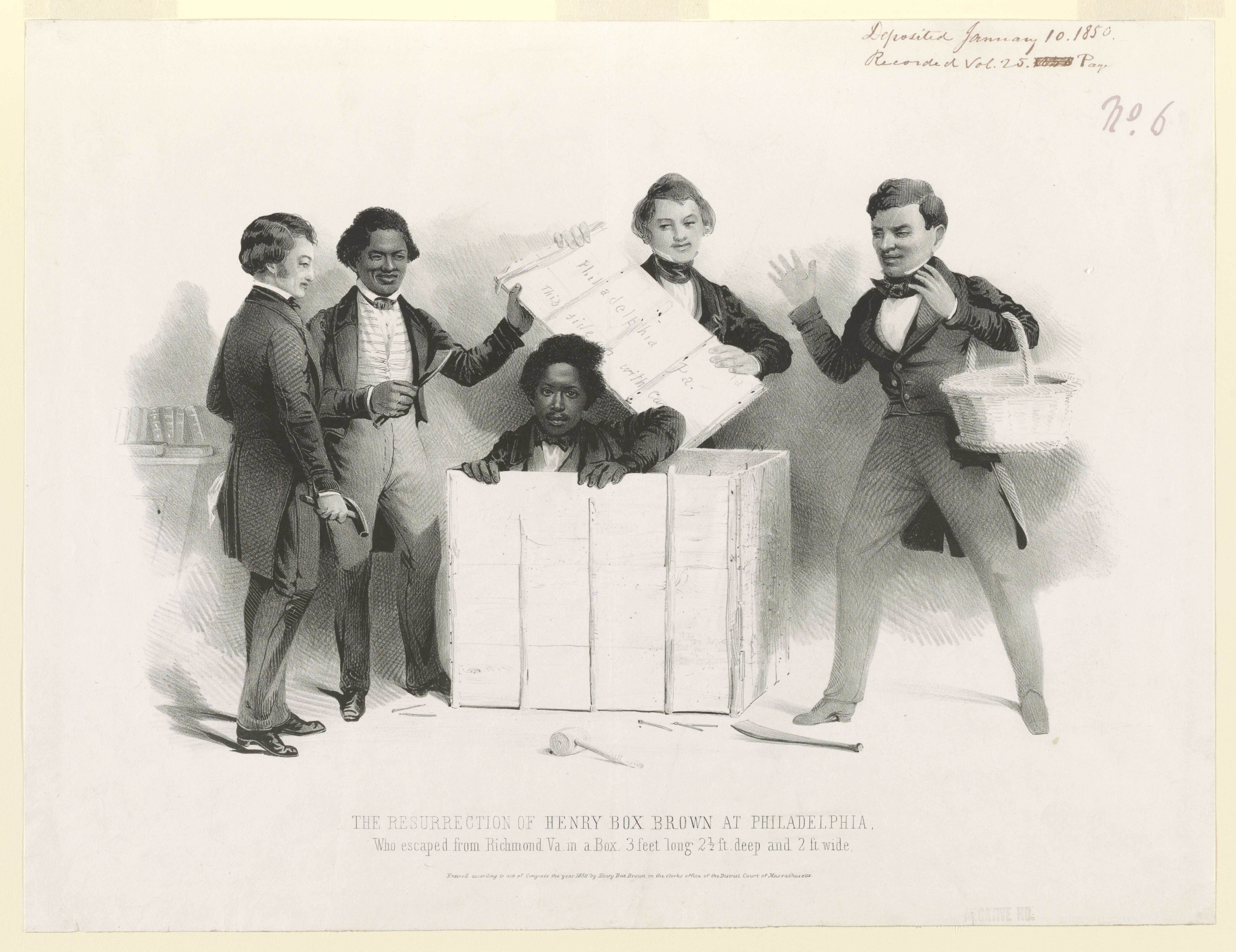
There is a kind of abolitionism that argues, and a kind that simply walks out the door, and the second kind was the boldest act of resistance the system faced. Every person who escaped slavery committed, by the act itself, the most concrete possible refutation of the lie that the enslaved were content, or property, or anything other than people who wanted to be free and would risk everything to be it. The law called this theft: the enslaved were stealing themselves, robbing their owners of valuable goods. That framing is grotesque, and it is also clarifying. To steal yourself is to declare that you were never anyone’s to own.
No one did it more daringly than a small woman from Maryland’s Eastern Shore who had been born, around March 1822, with the name Araminta Ross. The world would come to call her Harriet Tubman. She was enslaved from birth on a Dorchester County farm, and as a teenager she suffered an injury that would shape the rest of her life: an overseer hurled a two-pound lead weight at another enslaved person, missed, and struck Tubman in the head. The blow fractured her skull and left her with lifelong neurological episodes, sudden spells in which she would lose consciousness while somehow remaining aware of her surroundings (historians have guessed at narcolepsy or a related condition). It would have been reason enough for anyone to keep her head down. It never slowed her at all.
In the fall of 1849 Tubman ran. Her first attempt failed when the brothers who fled with her lost their nerve and turned back, dragging her with them. So she went again, alone, that October or November, following the secret routes north until she reached Philadelphia and freedom. And here is the thing that lifts her out of the ordinary courage of escape into something close to the unbelievable: having gotten herself out, she went back. Again, and again, and again, into the very country that would have killed or sold her on sight, to lead other people out the way she had come.
Now the numbers, and the numbers matter, because the inflated legend actually does Tubman a quiet disservice. The popular story says she made nineteen trips and freed more than three hundred people. That figure comes from a sympathetic nineteenth-century biography that padded the count for rhetorical and fundraising effect, and historians have since corrected it. The careful modern reckoning is that Tubman made roughly thirteen rescue expeditions back to Maryland and personally led out about seventy people (many of them her own family) while giving detailed escape instructions to perhaps fifty or sixty more who got themselves out on her directions. Hold those true numbers in your hand for a moment: thirteen times this woman, with a price on her head and a brain injury that could drop her unconscious at any moment, walked back into slavery on purpose to free other human beings. The real number is not smaller than the legend. It is, if anything, harder to believe, because every single one of those thirteen trips was a separate decision to risk her life when she was already safe. The enslaved community gave her a name that fit: “Moses,” after the prophet who led his people out of bondage, and the name turns up in the letters of fellow conductors and in the abolitionist press of the day. She summed up her own record decades later, at a suffrage convention in 1896, with a line that has never been improved on: “I was the conductor of the Underground Railroad for eight years, and I can say what most conductors can’t say. I never ran my train off the track and I never lost a passenger.”
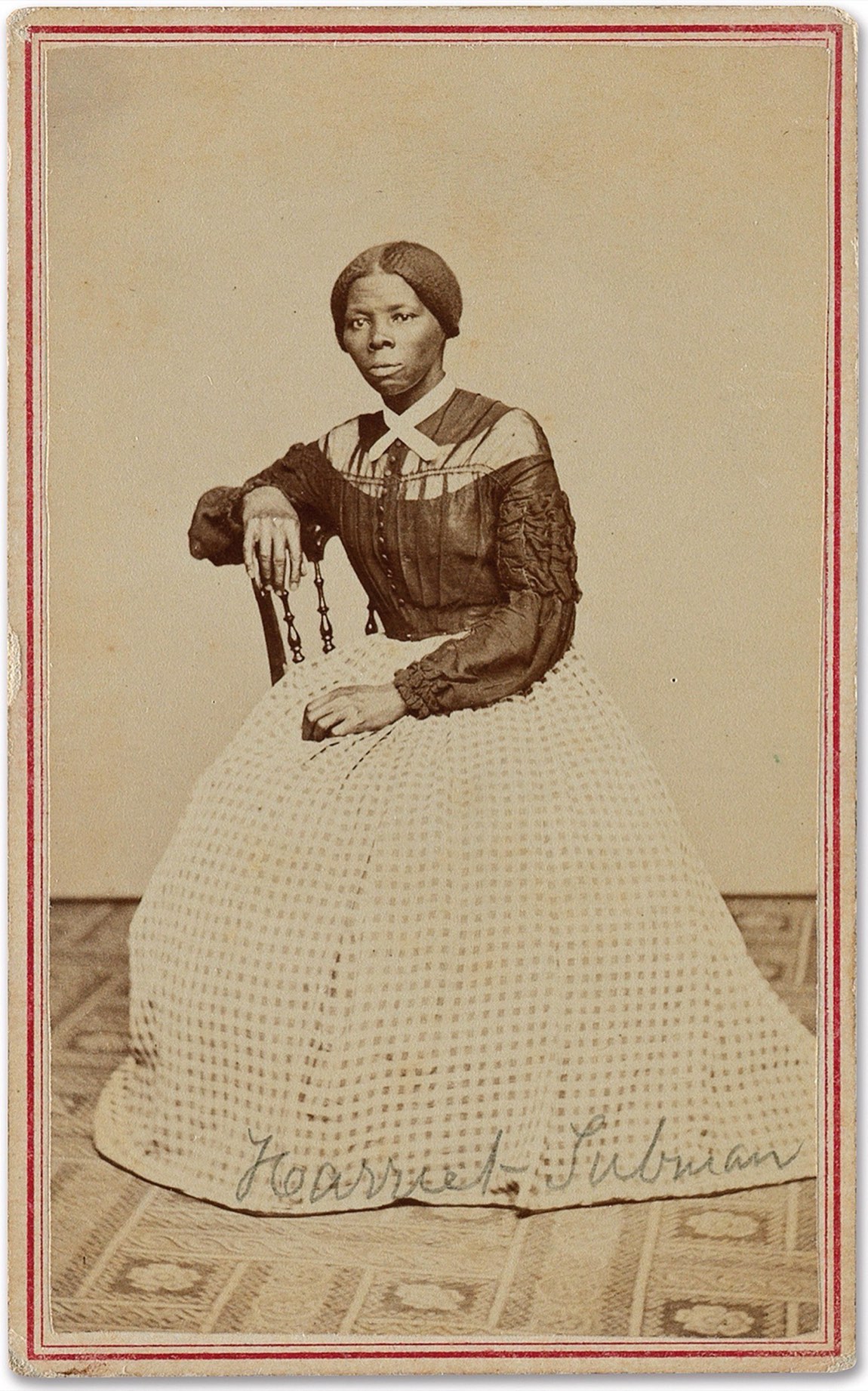
The “railroad” she conducted on needs explaining, because the name has come to carry a freight of myth it cannot bear. The Underground Railroad was not an institution, not an organization, not a thing with a headquarters or a roster. It was a loose, improvised, dangerous web of safe houses, hidden routes, and brave people who passed escapees from one set of hands to the next, borrowing the era’s newest technology for its code words, so that the guides became “conductors,” the safe houses “stations,” and the escapees “passengers.” It ran almost entirely through the free North; in the slave South, where escape actually began, there was no such network to lean on. And it was, contrary to a great deal of comfortable mythology, modest in scale. Historians estimate that somewhere between five and ten thousand people reached freedom through the Underground Railroad before the war, a real and heroic number, but a tiny fraction of the roughly four million held in bondage by 1860, well under one percent. Most people who escaped slavery did so on their own, with no network at all.
Two more myths deserve to be put down here, plainly, because the truth is better than the inventions. There is a beloved story that enslaved people sewed secret maps and signals into quilts and hung them out to guide escapees along the route, a theory called the “quilt codes.” There is no evidence for it. It surfaced in a single book in 1998, appears in none of the period slave narratives or the careful interviews collected from formerly enslaved people in the 1930s, and includes quilt patterns that did not even exist until the mid-twentieth century. The Yale historian David Blight has flatly called it “mythology.” And there is the broader romance of a vast, white-led, tightly run secret railroad spiriting hundreds of thousands to safety. That, too, is a later invention, and a revealing one: the early storytelling tended to credit kindly white Quakers and quietly write the Black participants out, when in fact the backbone of the whole enterprise was Black self-organization, Black communities sheltering their own and the strangers who reached them. The real Underground Railroad was smaller, more dangerous, and far more Black than the legend, and it does not need the embroidery. The plain truth is remarkable enough: ordinary people, mostly Black, risking prison and worse to move strangers through the dark.
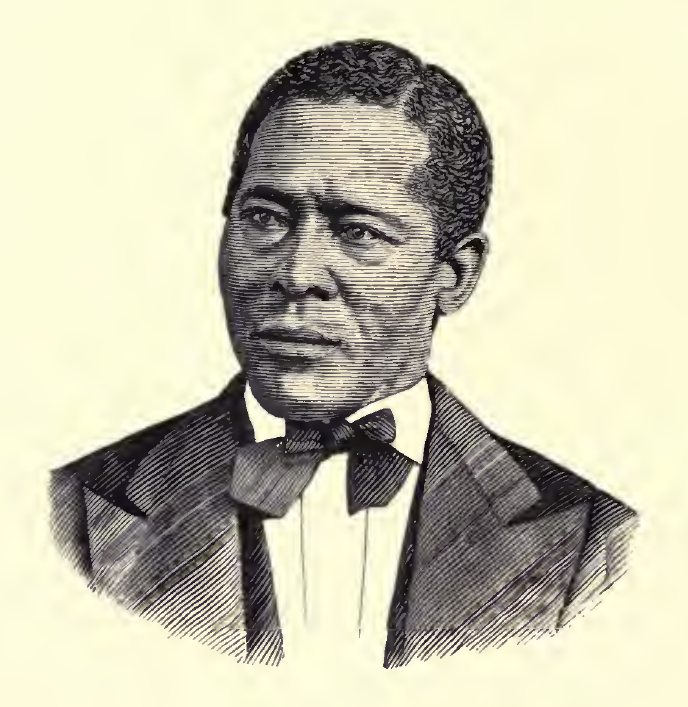
If Tubman was the railroad’s most daring conductor, its most meticulous one sat at a desk in Philadelphia. William Still, a free-born Black man, chaired the Vigilance Committee of the Pennsylvania Anti-Slavery Society, one of the local “vigilance committees” that sprang up in Northern cities to shelter, fund, and defend fugitives and to warn free Black residents when slave-catchers came hunting. Still’s great contribution was an act of bureaucratic courage: he wrote it all down. Every freedom seeker who passed through Philadelphia, Still interviewed (name, description, where they’d come from, where they were headed) and he hid the records, at real risk to everyone named in them, because he understood that families torn apart by slavery might one day use those notebooks to find each other again. He helped as many as eight hundred people to freedom and gave material aid and encouragement to Tubman when she was starting her own rescue work.
And it is in Still’s hidden notebooks that the two great weapons of this story come together: the act of stealing oneself free, and the written word. Because the escape was only half of the resistance; the record of it was the other half. The slave narrative, a first-person account of bondage and escape written or dictated by the person who lived it, became one of the great political instruments of the age, precisely because it could not be argued with. Douglass’s 1845 Narrative was the model, but it was joined by others that hit just as hard. In 1853 came Twelve Years a Slave, the memoir of Solomon Northup, a free Black New Yorker, a carpenter and violinist with a wife and children, who in 1841 had been lured to Washington, drugged, kidnapped, and sold into Louisiana slavery, where he spent twelve years before regaining his freedom. His account sold thirty thousand copies. And in 1861, on the very eve of the war, came Incidents in the Life of a Slave Girl, written by Harriet Jacobs. Jacobs published it under the pen name “Linda Brent,” not out of modesty but out of necessity, because she was writing about the one subject no respectable woman of the era was supposed to name aloud, and the truth of it could have destroyed her. She aimed her book squarely at the white women of the North, and she told them the thing slavery did to enslaved women that no man’s narrative had said so plainly: the relentless sexual coercion, the children fathered by owners, the impossible moral binds forced on women who had no legal power to refuse anything. These books did something no statistic could. They put a Northern reader inside a single human life and refused to let them look away, and the lives, in every case, belonged to the people the South insisted were merely property. After the war, Still published his hidden notebooks too, under the title The Underground Railroad Records (1872), and history eventually gave him the name his obituary in the New York Times affirmed: “the Father of the Underground Railroad.” It is worth noticing who that title belongs to: not a white benefactor, but a Black record-keeper who risked himself to make sure the escaped would not be forgotten, and who understood that to write a life down was its own act of resistance.
The hinge
For decades, slavery had been something a comfortable Northerner could regard as a Southern problem, distasteful, perhaps, but distant, somebody else’s sin, happening somewhere else. The genius and the catastrophe of the Fugitive Slave Act of 1850 was that it reached out and put the machinery of slavery into the North’s own hands. It made every Northerner complicit, by law, and in doing so it did more to turn ordinary, non-abolitionist Northerners against slavery than thirty years of moral argument had managed.
The law was passed as part of the Compromise of 1850, a bundle of measures meant to cool the fight over slavery’s spread into the new western territories. The deal had something for each side: the North got California admitted as a free state and the slave trade curbed in the nation’s capital; the South’s price for the bargain was a brutally strong new fugitive-slave law, and it got one. Read its provisions and you can feel why it radicalized people. Cases were decided not by juries but by federal commissioners, and the accused person, the alleged fugitive, was given no right to testify on his own behalf and no right to a jury at all. The commissioner who heard the case was paid on a sliding scale that should have shamed everyone who voted for it: ten dollars if he ruled that the person was a fugitive and could be carried off, but only five dollars if he ruled the evidence too thin. The law, in plain terms, paid its judges double to send a human being into slavery. It compelled ordinary Northern citizens to join slave-catching posses when called, and threatened anyone who helped a fugitive with a thousand-dollar fine, six months in jail, and a further thousand in damages for each person who got away. And because the accused could not testify, and a commissioner’s certificate was declared “conclusive,” any free Black person in the North could in principle be seized on a slaveholder’s sworn word and shipped south with no real hearing at all. That was not a hypothetical horror. It happened. Free people who had never been enslaved a day in their lives were kidnapped under color of the new law.
The North did not take it quietly, and the resistance had a way of turning into open confrontation. The first great flashpoint came on September 11, 1851, in the village of Christiana, in southeastern Pennsylvania, about twenty miles above the Maryland line, where a sizable community of free and escaped Black people had settled. A Maryland slaveholder named Edward Gorsuch came north that morning with his son, a federal marshal, and a few men, armed with a warrant to reclaim four people who had escaped him and taken shelter at the home of William Parker, himself a man who had escaped slavery. Parker and a band of armed Black neighbors refused to give the four up. In the gunfire that followed, Edward Gorsuch was shot dead and his son badly wounded; the escapees and most of the defenders made it to Canada, and not one of the four was returned. The government’s response showed how rattled it was: forty-one people were charged with treason against the United States (the gravest charge in the legal code) for resisting a slave-catcher. The case collapsed almost instantly. The first defendant tried, a white miller named Castner Hanway who had merely been present, was acquitted by the jury in about fifteen minutes, and the rest of the charges were dropped. The Christiana Resistance announced, early and unmistakably, that the Fugitive Slave Act could not be enforced in much of the North without bloodshed.
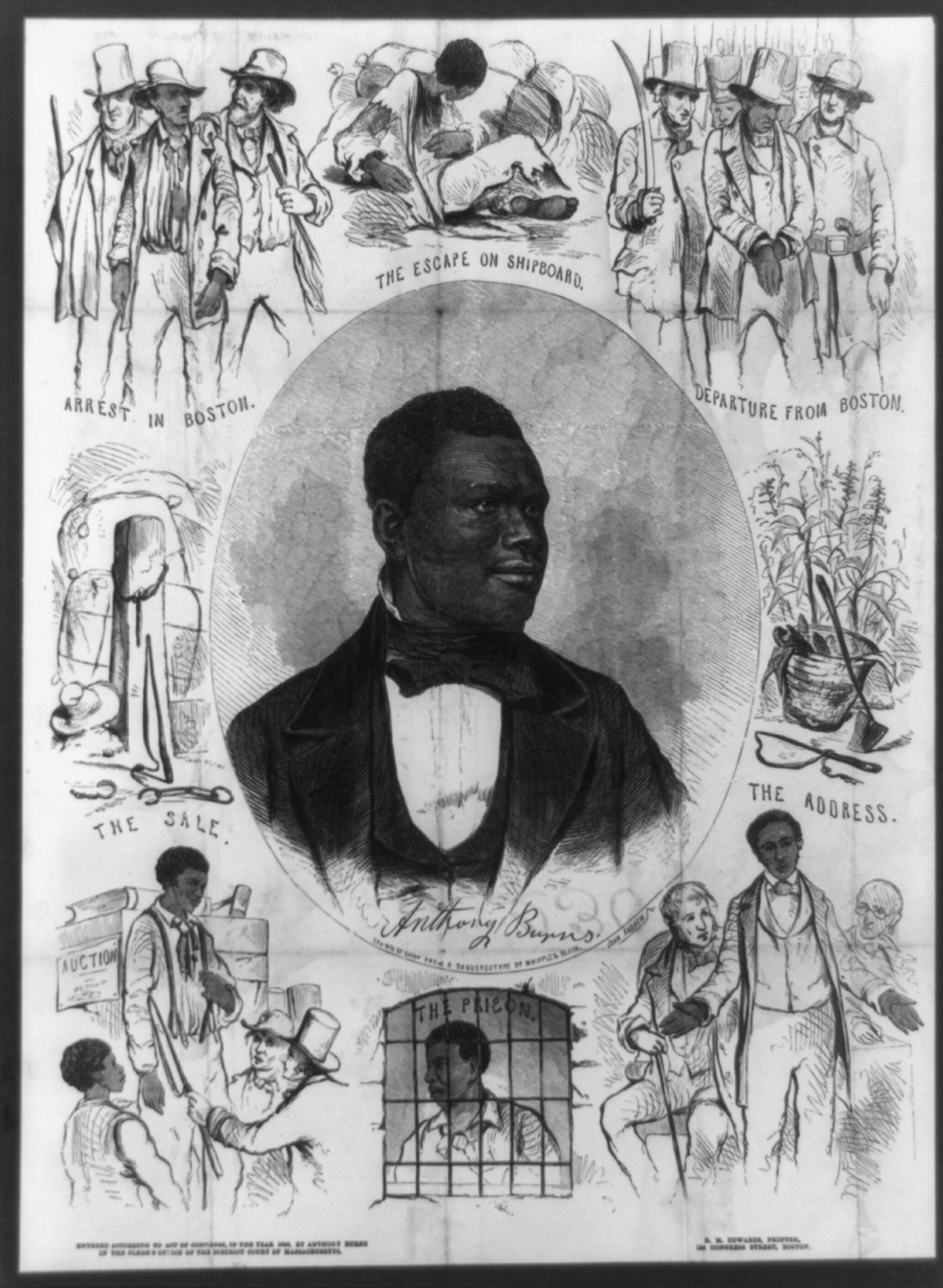
The second great flashpoint made the point in front of an enormous audience. In May 1854, a young man named Anthony Burns, who had escaped slavery in Virginia and was living in Boston, was arrested on a warrant from his former owner. His “trial” was no trial at all: an administrative hearing under the new law, before a commissioner, with the foregone conclusion that Burns must go back. What turned the case into a national spectacle was what it took to carry that conclusion out. Boston rose. An estimated fifty thousand people packed the streets between the courthouse and the harbor to protest, and to march one man back into bondage through that crowd the federal government deployed an army: roughly fifteen hundred Massachusetts militia, the entire Boston police force, a hundred and forty-five federal soldiers with a cannon, and a hundred special deputies, all to escort a single human being less than half a mile to a waiting ship. The whole performance cost the government upwards of forty thousand dollars by contemporary estimates. And the country watched. The spectacle of the United States Army marching one man back into slavery, down the streets of Boston, past fifty thousand jeering citizens, did something no pamphlet could: it radicalized moderates. People who had never cared a whit for abolition found that they could not stomach this.
And here is the detail that ties the two threads of this whole section into a single knot. At almost the exact moment the government was spending a small fortune and an army to drag Anthony Burns down to the water, a novel was quietly doing the opposite work in millions of Northern parlors. In 1852, two years before Burns, in the first shock of the Fugitive Slave Act, a Connecticut woman named Harriet Beecher Stowe had published Uncle Tom’s Cabin, and she wrote it, by her own account, in direct fury at the new law, which she saw as a moral atrocity that dragged every Northerner into the sin of slavery. The novel did what the slave narratives had been doing, but for an audience of millions: it made Northern white readers, most of whom had never witnessed slavery, feel its cruelty through the lives of invented but recognizable people. The sales were staggering: fifteen thousand copies in the first month, around three hundred thousand in the United States in the first year and more than a million across British editions, making it the best-selling novel of the century and, in America, the best-selling book of any kind behind only the Bible. The South banned it in fury. So picture the two things happening together: a government willing to march one man to a ship at bayonet-point to enforce slavery, and a book that was, page by page, in a million homes, turning the country’s stomach against the thing the bayonets were defending. The first hardened Northern resolve, the second softened Northern hearts, and together they made compromise harder by the month. (The famous tale that Lincoln greeted Stowe as “the little woman who wrote the book that made this great war” should be handled with care; it surfaced only decades later, from Stowe’s own son, and no contemporary record confirms it.)
But it is worth being precise about what Stowe did and did not do. A white novelist did not awaken the country to a horror it had not heard of. She translated, into fiction the mass white public would actually read, the testimony that Black writers and Black fugitives had been delivering for a generation, and she did it at the exact moment the Fugitive Slave Act had primed that public to receive it. The Black freedom struggle had spent thirty years making the argument. Stowe handed a version of it to people who had refused, until now, to listen. And Anthony Burns, less than a year after his rendition, got a coda the law had not intended: abolitionists simply bought his freedom for thirteen hundred dollars, and he came back to Boston a free man, later studying at Oberlin College, and died free in 1862, one man pulled back out of the machine that a whole country was beginning, at last, to hate.
What the struggle had done
By 1860, the work was done. Not the work of ending slavery, which would take a war, but the work of making slavery impossible to ignore, impossible to compromise away, impossible to keep treating as a tolerable feature of national life. And that work had been substantially Black-led from the start.
Run the chain back. A free Black man’s pamphlet, smuggled south in the seams of sailors’ coats, named the crisis before any white movement existed. A Black-owned newspaper insisted on pleading its own cause. A Black national convention met in secret to organize. An enslaved preacher rose in the Virginia night and showed the South its deepest fear was real. Black subscribers and a Black sailmaker kept the white movement’s flagship paper alive when it had fewer than fifty white readers. A formerly enslaved man became the most commanding voice in the country and told the nation, to its face, that its liberty was a lie. The enslaved themselves walked out the door by the thousands and went back for thousands more. And the books they wrote, and the resistance they mounted at Christiana and in the streets of Boston, turned ordinary Northerners, people who had never marched for anything, against the whole rotten arrangement. Stowe’s novel reached millions, but it carried an argument Black Americans had built. The white abolitionists who are remembered did genuine and courageous work; they did it inside a movement that Black people had founded, funded, and led.
The struggle was never of one mind about how to win, and as it reached its crisis the oldest argument of all came roaring back, the one that had split Freedom’s Journal in 1829: should Black Americans fight for this country, or give up on it and build a future somewhere else? After the Fugitive Slave Act of 1850 made even the free North unsafe, a brilliant and furious man named Martin Delany, a physician, editor, and explorer who had once co-edited The North Star alongside Douglass, concluded that the answer was no. A people the government would seize on a stranger’s word and a country that hunted them through their own free cities, he argued, owed that country nothing; Black Americans should gather themselves and emigrate to a land where they could govern themselves. In 1852 he laid out the case in a book whose title was its argument, The Condition, Elevation, Emigration, and Destiny of the Colored People of the United States, and in 1854 he convened a National Emigration Convention in Cleveland to plan it. Douglass rebutted him in public and in print, holding to the line he would hold to the end: this is our country, bought with our blood and labor, and we will stay and make it answer for us. It was the same fork the movement had reached again and again (Walker’s defiant “America is more our country,” Russwurm’s surrender to Liberia, now Delany versus Douglass with the stakes higher than ever), and once more the struggle did not resolve it so much as drive straight through it. The war would settle that argument too. When emancipation finally came with a Union army behind it, the question of whether to fight for America was answered by Black men fighting in America’s uniform.
That accumulated pressure had a political destination. By the late 1850s, three blows had together shattered Northern faith that any compromise with the slave South could hold. The Fugitive Slave Act had put the machinery of slave-catching into Northern hands. The fights over the western territories, the bitter, often bloody struggle over whether slavery would be allowed to spread into the vast lands the United States had just seized from Mexico, had turned the question of slavery’s future into the central issue of national politics. And in 1857 the Supreme Court handed down the Dred Scott decision: Scott was an enslaved man who had sued for his freedom on the grounds that his owner had taken him to live in free territory, and the Court not only ruled against him but declared that Black people, free or enslaved, were not and could never be citizens: that they “had no rights which the white man was bound to respect.” Out of the collapse of compromise rose a new political party, the Republicans, a brand-new organization founded in 1854 (and not to be confused with the very different party that bears the name today), a frankly Northern party built around opposition to the spread of slavery. It ran on the moral ground that Walker and Stewart and Douglass and Garnet and Truth and Tubman and Still had spent a quarter-century clearing. The party’s 1860 candidate, Abraham Lincoln, was no abolitionist; he did not propose to touch slavery where it already stood. But he was the product of a Northern political culture that the Black freedom struggle had remade beneath his feet, and his election was enough: enough to convince the slaveholding South that it had lost control of a country it had always assumed was its own, and to send it reaching for secession and war.
This is the thing to carry into everything that follows. The war’s deepest cause was not handed to the country by outsiders or imposed from above. It was generated from within, by the people slavery claimed to own, who refused to be silent, refused to be objects, refused to wait. They argued, organized, escaped, wrote, rose, and pushed until the nation could no longer look away, and a war came to settle what they had forced it at last to face. The freedom struggle did not end at Lincoln’s election. It put on a uniform and marched into the war it had helped to make.