There is a flattering way to picture the Civil War home front, and it goes like this: a whole people, North and South, rolling up their sleeves and pulling together, women knitting socks, families pinching pennies for the boys at the front, everyone sacrificing equally for the cause. There is real truth in it. But it leaves out the part that made people furious at the time, the part that produced the worst street violence the country had yet seen. Because the sacrifice was not equal, and everyone knew it. On both sides, the men who governed wrote the rules of the war so that the burden of actually fighting it (and the burden of going hungry behind the lines) fell hardest on the people who already had the least.
The South built the first national military draft in American history, then carved a hole in it big enough for a plantation owner's son to climb through. A year later the North built its own draft and put the same kind of hole in it, this one priced at exactly three hundred dollars. Both holes produced the same bitter slogan, on both sides of the line, a rich man's war and a poor man's fight, and the pressure behind that slogan kept building until it cracked. It cracked first in Richmond, where starving women smashed open the shops of the Confederate capital, and then in New York, where a riot against the draft turned into four days of mob murder. By the end, one of these two home fronts was booming and the other was eating itself alive.
The South drafts first
Here is a fact that surprises almost everyone: the Confederacy, the eleven Southern states that had broken away over the right to govern themselves, states' rights (the belief that individual states, not the national government, held supreme power) their whole creed, invented the American draft. Not the North. The South. And it did it first.
The reason was a manpower crisis. When the war began in 1861, Southern men had rushed to enlist, but most of them had signed up for just twelve months. By the spring of 1862 those enlistments were running out, men were thinking about going home, re-enlistment was coming in far below what the army needed, and the Union was massing for major offensives at exactly that moment. The Confederate government did the math and reached for the only tool that would keep the ranks full: compulsion. On April 16, 1862, the Confederate Congress passed the First Conscription Act, conscription being the legal power to force men into military service whether they volunteer or not, what Americans came to call simply "the draft." It was the first national draft in American history, beating the Union's by nearly a year. The states'-rights Confederacy had created compulsory national service before the federal government it was fighting did.
The first law made all white men aged 18 to 35 liable for three years' service. As the war ground on and the casualties mounted, the net widened: a second act that September raised the top age to 45, and by February 1864 the Confederacy was reaching for men as young as 17 and as old as 50, boys and graybeards, the bottom of the barrel.
A drafted man had one obvious way out, at least at first. He could hire a substitute, pay another man, one not subject to the draft, to go and serve in his place. On paper this was legal for everyone; in practice it was a door only the well-off could afford to walk through. The price tells you who could use it. A substitute in the South typically cost between $800 and $1,500, and as the war went on the going rate ran as high as $3,000 in specie (gold and silver coin), and higher still in Confederate paper, a sum a hill-country farmer could no more produce than fly to the moon. The substitution loophole drew so much anger as a rich man's escape hatch that the Confederacy abolished it on December 28, 1863. But by then a far more explosive exemption had already poisoned the well.
Twenty slaves and a way out
The exemption that did the damage came on October 11, 1862, and it had a nickname that tells you everything: the Twenty-Negro Law (also called the Twenty-Slave Law or the Overseer Law).
It worked like this. For every twenty enslaved people owned on a plantation, one white man could be exempted from military service, kept home, off the battlefield, to serve as an overseer, the white supervisor who managed the day-to-day labor of enslaved people on the plantation. (Two or more plantations within five miles of each other counted together, if between them they held twenty or more enslaved people.) The stated reason was control. With the white men away at war, somebody had to stay on the land to keep the enslaved population working and, the planters feared, to keep it from rising up. That fear was running hot in the fall of 1862 for a specific reason: just weeks earlier, on September 22, President Abraham Lincoln had issued his preliminary Emancipation Proclamation, a public warning that, if the rebelling states did not return, he would free the enslaved in them when the new year came. To slaveholders, that announcement made the prospect of a slave uprising feel suddenly real, and the Twenty-Negro Law was partly a response to it.
But look at how the law landed on an ordinary Confederate soldier, a man from the hill country who owned no slaves at all, dug in behind a fence rail with his enlistment forcibly extended, his family scraping by at home. The message he heard was unmistakable: own twenty human beings and the war the planters had started becomes optional. The planter's son goes home to mind the plantation; the poor man stays and bleeds. The timing made it worse. Passed right on the heels of Lincoln's emancipation warning, it read as the slaveholding class buying its own children out of the very war it had launched to protect slavery. This is where the phrase a rich man's war, poor man's fight was forged in the South, and one Confederate private wrote down exactly how it felt. Sam Watkins, an infantryman in the 1st Tennessee whose postwar memoir Co. Aytch is one of the great ground-level accounts of the war, put it plainly:
"A law was made by the Confederate States Congress about this time allowing every person who owned twenty negroes to go home. It gave us the blues; we wanted twenty negroes. Negro property suddenly became very valuable, and there was raised the howl of 'rich man's war, poor man's fight.'"
Here is the strangest part. The Twenty-Negro Law barely exempted anyone. The actual numbers were tiny, a few hundred men per state, set against an estimated 38,000 or so overseers across the whole Confederacy. The handful of men it let off the hook was almost beside the point. What it cost the Confederacy was not manpower but morale, the corrosive, war-long conviction among ordinary soldiers and their families that the system was rigged for the rich. The government kept tightening the screws on it, adding fees, a requirement that the exempted man had already been an overseer before the war, even mandatory sales of meat to the army at fixed prices, and none of it touched the underlying fury. The number of men exempted was small; the resentment was enormous, and it never went away.
The North's turn, and a price tag
The Union held off on a real draft for nearly a year longer than the Confederacy. It relied on volunteers and a brief 1862 militia call-up, but by early 1863, with the war's appetite for soldiers bottomless, that wasn't enough. On March 3, 1863, Lincoln signed the Enrollment Act (also called the Conscription Act), the first genuine federal draft in United States history. It made every male citizen, and every immigrant who had filed papers declaring his intent to become one, liable for service between the ages of 20 and 45.
And then it built in two escape hatches, written right into the law, that became the heart of everything that went wrong.
The first was substitution, the same device the South had used: furnish an acceptable substitute to serve in your place and you were excused. The second was new and far more inflammatory: commutation, the right to simply pay the government a $300 fee and be excused from that particular draft call. Not serve, not find a replacement. Just write a check.
To understand why that single number set the country on fire, you have to know what $300 was in 1863. For an unskilled laborer it was about a year's wages, the entire earnings of twelve months of work. A factory hand or a dockworker could no sooner produce $300 to dodge the draft than fly. But for a merchant, a lawyer, a comfortable family, it was a manageable sum, an unpleasant but survivable expense. The law had effectively put a price on staying alive, and set that price precisely where the working class couldn't reach it and the moneyed class could. The same slogan that had erupted in the South over the Twenty-Negro Law now erupted in the North, word for word: a rich man's war and a poor man's fight.
The substitution side bred its own ugly racket. A class of career swindlers called bounty jumpers worked the system: a man would enlist as a paid substitute, or sign up to collect one of the cash bounties (enlistment bonuses paid by federal, state, and local governments to lure volunteers), pocket the money, desert before he ever reached the front, then do the whole thing again somewhere else under a new name. Substitutes earned a reputation as the worst soldiers in the army, and not unfairly.
There is a deep irony buried in the Union draft, one that makes the hatred of it even more striking: it barely drafted anyone. Its real power was as a threat, not a machine. The looming possibility of being drafted is what drove men to volunteer, or to take a bounty, or to hire a substitute, which is exactly what the government wanted, because a volunteer or a bounty man was a better soldier than a conscript dragged in by lottery. Of all the men who served in the Union Army, only about 2 percent were actual draftees held to service. The first 1863 draft tells the story in miniature: of the roughly 292,000 names drawn, the overwhelming majority were excused for medical or hardship reasons, tens of thousands more bought their way out with the $300 commutation or furnished a substitute, and only a few thousand, something like 3 percent of those called, were actually held as conscripts.
So the draft that produced almost no draftees was hated all the same, hated because of the $300 door and the substitute door, because everyone could see who got to use them. Over time the government tried to close the worst of it, cutting the commutation back and then, in July 1864, effectively ending it except for conscientious objectors (people whose sincere religious or moral beliefs forbid them to take part in war). But by the summer of 1863, before any of those fixes, the resentment had already boiled over in the largest American city, in the deadliest way.
Draft Week
Start with the firemen, because they tell you this was never a random mob.
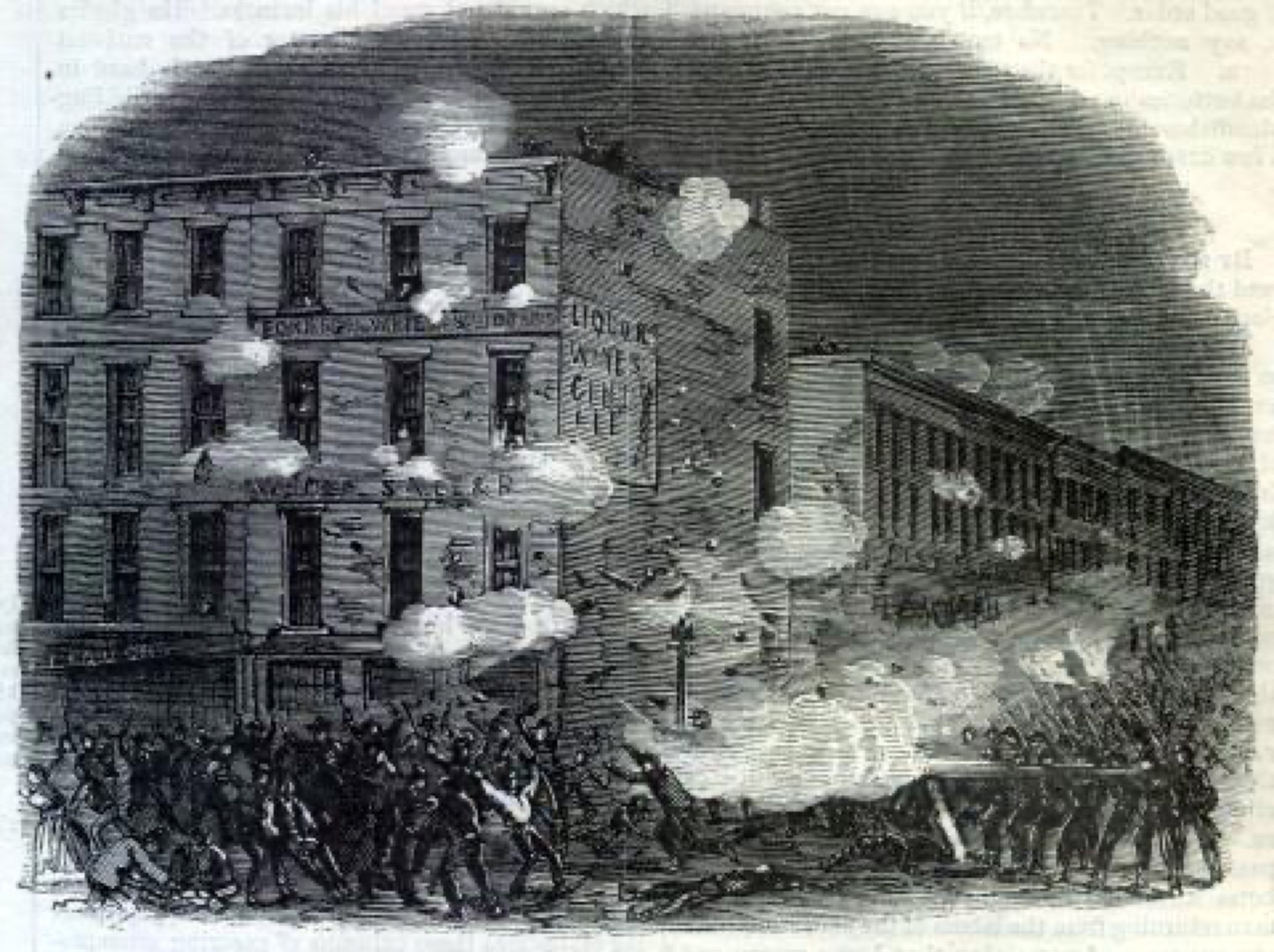
Around ten o'clock on the morning of Monday, July 13, 1863, the volunteer firefighters of Engine Company 33, a Manhattan firehouse crew known all over the city by their swaggering nickname, the "Black Joke," marched on the federal draft office at the corner of Third Avenue and 47th Street and tore it apart. They smashed the windows, beat back the police guarding the wheel of names, doused the building with turpentine, and set it ablaze. Firemen, the men whose whole job was to stop fires, had come to start one. And they had their reasons: volunteer firemen were a tight, proud, mostly Irish working-class brotherhood, and they had just learned that their long-standing exemption from military service was gone; they were now as draftable as any dockhand. The men who put out the city's fires were about to be marched south to die, while any banker's son could buy his way clear for $300. So they lit the match. From that single burning building the violence exploded outward and ran for four days, until July 16, in what New Yorkers came to call Draft Week, the worst civil insurrection in American history up to that point.
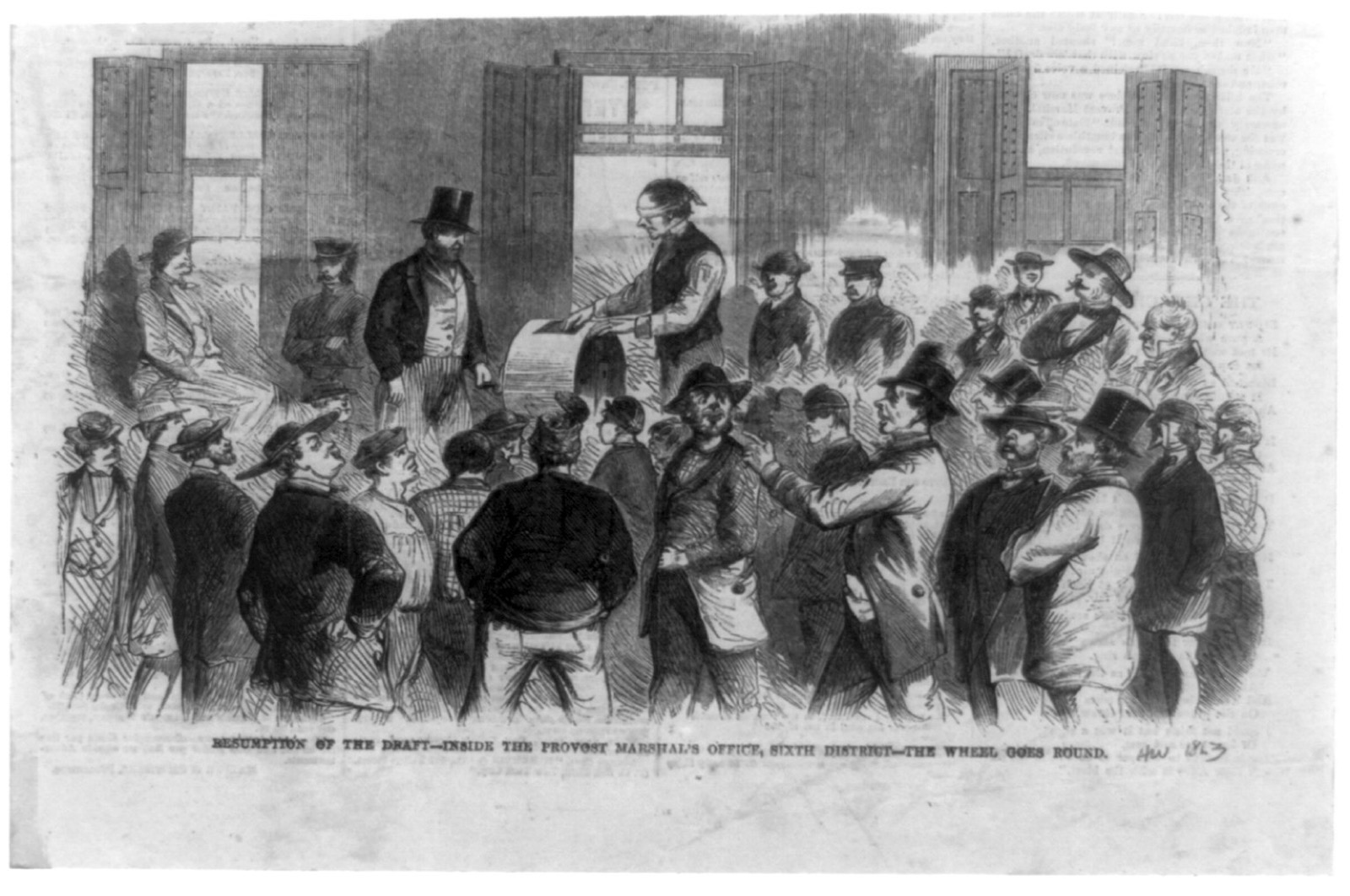
The fuse had been smoldering all weekend. The first drawing of draft names in the city had gone off peacefully on Saturday, July 11, at that same office, run, like every draft office, by the provost marshal (the military officer charged with enforcing and administering the draft). It was the second drawing, on Monday morning, that the Black Joke men interrupted with their turpentine. By then a crowd of some 500 had gathered behind them, and within hours it was a crowd of thousands.
Who were the rioters, and what were they actually so enraged about? Overwhelmingly they were Irish American working men, exactly the people the draft pressed hardest and who could never dream of producing $300 to escape it. Their fury braided together three strands. First, the draft and its rich-man's loophole, the grievance that had been building all spring. Second, a war whose purpose had visibly changed: the Emancipation Proclamation had taken effect on January 1, 1863, and now the war was openly about ending slavery, which, to a white laborer at the bottom of the Northern economy, raised the threatening prospect of freed Black workers flooding north to compete for his job. That fear wasn't abstract: earlier that very year, Black laborers had been hired as strikebreakers on the New York waterfront, dropped into a labor dispute against white workers. The draft, the economy, and race fused into one combustible mass. But the targeting of Black New Yorkers that followed was not reducible to labor competition. It expressed a hatred of Black people that needed no economic excuse at all; the proof is what the mob did that very first afternoon, to people who were no one's competitors for any job.
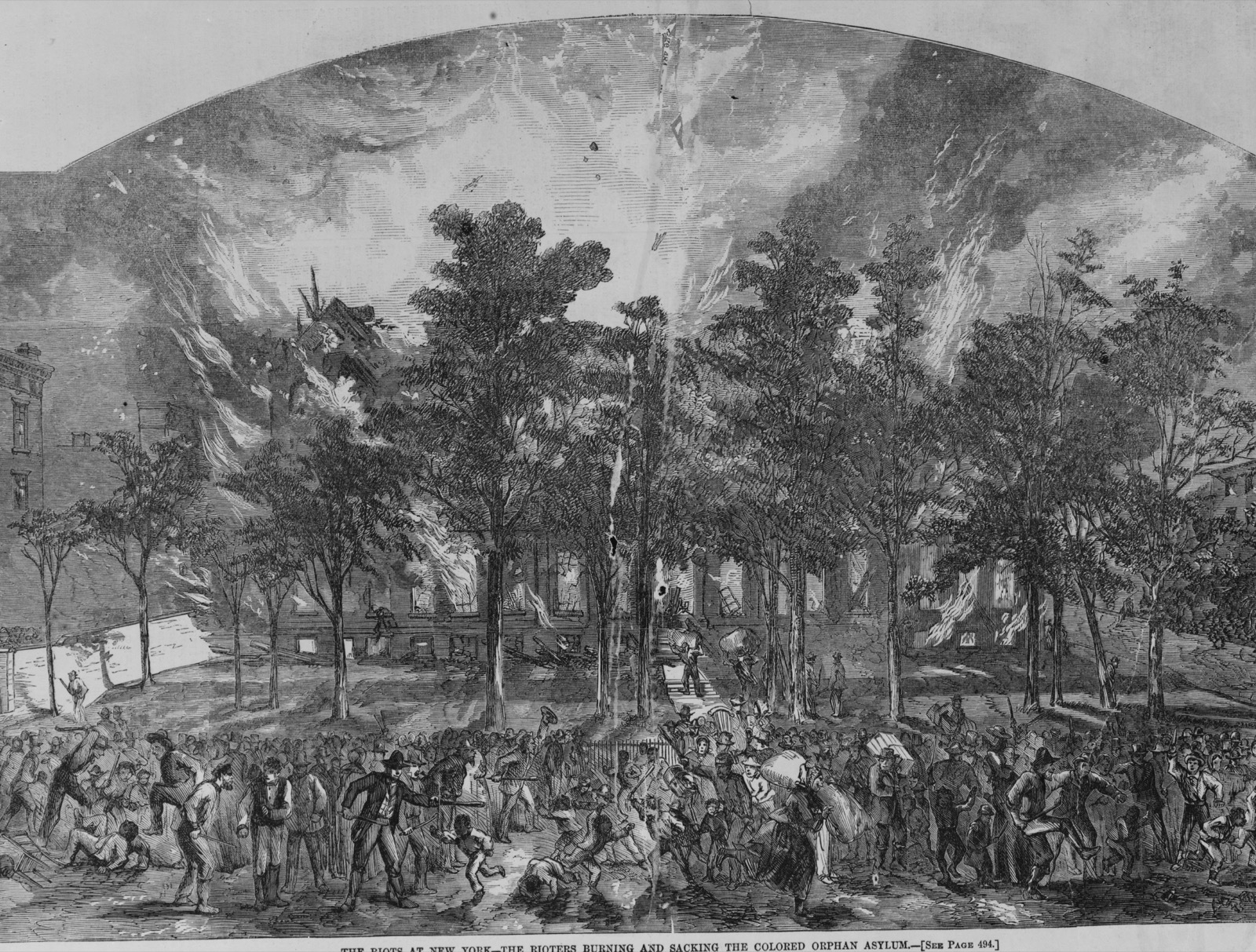
Because then the riot became something far darker than a protest against the draft. It turned into a racial pogrom, a coordinated campaign of mob violence aimed at an entire group, here the city's Black residents. Rioters beat Black New Yorkers in the streets, burned their homes and businesses, and lynched them. The single most infamous act came that Monday around four o'clock, at the Colored Orphan Asylum on Fifth Avenue near 43rd Street, an institution that housed roughly 230 Black children. A mob several thousand strong surrounded it. Inside, the staff hurried the children (toddlers to teenagers) down the stairs and out the back of the building while the crowd battered at the front; the police and the asylum's superintendent held the attackers off just long enough for every last child to get clear. Then the mob poured in, stripped the building of everything it could carry, and burned it to the ground. Not one of the 230 children was killed. They had been spared by minutes.
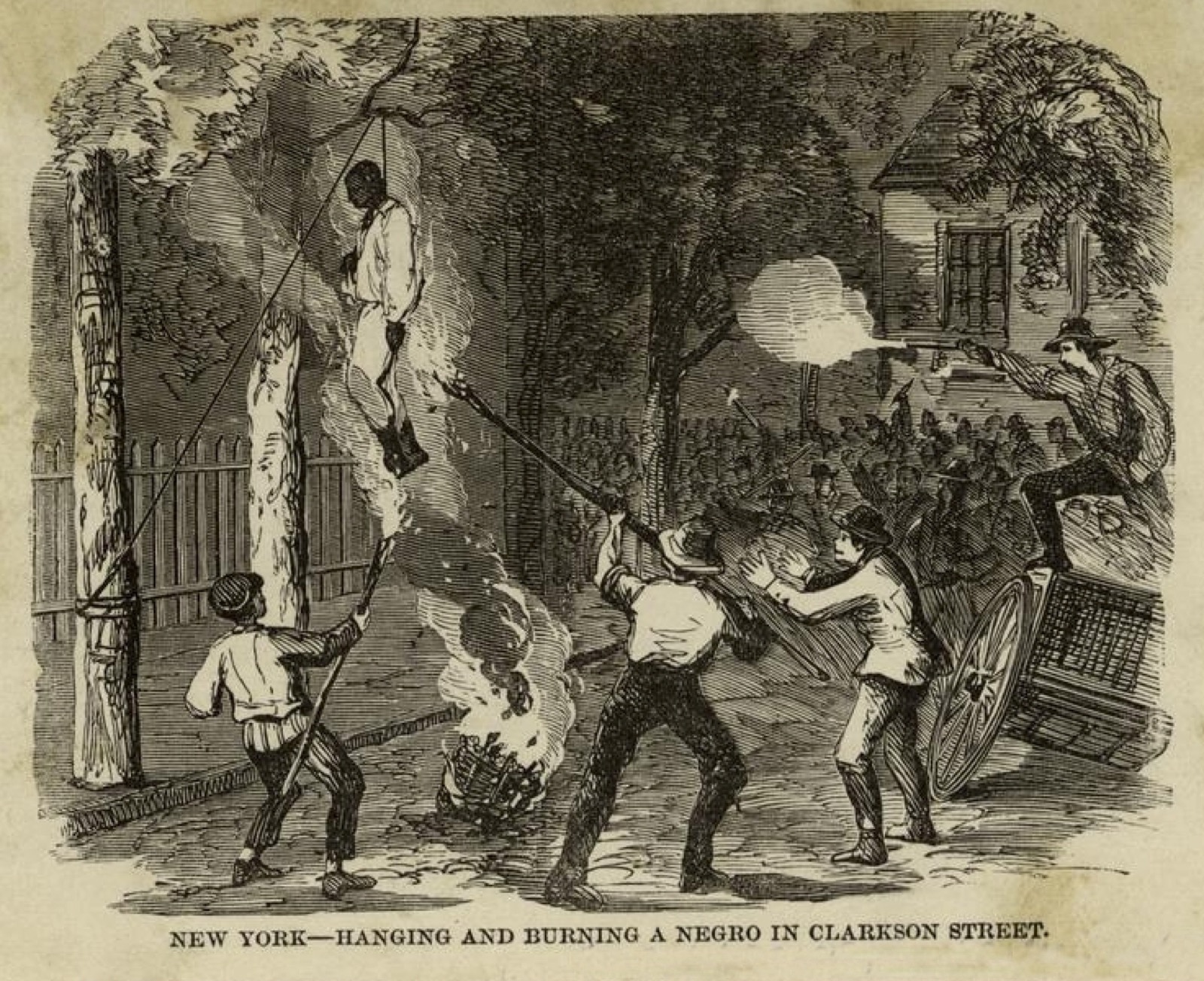
The Black New Yorkers caught in the open were not. Over the four days, mobs hanged or murdered eleven Black men and boys, often beating them senseless and then stringing them up from lampposts or trees and setting fires beneath them. Among the dead was Joseph Reed, a seven-year-old boy, born in Bermuda, who was chased down by a gang of men and women as he tried to flee his home, beaten so badly he died of his injuries days later. He had done nothing and could threaten no one. None of this can be softened, and it shouldn't be: a riot that began over a draft ended as a campaign of racial murder.
The city's own forces couldn't contain it. What finally broke the riots was the army; and not just any army. Just days earlier, the Battle of Gettysburg had been fought July 1 to 3, and in its aftermath Secretary of War Edwin M. Stanton pulled five regiments straight from the Army of the Potomac. Units including the 7th New York State Militia, the 152nd New York, the 26th Michigan, and the 27th Indiana force-marched to the city. By the time order was restored on July 16, more than 4,000 soldiers were stationed across New York to hold it down. The draft itself, run locally by Provost Marshal General James B. Fry and the city's provost marshal Robert Nugent, was suspended in the chaos, then resumed weeks later in August under heavy military guard, and went forward.
How many died is genuinely uncertain. The official count was about 119 to 120 dead. Some later accounts threw out far higher figures: one claimed 2,000 killed and 8,000 wounded, but historians regard those numbers as wildly inflated, and they should not be taken as fact; the firmest figure remains around 120, with the eleven Black men and boys lynched among the best-documented of the dead. Property damage ran somewhere between $1 million and $5 million in 1863 dollars, with about fifty buildings burned, including the orphan asylum and two Protestant churches. It stands as the bloodiest civil disorder in the nation's history.
The South starts to starve
While the Northern home front convulsed over the draft, the Southern home front was coming apart in a slower, grinding way: through the price of bread.
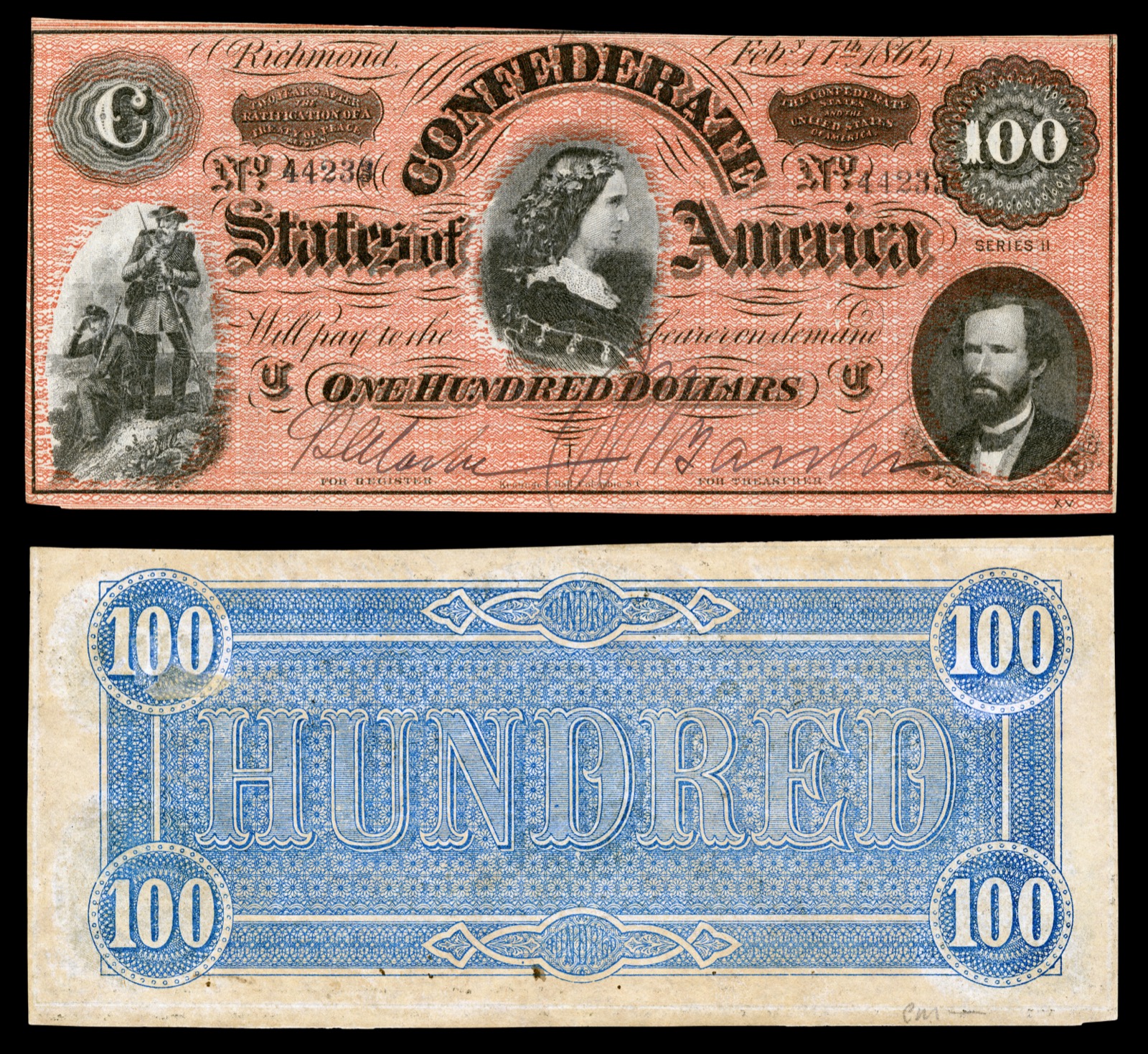
The defining fact of Southern civilian life in the war was inflation, the steady, relentless rise in the price of everything, which is what happens when the amount of money in circulation balloons faster than the goods it can buy. And in the Confederacy the inflation didn't just rise; it ran wild. Over the course of the war, Southern prices climbed by more than 9,000 percent, a measure of commodity prices that stood at 100 when the war began had passed 9,200 by April 1865. For long stretches prices rose roughly 10 percent a month, and faster than that toward the end. Put in human terms: a Confederate dollar that was worth about 90 cents in gold at the start of the war was worth roughly a penny and a half by the end. The money in a Southern family's hand was melting while they held it.
The cause was the printing press. The Confederacy had almost no other way to pay for its war. It couldn't tax a population that had little hard cash, and it couldn't borrow nearly enough, so it simply printed money, more and more of it. Between 1862 and 1865, over 60 percent of the Confederate government's total revenue came from printing currency. The money supply, the total amount of currency circulating in the economy, swelled roughly twentyfold over the war. (For comparison, the Union only about doubled its money supply over the same years.) Twenty times as many dollars chasing a shrinking pile of goods is a recipe for exactly the price explosion the South got.
And the pile of goods was genuinely shrinking, because of the Union blockade. The U.S. Navy had thrown a cordon across the South's ports, choking off the imports a half-industrialized agricultural region depended on: coffee, salt, medicine, shoes, manufactured goods of every kind. Everyday necessities became luxuries. Salt to preserve meat, shoes for winter, coffee in the morning, things ordinary families had never had to think about, turned into things they often simply went without.
Then the Confederate government, desperate for supplies its worthless paper money couldn't buy, started taking what it needed directly. In March 1863 it legalized impressment, the power of military agents to seize food, fuel, livestock, wagons, and enslaved labor outright, paying for them in depreciating (steadily-losing-value) Confederate dollars at fixed government prices set well below what the goods were actually worth. To a farmer, this meant soldiers showing up to haul off his hogs and his corn and leaving behind a fistful of paper that lost value by the week. The following month, April 1863, came the tax-in-kind, and because paper money was useless to the government too, it ordered farmers to hand over one-tenth of their actual produce, the corn and wheat and sweet potatoes themselves, straight to government collectors. The tax-in-kind fell hardest on exactly the small farmers who could least afford to lose a tenth of their crop, and it raised an estimated $62 million in goods for the Confederacy between 1863 and 1865 while turning much of the rural South bitterly against its own government. A late attempt at currency reform in February 1864, converting the largest bills into bonds (loans to the government, repaid later with interest) to shrink the money supply, trimmed the money stock by about a third and briefly nudged prices down, but it was far too little and came far too late.
That is the abstraction. The lived version was a farm wife standing in her own yard watching uniformed men load her last hogs onto a wagon and press a fistful of melting paper into her hand. By the spring of 1863, women like her had stopped waiting at home.
Bread or blood
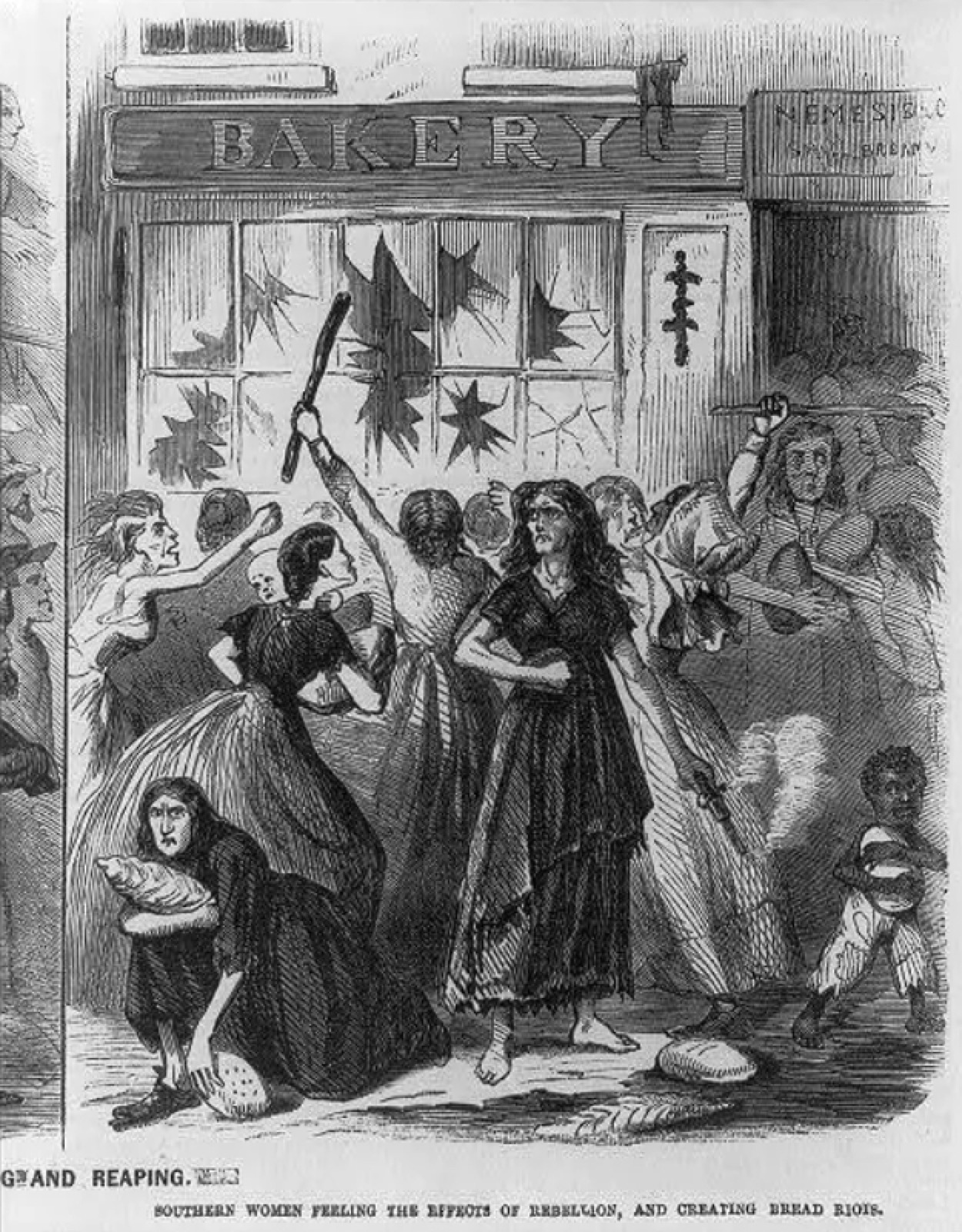
By the spring of 1863, the arithmetic of Southern hunger had a face, and it was a woman's. With the men gone off to fight a war for the independence of a slaveholding republic, a war fought, in the end, for a plantation class most of these women would never belong to, it was the women, mostly poor and mostly unsupported by anyone, who were left holding households together on melting money and emptying shelves. And on April 2, 1863, in Richmond, Virginia, the capital of the Confederacy itself, they took to the streets.
The Richmond Bread Riot didn't come out of nowhere. The day before, on April 1, a group of women had tried to meet with Virginia's governor, John Letcher, to beg for relief from the impossible prices of food and fuel. He turned them away. The action had been organized in Richmond's working-class Oregon Hill neighborhood, with quiet recruiting going back to late March. Two women were at the center of it. Mary Jackson, a market peddler, the mother of a soldier, had spent the last week of March moving through the stalls of the city market telling the other women, out loud, that there would be "a meeting of the women in relation to the high prices," pulling in workers from a government clothing factory and farm women from the surrounding counties. Beside her was Minerva Meredith, a butcher's apprentice, tall and forceful, the kind of woman a crowd follows.
On the morning of April 2 the meeting became a march, and somewhere along the route the march became a riot. There was a first shop, a first shattered window, a first armful of bacon carried off into the street; and then the thing caught. The crowd swelled to perhaps a thousand or more, with a hard core of four or five hundred breaking into the shops and warehouses of the Confederate capital and seizing food first, bacon and flour, then, as the looting ran on, clothing, shoes, even jewelry, carrying off goods worth tens of thousands of dollars. This was not a small disturbance in a back alley. It was the largest of a whole wave of bread riots, and it was happening a few blocks from the seat of the Confederate government.
What stopped it is the scene everyone remembers, and it is worth standing in the street to watch it. Word reached Jefferson Davis, President of the Confederate States, and Davis came out himself, into the middle of a food riot run by women, and climbed up onto a wagon to face them. By the well-known account he turned out his own pockets and threw what coins and bills he had down into the crowd. Then he pulled out his watch, held it up, and told them they had five minutes to go home before the soldiers drawn up behind him would open fire on them. For a long moment nobody moved. The President of a slaveholding nation balanced on a wagon over a sea of hungry women, a Bowie knife (a large fixed-blade fighting knife) reportedly somewhere in the crowd. Then the five minutes began to run, and the crowd broke up and went home. More than sixty rioters were arrested afterward for theft and rioting, Mary Jackson among them, reportedly the one who had been brandishing that knife and shouting "Bread or blood!"
And Richmond was only the biggest. That same spring of 1863, bread riots led by women broke out across the Confederacy: in Atlanta, in Salisbury, North Carolina, in Mobile, Macon, Columbus, Petersburg, and other towns. Hunger was not a Richmond problem; it was a Southern one. The Confederate government tried to suppress newspaper coverage of the Richmond riot specifically, to keep it from inspiring copycats. It was too late for that. The home front the South was counting on to feed its armies was itself going hungry.
The women who ran the war behind the lines
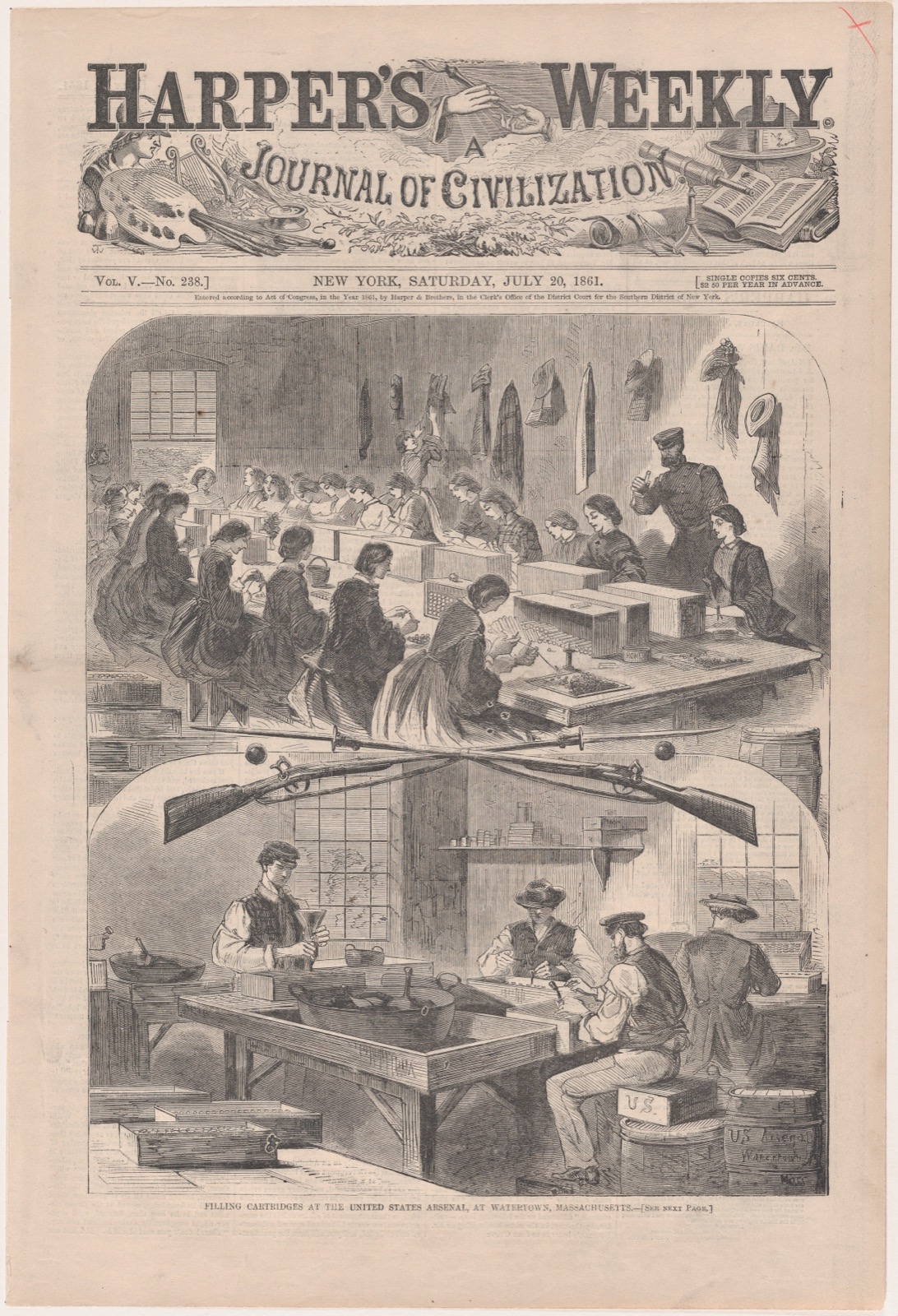
The bread rioters were the most dramatic face of a transformation happening everywhere, on both sides of the line: with the men gone, the war's enormous civilian labor fell to women, and it pushed them into work they had largely been kept out of before. They took over farm and plantation management: plowing, planting, harvesting, selling crops, running livestock. In the South this often meant a woman alone managing a plantation and its enslaved workforce as that workforce grew more and more unstable, and as enslaved people near the advancing Union lines escaped toward freedom. In both capitals, women moved into government work for the first time at real scale, taking clerkships in the U.S. Treasury and Post Office in Washington, and in the Confederate offices in Richmond, where women literally cut and signed the Confederacy's paper currency. They filled in as teachers and store clerks as the men who'd held those jobs marched off.
Some of that new work was lethal. The war's arsenals and munitions factories hired women and girls by the hundreds to assemble cartridges and ordnance (military weapons and ammunition), the fiddly, dangerous work of packing gunpowder, where small hands were prized. Two catastrophes show what that meant. On September 17, 1862 (the same day, hundreds of miles away, that the Battle of Antietam was turning a Maryland creek red) a series of explosions tore through the Allegheny Arsenal in Lawrenceville, near Pittsburgh, killing 78 workers, most of them young women and girls. It was the largest industrial disaster of the entire war, and it shared its date with the bloodiest single day of fighting. And on June 17, 1864, an explosion at the Washington Arsenal in the capital killed 21 women, most of them young Irish immigrants making cartridges; President Lincoln and Secretary Stanton attended their funeral, and the procession moved down Pennsylvania Avenue to the cemetery. These were civilians, women, killed making the ammunition the armies fired.
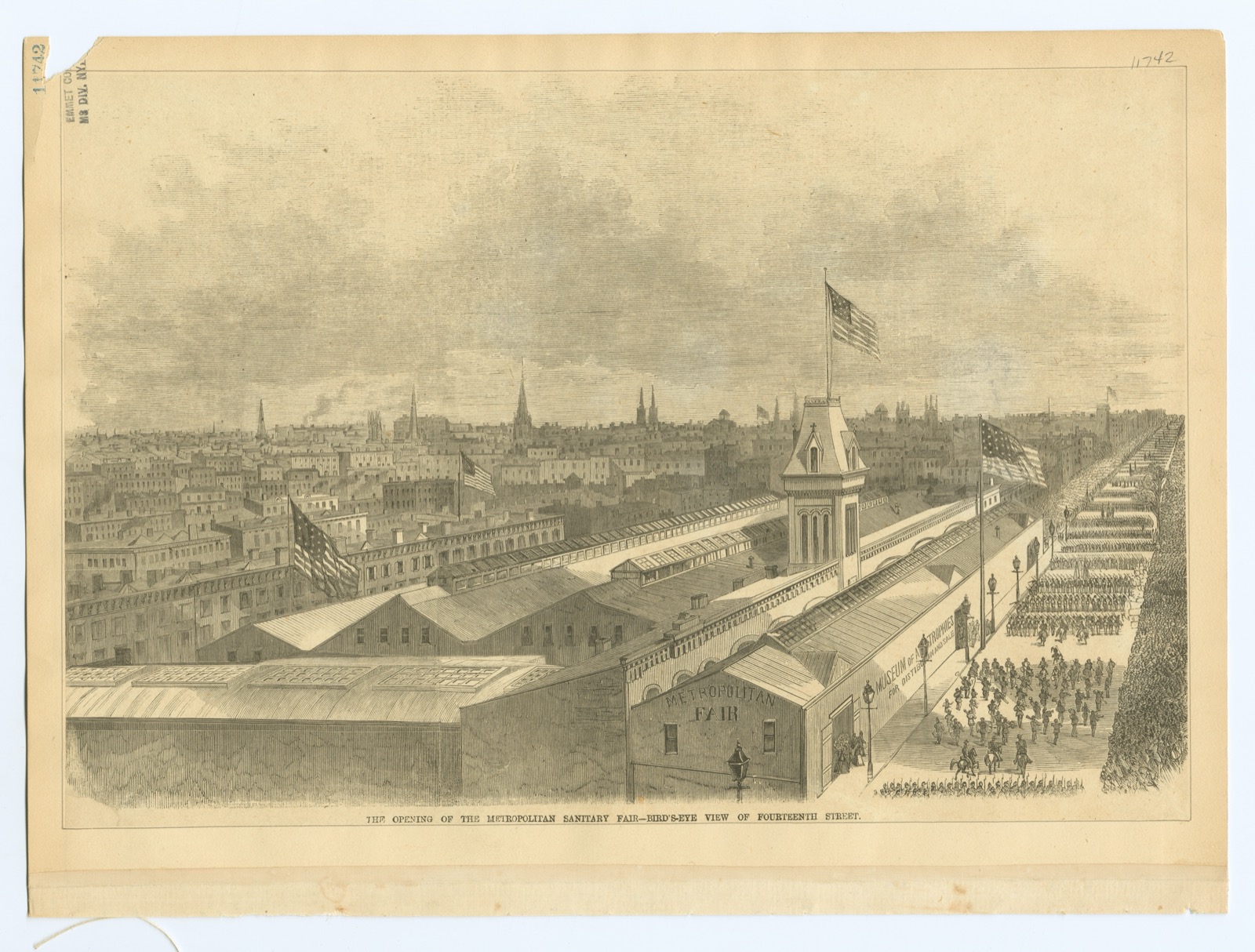
Women also built, almost from scratch, the war's civilian relief machine. In June 1861 the federal government authorized the United States Sanitary Commission, a private relief organization to look after the welfare of Union soldiers: their sanitation, food, supplies, and nursing support. Frederick Law Olmsted, on leave from designing New York's Central Park, served as its first Secretary-General. But the muscle of the Commission was a vast volunteer base of women, organized into thousands of local soldiers'-aid societies stitched together across the North; and the war's most famous nursing organizers, Dorothea Dix and Clara Barton, came out of this same surge of women into public wartime work. To fund it all, women invented the Sanitary Fair, a giant charity bazaar selling donated goods, artwork, and curiosities, with the proceeds going to the Commission. The first big one, the Northwestern Soldiers' Fair in Chicago in 1863, ran two weeks and raised about $80,000, and the idea spread into enormous fairs across Northern cities. Over the war the Sanitary Commission raised on the order of $25 million in cash and supplies, which made it the most successful relief organization of the conflict, a civilian war effort, organized and powered largely by women, operating at national scale.
The South had its women's relief network too: local Ladies' Aid Societies sewing uniforms, rolling bandages, and gathering food for the soldiers in town after town. But here, too, the contrast holds: the South's deep distrust of central authority meant those societies never combined into anything like the Sanitary Commission. They stayed local, stayed small, and could never reach the national scale the Northern women built. The same instinct, states' rights, localism, no strong center, that had shaped the Confederacy's founding now limited even its charity.
The North gets rich
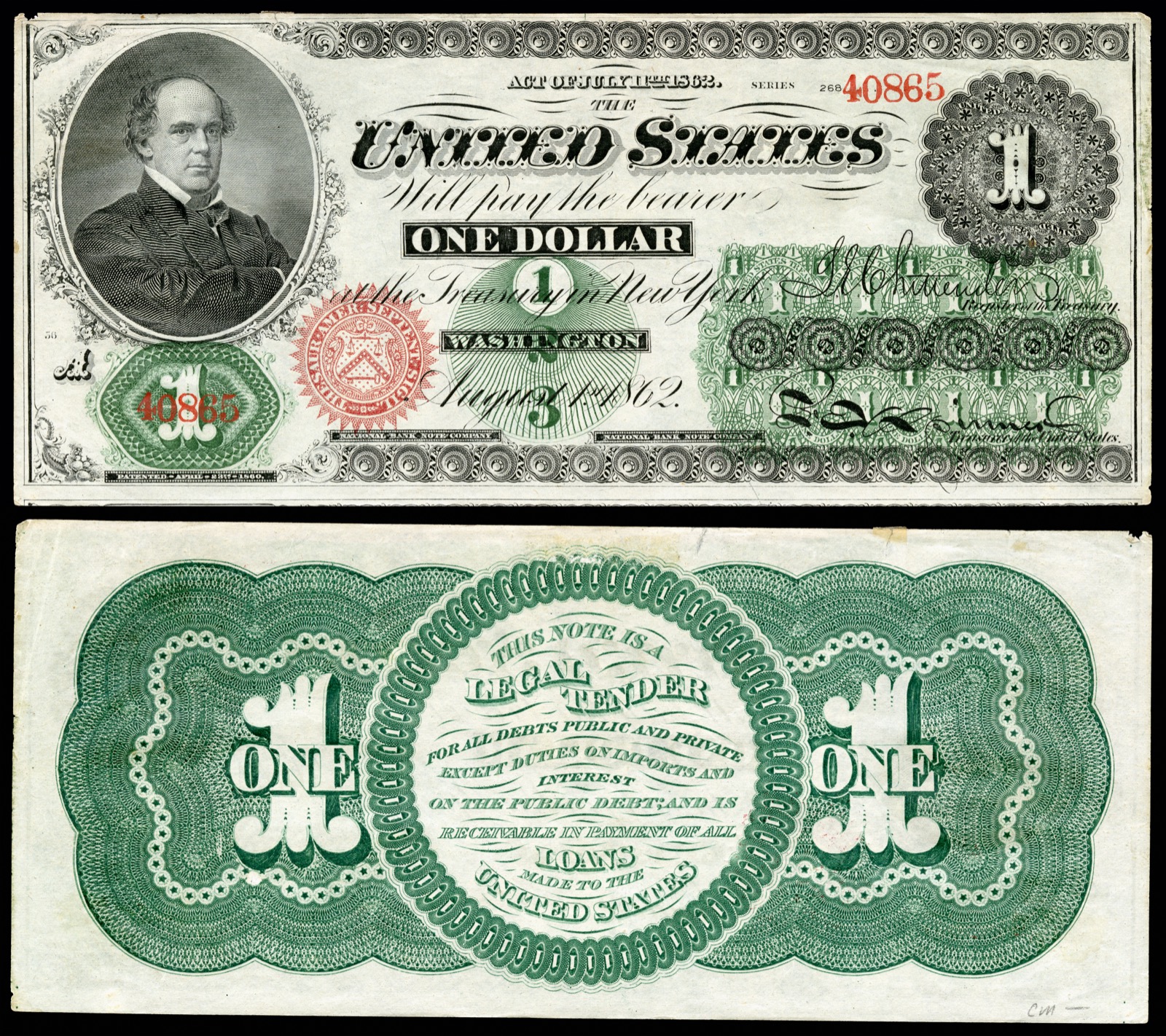
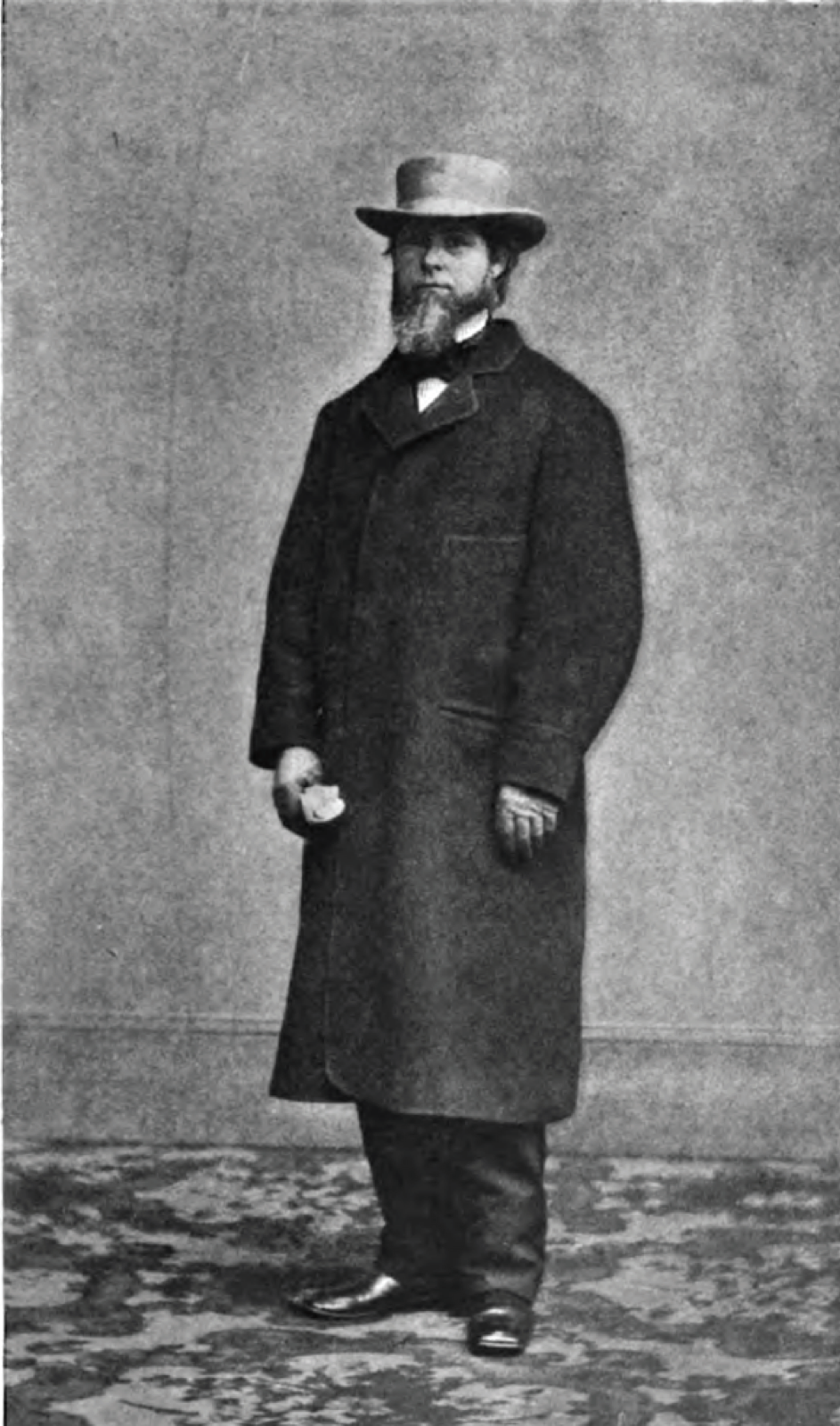
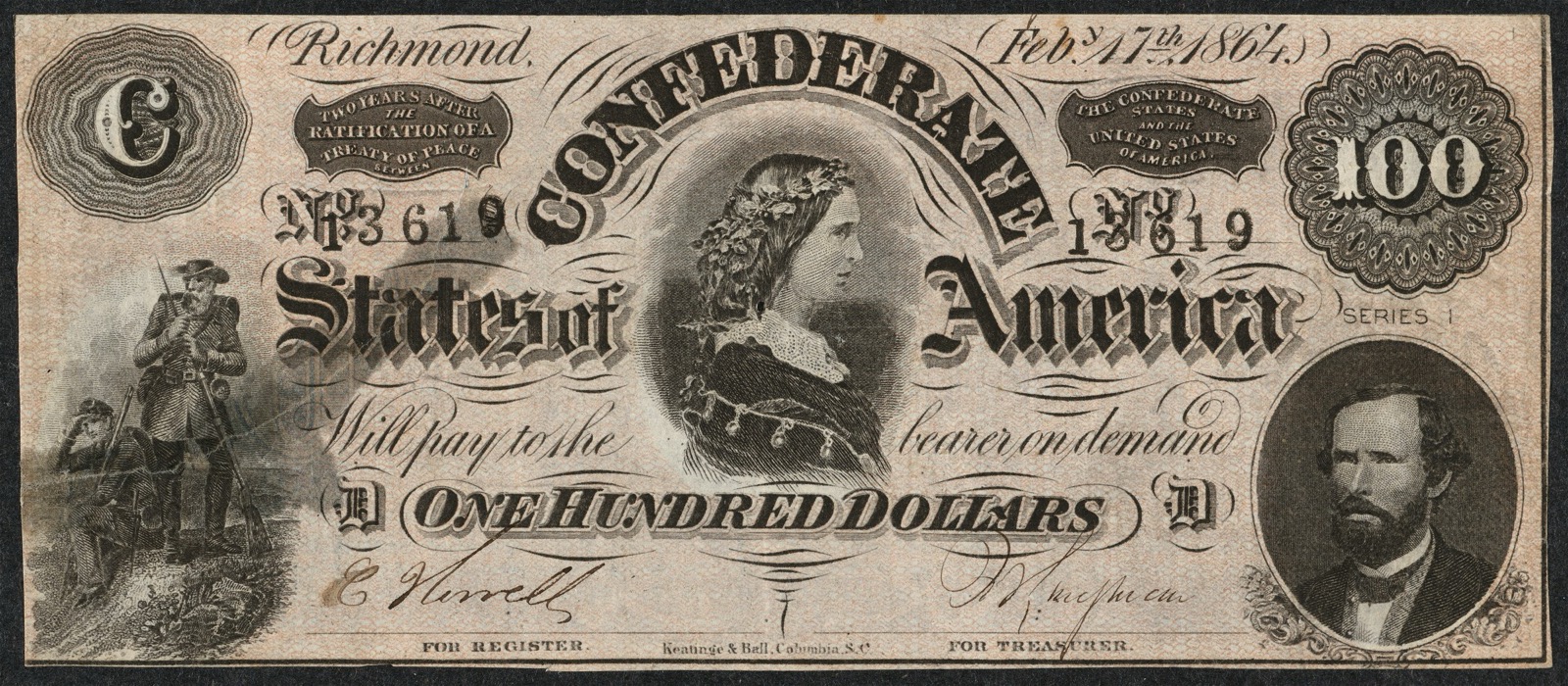
While Confederate prices rose 9,000 percent and Southern families watched their money turn to paper, the Northern economy did something almost incomprehensible from below the line: it boomed. It grew, modernized, and built the financial machinery of a modern nation, during the war, because of the war.
Part of why is who was no longer in the room. When the Southern states seceded (formally broke away from the United States), their representatives walked out of Congress, and the Republicans who remained suddenly had the votes to pass a sweeping nationalist economic program the South had blocked for a generation. In a single burst in 1862 they did it. The Homestead Act, signed May 20, 1862, offered 160 acres of public land out West to any adult head of a household who would pay a small fee and live on and improve the land for five years, opening the frontier to ordinary settlers. The Pacific Railway Act, signed July 1, 1862, authorized the first transcontinental railroad, backing the Union Pacific and Central Pacific with federal land and bonds to lay track all the way to the Pacific. A Congress with the South gone was, in the middle of a civil war, building the future of the continent.
It was also reinventing American money, out of sheer necessity. To pay for the war, Congress reached for tools the country had never used. The Revenue Act of 1861, on August 5, created the first federal income tax, a flat 3 percent on incomes over $800, the government's first attempt to tax what citizens earned. The Legal Tender Act of February 25, 1862, authorized the first national paper money: greenbacks, paper dollars (printed with green ink on the back, hence the name) that weren't backed by gold or silver in your hand but were simply declared legal tender, the officially recognized currency that everyone was required to accept as payment. The first act authorized $150 million of them; later acts pushed the total to $450 million. These were the first U.S. currency issued as legal tender, a foundational shift toward a national paper currency. To raise still more, Treasury Secretary Salmon P. Chase launched the first mass war-bond drive in American history, bonds being loans the public makes to the government, repaid later with interest, and the financier Jay Cooke, a Philadelphia banker, sold them not just to bankers but to ordinary citizens, a piece of popular salesmanship that funded much of the war. Finally, the National Banking Acts of 1863 and 1864 created a system of federally chartered national banks that had to buy government bonds to back the uniform national banknotes they issued, financing the government, building a stable national currency, and sweeping aside the chaotic patchwork of unreliable state-bank notes. It was the scaffolding of a modern national financial system, thrown up in the span of three years.
The boom had its rot, too. The Union's bottomless demand for uniforms, weapons, food, and supplies made fortunes and bred graft. Early in the war, contractors sold the army cheap uniforms that fell apart in the rain, made of reprocessed wool dust pressed into something that only looked like cloth; the word for that material was "shoddy," and it is sometimes said to have given the era its term for cheap goods and for the war-profiteering "shoddy aristocracy" who got rich off the army's contracts.
Two societies mobilized totally for the same war, and loaded its weight, on both sides, onto the people with the least: the hill-country soldier who couldn't own twenty slaves, the dockworker who couldn't find $300, the Richmond mother who couldn't buy bread. But the two home fronts came out the other side as opposites. The South printed money until it was worthless, taxed its farmers' crops out of their barns, and watched its women riot for food. The North taxed and borrowed and printed within limits, built a national currency and banking system, handed out free land and a transcontinental railroad, and came out of the war richer and more modern than it went in. One home front grew. The other starved. And that gap, as much as any battle, is why the war ended the way it did.