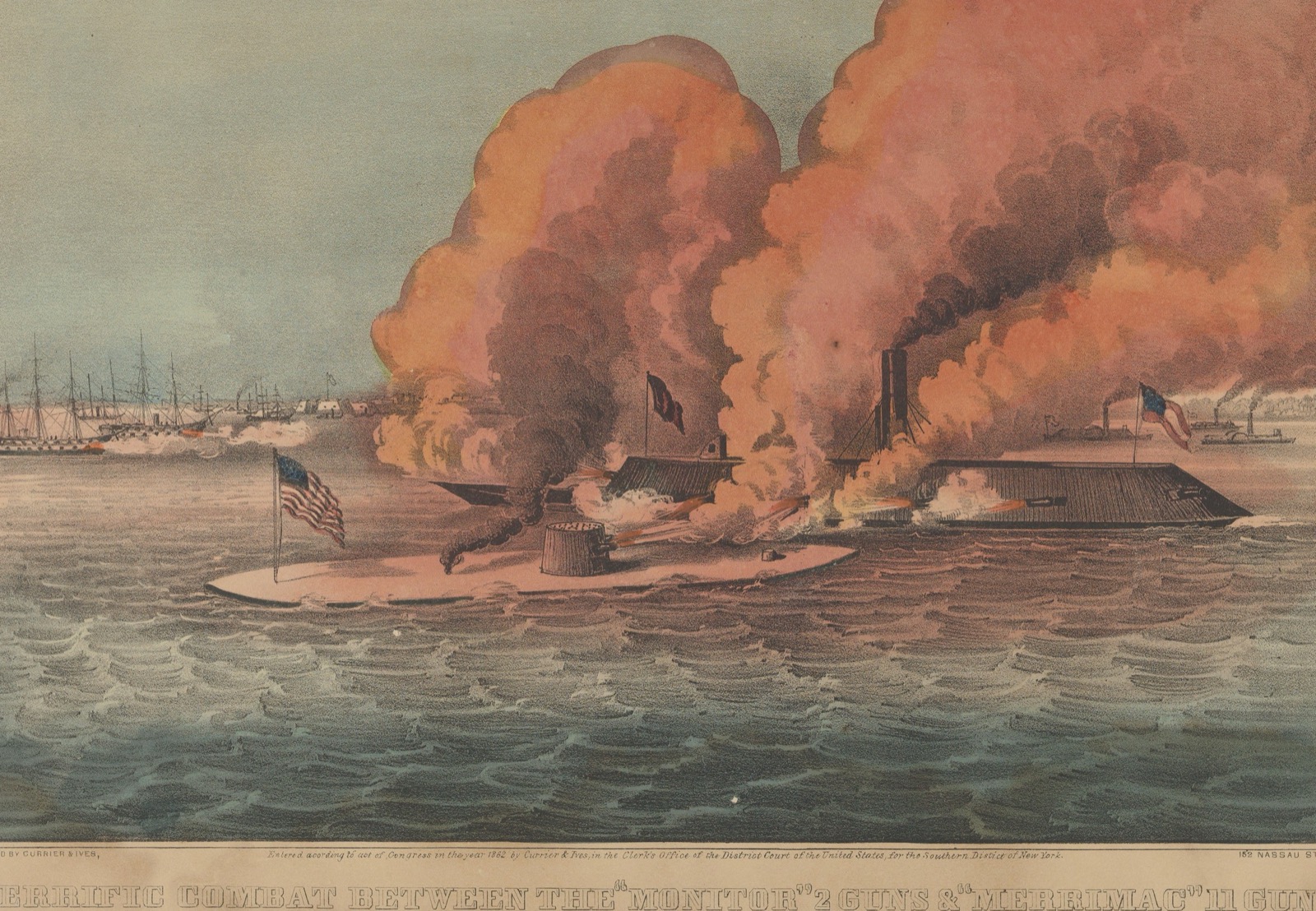
The fastest way to lose an empire is at sea, slowly, and almost nobody notices until it's too late. While the armies marched and the newspapers screamed about the next big battle on land, the Union was quietly tightening a noose around the entire Southern coastline, and the Confederacy was building a weapon meant to cut that noose with a single stroke. The noose was the blockade (a wall of warships parked outside an enemy's ports to stop anything from sailing in or out, choking off its trade by sea). The weapon was the ironclad (a wooden or iron warship sheathed in iron armor plating so that enemy cannonballs bounce off instead of punching through). And for two days in March 1862, in a wide stretch of water off Virginia, the two stories collided in a way that didn't just change the war; it instantly made every wooden warship on the planet obsolete.
The snake nobody wanted
In the spring of 1861, with the war only weeks old, the man who drew up the Union's first real plan to win it was too old and too sick to fight it himself.
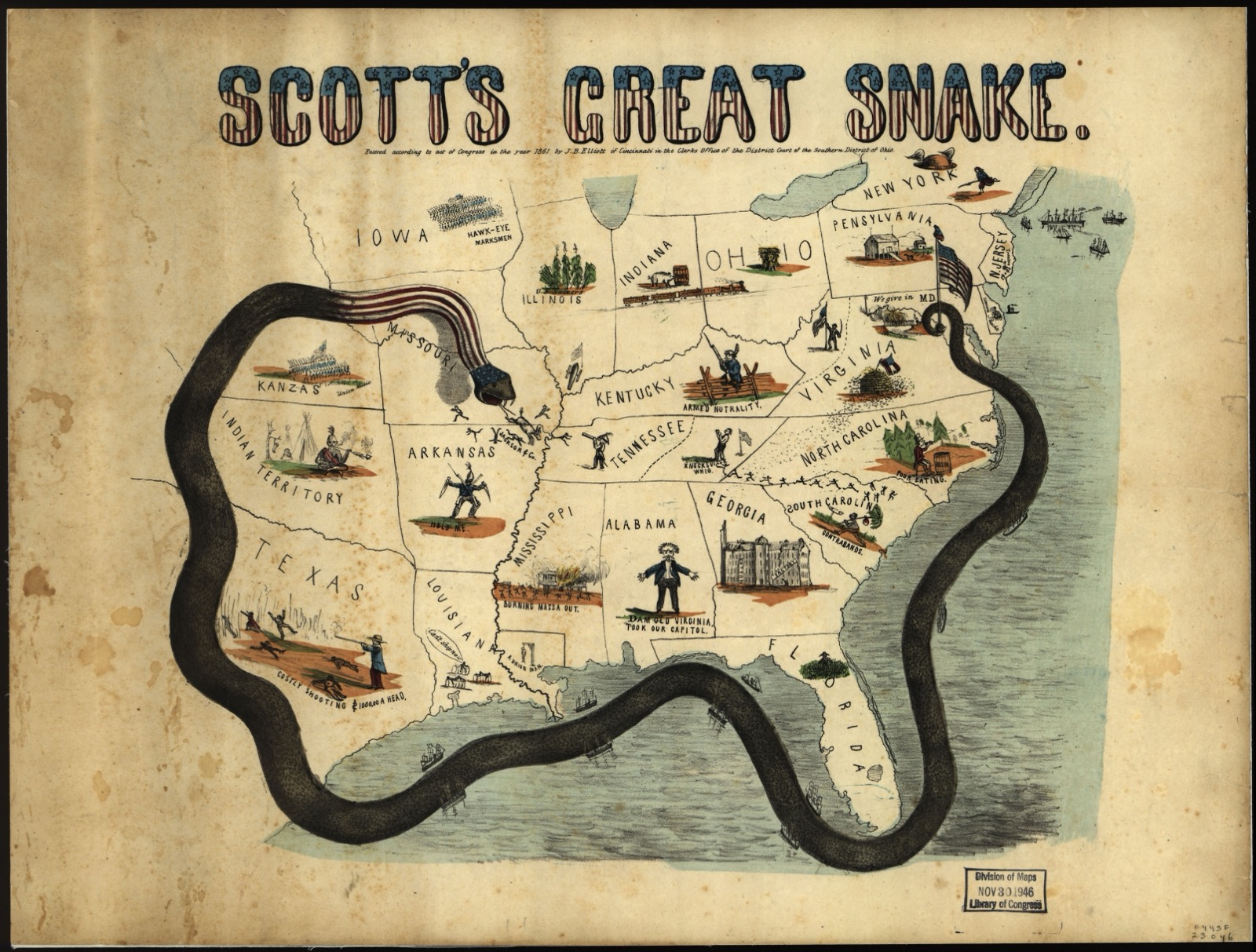
Winfield Scott was the U.S. Army's general-in-chief, its senior-most general, a hero of the War of 1812 (the last war the United States fought against Britain) and the Mexican-American War (the 1840s conflict that won the country its Southwest) who by 1861 was elderly and infirm. (He had also been the losing presidential candidate back in 1852, a man whose best days were a long way behind him.) But Scott understood something most of the hotheads around him did not. The Confederacy was vast, and you do not beat a country that big by winning one glorious battle. You beat it by strangling it.
So in a letter to Major General George B. McClellan dated May 3, 1861, with a fuller follow-up on May 21, Scott laid out a two-part strategy. First, throw a naval blockade around the Southern ports, sealing the coast so the Confederacy couldn't export its cotton and tobacco to Europe or import the weapons, gunpowder, and supplies it needed to fight. Second, send a strong column, "perhaps 80,000 men," straight down the Mississippi River to slice the Confederacy clean in two. The goal was not a knockout punch. It was suffocation: cutting the South off from the world economically and diplomatically, keeping Europe from ever recognizing them as a country, until it could no longer keep an army in the field.
The scale of the first job was almost absurd. Scott's blockade was meant to seal off at least 3,000 miles of coastline; once Virginia and North Carolina seceded and were added in, the line the Union actually had to guard ran to roughly 3,500 miles (5,600 km) of Atlantic and Gulf coast, with twelve major ports and an endless tangle of inlets, river mouths, and shallow sounds in between. Imagine trying to lock every door and window of a house the length of the entire U.S. eastern seaboard, with a navy that, as we'll see, barely existed yet.
The reaction was not gratitude. A loud faction of Union generals wanted blood now, a hard march "on to Richmond" and a quick, decisive win, and they thought Scott's slow plan was the strategy of a tired old man. They mocked it. They likened it to the coils of an anaconda, a giant constricting snake, slowly suffocating its prey. The man who first reached for that image was reportedly McClellan himself, the very general Scott had written to, before Northern newspaper editors seized on it and ran. The picture stuck so well that the name became the plan's name: the Anaconda Plan. It was meant as an insult, a sneer at a strategy too patient and passive for a public that wanted a war over by Christmas.
The sneer aged badly. The slow squeeze the critics laughed at turned out to be one of the foundations of Union victory. When David Farragut captured New Orleans in April 1862 and Ulysses Grant took Vicksburg in July 1863, the Mississippi belonged to the Union, the Confederacy was split, and the snake had done exactly what Scott said it would. Historians still argue about how decisive the seaward blockade alone was. It is a real argument, and the honest answer comes below. But the man everyone mocked had read the war correctly before almost anyone else.
A navy built from almost nothing
Here is the problem with announcing a blockade of 3,500 miles of coast: you need ships, and in 1861 the United States Navy did not have them.
President Abraham Lincoln proclaimed the blockade on April 19, 1861, about a week after the firing on Fort Sumter, declaring the ports of every seceded state from South Carolina to Texas closed; as Virginia and North Carolina left, their coasts went on the list too. It was, on paper, one of the most ambitious naval undertakings in history. And the navy assigned to carry it out had exactly 42 ships in active service, with another 48 laid up in storage and listed as "available" only once crews could be scraped together to man them. Forty-two ships to seal a coastline longer than the distance from Maine to Florida. It was, to put it mildly, not enough.
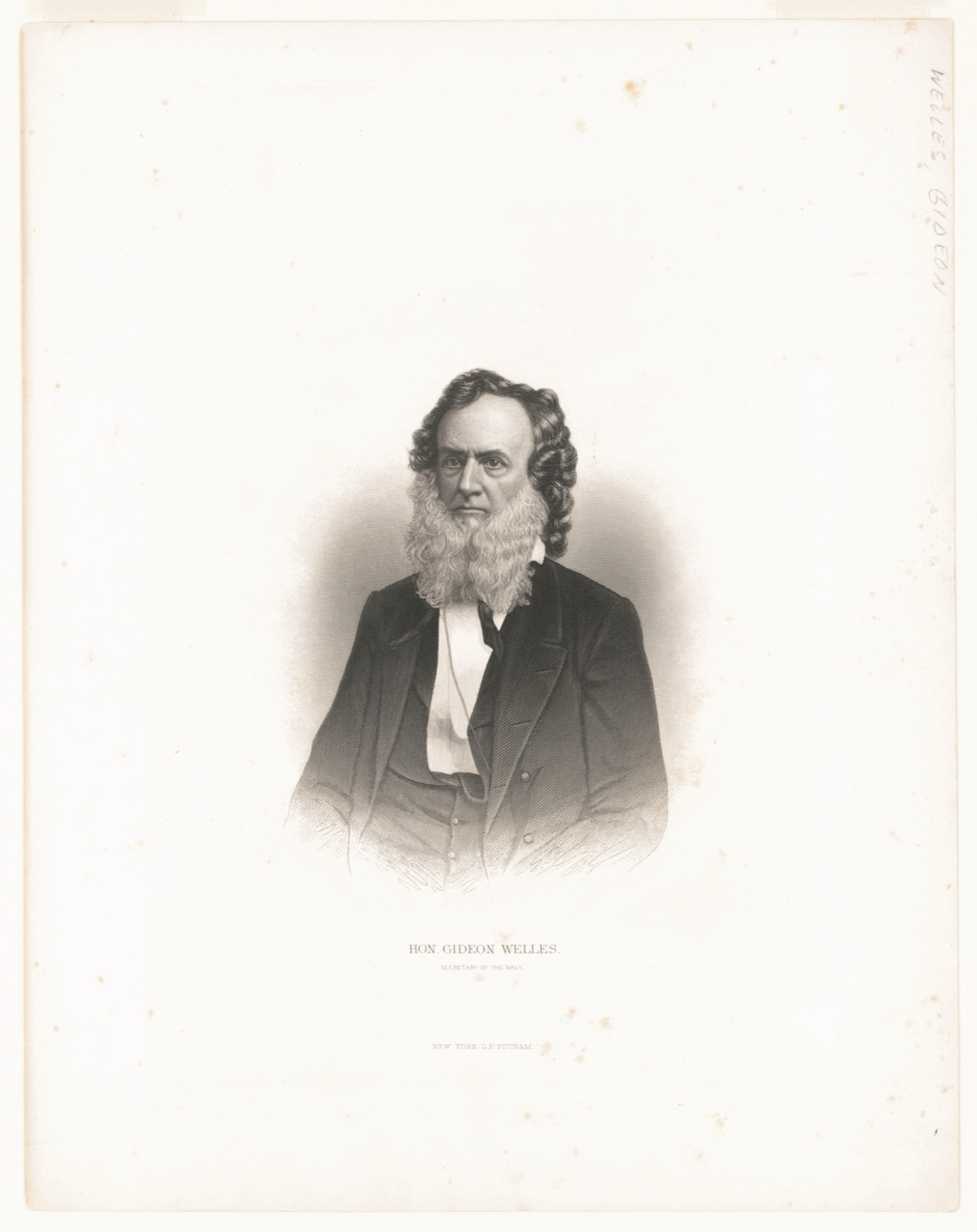
What happened next was one of the great industrial sprints of the war, and the man running it was Gideon Welles, Lincoln's Secretary of the Navy (the cabinet official in charge of the entire fleet). Under Welles, the Navy Department bought, built, and converted ships at a pace nobody had thought possible: buying up merchant steamers and harbor ferries and bolting guns to their decks, putting Northern shipyards on round-the-clock schedules to turn out warships that hadn't existed the year before. By the end of 1861 the blockading force had grown to around 160 vessels, nearly 80 steamers and about 60 sailing ships added in that first year alone. By November 1862 the navy counted 282 steamers and 102 sailing ships. By the war's end in 1865 it had about 671 ships, making the U.S. Navy the largest in the world. A force that started the war as an afterthought finished it as the planet's premier fleet, in four years flat.
To make a blockade actually enforceable, you also need places to refuel and resupply close to the coast you're watching, because a steamer that has to sail all the way home to load coal isn't guarding anything. So in 1861 the Union set up a joint army-navy commission, the Blockade Strategy Board, to figure out which Confederate ports and coastal points to seize and turn into forward coaling and supply bases. The blockade, in other words, wasn't just a wall of ships. It was a slowly built machine for keeping that wall fed and in place.
Five out of six got through (and it didn't matter)
The blockade was full of holes and worked anyway.
Early in the war the wall leaked badly. In 1861 and 1862, only about one ship in ten trying to slip past the blockade was caught. The fleet was still small, the coast was enormous, and a fast captain on a dark night had excellent odds. As the navy grew the net tightened dramatically, until by 1864 about one runner in three was being intercepted. But across the whole war, roughly five out of every six attempts to run the blockade succeeded. By that measure, the blockade was a sieve.
So why does anyone call it one of the things that won the war? Because counting individual runners is the wrong scoreboard. The point of a blockade is not to catch every ship; it's to make the trade so dangerous, so expensive, and so unreliable that the volume collapses, and on that scoreboard the blockade was devastating. Cotton was the South's economic lifeblood, its one great export, the thing it sold to the world to buy everything else. In the three years before the war the South had shipped out about 10 million bales of it. During the blockade, that fell to roughly 500,000 bales, a drop of about 95 percent. The fast little runners kept slipping through, and the Southern economy strangled anyway, because a few bold ships getting past is not the same as a functioning export trade. Over the war, about 1,500 blockade runners were captured or destroyed, but the deeper damage was the trade that simply never sailed.
By the raw catch rate, the blockade failed: most runners got through. By the economic result, the blockade succeeded enormously: Southern trade cratered. Both are true. The blockade was not a leak-proof wall; it was a slow chokehold, and a chokehold doesn't have to stop every breath to win.
And it wrecked the South's grandest strategic bet. The Confederacy had convinced itself of something it called "King Cotton," the idea that cotton was so essential to the textile mills of Britain and France that, in the South's own confident phrase, "no power on earth dares make war upon it." Cut off Europe's cotton, the theory went, and London and Paris would be forced to smash the blockade just to keep their factories running. It was a gamble that the world needed the South more than the South needed the world. The world called the bluff. Europe rode out the cotton shortage, found other suppliers, and left the blockade alone, and the great cotton weapon turned out to be a weapon the South had pointed at its own economy.
The cat-and-mouse off Nassau
The ships that beat those long odds were a breed of their own, purpose-built for one job: getting in and out without being seen.
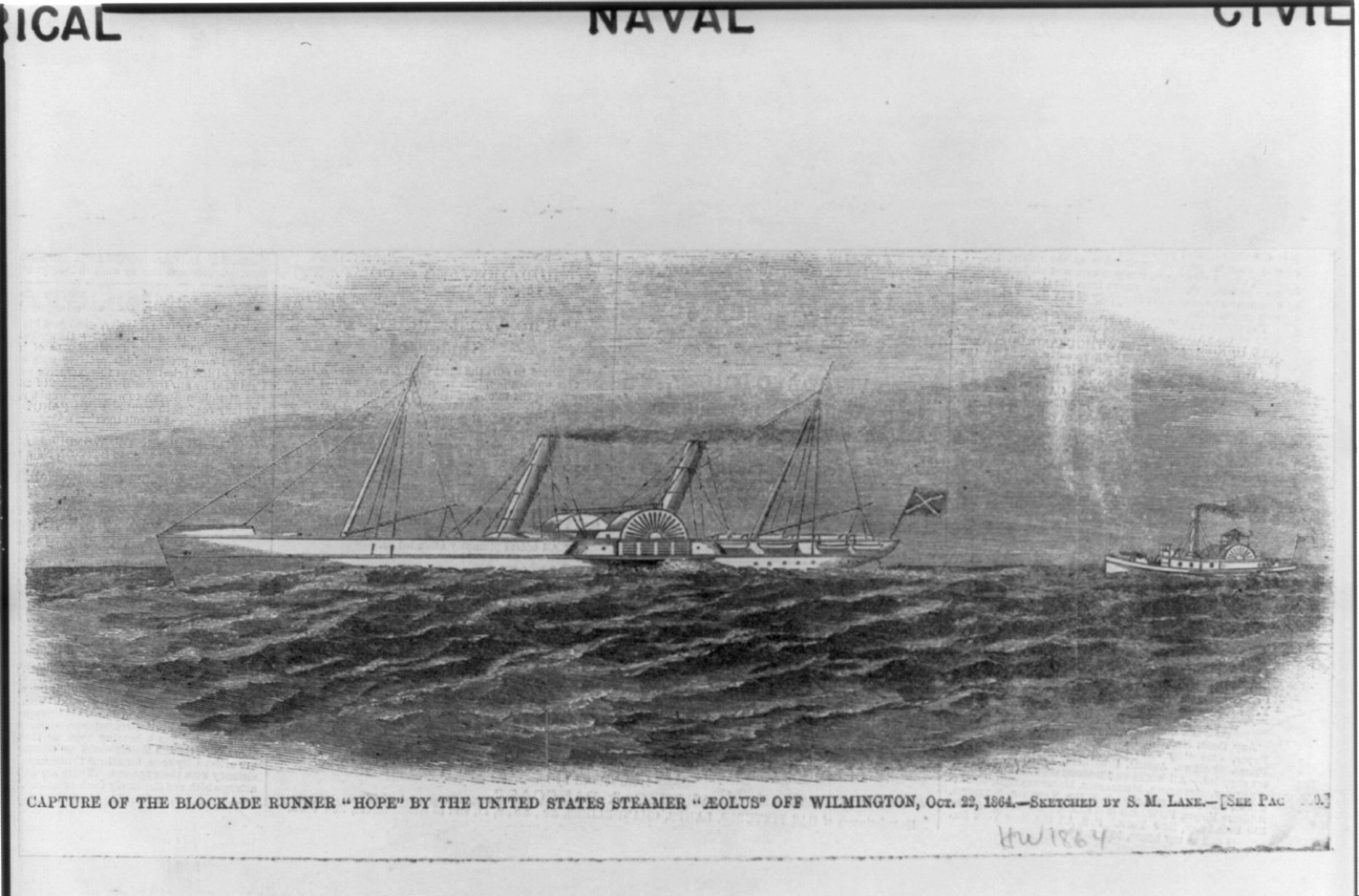
A blockade runner was typically a fast, shallow-draft steamer, draft being the depth of water a ship needs to float, so a shallow-draft vessel could skim over sandbars and slip up shallow channels that the deeper Union warships couldn't follow. Many ran 400 to 600 tons, with long, low hulls (often six to nine times as long as they were wide) to cut their profile down on the water. They had telescopic smokestacks that could be lowered to shrink the ship's silhouette against the night, dull lead-gray paint for camouflage in the dark, and they burned smokeless anthracite coal so a betraying smudge of smoke wouldn't give them away at dawn. Some could make 13 to 19 knots (a knot is a unit of speed at sea, one nautical mile per hour, so roughly 15 to 22 miles per hour), genuinely fast for the era. They were built to be ghosts. One of them, the Syren, earned the title outright, slipping through the blockade a record 33 times and getting caught not once.
The supply chain that fed them had a clever geography. The cargo, much of it bought in England, didn't sail straight into a Confederate port. It went first, in ordinary British merchant ships, to neutral way-stations in the Caribbean and Atlantic, chiefly Nassau in the Bahamas and Bermuda. There the goods were transferred to the fast little runners for the final sprint through the blockade. Nassau sat about 570 miles from the Confederate coast; Bermuda lay about 674 miles nearly due east of Wilmington, North Carolina, which became the single most important runner port, guarded by Fort Fisher, a massive Confederate coastal fortress whose guns made Wilmington the hardest harbor on the coast to seal. Charleston and Savannah were the other main destinations. The trade was enormous: by war's end, 397 ships had sailed out from the Confederacy to Nassau and 588 had run from Nassau back in.
There was a rot inside the operation, though, and it's a telling one. The runners were supposed to carry the South's cotton out and bring weapons, gunpowder, and military supplies back in. But arms and powder were heavy, bulky, and not very profitable per ton, while luxury goods, the silks and liquors and fineries a war-starved South would pay a fortune for, were light and enormously profitable. Private runner owners, chasing the bigger margin, increasingly filled their precious cargo space with luxuries instead of military supplies, which slowly compromised the whole point of the enterprise. The Confederate government tried to force the problem closed: under a "New Plan" begun in late 1863, it required every runner to reserve a third of its cargo space for the government's war supplies, and by March 1864 it had raised that share to half. But the mandates were honored where the government could lean on the trade, at Wilmington and Charleston, and largely ignored along the Gulf, widely evaded wherever owners could get away with it. The ships meant to keep the Confederate army supplied stayed partly busy keeping its parlors stocked, and even the law couldn't fully stop them.
Mallory's gamble
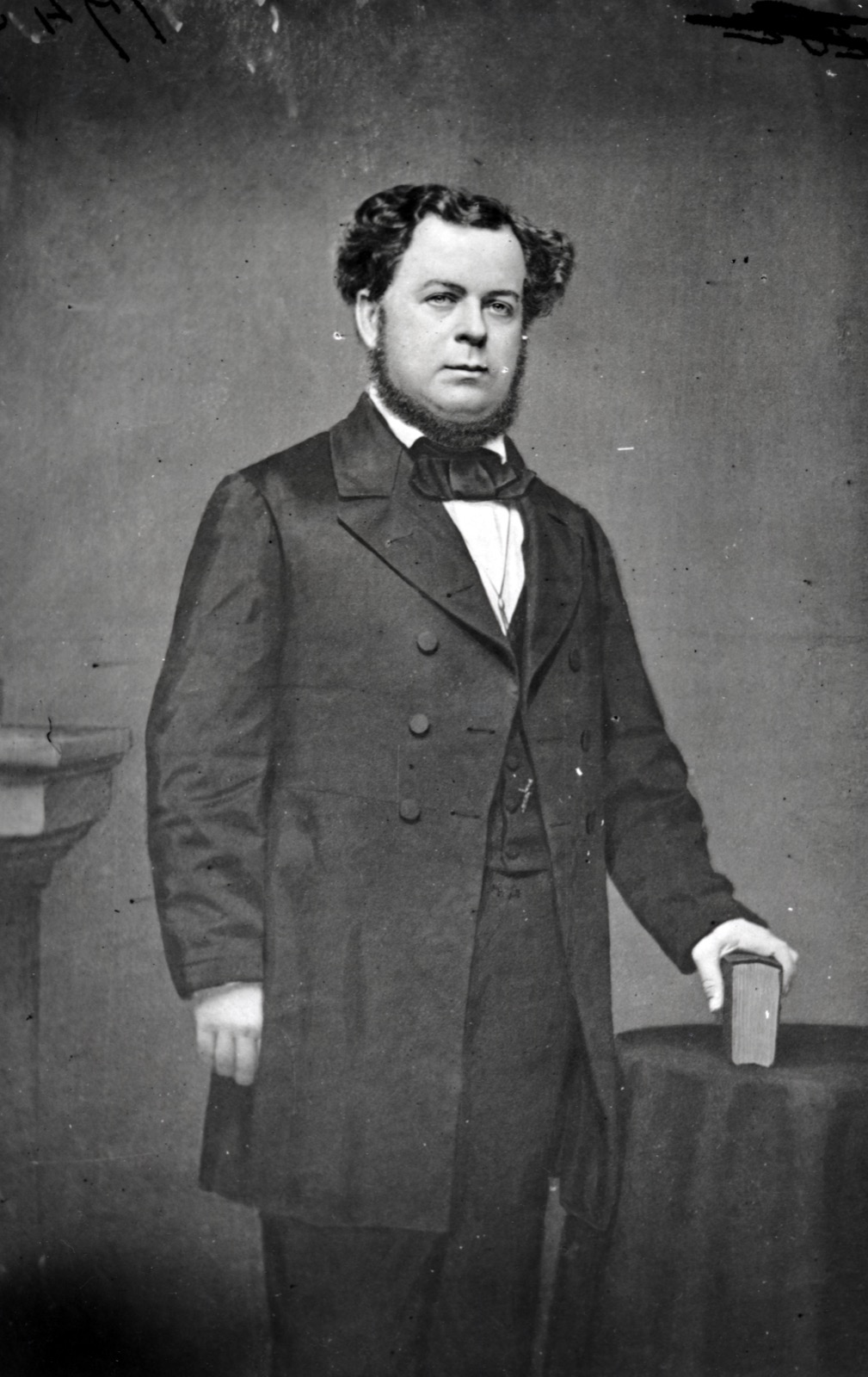
While the Union was building a fleet, the Confederacy was doing the math, and the math was hopeless. There was no way the South, with a fraction of the North's industry, could out-build the U.S. Navy ship for wooden ship. So the man in charge of the Confederate navy decided not to try. He decided to leapfrog it. Not in any abstract spirit of engineering, but to build a weapon that could break the blockade strangling the Confederacy's slave-labor economy and free its war machine to keep fighting.
Stephen Mallory, the Confederate Secretary of the Navy, bet everything on a new technology that could make numbers irrelevant: the ironclad. One iron-armored warship, he reasoned, might be worth a whole squadron of wooden ones, because the wooden ones couldn't hurt it. In the spring of 1861, weeks into the war, he put it bluntly to the Confederate Congress:
"I regard the possession of an iron-armored ship as a matter of the first necessity."
He went further, arguing that such a ship "could traverse the entire coast of the United States, prevent all blockades, and encounter, with a fair prospect of success, their entire navy." That was the dream in one sentence: a single ship that could break the Anaconda's coils all by itself and keep the cotton economy that the whole Confederacy was built to defend alive.
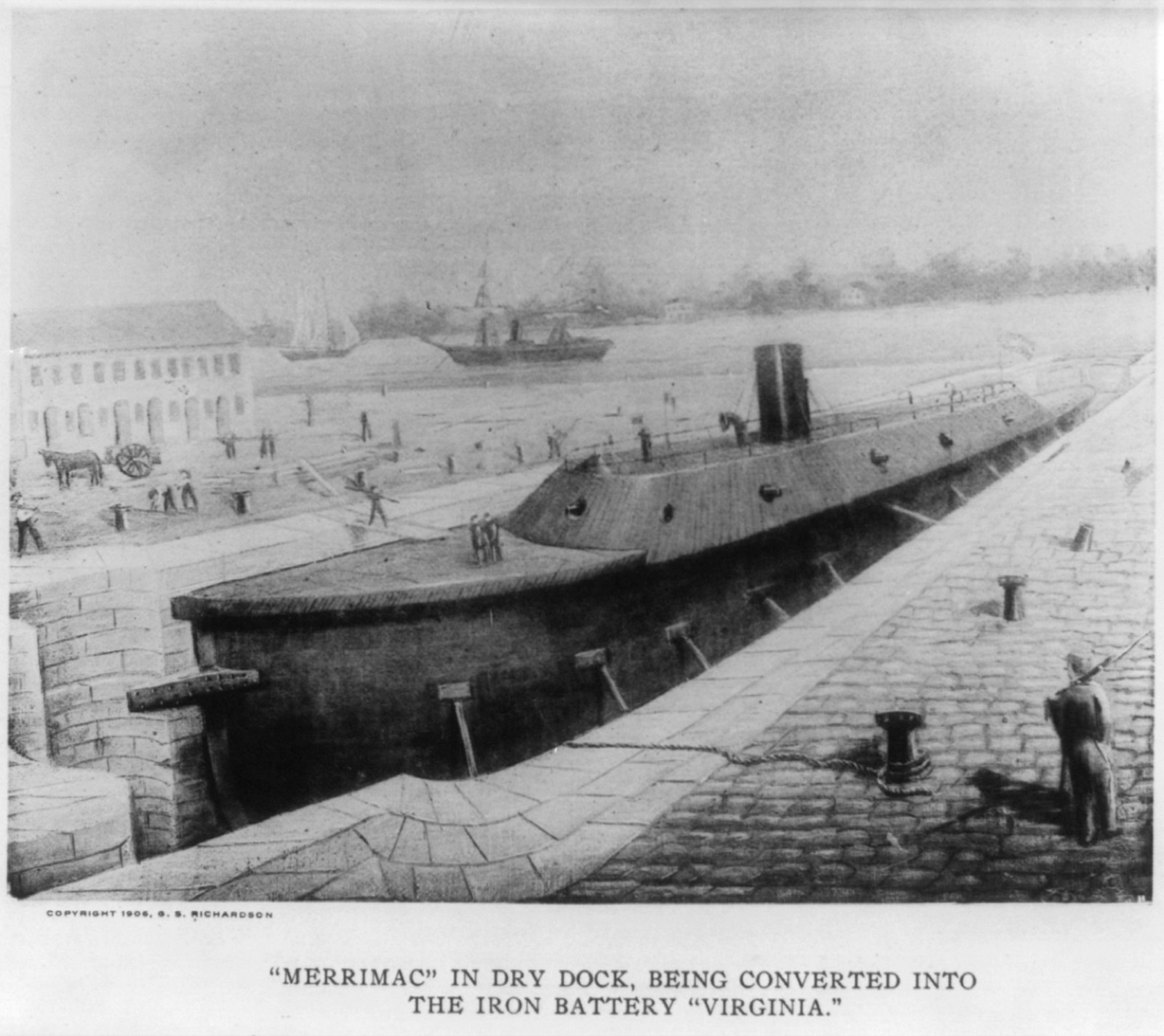
And fate had handed the Confederacy the raw material to build one. When Union forces abandoned the Gosport Navy Yard at Norfolk, Virginia, on April 20, 1861, they tried to deny its ships to the enemy by burning the steam frigate Merrimack (a frigate being one of the navy's large warships) down to the waterline and scuttling her, deliberately sinking her, in the harbor. The job was botched. The Confederates secured the yard the next day, and by May 30, 1861, they had raised the Merrimack's hull back out of the water.
Mallory ordered the salvaged hull rebuilt into his ironclad, and the result was the *CSS Virginia**. (Northerners stubbornly kept calling her the Merrimack, which is why this whole episode is so often remembered as "the Monitor and the Merrimack.") She was a casemate ironclad, a casemate being a sloped, armored box built on top of the hull, its sides angled so cannonballs would glance off, with the guns firing out through openings called gunports. Inside that box she carried ten heavy guns: six 9-inch Dahlgren smoothbores and four Brooke rifles, with two of the Dahlgrens rigged to fire heated shot. An iron ram, a reinforced beak, was fitted to her bow so she could sink wooden ships the old-fashioned way, by hitting them. Her armor was about four inches of iron (two two-inch plates) backed by roughly two feet of oak and pine. She was about 275 feet long. And she drew an enormous 21 to 22 feet of water. That deep draft made her a monster in open water but would eventually be her death sentence. The Virginia* was commissioned on February 17, 1862, a slow, ugly, low-slung iron fortress that floated. Nothing afloat could stop her, and she was about to prove it.
March 8: the worst day
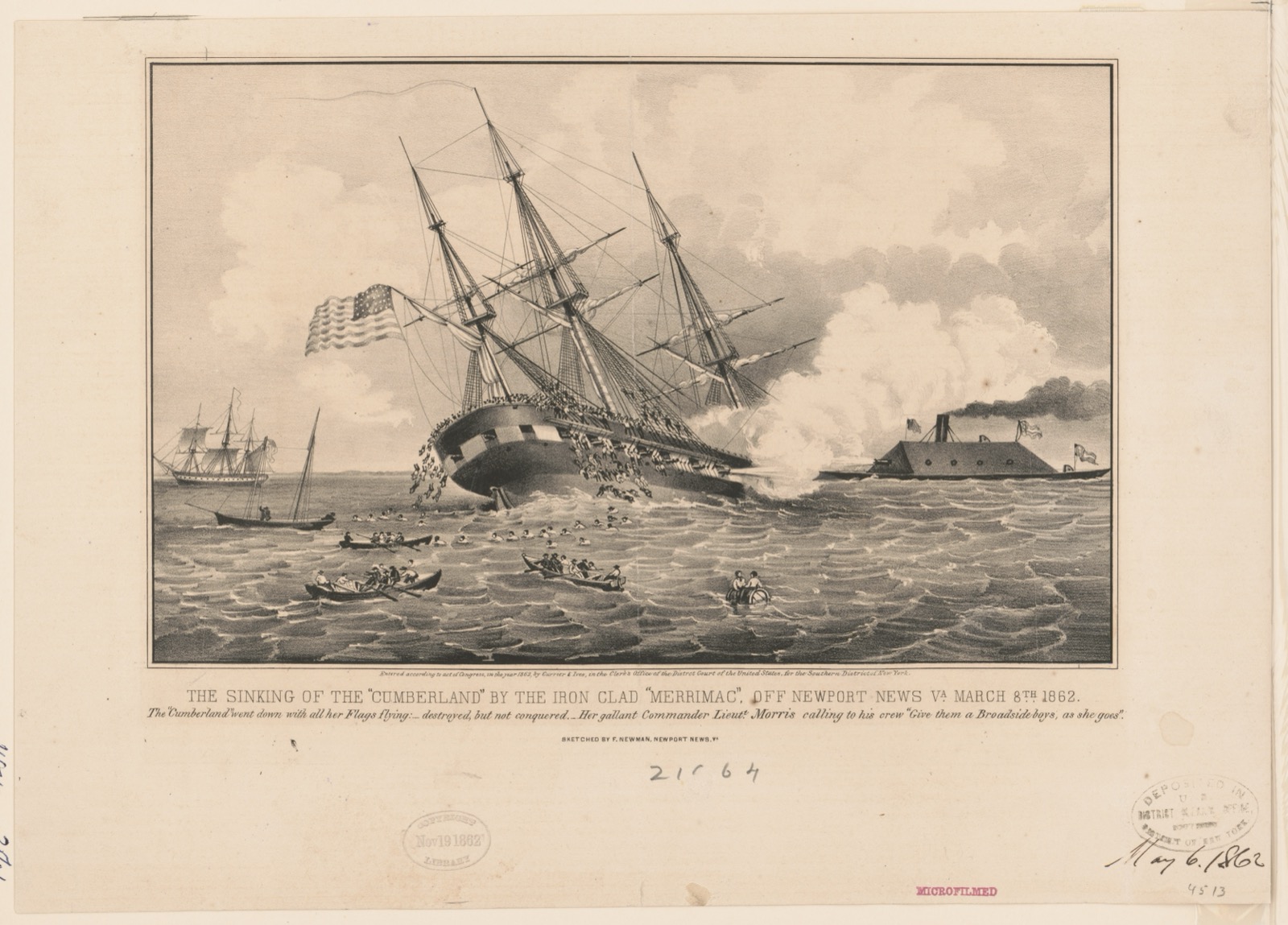
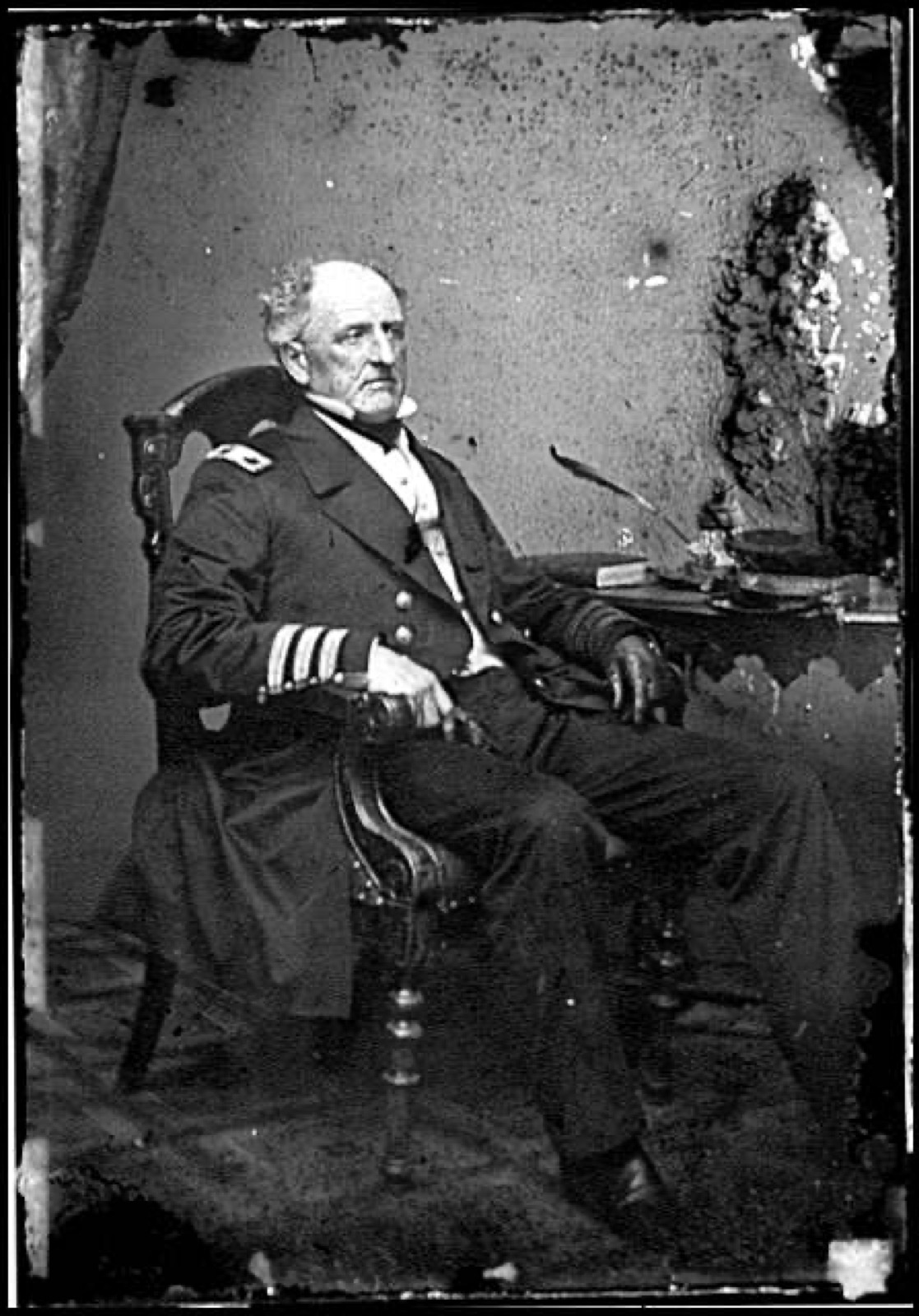
On the morning of March 8, 1862, the Virginia steamed out to fight, and the wooden navy that came out to meet her had no idea it was already obsolete.
Her destination was Hampton Roads, the wide roadstead (a sheltered body of water where ships anchor) where the James, Elizabeth, and Nansemond rivers spill into Chesapeake Bay near Norfolk. Anchored there was the wooden Union blockading squadron, and the Virginia, under Flag Officer Franklin Buchanan (a flag officer being a senior commander roughly equivalent to an admiral), went straight for it.
She went for the sailing sloop Cumberland first. The men at the Cumberland's guns did what their training told them to do: they opened up with everything they had, firing broadsides, all the guns down one side of the ship going off together in a single thunderous volley. The heaviest solid shot (plain iron cannonballs, the most powerful rounds a wooden warship could throw) slammed into the Virginia at point-blank range. And they watched the shot strike that sloped iron flank and simply fall away, skipping off into the water like stones off a roof. They reloaded. They fired again. Nothing. The smoke cleared and the iron ship was still coming, unmarked, unbothered, growing in the gunports. Whatever every man aboard had been taught about how a sea fight worked had just stopped being true in front of his eyes, and the Virginia had not even reached them yet. Then she did. She drove her iron beak straight into the Cumberland's forward starboard bow, tearing a hole the witnesses compared to a wagon, and the sea poured in. The Cumberland went down still firing, her gun crews working the cannon as the water climbed the deck, men dragged under at their posts. About 121 of her crew drowned with her; counting the wounded, her losses came to nearly 150 out of the roughly 376 aboard. They had fought as bravely as men can fight, and their weapons had never had a chance.
The Virginia turned next on the frigate Congress. For about an hour she pounded her at close range, a wholly one-sided fight, the Congress answering with broadsides that did nothing, until her decks were a slaughterhouse and she struck her colors and surrendered. What happened next was the day's ugliest moment. As Union small boats pulled out to take off the wounded and the survivors, Confederate fire from the shore drove them back from the burning ship; Buchanan, reportedly enraged at the Union resistance, climbed up onto his own exposed deck to fire back and was struck in the left thigh by a rifle bullet. The Congress was finished off with hot shot (deliberately heated cannonballs meant to set fires) and burned to the waterline through the night, men trapped aboard a ship nobody could safely reach. She lost around 110 killed, missing, or presumed drowned, plus 26 wounded, ten of whom died within days, out of about 434 aboard. More than a quarter of her crew killed in a single afternoon. Command of the Virginia, with Buchanan down, passed to his executive officer (his second-in-command), Lieutenant Catesby ap Roger Jones, who would have to fight whatever tomorrow brought.
The numbers from that one day are staggering, and they're worth stating plainly because they measure a true catastrophe. Across the two-day battle the Federal navy lost 261 killed and 108 wounded, most of it on March 8, more than in any sea battle in American history up to that point. The Virginia lost two men killed and a handful wounded. March 8, 1862 would stand as the bloodiest day in U.S. naval history until December 7, 1941, the attack on Pearl Harbor, nearly eighty years later.
But the body count, terrible as it was, isn't really the point. The point is what the survivors understood by sundown. They had watched their solid shot bounce off an enemy ship. They had watched two powerful wooden warships, the pride of the navy, get rammed and burned by a single iron box that shrugged off everything they threw at it. In one afternoon, the Virginia had demonstrated that every wooden warship on Earth, every fleet of every navy in the world, was now junk, confirming a fear the great European navies had already begun to whisper among themselves. And there was every reason to think tomorrow would be worse: the steam frigate Minnesota, another of the navy's big wooden warships, had run aground trying to escape and sat helpless in the shallows, plainly the Virginia's next meal come morning. The most powerful navy on the continent had just had its worst day ever, and it was about to get a stranger one.
A cheesebox on a raft
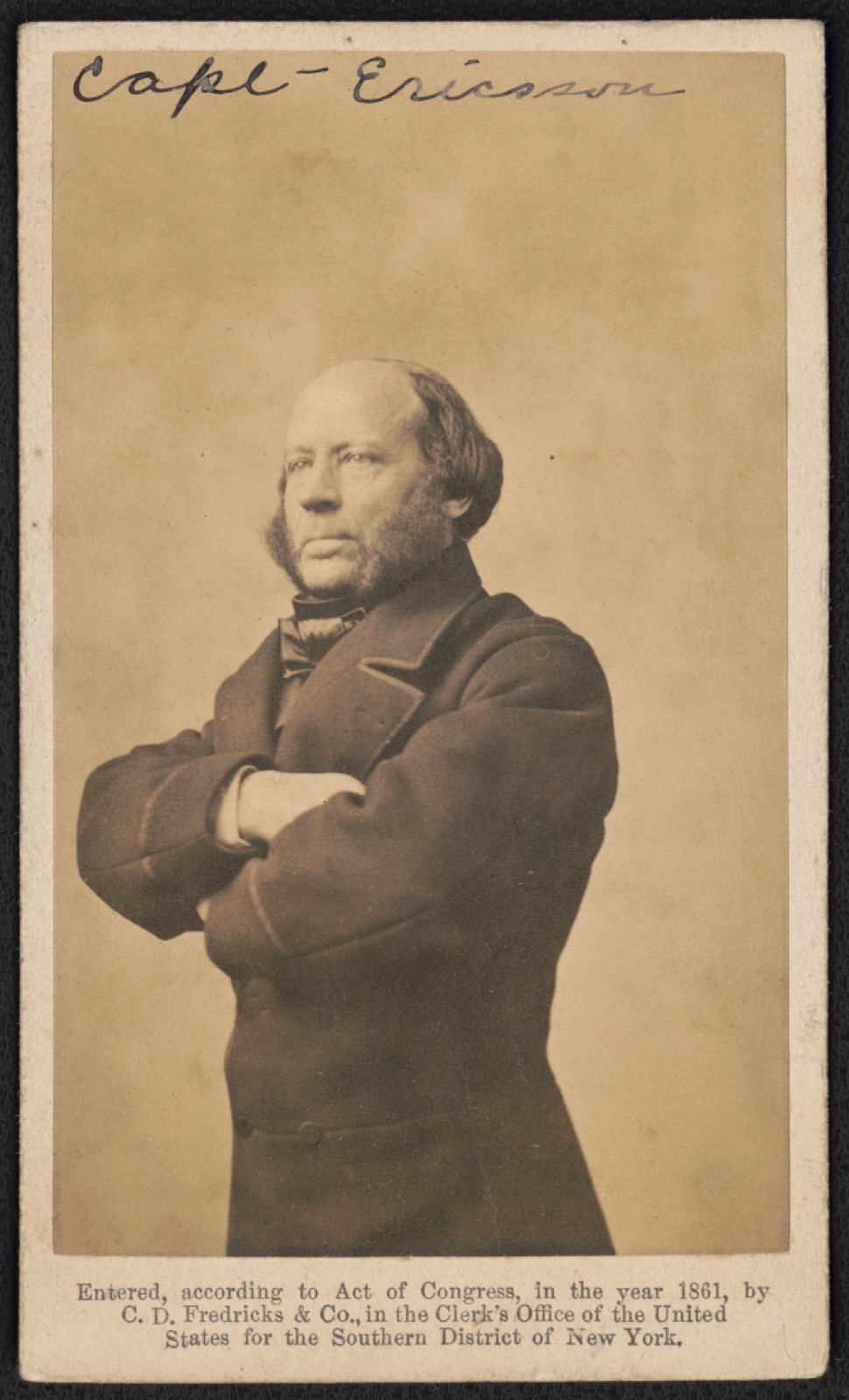
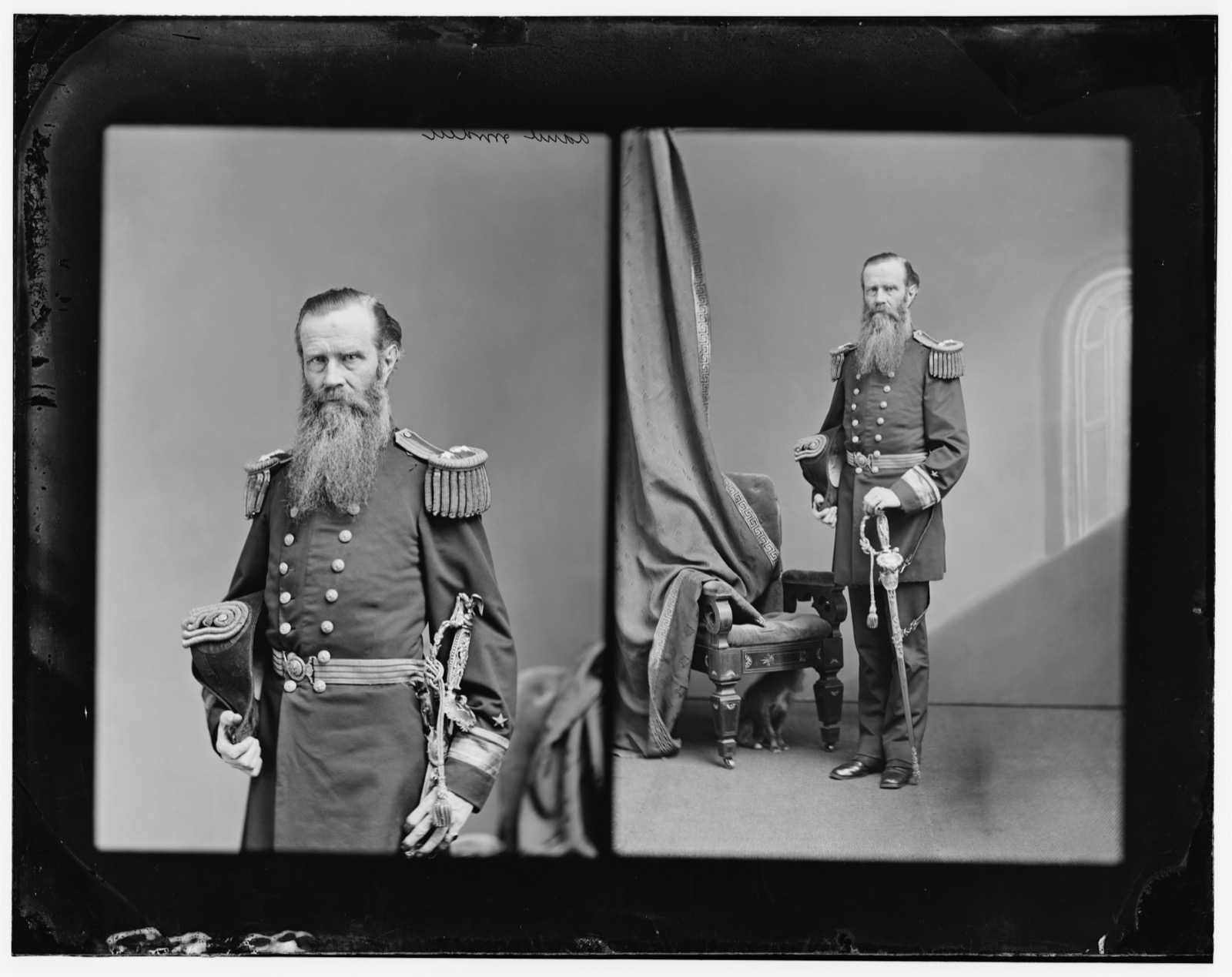
What saved the Minnesota, and arguably the blockade, came chugging into Hampton Roads that same night, and it looked like nothing anyone had ever seen.
It was the *USS Monitor**, and to call it a ship is almost generous. It was the brainchild of John Ericsson, a Swedish-born engineer with a radical idea. Where the Virginia was a tall armored box, Ericsson's design rode almost completely flat, nearly the entire hull sitting at or just above the waterline, so there was almost nothing for an enemy to hit. And instead of a row of fixed guns firing out through ports, the Monitor* carried her two guns inside a single revolving armored turret, a rotating drum, about 20 feet across and 9 feet high, walled in eight inches of iron, that could spin to aim in any direction without turning the whole ship. The guns inside were two 11-inch Dahlgren smoothbore cannon (smoothbore meaning the barrel had no internal grooves, powerful but shorter-ranged than the spiral-cut "rifled" guns coming into use). The look of the thing, a flat raft with one round drum sitting on top, earned it an instantly famous nickname:
"a cheesebox on a raft"
The design was so packed with new ideas that it reportedly held 40 patentable inventions. It also got built at a speed that matched the Virginia's urgency: the contract was issued on October 4, 1861, demanding completion in 100 days, and she was launched at the Continental Iron Works in Greenpoint, Brooklyn, on January 30, 1862, built in roughly a hundred days flat. Even Lincoln, shown the strange turret design, was reportedly intrigued enough to push it forward over the doubts of his own naval board.
She was towed down from New York and arrived in Hampton Roads on the very night of March 8, hours after the Virginia's rampage. To the exhausted sailors on the grounded Minnesota, who had spent the day watching the wooden navy die and fully expected to be killed at first light, the thing that appeared out of the dark must have looked less like rescue than like a hallucination: a low black raft with a barrel on it, riding so flat it was nearly invisible, nothing like a warship at all. Whatever they made of it, it placed itself squarely between the wrecked, grounded Minnesota and the iron monster that meant to finish her. Her commander was Lieutenant John Worden. When the sun came up, the world's first battle between ironclads was about to begin.
March 9: the duel that changed everything
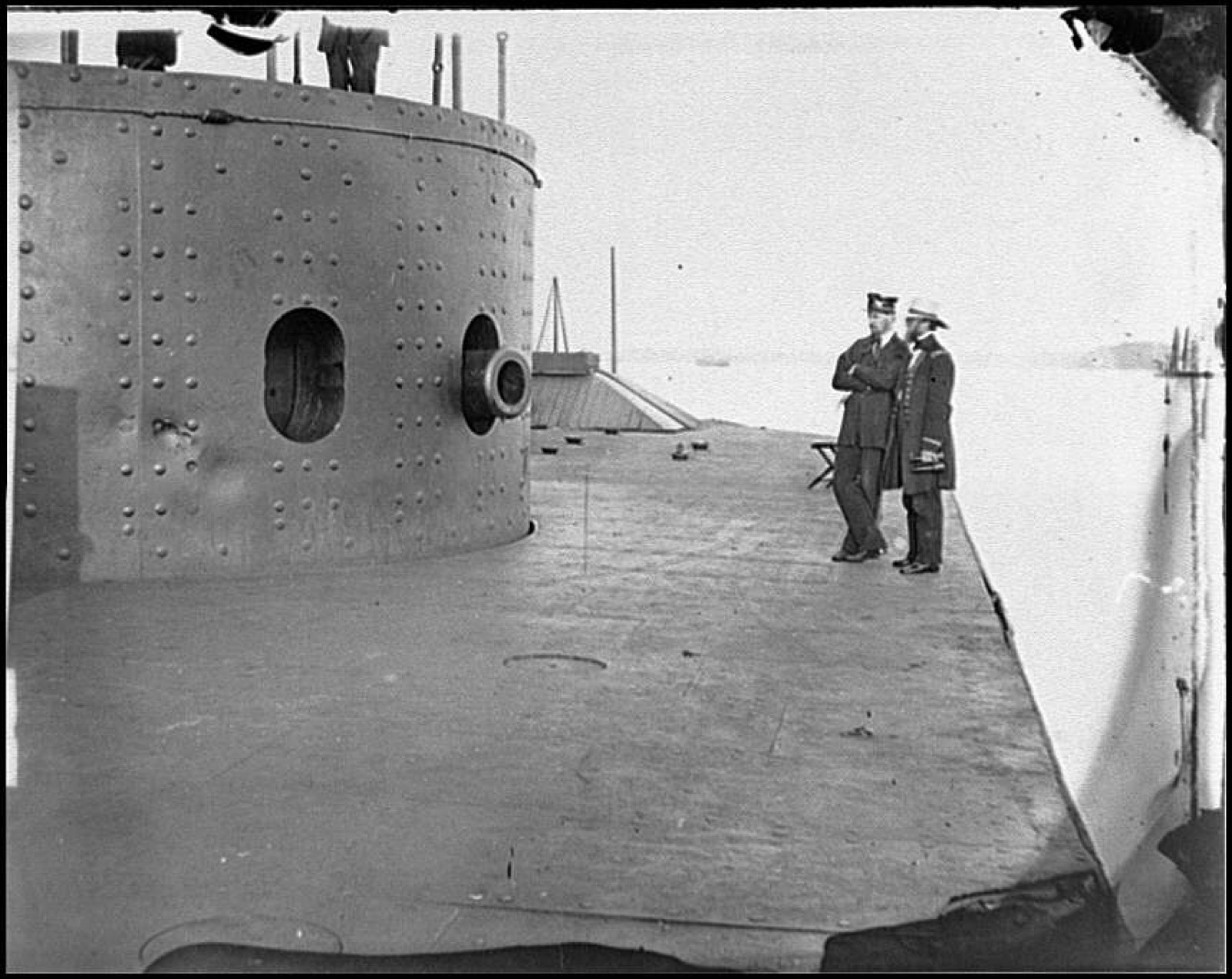
On the morning of March 9, 1862, the Virginia, now under Lieutenant Jones, came back out to finish off the helpless Minnesota, and found the strange little raft waiting for her instead.
What followed had never happened before in human history, and neither captain had a rulebook for it: two ironclads, fighting each other, both crews improvising a kind of war that did not exist when they had woken up the day before. The first shots told the story of the whole morning. The Virginia's broadside crashed into the Monitor; inside that iron turret, where the noise of an 11-inch shell striking the wall was a physical blow that staggered men off their feet and rang in their skulls, the gunners picked themselves up and found the armor had held. So had the Virginia's. The two ships spent three to four hours at point-blank range, sometimes almost touching, hammering each other with the heaviest guns afloat, and the shot kept doing what it had done to the Cumberland the day before. Bouncing, skipping, falling away. Except now it happened both ways, iron against iron, and neither ship could land a killing blow. They circled in the smoke. The Virginia tried to ram the little raft and only shoved her aside. Both ran aground and worked themselves free. The men inside two iron shells fought blind through gunsmoke and deafening noise, firing at a thing they could barely hurt, and slowly the impossible truth of the new age settled over the water: the weapons had finally met armor they could not beat.
The closest thing to a decisive moment came late, and it nearly cost the Union its captain. A shell from the Virginia struck the Monitor's pilothouse, the small armored box from which Worden steered and watched the fight, and exploded against the viewing slits, driving paint and iron fragments into Worden's eyes and temporarily blinding him. He turned command over to his executive officer, Lieutenant Samuel Dana Greene, and the Monitor sheered off (turned away from the fight) briefly before the two ships eventually broke off the battle on their own.
A draw, then. But here is why a draw was, for the Union, a quiet victory. The Monitor had checked the Virginia. The Virginia withdrew. The grounded Minnesota was saved. And the Union blockading fleet at Hampton Roads, which had looked doomed the night before, was preserved. The Confederacy's wonder-weapon, the ship Mallory had hoped could "prevent all blockades," had been fought to a standstill and had broken nothing. The Anaconda's coils held.
And the larger meaning dwarfed the local one. Two iron ships had just spent a morning proving they could shrug off each other's fire, and the whole world was watching. In two days, March 8 had shown that ironclads destroy wooden ships, and March 9 had shown that only an ironclad can fight an ironclad. The age of the wooden warship, every sail-of-the-line and broadside frigate that had ruled the seas for centuries, ended in that stretch of Virginia water. Every navy on Earth now knew, beyond argument, what some had only suspected. The future was iron.
Both ships gone by Christmas
For two vessels that changed naval history forever, the Virginia and the Monitor had astonishingly short lives. Neither survived the year.
The Virginia was killed by her own greatest strength. That deep 22-foot draft, which had made her unstoppable in Hampton Roads, meant she couldn't run for safety up the shallow James River when Union forces advanced and the Confederates abandoned Norfolk in May 1862. She was too deep to escape inland and too valuable to surrender, so rather than let her be captured, Flag Officer Josiah Tattnall III ordered her destroyed. She was scuttled and blown up on May 11, 1862, near Craney Island. The ship that had terrified the entire U.S. Navy had been afloat as a warship for under three months.
The Monitor died of her other great strength. The near-flush deck that made her so hard to hit also made her dangerously unseaworthy in open ocean, with almost no hull riding above the waves to keep the water out. Under tow off Cape Hatteras, North Carolina, she foundered in a storm and sank on December 31, 1862, taking 16 of her crew down with her. The cheesebox on a raft turned out to be a poor raft. (Her wreck was located off Hatteras in August 1973 and positively identified the following year; the turret, raised in 2002, is now conserved at The Mariners' Museum in Newport News.)
But the idea they introduced did not sink with them. Hampton Roads had been watched by every naval power on Earth, and it confirmed what some in Europe already suspected, that armored, steam-powered, turreted warships had made the old wooden fleets obsolete overnight. It poured fuel on an ironclad arms race already smoldering across the Atlantic, where Britain had built the iron warship Warrior and France the Gloire. The Monitor's name even became a category: the U.S. and other navies built whole classes of low, turreted warships and called them "monitors." The two ugly, short-lived ships that fought to a draw off Virginia had ended one age of naval warfare and begun another.
And it bears repeating that Hampton Roads was only the most dramatic face of the revolution, not the only one. Far to the west, on the muddy rivers that mattered just as much to the war, a St. Louis industrialist named James Eads was building a fleet of shallow-draft ironclad gunboats, the City-class, designed by naval constructor Samuel Pook and nicknamed "Pook's Turtles" for their humped, awkward look. Eads won the contract at $89,600 a vessel to build seven of them, and all seven were delivered by late January 1862. These river turtles would prove decisive on the Mississippi and its tributaries, and one of them, the Cairo, earned a grim first of its own, becoming the first ship ever sunk by a remotely, electrically detonated naval mine, in December 1862 on the Yazoo River, with no lives lost. By the end of 1862, the war at sea and on the water was iron all the way down.