Picture two men, two cities, six weeks apart.
On a February afternoon in Montgomery, Alabama, a gray-bearded planter named Jefferson Davis climbs the steps of a wide-columned statehouse, lays his hand on a Bible, and swears to defend a country that is two weeks old and does not yet have an agreed-upon name. Six hundred-some miles north, on a raw March day in Washington, a tall, awkward lawyer from Illinois named Abraham Lincoln takes the same kind of oath on the steps of the United States Capitol, beneath a dome that is literally half-built, ringed in iron scaffolding and a construction crane, an unfinished symbol of an unfinished nation. Two oaths. Two crowds. Two flags going up the pole. Two men, in the same season, each swearing to govern the same stretch of North American ground.
For a few strange months in 1861, the United States had two governments, and for a while, before the shooting that would decide it, the question of which one was real had no answer. It was a slow-motion divorce in which both parties insisted they were the rightful owner of the house.
Seven states were already gone when 1861 began: South Carolina out first in December 1860, then Mississippi, Florida, Alabama, Georgia, Louisiana, and Texas, all gone by the first of February. What those seven states actually built once they had walked out is the story that starts here. Because secession (the legal term these states used for formally quitting the United States) is just leaving. A government is a thing you have to make.
And here is the part the comfortable version of this story has spent a century and a half trying to forget. We have, sitting in the archives, the documents the secessionists wrote in their own hands, in their own time, to explain to the world exactly what they were doing and why. They were not shy about it. They were proud of it. They put it in their speeches, in their declarations, and, most damningly of all, in their constitution. And when you read what they actually said, the polite later euphemism about "states' rights" falls apart in your hands. The men who built the second American government told you, at length and on the record, what the right in question was.
The Government in Montgomery
On February 4, 1861, while the cold still held, delegates from six of the seceded states gathered in Montgomery, Alabama, the cotton-trading town that would be, for the next few months, the capital of a country that did not yet have a name. (Texas, which had voted itself out only three days earlier, sent its men along shortly after.) They had come to do something no group of Americans had attempted since 1787: to invent a national government from scratch, fast, under pressure, with war very possibly weeks away.
They moved with startling speed. Within four days, on February 8, they had adopted a provisional constitution (a temporary founding charter, meant to hold the new nation together until a permanent one could be written). The next day, February 9, they chose a provisional president (temporary, until proper elections could be organized). The vote was unanimous, and the man they picked was not in the room.
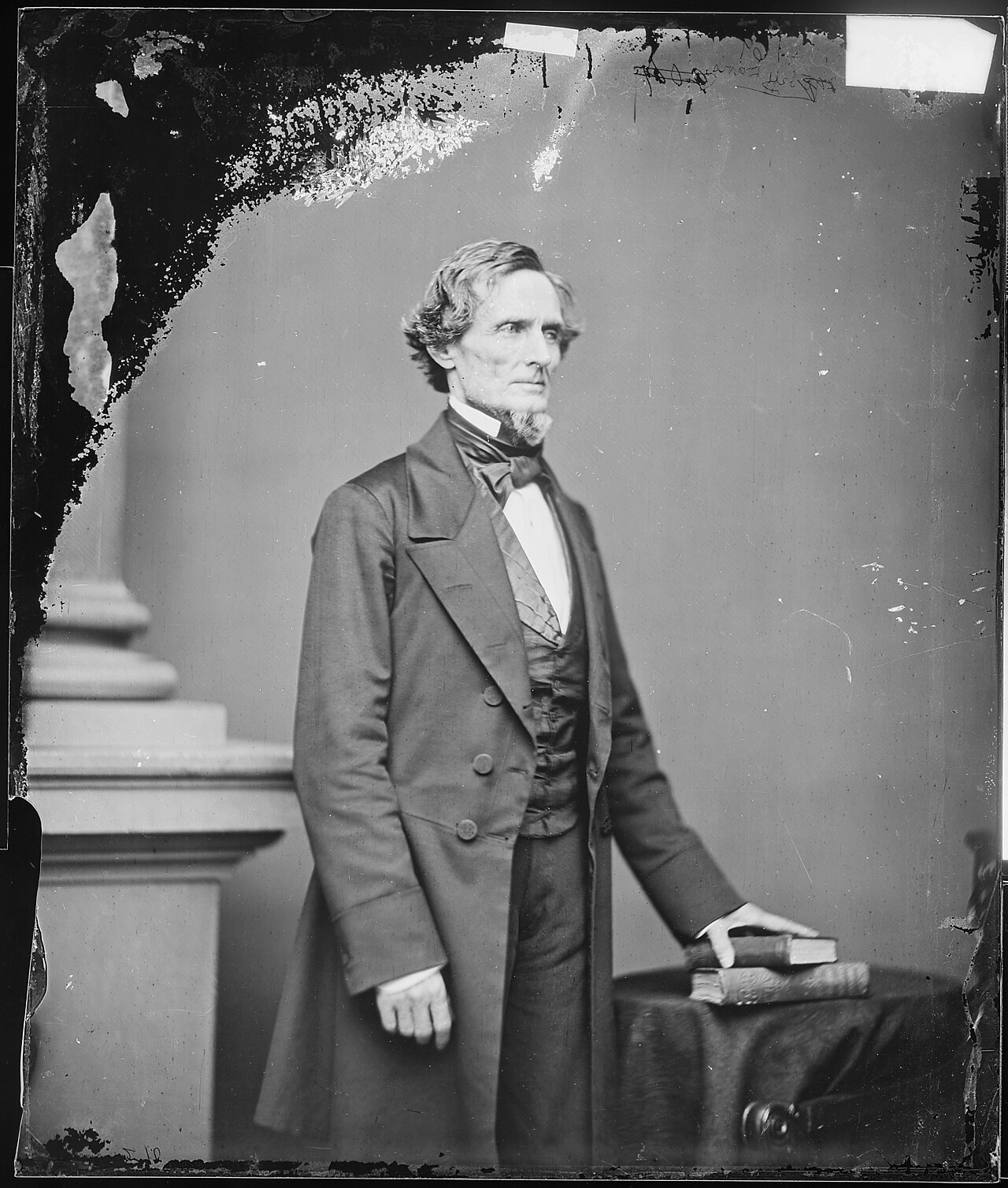
His name was Jefferson Finis Davis, and on paper he was the most qualified man in America to run a war.
Davis was a Mississippi planter, born in Kentucky in 1808, raised on cotton money, and trained at West Point (the United States Military Academy on the Hudson River, the country's school for professional army officers). He had graduated in 1828, served as an army lieutenant on the frontier, fought in the Black Hawk War (a brief 1832 conflict with Native American forces in the upper Midwest), and then made his name as a combat veteran who distinguished himself at the Battle of Buena Vista in the Mexican-American War of the 1840s, where he commanded a regiment of Mississippi riflemen. After that came a political career that read like a résumé built specifically for this moment: U.S. Congressman, then U.S. Senator from Mississippi, and, the credential that mattered most, Secretary of War (the civilian cabinet minister who runs the army) under President Franklin Pierce from 1853 to 1857. He had run the United States Army. He had modernized it, surveyed railroad routes across the West, even championed an experiment importing camels for desert transport. He was, by every conventional measure, an accomplished and serious administrator, a soldier-statesman who had spent his adult life at the center of national power.
He was also the owner of roughly 113 enslaved human beings on his Brierfield plantation in Mississippi, a fact worth holding onto, because it is the through-line of everything that follows.
Set him beside the other man inaugurated that year. Abraham Lincoln was a one-term former congressman and a railroad lawyer from Illinois whose entire military experience consisted of the same brief, undistinguished militia stint in the same Black Hawk War. By his own public admission, he had seen no combat at all; he joked, in an 1848 speech in Congress, that his fiercest enemies had been mosquitoes: "I had a good many bloody struggles with the musquetoes," he said, "and although I never fainted from the loss of blood, I can truly say I was often very hungry." His own party had preferred other men for the nomination. Much of the country, North and South, regarded him as a backwoods curiosity who had stumbled into the presidency on a split vote. If you had stood in early 1861 and asked which of these two men was built to lead a nation through war, the answer would have seemed obvious. The seasoned insider versus the underestimated outsider. The professional versus the amateur.
Hold that expectation. It is one of the great wrong guesses in American history, but it would have been everyone's guess that spring, and the men in Montgomery made it with confidence.
Two days later, on February 11 (his forty-ninth birthday), Alexander H. Stephens of Georgia took his oath as the new nation's vice president. Stephens was a frail, sickly, sharp-tongued lawyer who had actually argued against secession right up until his state left, then gone with it when Georgia voted to go, putting loyalty to his state above his own judgment, the same wrenching arithmetic that would later catch a far more famous Virginian. Remember him too. Within weeks he would deliver the single most revealing speech of the entire Confederate experiment.
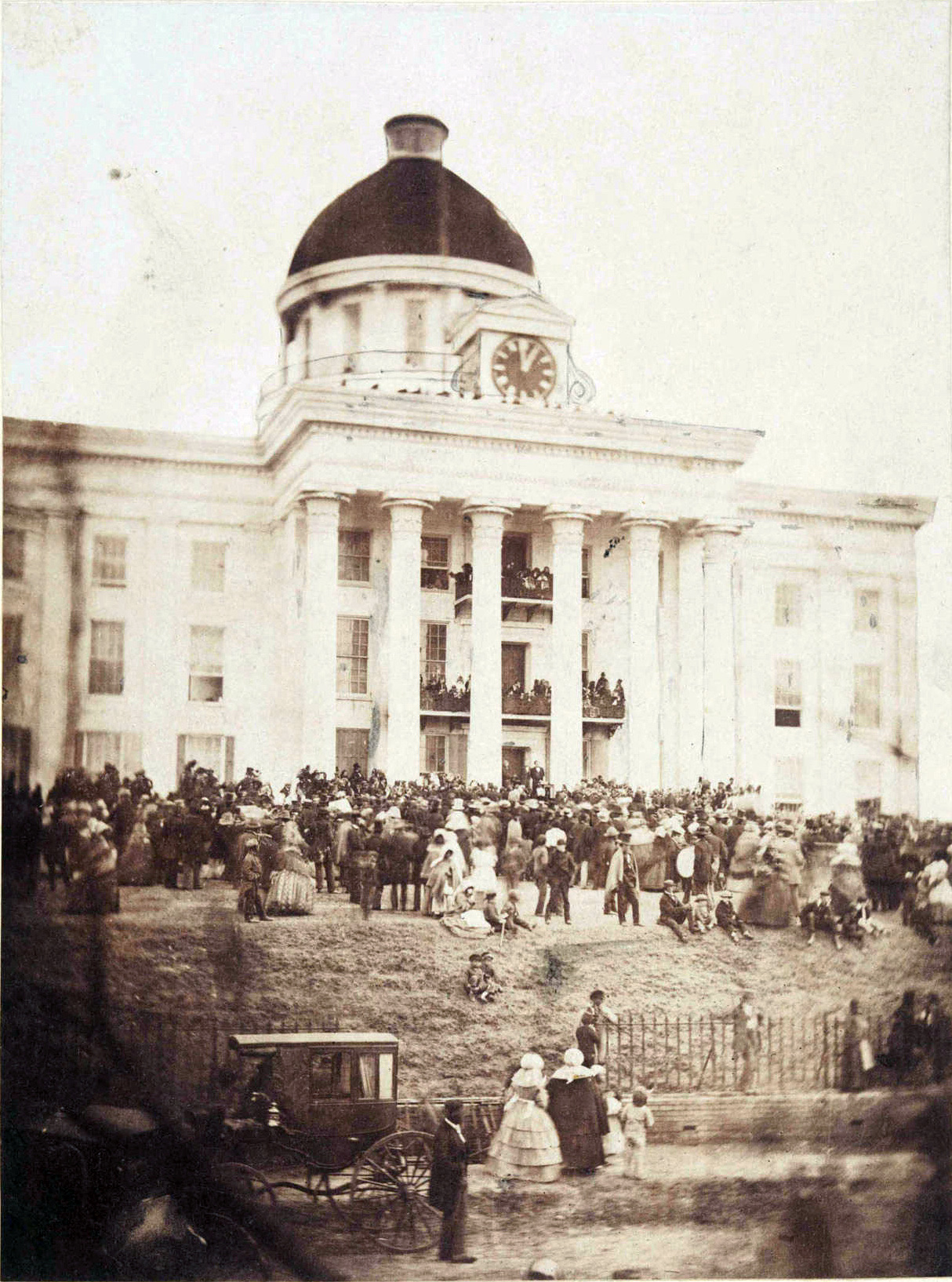
On February 18, 1861, at one o'clock in the afternoon, on the steps of the Alabama State Capitol, Jefferson Davis was inaugurated provisional president of the Confederate States of America. He wrote the whole address the night before and delivered it in about fifteen minutes. It was measured, not fiery. He grounded the new nation's existence not in slavery but in the Declaration of Independence, in the language of self-government and the consent of the governed, pointing to "the right solemnly proclaimed at the birth of the States," which, he said, recognized "in the people the power to resume the authority delegated." In plain terms: he was claiming that the Southern states had originally lent a portion of their sovereignty to the federal government, and were now simply taking it back. This was no revolution, he insisted. "It is by abuse of language," he said (meaning: it is flatly the wrong word), "that their act has been denominated a revolution." Not a rebellion. A lawful resumption of self-rule.
And, tellingly, his inaugural address did not mention slavery once.
Davis framed the whole project in the clean, abstract, high-minded vocabulary of constitutional liberty. No enslaver listening would have missed what was being protected; no one needed it spelled out. But for the public record, for the watching world, for posterity, the new president kept the actual stakes offstage and spoke only of principle.
His vice president was about to do the opposite.
In Their Own Words
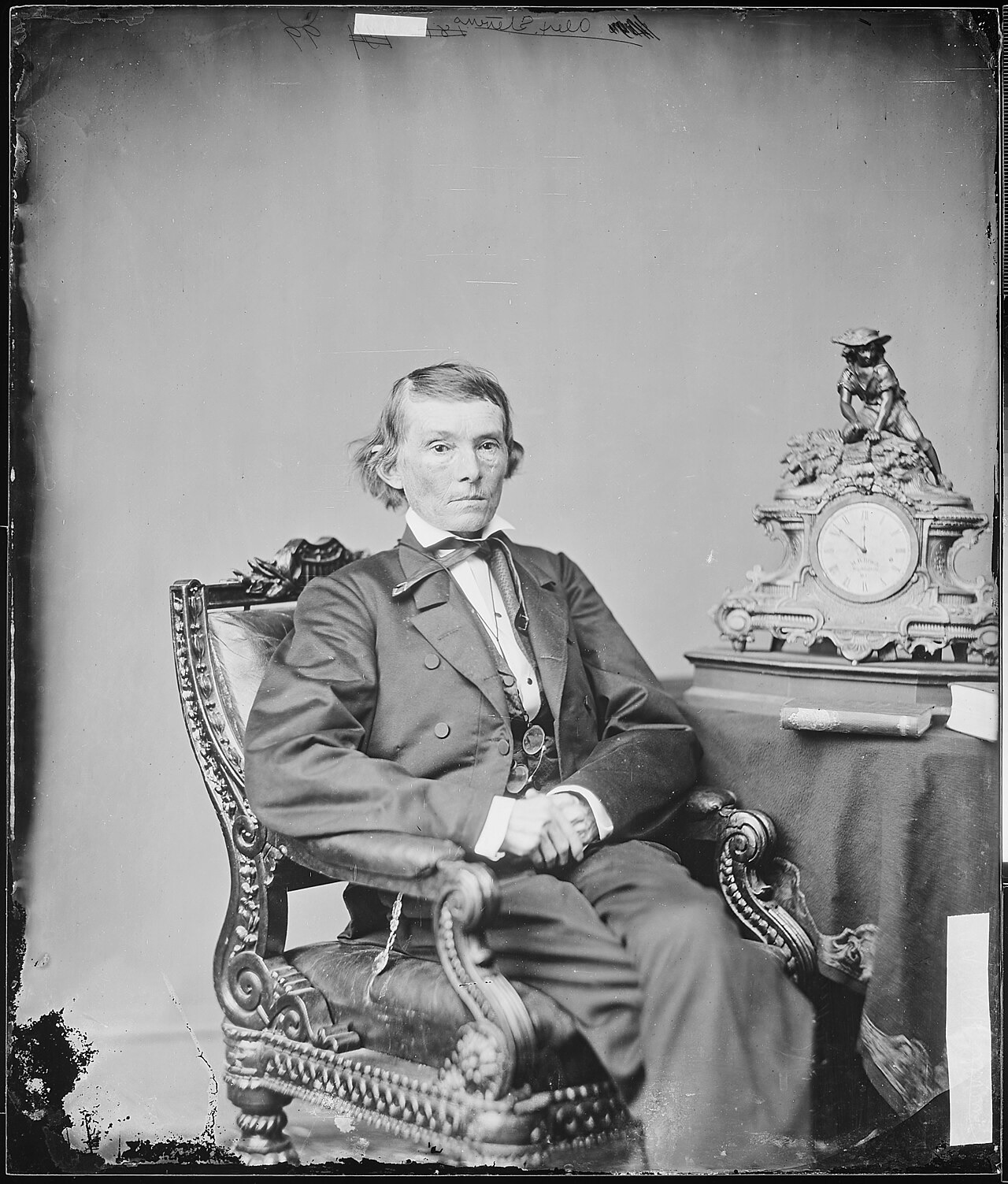
On March 21, 1861, three weeks after Davis's careful, slavery-free inaugural, Alexander Stephens stood up at the Athenaeum, a public hall in Savannah, Georgia, in front of a large and friendly crowd, and explained, off the cuff and without a prepared text, what the new nation was actually for. He began by telling them that the old Constitution's great unsettled fight was finally over:
"The new Constitution has put at rest forever all the agitating questions relating to our peculiar institution—African slavery as it exists among us—the proper status of the negro in our form of civilization. This was the immediate cause of the late rupture and present revolution."
Then he kept going. The Founding Fathers, he said, had built the old republic on a fundamental error: the notion that all men are created equal:
"Those ideas, however, were fundamentally wrong. They rested upon the assumption of the equality of races. This was an error."
And then came the passage that gave the speech its name. The new government, Stephens explained, was founded on the opposite idea:
"Our new government is founded upon exactly the opposite idea; its foundations are laid, its corner-stone rests, upon the great truth that the negro is not equal to the white man; that slavery, subordination to the superior race, is his natural and normal condition. This, our new government, is the first, in the history of the world, based upon this great physical, philosophical, and moral truth."
Read that and let it land before anything frames it for you. A corner-stone is the foundation block of a building, the stone the whole structure is squared against and built upon; Stephens was not being coy with the word. He was boasting. The Confederacy, he told the crowd in Savannah, was the first nation in the history of the world built deliberately and explicitly on the foundation of human inequality and Black enslavement, and he offered this as a point of pride, a civilizational achievement, the great moral truth the old Union had been too cowardly to admit. That is the Confederacy's own vice president, in its founding weeks, in front of an approving audience, telling you what the country was for. Three weeks earlier, Davis had given an inaugural that never said the word slavery; here was the number-two man in the same government, naming it as the cornerstone of everything, without a flinch.
(A note on the source, because it matters. Stephens spoke extemporaneously; there is no official transcript. The accepted text comes from a contemporary newspaper transcription, the Savannah Republican's report of the March 21 speech, later reprinted in Frank Moore's wartime Rebellion Record and in Henry Cleveland's authorized 1866 collection of Stephens's papers. Years later, after the war was lost and the cause needed laundering, Stephens would claim the reporters had garbled his words. Historians don't buy it: the disclaimer arrived exactly when it was convenient, and it matches none of the multiple corroborating contemporary accounts. Do not confuse this canonical Savannah text with the Southern Confederacy of Atlanta, which reported a separate, earlier version of the same basic address that Stephens delivered in Atlanta on March 12, a different speech on a different day. The words above are the scholarly standard for the Savannah cornerstone speech.)
Here is where the comfortable story and the documentary record part ways for good. For generations afterward, a tidy explanation took hold: the "states' rights" version, in which the South seceded over an abstract constitutional principle about the balance of power between the states and the federal government, and slavery was merely one issue among several, almost incidental. It is a soothing account. It lets the war be a tragic misunderstanding between honorable men rather than what the founders of the Confederacy themselves, in 1861, said plainly that it was. And the simplest way to dismantle it is not to argue. It is to let the men who built the second government keep talking, because Stephens was not a lone voice getting ahead of his colleagues. The states had already said the same thing, officially, in writing.
When several of the seceding states walked out, they published "Declarations of the Causes," formal statements of grievance modeled on the Declaration of Independence, laying out for the world exactly why they were going. They are extraordinary documents, and they are not subtle.
Mississippi's, issued January 9, 1861, opens with a sentence that should be carved over the door of every argument about what the war was about:
"Our position is thoroughly identified with the institution of slavery—the greatest material interest of the world."
It goes on, and the reasoning is almost clinical: a defense of slavery grounded in economics and a frank claim of racial fitness:
"Its labor supplies the product which constitutes by far the largest and most important portions of commerce of the earth. These products are peculiar to the climate verging on the tropical regions, and by an imperious law of nature, none but the black race can bear exposure to the tropical sun."
In plain terms: Mississippi was arguing that Black people were biologically meant for forced labor in the heat, racist pseudoscience offered as a reason the system should continue. The choice, Mississippi declared, was stark: "There was no choice left us but submission to the mandates of abolition" (abolition being the movement demanding an end to slavery) "or a dissolution of the Union." And the stakes were spelled out in dollars: abolition would mean, the declaration warned, the "loss of property worth four billions of money." That "property" was human beings. Mississippi was telling the world it was leaving the Union to protect four billion dollars' worth of people it owned.
South Carolina, the first state out, had filed its declaration on December 24, 1860, and its grievance was identical in substance: a long bill of complaint that the Northern states had betrayed their constitutional duty to slavery. The whole document orbits a single planet. South Carolina charged that fourteen Northern states "have deliberately refused, for years past, to fulfill their constitutional obligations," meaning they would not return escaped enslaved people. It accused the North of having "encouraged and assisted thousands of our slaves to leave their homes," and of inciting "servile insurrection" (a slave uprising). And it named the election of Lincoln (whom it quoted as believing the country "cannot endure permanently half slave, half free") as the final proof that the federal government would now be turned against the institution. The grievance was slavery, top to bottom; "states' rights" appears only as the right of a slave state to keep slaves and to force free states to help.
Georgia's declaration, January 19, said the quiet part with the same bluntness: "For the last ten years we have had numerous and serious causes of complaint against our non-slave-holding confederate States with reference to the subject of African slavery." It identified the threat precisely: the new Republican Party, it said, was "an anti-slavery party," and "the prohibition of slavery in the Territories is the cardinal principle of this organization." And it reached for the language of existential terror, charging that the North's "avowed purpose is to subvert our society, and subject us, not only to the loss of our property but the destruction of ourselves, our wives and our children, and the desolation of our homes, our altars, and our firesides."
And Texas, last of the seven to leave, filed its declaration on February 2 and dispensed with even the pretense of grievance, stating its founding identity outright. Texas, it said, "was received as a commonwealth holding, maintaining and protecting the institution known as negro slavery—the servitude of the African to the white race within her limits." It then laid down its theory of race as settled fact, that Black people "were rightfully held and regarded as an inferior and dependent race, and in that condition only could their existence in this form be tolerable or advantageous," and accused the North of demanding "the abolition of negro slavery throughout the confederacy, the recognition of political equality between the white and negro races." Where Mississippi argued economics and South Carolina argued constitutional betrayal, Texas simply asserted a racial hierarchy as the natural order and dared anyone to disturb it.
Four states. Four official documents. One cause, named over and over, without embarrassment, because in early 1861 no one in the seceding South felt any need to hide it. The euphemism came later, after the war was lost, after the cause needed a respectable afterlife. In the moment of founding, the founders were perfectly clear.
And then they wrote it into law.
The clearest evidence of all is the Confederate Constitution itself, adopted in permanent form on March 11, 1861, ten days before Stephens climbed the platform in Savannah, which is precisely the document he stood up to celebrate. In most respects it copied the United States Constitution nearly word for word: same structure, same branches, same Bill of Rights. But the framers made a handful of deliberate changes, and the changes tell you everything.
Start with a single word. The U.S. Constitution, in 1787, had been written by men embarrassed enough by slavery that they refused to use the word at all. They wrote around it. Enslaved people appeared in the original text only as "other persons" and as those "held to service or labor," careful euphemisms designed so the founding document never had to say slave or slavery out loud. The Confederate framers threw that squeamishness out. Their constitution says slaves, plainly, again and again. Take the formula both constitutions used to apportion seats in Congress: the U.S. version had quietly counted each enslaved person as three-fifths of a person, adding to a Southern state's population (and therefore its number of representatives) without, of course, letting any of those people vote. Where the old document buried that bargain as "three-fifths of all other persons," the Confederate version states it cleanly as "three-fifths of all slaves." Where the founders tiptoed, the framers strode.
And then the Confederate Constitution went where the United States Constitution had never gone. It made the protection of slavery a permanent, unamendable guarantee. Its Article I forbade the Confederate Congress from ever passing any "law denying or impairing the right of property in negro slaves." Read that again: the new nation's founding charter made it constitutionally impossible to weaken slavery, ever, by ordinary law. It guaranteed enslavers the right to travel between Confederate states with their "slaves and other property" intact. And it settled the very fight that had torn the 1850s apart. The question of whether slavery could spread into new western lands was answered by declaring that in any future Confederate territory, "the institution of negro slavery, as it now exists in the Confederate States, shall be recognized and protected." The great political war of the previous decade had been over exactly that. The Confederate Constitution answered it permanently: yes, always, everywhere, protected by law.
Now hold those two clauses up to the light, because together they detonate the "states' rights" story from inside the Confederacy's own founding document. A constitution supposedly built to protect the rights of individual states forbade any Confederate state from ever choosing to weaken or abolish slavery within its own borders; the property clause made that decision unconstitutional everywhere, for everyone, forever. And the territories clause stripped every future territorial population of the right to vote slavery down; the institution was mandatory, not optional, regardless of what the people who lived there wanted. So the Confederacy protected precisely one right, the enslaver's right to own human beings, and used that single right to override any state's right, or any territory's right, to do otherwise. "States' rights" turns out to name one specific right, held by one specific class of people, and to crush all competing rights beneath it.
So set the two foundational moments side by side. The United States, founded on a document so uneasy about slavery it would not print the word, with a Declaration insisting all men are created equal. The Confederate States, founded on a constitution that named slavery plainly and made it eternal, and a vice president who stood up and called human inequality the corner-stone of the whole edifice and the first great truth of any government in history.
There were two governments in America that spring. Only one of them announced, in its own words, in its own founding documents, that it existed to keep human beings as property. That is not an interpretation imposed by later historians. It is the confession of the founders, written in their own hand, and they meant every word.
And it is worth saying plainly what the founders' documents treated only as a line item: the four million enslaved people whose bondage was being written into law were not bystanders to this argument. They were its subject and its stake, and they understood the stakes better than anyone: the spring of 1861 was deciding whether their children would be born free or born owned. The men in Montgomery were drawing up a country to keep them in chains. Soon enough, they would have something to say about that themselves.
"We Are Not Enemies, but Friends"
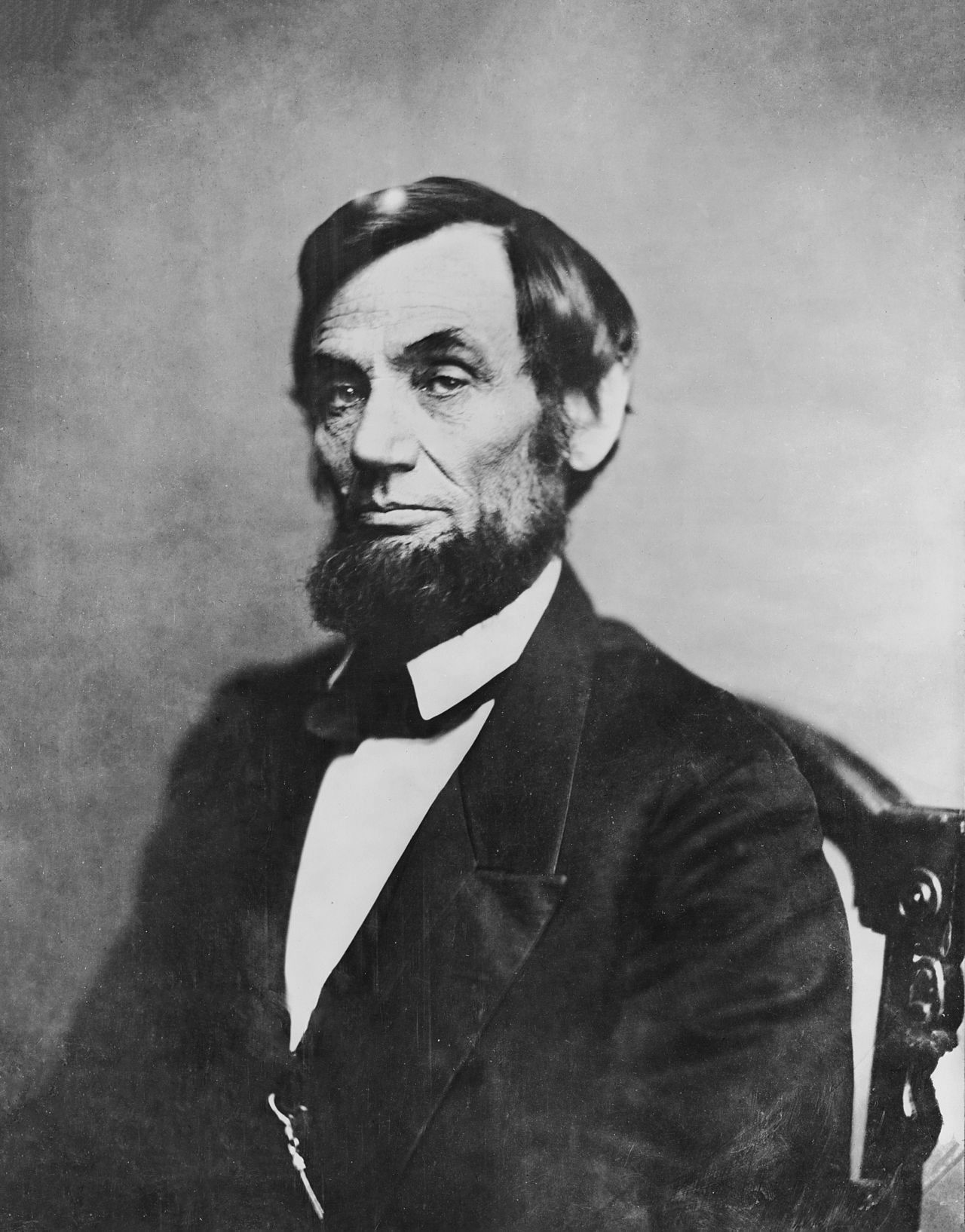
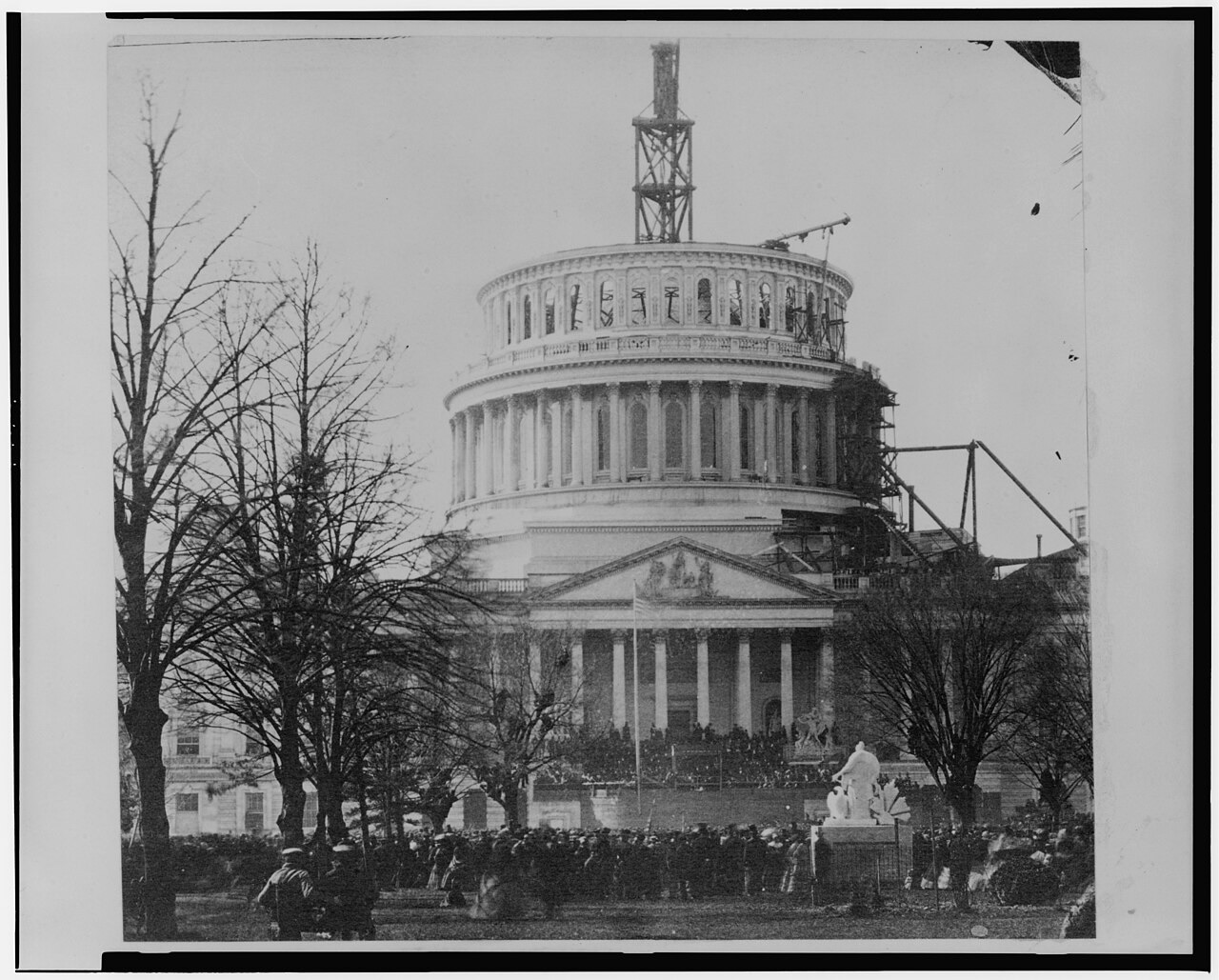
Back in Washington, the other president had a harder rhetorical problem.
By the time Abraham Lincoln stood on the steps of the unfinished U.S. Capitol on March 4, 1861, to take his oath, the Confederate provisional government was already thirteen days old and seven states had gone. He was being inaugurated president of a country that had just lost a quarter of itself, and the four wavering slave states of the upper South (Virginia, North Carolina, Tennessee, Arkansas) were watching every syllable to decide whether to follow the Deep South out of the Union. His inaugural address had to do two contradictory things at once: reassure the South that he would not attack slavery, and warn it that he would not let the Union be broken. It is one of the great threading-the-needle performances in American oratory, conciliation and steel braided together so tightly you can read it twice and get opposite impressions.
The conciliation came first. Lincoln went out of his way to promise he had no intention of touching slavery where it already existed:
"I have no purpose, directly or indirectly, to interfere with the institution of slavery in the States where it exists."
He meant it. Lincoln in 1861 was no abolitionist (someone demanding the immediate destruction of slavery); he believed the federal government had no constitutional power to abolish slavery in the states, and he said so plainly, hoping to keep the upper South from bolting. But running directly beneath the reassurance was a line of pure, unbending steel. The Union, Lincoln insisted, was not a club a state could quit. It was permanent, older than the states themselves, and secession was not a legal act but simply a falsehood with cannon behind it:
"I hold that in contemplation of universal law and of the Constitution the Union of these States is perpetual."
Then came the operative threat, the sentence that pointed straight at Charleston harbor. He would hold what was the federal government's:
"The power confided to me will be used to hold, occupy, and possess the property and places belonging to the Government, and to collect the duties and imposts; but beyond what may be necessary for these objects, there will be no invasion, no using of force against or among the people anywhere."
There were federal forts, arsenals, and customs houses scattered across the seceded states, and the Confederacy regarded them as foreign installations on sovereign soil. Lincoln had just announced, in his first hour as president, that he considered them United States property and intended to keep them. (Translation: he would not surrender the federal forts inside Confederate territory, including a half-finished one sitting in the middle of Charleston harbor, called Fort Sumter.) He would not start a war. But he would not abandon a fort, either. And then, in case the meaning was unclear, he set the choice down squarely in his opponents' laps:
"In your hands, my dissatisfied fellow-countrymen, and not in mine, is the momentous issue of civil war."
You decide, he was saying. I will hold what is mine and fire on no one. If there is a war, you will have started it.
Then, having delivered the threat, he closed with the most famous passage he ever wrote: a deliberate, aching reach across the widening gap. The original draft had ended on a flatter, more lawyerly note; his incoming Secretary of State (the senior cabinet minister who runs the country's foreign affairs), William Seward, suggested a softer landing about a "guardian angel of the nation," and Lincoln took the pedestrian suggestion and transmuted it into music:
"I am loath to close. We are not enemies, but friends. We must not be enemies. Though passion may have strained it must not break our bonds of affection. The mystic chords of memory, stretching from every battlefield and patriot grave to every living heart and hearthstone all over this broad land, will yet swell the chorus of the Union, when again touched, as surely they will be, by the better angels of our nature."
Lincoln deployed the better angels of our nature as an instrument of policy, a last, genuine appeal to the slave states still inside the Union, and to the seven outside it, to step back from the cliff. He was still hoping the whole thing could be talked down.
It could not. Five hundred miles south, in Charleston harbor, the talking was about to end.
The Fort in the Harbor
Fort Sumter sat on a man-made island of granite at the mouth of Charleston harbor, in South Carolina, the very state that had led the secession. It was federal property: a United States Army fort, garrisoned by United States soldiers, flying the United States flag, planted squarely in the middle of the harbor of the Confederacy's most defiant city. The whole secession crisis had been searching for a single point sharp enough to draw blood, and geography had supplied it.
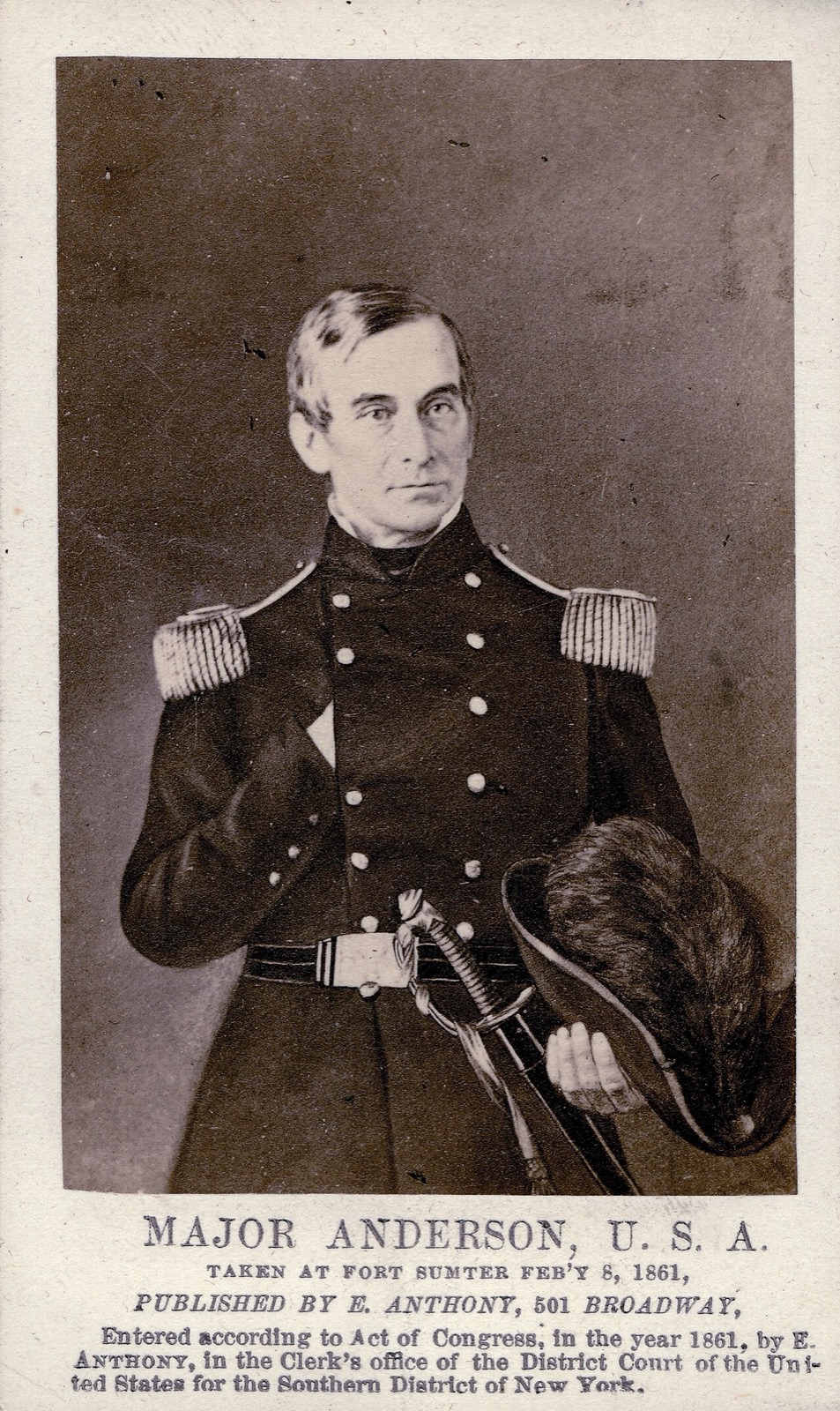
Inside the fort was Major Robert Anderson and a garrison (a small military force assigned to hold a fort) of about eighty-five men. Anderson had not been ordered to Sumter; he had moved there himself, on his own initiative, back on December 26, 1860, slipping his small command across the harbor by night from the older Fort Moultrie. Moultrie sat on the shore, open to attack by land from every side; Sumter, on its island, could only be reached across open water, far harder to storm, far easier to hold. It was a bold, unilateral move, and it instantly raised the temperature: the Confederates regarded it as a provocation, a federal garrison digging in where it had no business being. (Anderson was, by an irony the war was full of, a Kentucky-born former enslaver himself, a Southern man who had acquired enslaved people through his marriage, and who simply would not break his oath to the United States. The line between the two governments did not run cleanly between regions. It ran through families, through old friendships, through individual men.)
By April 1861, Anderson's garrison was running out of food. He sent word to Washington: without resupply, he would be starved out within days and forced to evacuate. And that simple fact, a fort with empty larders, became the hinge on which the war turned, because it forced a question that had no painless answer. If Lincoln resupplied the fort, he risked firing the first shot of a civil war. If he abandoned it, he handed the Confederacy a triumph and conceded that federal property in seceded states was forfeit, gutting the one firm promise of his inaugural.
He found a third path, and it was clever. On April 4, Lincoln informed the South Carolina authorities that he would send a relief expedition to Fort Sumter, but it would carry food only. No reinforcements. No weapons. No ammunition. Just provisions to feed hungry men. It was a masterstroke of moral positioning. Lincoln was not reinforcing the fort; he was feeding it. If the Confederacy wanted to stop a few barrels of pork and hardtack from reaching starving soldiers, it would have to open fire on a humanitarian supply run, and the whole world would see who had started the war. Lincoln had handed Jefferson Davis the decision he had spent his inaugural trying to hand him: you fire the first shot, or you let the fort stand.
This is the mechanism worth slowing down on, because it is the quiet genius of the whole episode and it is usually skated past. Lincoln did not send an army to take a stand. He sent a supply ship. By reducing the relief expedition to food, he transformed the situation from "the Union is reinforcing a fortress" (which the South could plausibly call aggression) into "the Union is feeding hungry men, and the Confederacy must decide whether to shoot them to stop it." The choice to start the war was no longer Lincoln's. It was Davis's. And the difference between an army and a breadbasket was the difference between the Union firing first and the Confederacy doing it.
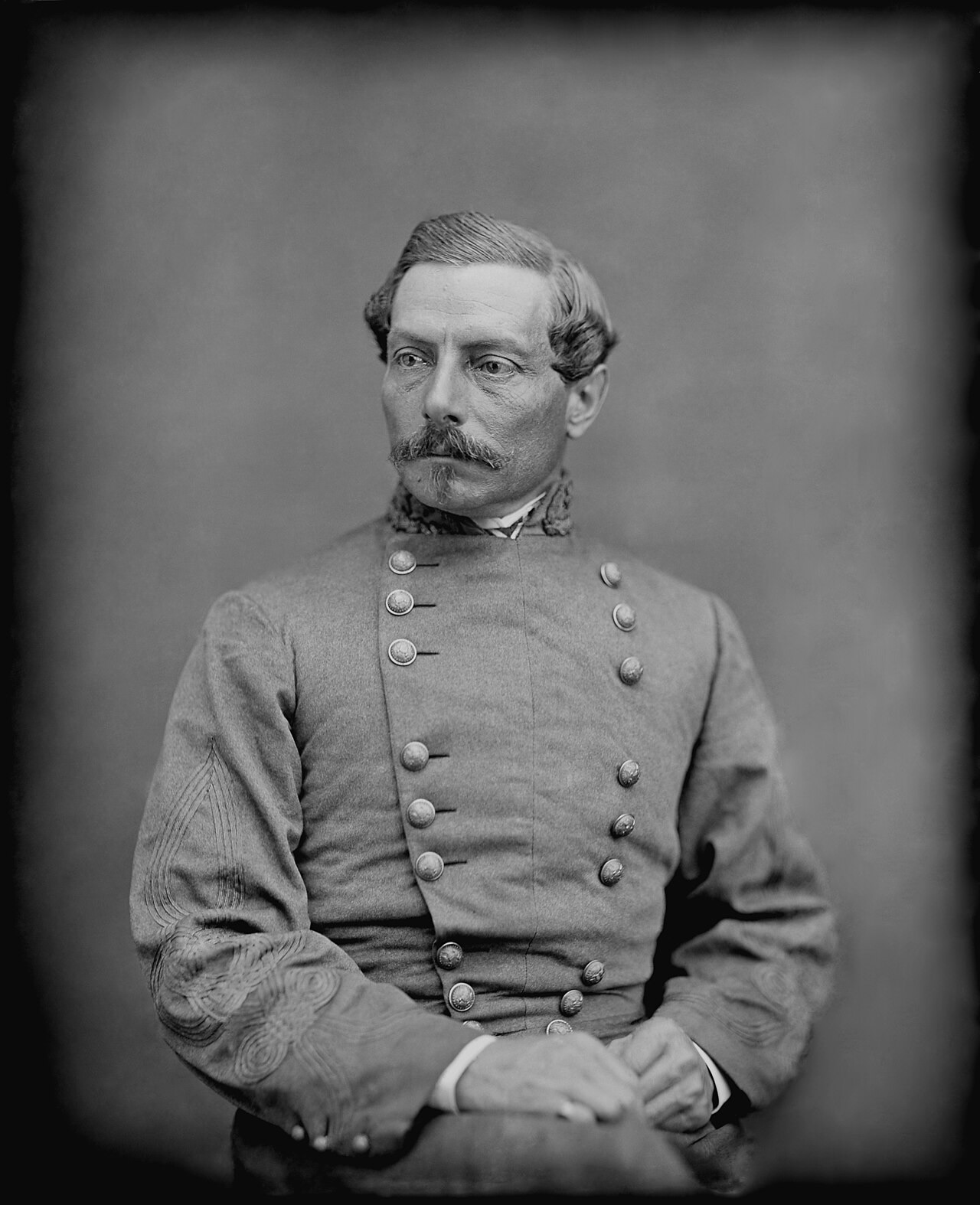
Davis took the bait, or rather, walked into the trap with his eyes open. He had already sent General P.G.T. Beauregard (a West Point graduate from an old French-speaking Louisiana family, who had been named the Academy's superintendent only weeks before, a posting that lasted just five days before Louisiana seceded and the government revoked his orders) to command the Confederate forces ringing the harbor. Beauregard carried his own private irony into the fight: years earlier at West Point, his artillery instructor had been a young officer named Robert Anderson. The teacher was now penned inside the fort; the student was now arranging the guns to blow it apart. On April 9, Davis and his cabinet decided to strike before the food arrived: to take the fort by force rather than let it be resupplied. Letting a Union fort be resupplied in the Confederacy's most symbolic harbor meant accepting a permanent federal military post in the heart of the new nation, a humiliation Davis could not stomach. On April 10, Beauregard's officers formally demanded Anderson's surrender. Anderson refused, but told them, almost gently and off the record, that he would be starved out in a few days anyway if they would simply wait. They decided not to wait.
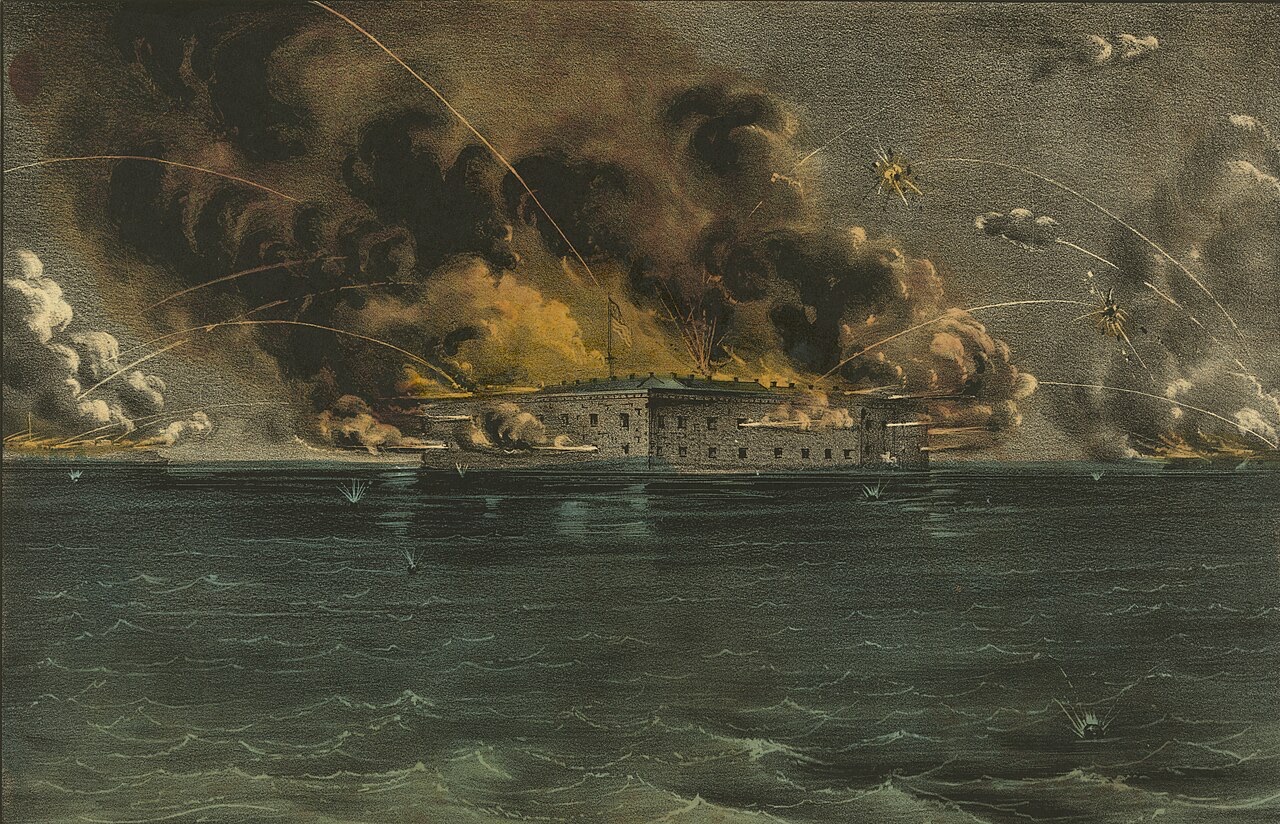
At 3:30 in the morning on April 12, 1861, Beauregard sent his final notice into the dark: he would open fire in one hour. At 4:30 a.m., the first Confederate shell (a mortar round, the kind of shell lobbed in a high arc to drop down behind walls) arced up over Charleston harbor and burst above Fort Sumter, and the bombardment began. (A note, because the question always gets asked: who fired the first shot of the Civil War? The honest answer is that no one knows for certain. Several Confederate officers have been credited over the years, and the accounts disagree; the traditional candidates either declined the honor when the moment came or are named only in contested recollections. The shell came from the Confederate mortar batteries, that much is sure, but history cannot hand you a single trembling finger on a single lanyard, and the stories that try to are not reliable.)
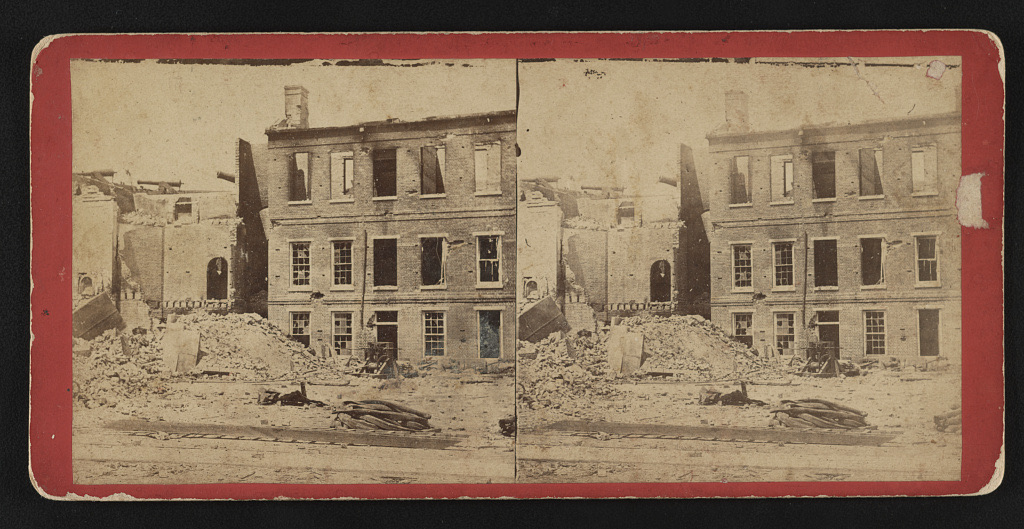
Anderson's outgunned garrison held out for about thirty-four hours under a rain of more than three thousand shells from forty-three guns and mortars ringed around the harbor. The fort caught fire. The walls crumbled. The flag stayed up. And then, on the afternoon of April 13, with his men exhausted and his ammunition nearly gone and the fort burning around him, Major Anderson surrendered. The garrison would evacuate the next day.
Now here is the fact that nobody believes the first time they hear it.
In thirty-four hours of bombardment, more than three thousand artillery shells fired between two armies at the opening of the bloodiest war in American history, not one soldier on either side was killed. The war that would eventually kill some three-quarters of a million people opened with a thunderous, days-long artillery duel that killed exactly no one.
The first deaths came afterward, and they came by accident.
Before evacuating on April 14, Anderson asked permission to fire a hundred-gun salute to the United States flag (a ceremonial volley of blank cannon rounds, a formal military honor) before he hauled it down. Partway through the salute, a cannon cartridge exploded prematurely. Private Daniel Hough of the 1st U.S. Artillery was killed instantly. Private Edward Galloway was mortally wounded in the same blast and died of his injuries days later. Hough is generally counted as the first military fatality of the American Civil War, and he did not die in battle. He died in a ceremonial accident, saluting the flag of a fort that had already surrendered, in a war that had not yet, technically, killed anyone on purpose.
It is one of the strange, quiet ironies the war kept producing. The conflict "began" without a single combat death. Two men died by accident, honoring a flag, in a war that would soon stop being careful about death at all. The carnage was coming. It just had not arrived yet.
Choose
The bombardment of Fort Sumter killed almost no one, but it killed something larger: the possibility of staying neutral.
For months, the four slave states of the upper South had been sitting on the fence, watching, waiting, hoping the crisis would resolve without forcing them to pick a side. Fort Sumter ended the watching. On April 15, the day after the garrison marched out, Lincoln issued a proclamation calling for 75,000 state militia volunteers to put down what he called the rebellion. In 1861 the United States had no large standing army of its own; each state maintained its own body of part-time citizen-soldiers, its militia, and to raise a force the federal government had to ask the states to send their men. So Lincoln asked, for ninety-day enlistments, because almost everyone, North and South, assumed the whole business would be settled in a single short, glorious summer. (It would not. Those "ninety-day men" are one of the war's bleakest little ironies: the conflict they signed up to finish by July would still be killing their countrymen four years later.) And critically, the request went to all the states still in the Union, including the slave states of the upper South.
That was the line they would not cross.
It was one thing to disapprove of secession. It was another to send your own sons to march south and shoot other slaveholders. Lincoln's militia call asked the upper South to take up arms against the Deep South (to choose the Union over their fellow slave states), and for Virginia, North Carolina, Tennessee, and Arkansas, that was the choice that decided it. They had been ambivalent about leaving. They were not ambivalent about invading.
Virginia went first, on April 17, just two days after the militia call. It was the largest, richest, most populous, most industrially powerful state in the South, and its departure transformed the war overnight.
The consequences fell into place fast, and they were geographic. Within weeks the Confederacy voted to move its capital from sleepy Montgomery to Richmond, Virginia, partly to bind the crucial new state to the cause, partly because Virginia's industrial output nearly equaled that of all the other Confederate states combined, and the new nation needed its factories and foundries. By late May, Davis and his government had packed up and moved north by train. And now the geography snapped into place: the Confederate capital sat barely a hundred miles from Washington. The two governments were close enough to threaten each other directly, and the long stretch of Virginia between them would become the most fought-over ground in the war.
The rest followed Virginia out. Arkansas seceded on May 6. North Carolina on May 20. Tennessee, by popular referendum, on June 8; though its eastern mountain counties were so stubbornly pro-Union that East Tennessee would spend the war as a Confederate state full of Union loyalists, a wound that never closed. When the dust settled, eleven states had joined the Confederacy.
And in the days when Virginia made its choice, so did the most consequential soldier in the United States Army.
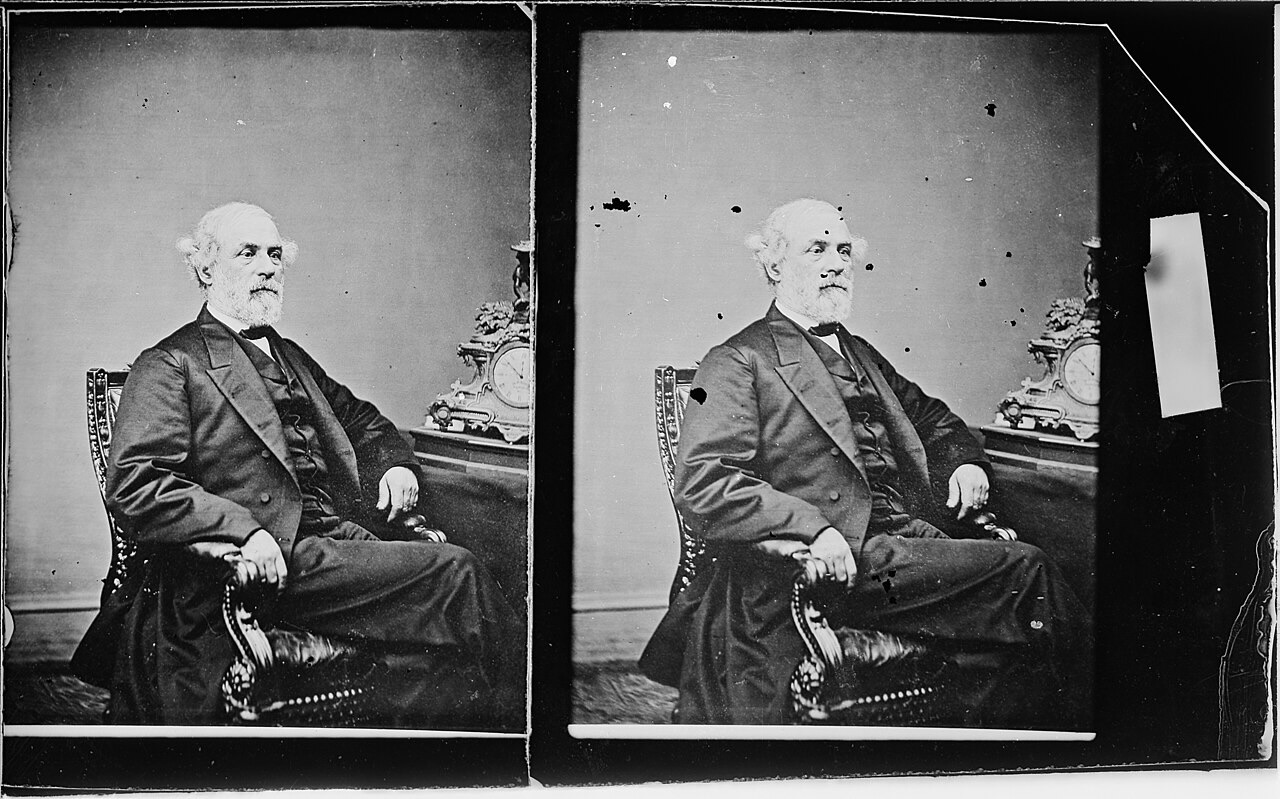
Robert E. Lee was a colonel, a thirty-two-year veteran, recently superintendent of West Point, and widely regarded as one of the finest officers the army had. General-in-Chief Winfield Scott (the aged hero who commanded the entire U.S. Army) considered him close to indispensable. Lee personally opposed secession; he called it "nothing but revolution" in his private letters, and he had no love for the institution of slavery in the abstract, though he was himself an enslaver, holding people he had inherited through his wife's family. He was, in other words, exactly the kind of reluctant, conflicted, Union-leaning Southerner the war was about to tear in half.
On April 18, the day after Virginia voted to leave, Francis Preston Blair, a veteran political operator acting as Lincoln's trusted emissary, met with Lee and offered him field command of the army being raised to suppress the rebellion. Command of the Union's main force in the field, handed to the man Winfield Scott thought irreplaceable. Lee declined. He could not, he said, take part in an invasion of the Southern states. He explained it as candidly and courteously as he could, but the answer was no.
Two days later, on April 20, 1861, Lee resigned his commission in the United States Army. He could not raise his hand against Virginia: his home, his family, his state. The choice followed his geography, not his convictions; he opposed secession and deprecated war, and went with his state anyway. He would shortly take command of Virginia's forces, and in time would lead the Confederate army that became the Union's most dangerous opponent for four years. The Union had just lost, in a single resignation, one of its most capable senior officers, a deficit it would spend three years and a great deal of blood learning to compensate for.
That is what Fort Sumter did. It did not just start the shooting. It forced every fence-sitter (every wavering state, every conflicted officer, every divided family) to come down on one side. After Sumter there was no middle ground left to stand on.
Except, it turned out, in four states that found a way to stand on it anyway.
The Hinge
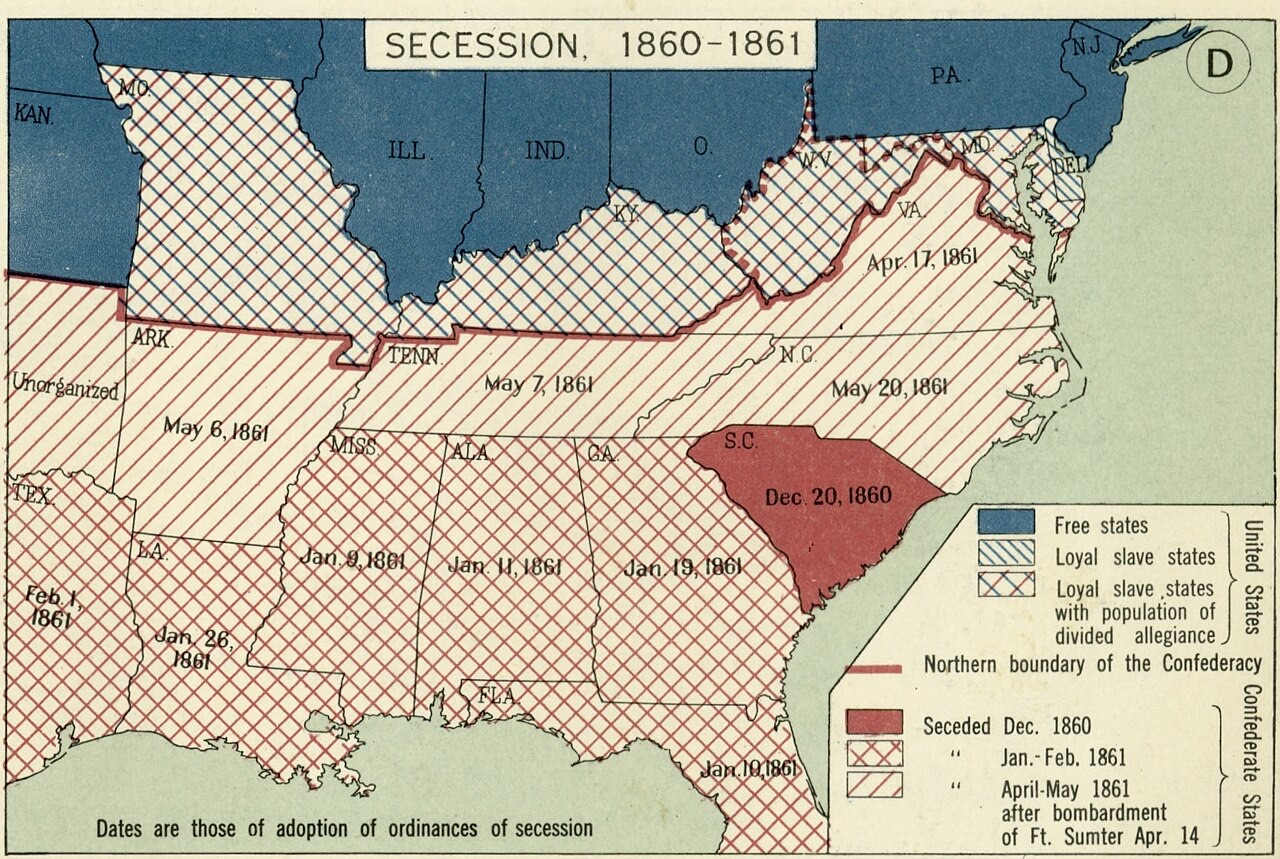
There were four slave states that did not secede: Delaware, Maryland, Kentucky, and Missouri. They are the most overlooked actors in the entire war, and they may have decided it.
These were the border states: slaveholding states that stayed in the Union, wedged along the seam between North and South. And they were not minor. Together they held a large white population, vast industrial capacity, and the country's most important rivers: the Ohio, the Mississippi, the Potomac, the Missouri, the highways of nineteenth-century commerce and war. Most of all, look at a map and notice where they sit. They nearly surround Washington, D.C. Lose them, and the United States capital would be an island in hostile country, the Mississippi River would belong to the enemy, and the war might be over before it had properly begun.
Lincoln understood this with absolute clarity, and he said so in a private letter to his old friend Orville Browning on September 22, 1861, in words that have the cold ring of a man doing arithmetic he cannot afford to get wrong:
"I think to lose Kentucky is nearly the same as to lose the whole game. Kentucky gone, we can not hold Missouri, nor, as I think, Maryland. These all against us, and the job on our hands is too large for us."
To lose Kentucky is nearly the same as to lose the whole game. That is the border states in one sentence: not a sideshow, but the hinge the war swung on. (You may have heard a more colorful version of this sentiment, the line about how Lincoln hoped to have God on his side but must have Kentucky. It's a good line. There is no evidence Lincoln ever said it; it surfaces only as something he was "reputed" to have said, with no letter or diary behind it. The Browning letter is the real, sourced version, and it says the same thing without the polish.) And to keep these four states, Lincoln, the man of the better angels, was prepared to be ruthless. The conciliator of the inaugural address had a much harder hand, and he played it.
Take them in order of how hard they fought him.
Delaware was the easy one. Slavery had nearly died out there: by 1860 the state held only about 1,800 enslaved people against 20,000 free Black residents, and its economy had long since knit itself into the North's. Its legislature voted unanimously against secession, and the matter was effectively settled before it began.
Maryland was the nightmare. Geography made it the single most dangerous state in the Union, because Washington, D.C., is surrounded by Maryland on three sides. If Maryland seceded, the federal capital would be cut off entirely: an island of Union government floating inside the Confederacy, severed from the loyal North. Holding Maryland was not one priority among many. It was the priority, because holding Maryland was the only way to hold Washington.
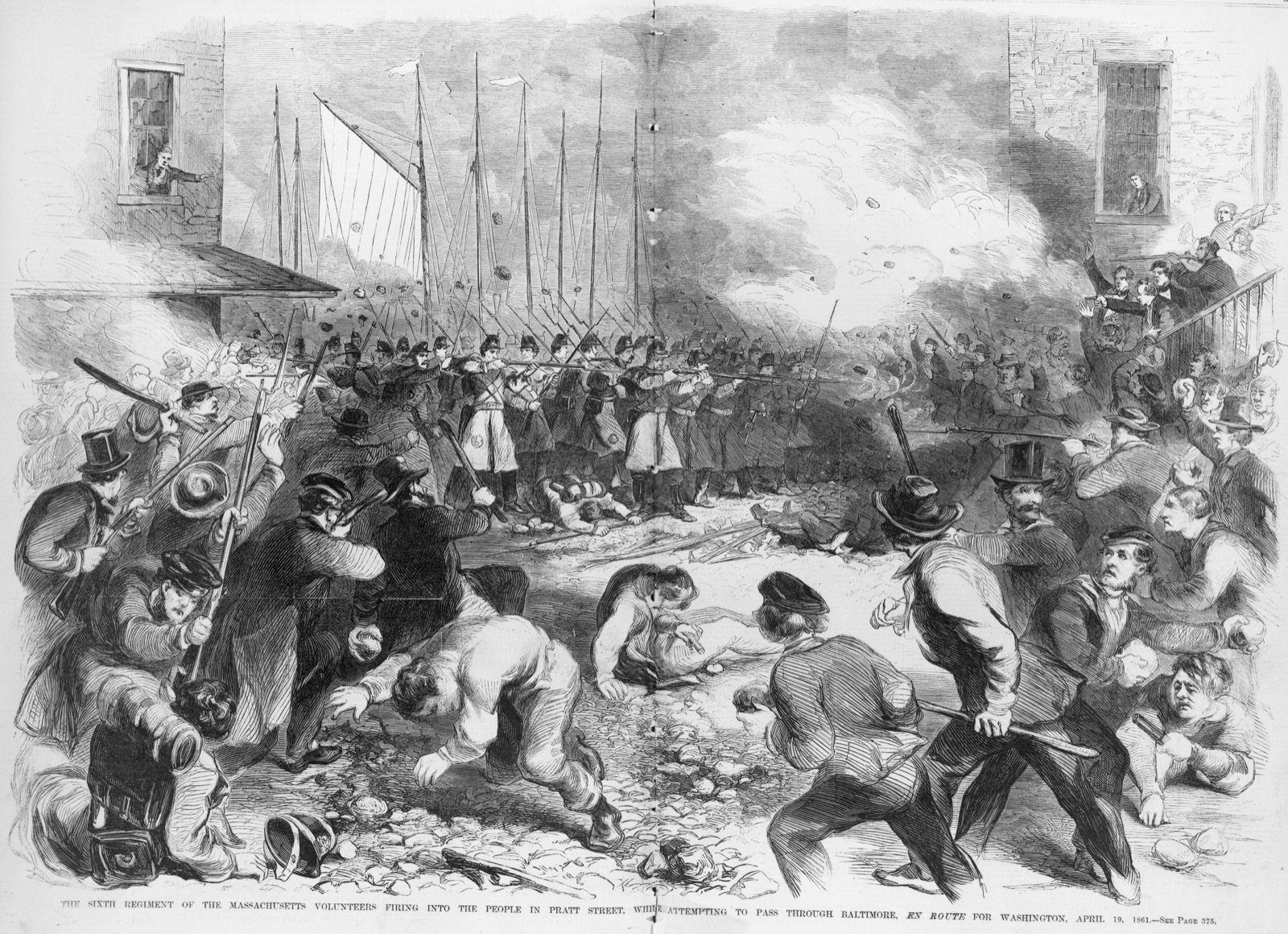
And Maryland nearly went. On April 19, 1861, four days after Lincoln's militia call, the 6th Massachusetts Militia, marching through Baltimore on its way to defend Washington, was set upon by a pro-Confederate mob. (Pennsylvania troops had come through the day before without incident; on the 19th it was the Massachusetts men the crowd was waiting for.) The mob hurled paving stones and opened fire; the soldiers fired back. When it was over, five Union soldiers and at least twelve civilians lay dead or dying in the streets of Baltimore, the first deaths on the ground of the Civil War, killed in a city riot days before any army met any other army in the field. Baltimore's mayor, trying to stop more Northern troops from coming through, ordered the railroad bridges into the city burned, cutting Washington's main rail link to the North at the exact moment the capital was most vulnerable.
This was the lifeline. The trains through Baltimore were how soldiers and supplies reached Washington from the loyal states, and a secessionist Maryland could sever that line at will and strangle the capital. So Lincoln reached for a drastic legal weapon: he suspended habeas corpus (the centuries-old rule that the government cannot lock a person up without bringing them before a court and proving a lawful reason to hold them) along the military corridor between Washington and Philadelphia.
It is worth slowing down here, because this is the most charged moment in the whole spring. Habeas corpus (Latin for "you shall have the body") is the legal mechanism behind that protection. A writ of habeas corpus is a court order forcing the government to produce a prisoner in open court and justify the imprisonment, or else let the prisoner go. It is one of the deepest guarantees in Anglo-American law, the thing that stands between a citizen and indefinite jailing on a government's say-so. To suspend it is to switch that protection off: it meant the army could now arrest suspected secessionists in Maryland and hold them without trial, without charge, indefinitely, and that is exactly what happened. Pro-Confederate agitators and militia organizers were rounded up and jailed, among them a Maryland man named John Merryman.
The legal collision was immediate and dramatic. Chief Justice Roger Taney (the same justice who had written the notorious Dred Scott decision declaring that Black Americans could never be citizens) ruled, in an emergency decision, that Lincoln's suspension was unconstitutional, that only Congress could suspend the writ, and that the president had overstepped. Lincoln simply ignored him. The Chief Justice of the United States declared the president's action illegal, and the president kept doing it anyway, because he had decided that losing Maryland would mean losing the war, and a war lost would mean no Constitution left to protect. It is one of the hardest, most contested decisions of his presidency, and he never flinched from it.
It worked. Under heavy federal pressure, with Union troops already occupying key points in the state, the Maryland legislature voted 53 to 13 against secession on April 29. (Months later, in September, the federal government would go further still, arresting roughly a third of the Maryland General Assembly (the state legislature) to prevent any future secession vote, a follow-on act of the same iron logic that had governed the spring.) Maryland stayed in the Union. Washington stayed connected to the North. And it stayed that way because Lincoln was willing to jail men without trial and defy the Chief Justice to make it so.
Kentucky was the prize, and Kentucky tried the impossible: it tried to sit out the war entirely. On May 20, 1861, the state declared official neutrality, refusing to send troops to either side, attempting to be a kind of Switzerland between the warring halves of its own country. It was an absurd position and everyone knew it. It was also loaded with a strange personal symmetry, because both presidents were sons of Kentucky. Lincoln had been born in a log cabin in Hardin County in 1809; Davis had been born about a hundred miles away in Fairview the year before. The two men leading the two governments (the Union and the Confederacy, the better angels and the cornerstone) had come into the world within a long day's ride of each other, in the very state now trying to belong to neither of them. Lincoln, who knew that ground in his bones, chose patience over force. He respected the neutrality on paper while quietly funneling weapons to pro-Union home guards inside the state, letting Kentucky's loyalty ripen rather than demanding it. The gamble paid off: when Confederate forces marched into Kentucky in September 1861, violating the neutrality the state had declared, Kentucky's legislature blamed the Confederacy for the breach and threw in with the Union. Lincoln had won the state he said he could not afford to lose. By waiting.
Missouri got the worst of all worlds: it stayed in the Union, but only after fighting a vicious little civil war inside the larger one. Its governor, Claiborne Fox Jackson, publicly professed loyalty while privately working for secession, and around St. Louis the contest turned violent fast. On May 10, 1861, a Union commander named Nathaniel Lyon, then only a captain, cornered a pro-Confederate state militia force at its training camp outside St. Louis, a place called Camp Jackson. The militia had quietly armed itself with cannon stolen from a federal arsenal, and Lyon (leading regiments made up largely of pro-Union German immigrants) had come to take both the camp and the guns. He did, without a shot. The trouble came afterward. As his men marched their prisoners back through the city streets, a crowd of Southern sympathizers closed in; when someone in the mob fired on the soldiers, Lyon's troops fired back into the crowd, killing roughly twenty-eight civilians. The Camp Jackson affair secured St. Louis and Missouri's critical river and rail network for the Union, but it enraged Southern sympathizers across the state and helped push Missouri into years of savage guerrilla warfare, neighbor against neighbor, the ugliest and most personal fighting the war would produce.
Four small slave states. None of them seceded. And because they didn't, Washington kept its lifeline, the Union kept the great rivers, and the Confederacy never got the strategic depth it needed. Lincoln held the border by every means he had: patience in Kentucky, occupation and arrests in Maryland, force in Missouri, and a willingness to bend the Constitution he had sworn to defend. It was not pretty. It was not the language of the better angels. It was the cold arithmetic of a man who had read the map and understood that the war could be lost in the spring of 1861, in four states that never fired a shot in any famous battle.
The border held.
Two Governments, One Verdict
By the summer of 1861, the strange interlude was over. There were two governments, two presidents, two constitutions, two capitals now glaring at each other across a hundred miles of Virginia. The fence-sitters had climbed down; the slaveholding upper South had gone with the Confederacy, and the slaveholding border had stayed with the Union, through persuasion and force. The lines were drawn.
But notice what the two governments had each told the world about themselves in the making. One of them had been founded by men who explained, in speeches and declarations and the plain text of their constitution, that it existed to keep human beings as property forever, who called that the corner-stone of their whole experiment and offered it as a point of pride. The other had been founded on a document too ashamed of slavery to print the word, on a Declaration that all men are created equal, and was now led by a man who would do ruthless and constitutionally dubious things to keep it whole. The later euphemisms cannot survive the documents. The men who built the second American government told you exactly what it was for, and we should believe them, because they were not lying. They were boasting.
Two governments took shape in America in 1861. Only one of them was founded, in its own words, to perpetuate slavery. And the war that was about to begin in earnest would decide which one survived, and, in time, whether the four million people written into that second constitution as property would ever be written out.