The battle of Glorieta Pass was not decided by the men who fought it. It was decided by about 450 men who spent the day climbing a mesa. While Scurry and Slough hammered at each other on the Santa Fe Trail, Major John M. Chivington's (North) flanking detachment was doing something the Confederates had not planned for and could not see: crossing the high tableland to come down in the Confederate rear, where the entire Texan army had left its lifeline sitting in the sun, almost unguarded.
The two halves of the Union force fought their separate fights in total ignorance of each other all day. There was no way to send word across that ground in time. Miles of mountain, no line of sight, no way for a message to climb the mesa and come down the far side faster than events were moving, so Slough on the trail never knew where Chivington was, and Chivington on the mesa never knew Slough was losing. The day's two halves were not a plan working in concert. They were two blind blows that happened to land together.
Over the mesa
A mesa is a flat-topped highland with steep sides, a tableland standing well above the valley floor, and the one south of the trail, Glorieta Mesa, rose roughly 2,000 feet (610 m) above the canyon. Chivington's men had to get over it. They could not have done it alone. Their guide was Lieutenant Colonel Manuel Chaves (North), a New Mexican frontiersman who had spent his life in this mountain country and now served as an officer in the territory's own Union militia, chosen by Colonel Edward R.S. Canby (North) and Chivington precisely because no Coloradan or Texan knew this ground the way he did. Chaves and his New Mexico volunteers led the detachment on a roughly 16-mile (26 km) march, up through a canyon, across the top of the mesa, and out to a vantage point on its edge, and from up there, looking down, they could see what they had come for. Below them, at the western mouth of the pass at Johnson's Ranch (the Confederate supply depot, also called Cañoncito), sat the entire forward supply reserve of the Army of New Mexico.
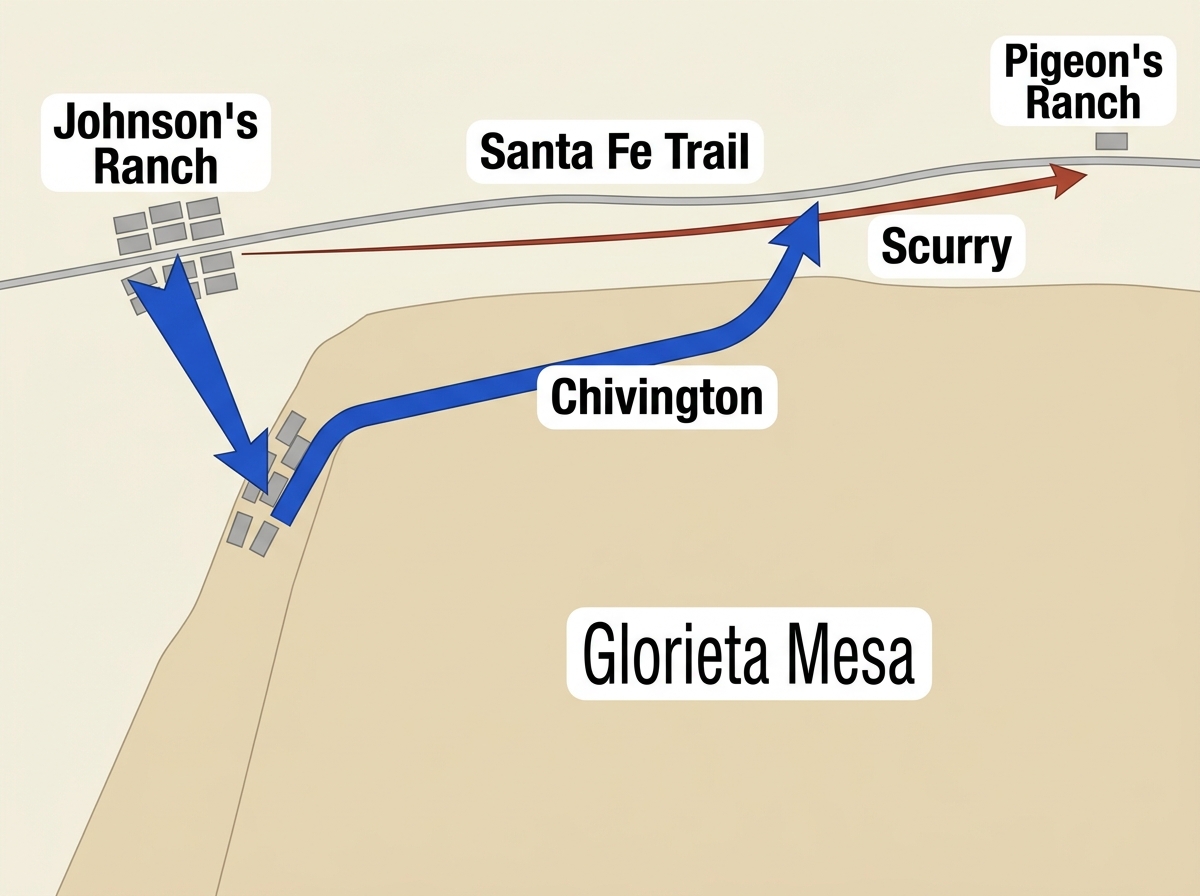
It was guarded by perhaps a couple hundred men and a single cannon. Everything else, all the Texan fighting strength, was eight long mountain miles away, winning the battle at Pigeon's Ranch.
The fire that ended the campaign
Chivington's men came down the steep western face of the mesa, by one account descending the cliffs in about half an hour, and fell on the camp. The fight for it was short. They overwhelmed the guard, spiked the lone cannon (driving a metal spike into the touch-hole so it could not be fired), and took 17 prisoners, whom they paroled (released them on their sworn word not to fight again until formally exchanged, a standard practice on both sides of the war). Then they went to work on the wagons.
What they destroyed was the Confederate campaign itself. The supply train held food, ammunition, medicine, forage (feed for the horses and mules), clothing, even the officers' baggage, essentially everything the Texan army needed to keep existing in a territory that could not feed it. They burned roughly 60 to 80 wagons of it (the sources split on the exact count, with figures running from 60 to 73 to 80) and killed or drove off the horses and mules (the draft animals that hauled the wagons and dragged the cannon, the muscle that moved the army), somewhere on the order of 500 to 600 of them. When it was done, the supply train was ash and the animals were dead or gone.
The man who led this raid was Chivington, and the mainstream record is clear that he commanded it. (A single New Mexico newspaper, writing two years later in 1864, claimed that someone else proposed the attack and that Chivington had to be talked into it, and that a Captain William Lewis (North) actually led the assault. No other source backs this up, the account appeared when Chivington had become a controversial figure, and the standard histories do not echo it.) What is not in dispute is the result, which Slough reported in his official dispatch:
"we took and destroyed their train of about 60 wagons, with their contents."
A victory you cannot eat
Scurry had won the field at Pigeon's Ranch. He held the ground, he had beaten Slough, he had every reason to think he had opened the road to Fort Union. And in those same hours, eight miles behind him, he had lost every wagon of food and every cartridge in reserve and most of the animals that could have hauled what was left. A Civil War army in 1862 could not fight, or march, or even stay alive, without its supply train. Scurry had nowhere to go but back. His own report says it plainly: the loss of his supplies so crippled him that, after burying his dead, he could not follow up the victory he had bled for. The Texans had won the battle and lost the campaign in the same afternoon, and they had to walk past their own burned wagons to understand it.
The retreat that followed was a slow catastrophe. The Confederate army could not be resupplied anywhere in New Mexico, Fort Union still in Union hands, Santa Fe's provisions thin, Canby's troops closing in. On April 12, Brigadier General Henry Hopkins Sibley (South), the campaign's architect, who had not even been present on the battlefield at Glorieta, ordered his men to abandon Albuquerque and start the long retreat south to Texas. It was a march through misery. Blocked along the river by Canby, the army was forced through the mountains and across the Jornada del Muerto (the "Journey of the Dead Man"), a roughly 90-to-100-mile (145 to 160 km) waterless desert basin along the Rio Grande, a flat, sun-scorched stretch of the old Spanish road with no reliable water for days at a time, named for exactly what it did to travelers. Hungry soldiers stripped food from New Mexican civilians along the way, and some of those civilians fought back. Of the roughly 2,500 men Sibley had marched up the Rio Grande, only about 1,500 made it back to San Antonio by that summer. Something like 500 were dead of fighting, starvation, or disease, and another 500 captured, about 40 percent of the army gone. The Confederacy never again mounted a serious campaign for the Southwest or the Pacific. The dream of a slaveholding republic stretching to the ocean died in a burning wagon park at the mouth of a canyon.
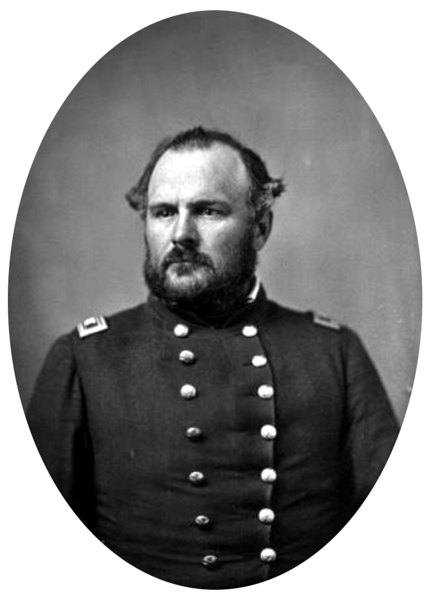
There is a darker chapter to the man who lit that fire. Just over two years later, in November 1864, the same John Chivington, by then a colonel commanding in Colorado, led the Sand Creek Massacre, in which his men attacked a peaceful Cheyenne and Arapaho encampment and killed scores of people, most of them women and children. The officer who saved the Union's hold on the Southwest became one of the worst perpetrators of anti-Native violence in the West. Both of those things are true, and the second does not erase the first, or the first the second.