It took five weeks to set and about a day to spring. When Island Number Ten surrendered, the garrison stacking its arms in the dark near Tiptonville, the flag coming down to the river flotilla, roughly 4,500 to 5,000 Confederate soldiers went into prisoner-of-war camps in exchange for fewer than three dozen Union dead. Three generals and seven colonels were taken in the bag, along with somewhere between 109 and 123 heavy guns and thousands of small arms. A whole army surrendered for the price of a bad afternoon’s skirmish. The rest of this is the story of how a trap closes that tight.
April 7–8
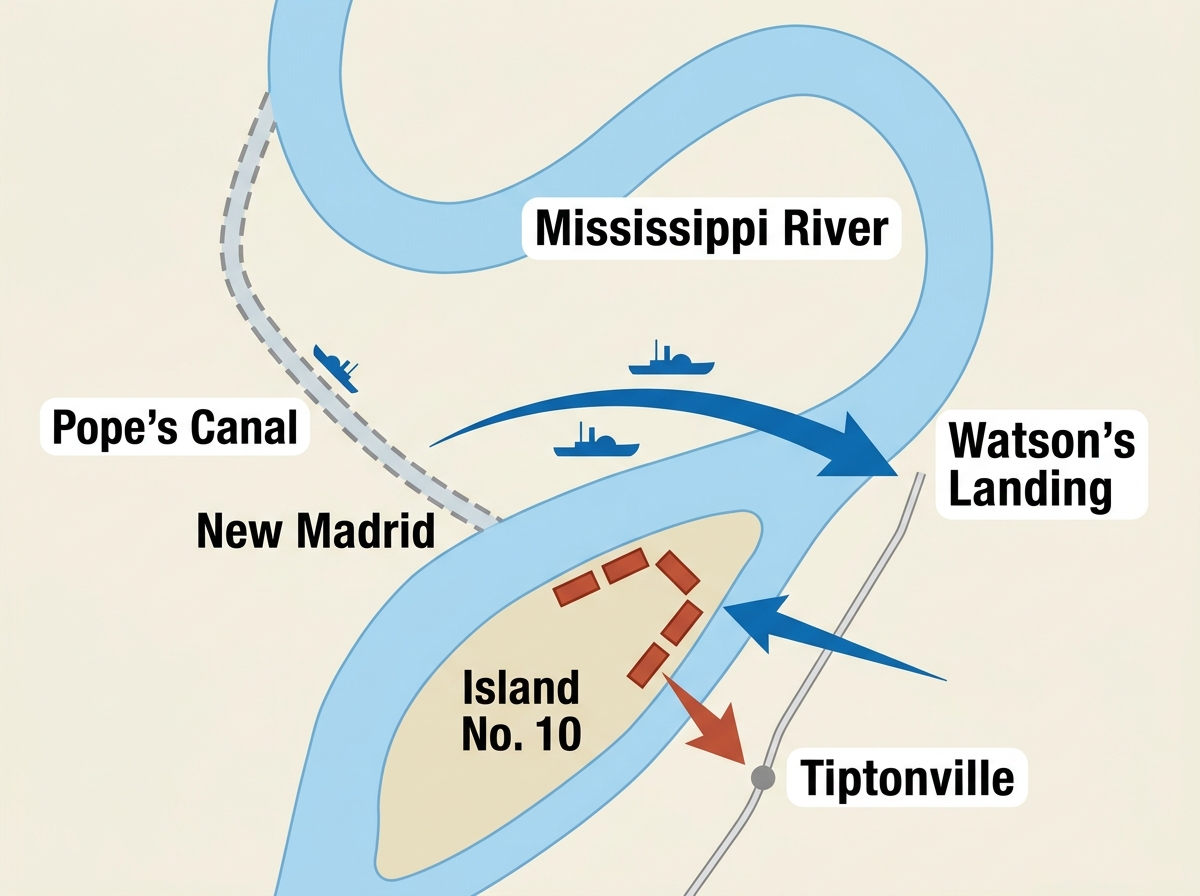
Pope had spent those five weeks assembling his pieces, the captured town, the impossible canal, the two gunboats that had run the guns, and on April 7 he snapped them all shut at once. The whole point of the gunboats below the island had always been this single move: to cover an army crossing the river where the Confederates couldn’t stop it. With the Carondelet and the Pittsburg working the Tennessee bank, driving off or silencing the last Confederate shore batteries below the island, Pope finally had a safe place to put his men on the far shore.
He moved on the afternoon of April 7. Using the transports that had crept through Bissell’s canal, steamers with homely names like Hetty Gilmore, Terry, Trio, and Emma, Pope ferried roughly 3,000 men across the Mississippi to the Tennessee side at Watson’s Landing, the two gunboats riding shotgun the whole way. It was the crossing the entire campaign had been built to make possible, and it landed Pope’s army squarely astride the one weakness in the whole Confederate position.
Because for all its 52 guns, Island Number Ten had a fatal flaw: the garrison could be supplied and could escape by exactly one road, running south to the village of Tiptonville, Tennessee. Cut that road and everyone on the island and along the bend was trapped between Pope’s army, the river, and the surrounding swamps, with nowhere to go. Pope’s crossing cut it.
The man who had to watch the door close was Brigadier General William W. Mackall (South). He had been in command of Island Number Ten barely a week. He took over from McCown only around March 31, inheriting a position his superiors still believed was secure even as the ground gave way beneath it. The only road out was the one running south to Tiptonville, and there was a moment, somewhere in the wet dark of April 7, when Mackall understood that the Union infantry was already moving to cut it, and that there was no move left to make. By the time he gave the order to retreat south, the race was already lost. His men started for Tiptonville; Union gunboats sealed off any escape by water; Pope’s infantry raced overland to get astride the road first. They won the race.
It ended around 2 a.m. on April 8, in the rain, near Tiptonville. Mackall surrendered the garrison to Pope unconditionally; Island Number Ten itself struck its colors, lowered its flag, the traditional signal of surrender, to Foote and the flotilla at about the same hour. The size of the haul is the one genuinely murky fact in the whole clean story: Pope claimed 273 officers and 6,700 enlisted men, close to 7,000, but Confederate strength returns show no more than about 5,300 present at the end of March, so the honest figure is roughly 4,500 to 5,000, his numbers almost certainly padded. Among the prizes was a stranger one than guns. The Confederate quarters ship Red Rover, holed by Union shellfire during the bombardment and abandoned, was seized intact in the surrender; repaired and refitted, she would go on to become the U.S. Navy’s first hospital ship, tending thousands of sick and wounded sailors up and down the Mississippi for the rest of the war.
That near-bloodless cost is the whole point. The Army of the Mississippi’s combat losses in this campaign were tiny, on the order of 8 killed, 21 wounded, and a handful missing, well under three dozen men, with total campaign casualties including the navy still under 80. Compare that to Antietam’s 22,000 in a single day that September, the bloodiest day in American military history, or to the thousands Grant lost at Shiloh that very same week. The prize here was never measured in casualties. It was measured in miles of river.
Eastern TheatreAntietam: the bloodiest single day, five months laterWestern TheatreShiloh: Grant’s bloodbath the very same weekApril 7–8 · What it opened
And the river was the prize. With Island Number Ten gone, the upper Mississippi lay open to Union vessels all the way down to the next Confederate strongpoint, Fort Pillow, about 70 miles (113 km) north of Memphis. The dominoes fell quickly: Fort Pillow was abandoned by June 4, and Memphis itself fell on June 6 after a sharp naval battle, putting one of the South’s great river cities in Union hands. It was, as the histories flatly put it, "the first time the Confederate Army lost a position on the Mississippi River in battle," the first knot in the Anaconda untied, with only Vicksburg and Port Hudson still corking the river below.
For John Pope, it was the making of his name. The general who had taken a fortress and 5,000 men at the cost of a few dozen casualties became a national celebrity overnight, won his major general’s stars, and was soon called east by Abraham Lincoln to command an army against Robert E. Lee. That August, he would be wrecked at the Second Battle of Bull Run and spend the rest of the war out west. Foote, who had pounded the island for three weeks and finally received its surrender, was thanked by Congress and promoted to rear admiral, but the strain had worn him out; he died in June 1863 without the sea command he wanted. The men faded, the way men do. The thing they had won did not. The Anaconda had its first real coil around the Mississippi, and it would not let go until the whole river belonged to the United States and the Confederacy was cut clean in two.
Eastern TheatreSecond Bull Run: where Pope’s reputation came undone