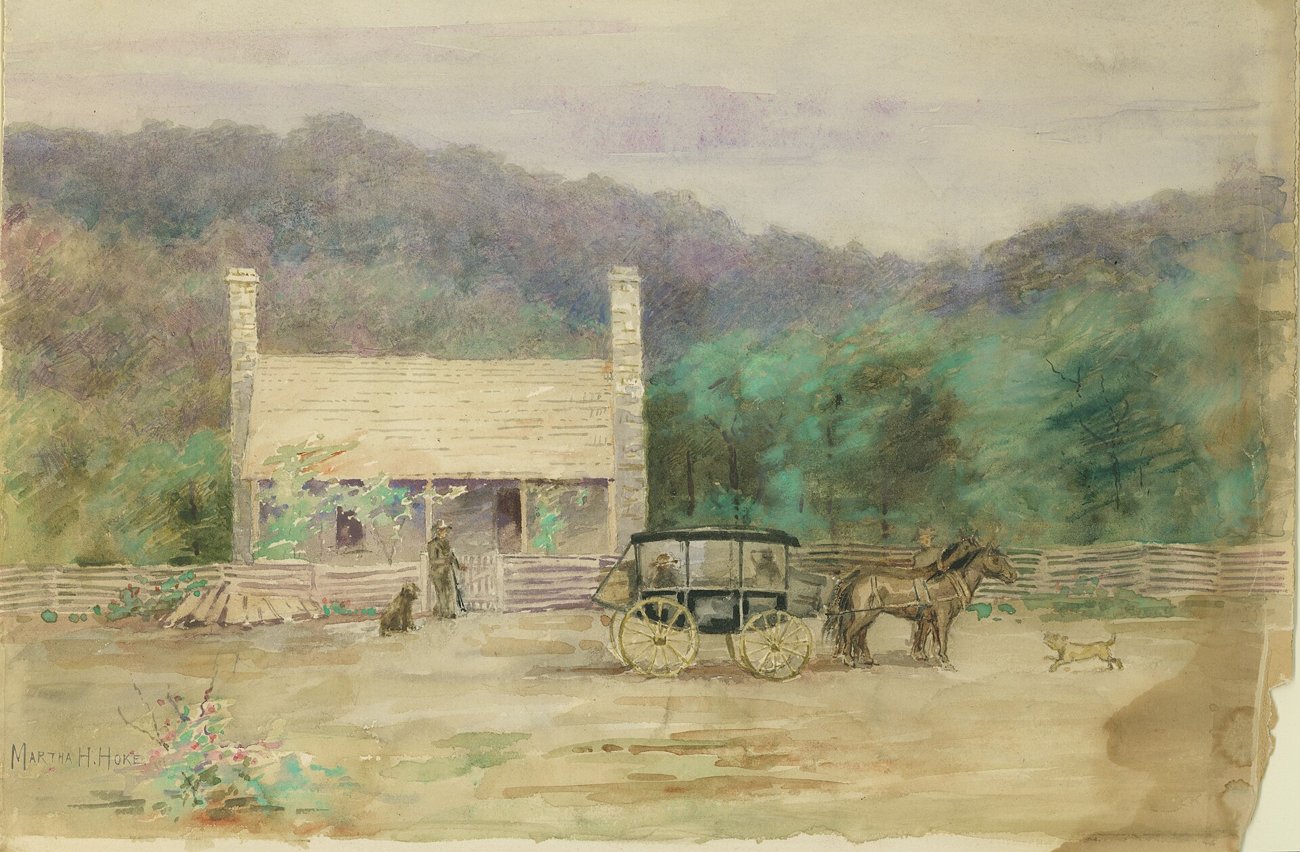
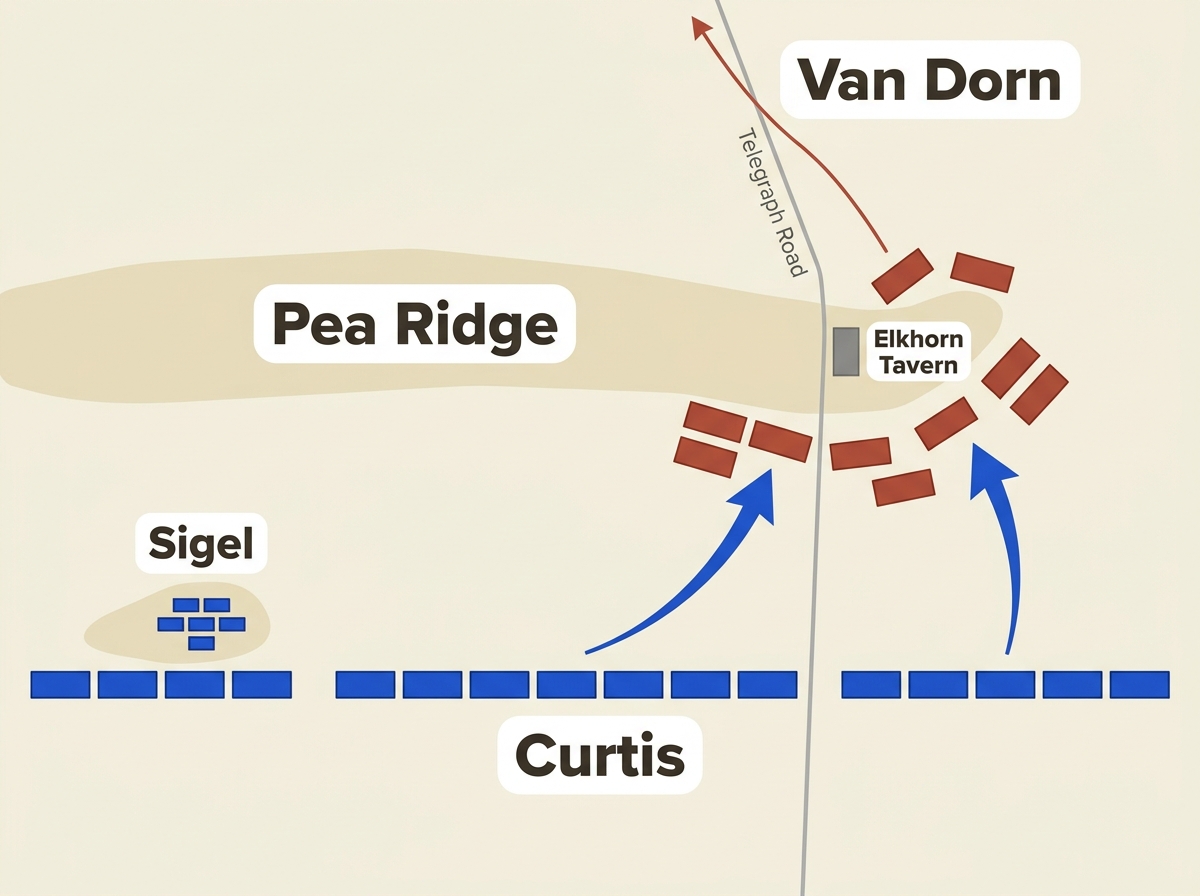
The first day had ended in a way that should have terrified Curtis. Over on the eastern side, by the Elkhorn Tavern, Price's Missourians had hammered Carr's outnumbered division back through four successive defensive lines and seized the tavern and the high ground around it by nightfall. Carr held that ground at a cost few commanders would have paid: shot three times over the course of the day, in the arm, the neck, and the leg, he refused to leave the field, and his stubborn, bleeding stand bought Curtis the hours he needed to bring the rest of the army around. It cost the Confederates, too. Price himself took a wound during the fighting but stayed in command, and Brigadier General William Slack (South), one of his Missouri State Guard brigade commanders, was shot through the body and carried off the field; he would die of the infected wound two weeks later, on March 21. By dark, the Confederate right wing was wrecked and both its top generals dead, but on the left, Price had the tavern, and that was the deepest into Curtis's position the Confederates would ever get.
Curtis rode over to the Elkhorn Tavern front in the evening and ordered a counterattack to steady the line. Then he spent the night doing what good commanders do. He fed his men, resupplied them, and pulled his entire army into one continuous line facing north, ready to fight as a single fist in the morning. The Confederates spent that same freezing night exactly as they had spent the march: exhausted, unfed, and, fatally, cut off from their ammunition wagons, which were still hours away on the wrong side of the battlefield.
The barrage and the empty cartridge boxes
Day two belonged to the guns. Van Dorn tried to open it the way he'd hoped to win it, with his own artillery, but his barrage was scattered and ineffective, and it accomplished little before the Union answer came. On the Union left, west of Elkhorn Tavern, Brigadier General Franz Sigel (North) massed his artillery, on the order of twenty cannon, on an exposed knoll and opened a bombardment that one man on the receiving end remembered as a continual thunder, like the day of judgment had come. This was the turn of the whole battle. The day before, the artillery had run the other way: at Elkhorn Tavern, Price's roughly fourteen guns had outshot Curtis's four, and the Confederates had pushed forward partly on the strength of that advantage. Now Sigel's massed twenty-odd pieces flipped it completely, and his gunners worked methodically, knocking out the Confederate cannon one by one.
And the Confederate guns, when they tried to answer, started to go quiet for a reason that had nothing to do with courage: they were running out of ammunition. This was Van Dorn's clever flank march coming back to kill him. His reserve ammunition trains (the supply wagons carrying the extra powder and shot) were with the rest of the baggage, which his own night march had stranded five or six hours away by road, on the far side of Union-held ground. He had never given orders to keep the trains close behind the army. Now, with the battle going against him, there was simply no way to get more powder and shot to the men who needed it. A forty-round cartridge box doesn't last long in a stand-up fight.
You could see it on the field: a gun crew standing at a piece they could no longer use, the rammer idle, the limber chest behind them scraped empty, a cannon and the men to serve it and nothing left to load into it. One by one, down the Confederate line, the guns went silent not because the gunners had lost their nerve but because they had fired their last round and there was no more.
Curtis read the quiet. By mid-morning the Confederate return fire had gone thin, batteries that had answered Sigel at dawn barely answering now, and he knew the balance had tipped. He ordered a coordinated advance: a synchronized barrage (sustained, concentrated cannon fire) and infantry assault (soldiers on foot charging forward) across his whole line at once. Union troops drove Stand Watie's Cherokee off the high ground on the right, and the blue line surged forward everywhere. Van Dorn, his guns going quiet and his men pushed back across the field, ordered a retreat near 11 in the morning. It was less a withdrawal than a coming-apart: the Army of the West fell back in three separate directions on different roads, no longer a single coherent army. By noon, Curtis's converging divisions met near Elkhorn Tavern, and the field was his.
The Confederates didn't run out of nerve at Pea Ridge. They ran out of bullets, left behind by the very march that was supposed to win the battle.
One solid number and one contested one
The Union loss is firm: about 1,384 men, killed, wounded, and missing, with the heaviest fighting and the heaviest toll falling on Carr's division at Elkhorn Tavern. That figure is stable across the sources.
The Confederate loss is a different matter. Van Dorn's official report claimed only around 800 to 1,000 killed and wounded plus a few hundred prisoners, and almost no historian believes him. It is hard to credit that the attacking army, which had outnumbered Curtis going in, somehow lost fewer men than the defenders did. Van Dorn's count also left out his Native troops entirely, since they dispersed on their own and were never tallied, and the Confederate records for this army are patchy to begin with. The modern scholarly estimate is roughly 2,000 Confederate casualties, well above the number Van Dorn put in his report. The lopsided arithmetic of his own account is part of how we know he lowballed it.
A general who has lost will sometimes shade the numbers. Van Dorn shaded them so far that the gap itself gives him away.
Missouri held
For all Van Dorn's recklessness, the bottom line was simple and final. Pea Ridge was the largest and best-organized attempt the Confederacy would ever make to retake Missouri, and it failed completely. The Confederates never again seriously threatened the state. Missouri, the slave state on the knife's edge, the prize the whole campaign had been about, stayed in the Union for the rest of the war, and St. Louis and the upper Mississippi stayed safely Federal. The door that had hung open since Wilson's Creek swung shut for good. (As Curtis's army pushed deeper into Arkansas over the following months, it would emancipate enslaved people on a large scale along the way, the war over a slave state turning, on the ground, into the undoing of slavery itself.)
Off the fieldEmancipation: how the war to hold the Union became a war to end slaveryVan Dorn refused to call it a defeat. He reported afterward that he had not been beaten, only foiled, the verdict of a man who had just marched his own army to pieces. The consequences read like a defeat all the same. Within weeks, the Confederate high command ordered him to haul his army east across the Mississippi to join the great concentration at Corinth, Mississippi (the buildup that fed the bloodbath at Shiloh, a two-day battle in April 1862 that left nearly 24,000 men dead or wounded and shocked both sides with its scale). Van Dorn obeyed, marching the remnants of the Army of the West out of Arkansas entirely, and in doing so stripped the state of virtually all its organized defenders, leaving it nearly naked to Union advance. His army arrived at Corinth on April 23, too late to do anything; Shiloh had already been fought and lost. As for Pike, the controversy he'd been pilloried for never quite let go: he resigned his Confederate commission that July and was later indicted in Federal court for inciting wartime atrocities, though he was never tried.
Western TheatreShiloh: the bloodbath Van Dorn’s army marched east to join, and missedA Confederate army that outnumbered Curtis, outschemed him, and pulled off a daring all-night march to get clean into his rear was beaten in the end not by Curtis's guns but by its own cleverest move, which had carried its bullets off to the wrong side of the battlefield and left its cannon standing empty in the snow. Van Dorn's army wasn't defeated by the Army of the Southwest. It was defeated by Van Dorn.