The Battle of Westport was lost, but the campaign was not yet over, and for Major General Sterling Price (South) the worst was still ahead. He turned his beaten army south down the Kansas-Missouri line, his wagon train slowing every mile, and behind him came the Union cavalry of Major General Alfred Pleasonton (North) and Major General James G. Blunt (North), no longer fighting to stop him but to destroy him outright. The retreat from Westport became a running rout that lasted for days.
On October 25, two days after Westport, the pursuers ran the Confederate rear to ground in a double disaster along the Marais des Cygnes and at Mine Creek, just over the line in Kansas. At Mine Creek, a sharp cavalry charge smashed Price's rear guard and captured two of his generals, Brigadier General John S. Marmaduke (South) and Brigadier General William L. Cabell (South), along with about six hundred men and several of their guns. It was one of the largest cavalry actions of the entire war, and one of the few clear Union victories won by mounted men charging on horseback. Price's army, already broken at Westport, was now being dismembered on the road.
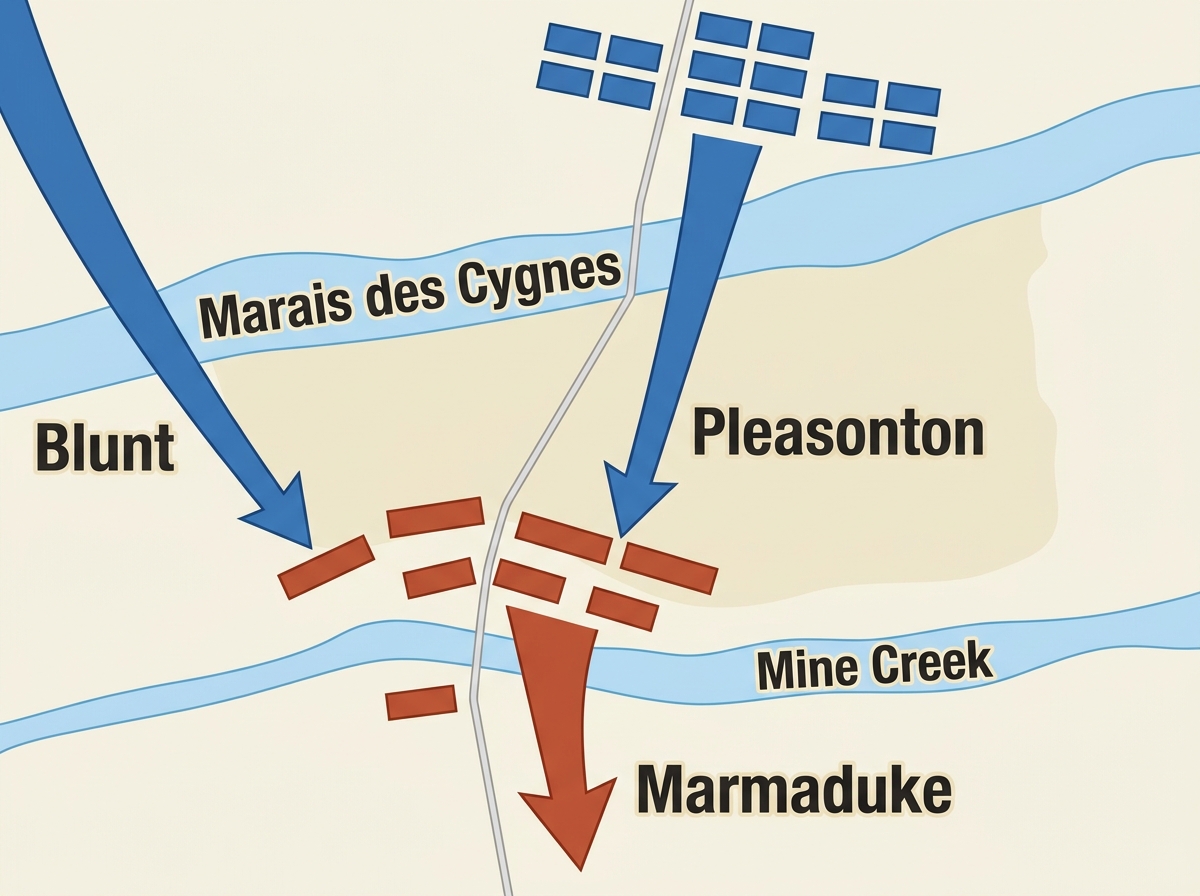
What was left came home
What was left of the Army of Missouri kept going south, into Indian Territory and Arkansas and finally Texas, harried and starving the whole way, eating its own draft animals before it was through. The expedition that had set out in September with about 12,000 men limped back across the Arkansas line with fewer than half that number still under arms. Price had marched well over a thousand miles, fought more than forty engagements, and accomplished almost nothing he set out to do. He had not taken St. Louis or Jefferson City, he had not held any ground, and the recruits he had gathered melted away as fast as the army shrank.
The Trans-Mississippi goes quiet
Westport ended the war west of the Mississippi as a contest of armies. It was the last major Confederate offensive in the whole Trans-Mississippi theater, the South's final attempt to march an army north and change the course of the war, and it had failed completely. After Westport the United States held Missouri firmly for the rest of the conflict, and the cause Price had marched for, a Confederacy whose founding purpose was the protection of slavery, had run out of armies to send. The fighting that remained in the region would be the guerrilla kind, bushwhackers and raiders in the back country, not armies in the field.
The timing made the defeat doubly cruel for the South. Price had launched the raid in part to shake Northern confidence before the election, and it did the opposite. News of the victory at Westport reached the North in the last days of the campaign for the presidency, one more piece of good war news in an autumn that had already brought the fall of Atlanta. Far from turning voters against Abraham Lincoln, the collapse of the last Confederate invasion helped confirm that the war was being won. In November, Lincoln was reelected. The bid to win the war at the ballot box had helped lose it there instead.
Off the fieldLincoln and the 1864 election: the vote Price's raid was meant to swingSome have called Westport the Gettysburg of the West, for its size and for the way it turned back a Confederate invasion. The comparison flatters the battle a little, but the core of it is fair. As Robert E. Lee's army had been turned back at Gettysburg in the East, Price's was turned back here, and where Lee's army survived to fight for nearly two more years, Price's simply disintegrated on the long road home. West of the Mississippi, the war as a war of marching armies was over. What was left was the waiting, while the armies in the East ground toward the surrender that would end it for good.