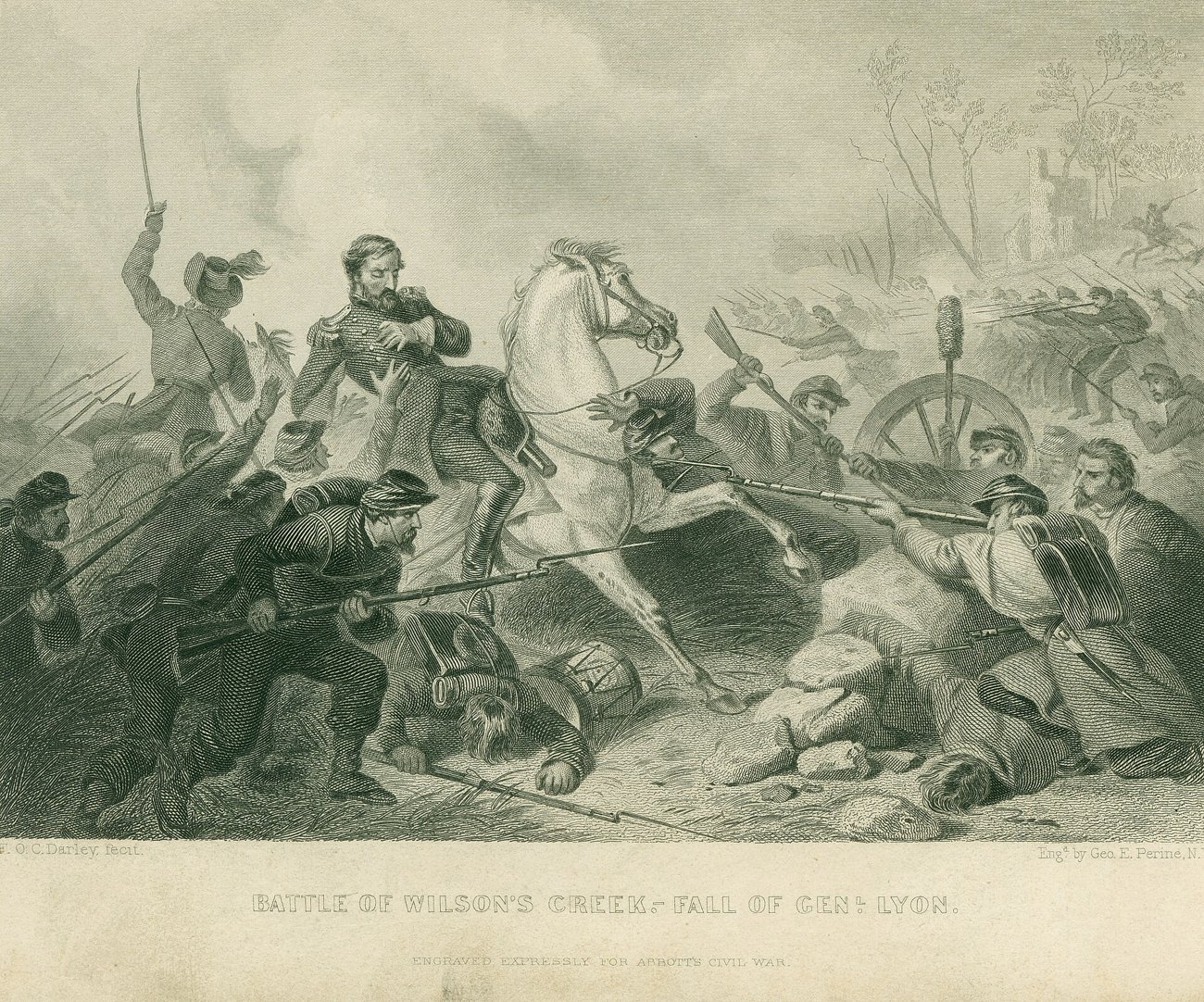
By mid-morning on August 10, Brigadier General Nathaniel Lyon (North) had already given more to the battle than most men give in a war. He had been shot in the leg and grazed across the head, and his horse had been killed under him. One observer remembered him as masked in blood from his earlier wounds. He had ridden the whole length of his line all morning, in his old captain's coat rather than a general's uniform, rallying men who were fighting two-to-one odds on a hill that was filling up with the dead. And the Union center was starting to waver. So Lyon did the only thing he knew how to do. He got on another horse and rode to the front to lead a counterattack in person.
A general at the head of the charge
Sometime around half past nine or ten o'clock in the morning, Lyon put himself at the head of a charge (the 2nd Kansas Infantry, with the 1st Iowa alongside by some accounts) aimed at the weakening Union center, and waved his men forward, still in that worn captain's coat. He is remembered to have called out as he went, "Come on, my brave boys, I will lead you! Forward!", words that appear on the marker at the site and have been repeated in account after account, though they come down to us as a remembered, reported line rather than anything written at the time. Moments later a bullet struck him in the chest, through the heart, and he died almost at once. Nathaniel Lyon became the first Union general to be killed in combat in the Civil War, dead on a Missouri hill in the war's first summer. His body was later carried to the farmhouse of a local family named Ray, just off the Wire Road, where it was laid out on the family bed, while in the rooms around it the same house was doing service as a field hospital for wounded Southern soldiers, the dead Union commander and the bleeding men he had been killing laid out under one roof.
The battle went on without him, the way battles do. The man who had started Missouri's war on his own authority was gone before lunch, and the soldiers still on Bloody Hill now belonged to someone else, facing a very different problem than the one Lyon had set out to solve.
Pulling the army out
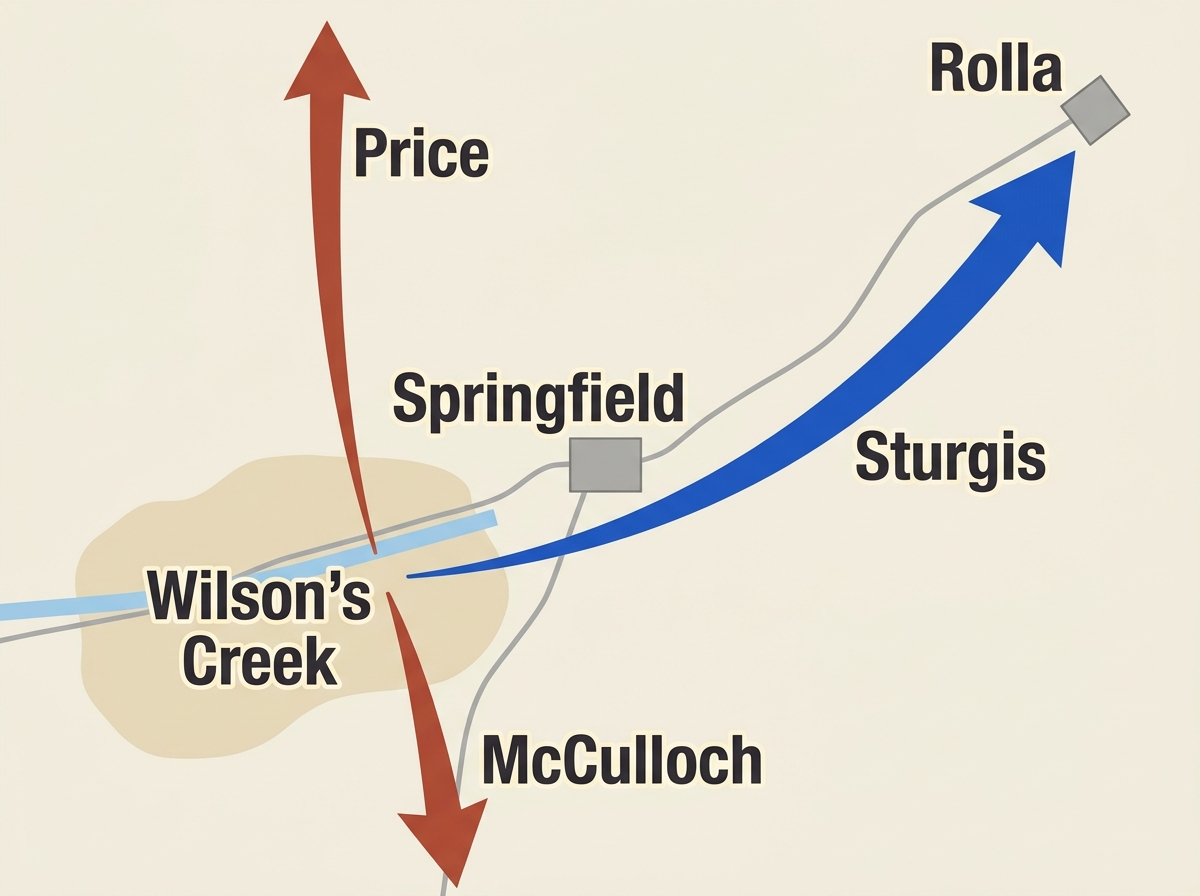
Command passed to Major Samuel D. Sturgis (North), and Sturgis inherited a wreck. His commanding general was dead, Sigel's column had been destroyed and scattered hours earlier, his men were exhausted, and they were running low on ammunition. He reorganized the line, beat back one more Confederate assault, and then made the only sane call available: he ordered a withdrawal. Around half past eleven that morning the Union army began pulling off Bloody Hill, and it did so in good order, falling back in formation, with the cavalry of Colonel Gordon Granger (North) covering the column's flank. They reached Springfield by about five that afternoon and, the next day, began the long retreat to Rolla, the railhead a hundred-odd miles to the east-northeast that was their supply base. The Confederates, for their part, did not chase. They were too spent and too low on ammunition to follow. As the Arkansas commander Brigadier General Nicholas Bartlett Pearce (South) put it, watching the blue column go: "We watched the retreating enemy through our field-glasses, and were glad to see him go."
"We watched the retreating enemy through our field-glasses, and were glad to see him go." Brig. Gen. Nicholas Bartlett Pearce, on watching the Union army withdraw.
A small battle's terrible rate
The casualty figures vary across reputable sources by a couple hundred (the most commonly cited academic numbers put Union losses around 1,317 and Confederate around 1,222, while the American Battlefield Trust gives somewhat lower figures, roughly 1,235 Union and 1,095 Confederate). What set Wilson's Creek apart was the rate, not the total. Lyon lost something like a quarter of every man he brought to the field, roughly 24 to 25 percent. The Confederates, despite winning, lost about 12 percent of theirs. For armies this size, those are appalling numbers; Wilson's Creek ranked among the bloodiest battles in American history up to that point, measured by the share of men it chewed up. The 1st Kansas Infantry alone suffered one of the heaviest single-battle tolls of any Union regiment in the entire war. This was a small battle in a far corner of the country, and it bled like a great one.
An empty win
The South won the battle and could do almost nothing with it. It was a clear tactical victory: they held the field, they killed the enemy commander, they drove the Union army off the hill and out of Springfield. But McCulloch refused to pursue, pleading exhaustion, empty cartridge boxes, and worry about his supply line back to Arkansas. And the moment the fighting stopped, the two-headed command that had hampered the battle finished the job of wrecking the campaign. Price wanted to march north toward the Missouri River and the heart of the state; McCulloch wanted to stay and hold the southwestern corner. They could not agree, so the coalition simply came apart: McCulloch took his Confederates back to Arkansas, and Price marched his Missourians north alone. Price's lone march did score one more triumph, the capture of the Union garrison at Lexington in September, but his new recruits had no logistics behind them and roughly two-thirds of them melted away when the Union pushed back. A battle won, and nothing won by it.
The Union holds, the guerrilla war begins
And in the end, the great prize, Missouri itself, slipped through the Confederacy's fingers even in victory. The Unionist provisional government kept its grip on the capital and the legal machinery of the state, and Missouri never actually left the Union. But Wilson's Creek did not settle the question so much as split it in two. That October, secessionist Missouri legislators met at Neosho and voted to officially leave the United States, and on November 28, 1861, the Confederacy formally recognized Missouri as a Confederate state, giving the state two rival governments at once for the rest of the war, each claiming to be the real one.
And so a state with two governments and a population genuinely divided over which country Missouri belonged to became the center of the most vicious irregular fighting of the entire war. Bushwhackers and jayhawkers (homegrown partisan raiders, the bushwhackers fighting for the Confederacy and the jayhawkers for the Union) turned Missouri into a landscape of ambushes, burned farms, and neighbor murdering neighbor for years, well into Reconstruction (the years after the war when the federal government tried to rebuild the South). It was not a tidy, symmetrical feud. Both sides committed atrocities, but the pro-Confederate bushwhackers were fighting, specifically, to keep slavery in place, terrorizing Unionist families, free and enslaved Black Missourians, and Free State settlers to do it. Wilson's Creek was the opening shot of three and a half years of guerrilla war that would make Missouri the third most-fought-over state in the conflict. The organized Confederate threat in the region was finally broken at Pea Ridge, Arkansas, in March 1862, where McCulloch, the general who had refused to chase Lyon's beaten army off Bloody Hill, was himself killed, but the bushwhacking went on long after the armies left. The first major battle west of the Mississippi had earned its nickname, the Bull Run of the West, and it had previewed the whole character of the war west of the Mississippi to come: divided commands, victories no one could exploit, and a state set savagely against itself.
Trans-MississippiPea Ridge: where McCulloch was killed and the regular Confederate threat in Missouri was brokenOff the fieldThe guerrilla war: the savage irregular fighting that tore Missouri apartThe monuments tend to leave out one thing about Lyon. The North made him a martyr, the first Union general to fall, the man credited with saving Missouri, and in the simplest accounting he did win the thing he died for: Missouri stayed in the Union. But historians have never fully agreed on the verdict. The same aggression that made Lyon effective at Camp Jackson also drove thousands of neutral Missourians into the secessionist camp and helped ignite the very guerrilla war that then tore the state apart for years. Some judge that Lyon saved Missouri; others that he made its war far nastier than it had to be. The honest answer is that he may have done both at once.