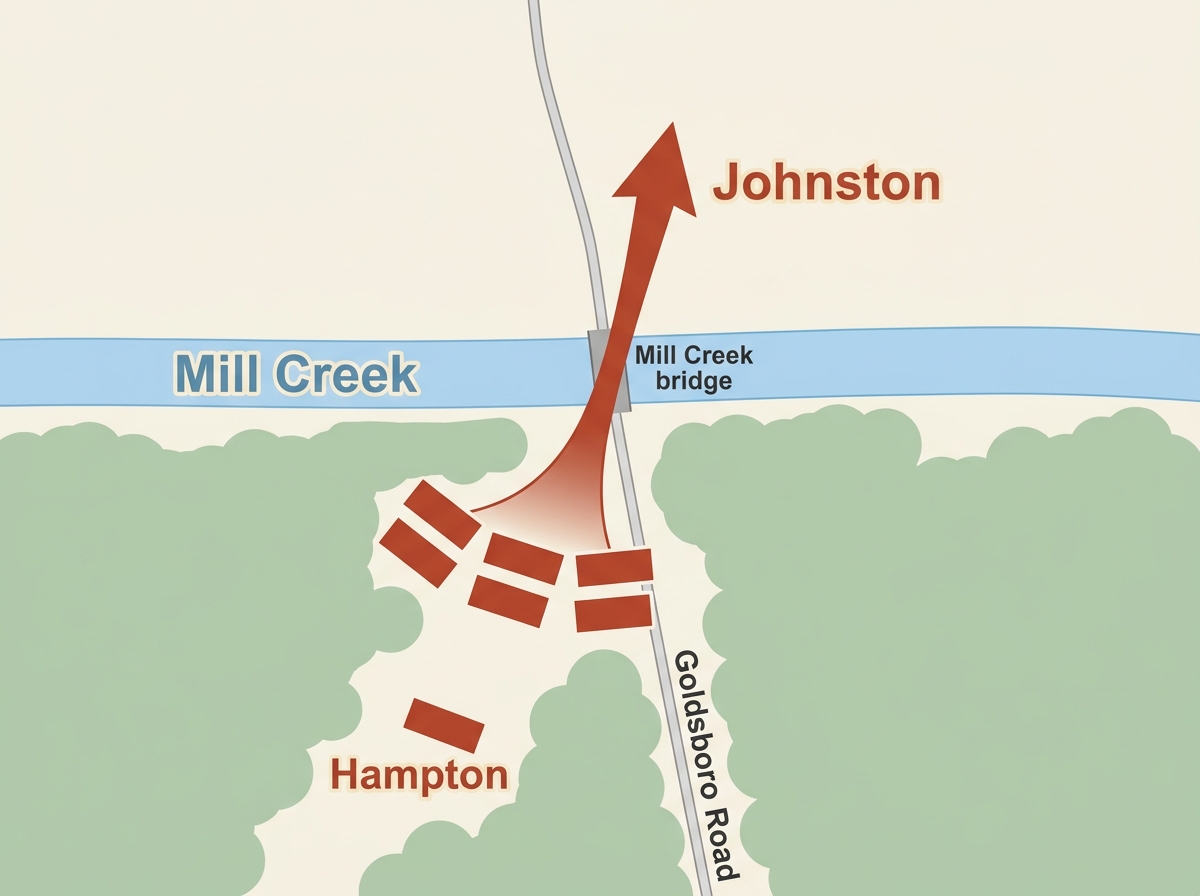
By March 21, Sherman’s patience with Joseph E. Johnston’s (South) refusal to leave had worn thin. The day came on wet, a soaking rain over the pine woods, and the two armies traded fire across their lines with no one expecting much. Then one Union general decided, more or less on his own, to go looking for a fight. Major General Joseph A. Mower (North), a hard-driving division commander in Howard’s wing, asked leave to push forward on what he called a reconnaissance and turned it into a full attack. He took two brigades and drove straight at the weak Confederate left, the thinly held ground covering the Mill Creek bridge, Johnston’s one road out.
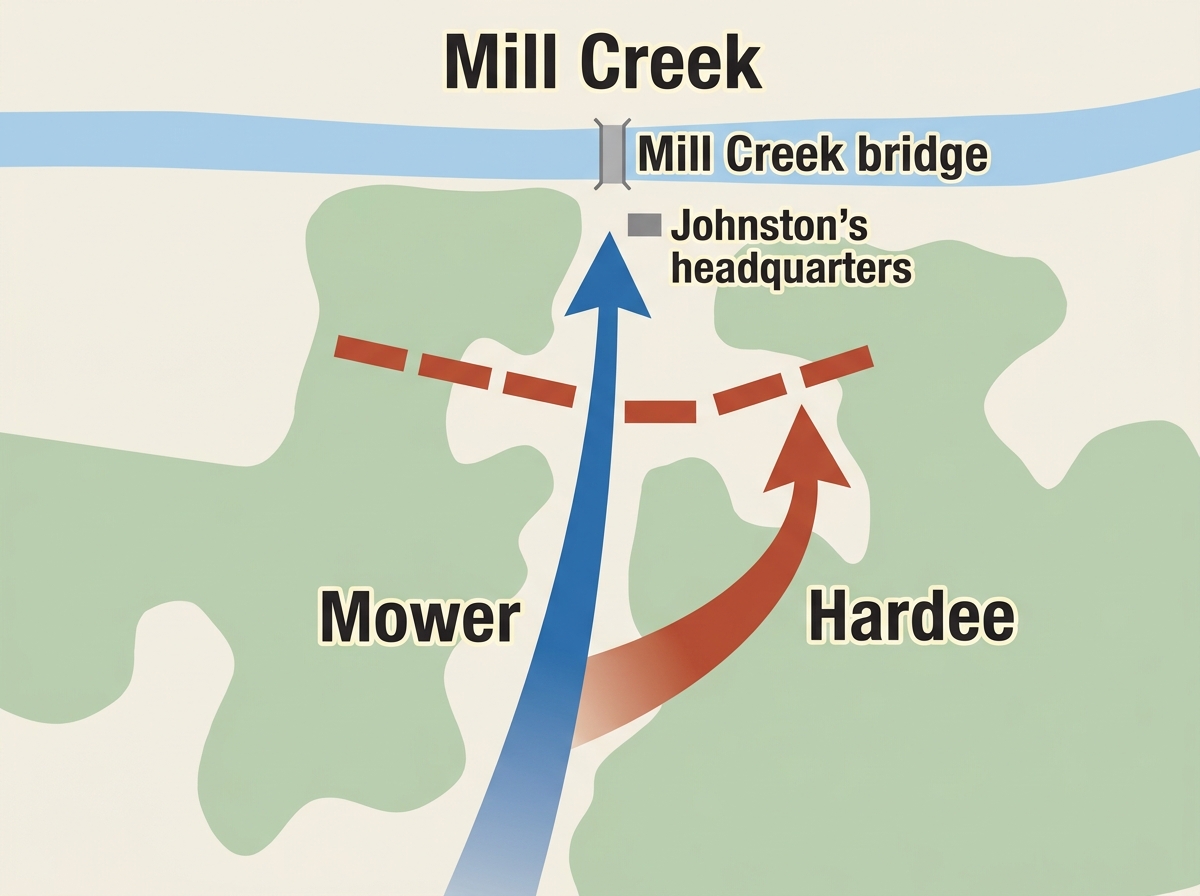
It nearly ended the war’s last battle in disaster for the South. Mower’s men punched through the cavalry and skirmishers on that flank and rolled up to within about a mile of the bridge. They overran Johnston’s own headquarters, sending the general and his staff scrambling to get away. For a few minutes the single crossing that the entire Confederate army needed to escape was almost in Union hands. Had Mower reached it, Johnston’s army, the last real army the Confederacy had outside Virginia, might have been trapped on the wrong side of the creek and destroyed.
Two things saved it. Lieutenant General William J. Hardee (South) threw together a scratch counterattack from whatever he could grab, including cavalry, and hit Mower’s exposed brigades hard enough to stop them and shove them back. And Sherman, true to his decision not to fight a costly general battle when the war was nearly won, ordered Mower to break off and return to the main line. Sherman later admitted in his memoirs that calling Mower back was a mistake, that he had let slip a chance to cut off and perhaps capture Johnston’s whole army. The bridge stayed in Confederate hands. The escape route held.
Hardee’s boy
Hardee’s counterstroke saved the army and cost him his son. His boy Willie, sixteen years old, had begged to join the fight, and only hours before the charge Hardee had reluctantly let him enlist in a Texas cavalry regiment. The regiment was among the troops thrown in to stop Mower. Willie Hardee was shot during the action and died days later. A general who had saved an army at the very end of a lost war buried his teenage son for it, in one of the war’s last battles, with the surrender already in sight.