Skirmishing, the scattered probing fire of the lead troops feeling out the enemy, opened at dawn as Grant’s three columns groped their way west along the three roads. The first man to grasp what was happening was on the Confederate side. Brigadier General Stephen D. Lee (South), no relation to Robert E. Lee despite the name, held a brigade of Alabamians (a brigade being a few regiments, smaller than a division) posted on top of Champion Hill, and from that high ground he could see what the men down on the roads could not. Off to the north, on the Jackson Road, a heavy Union column was coming on. Lee understood instantly what it meant: that column was aimed at the very flank of the army, the exposed end of a battle line, the place an army is easiest to get around and behind, and if it got past it would cut Pemberton off from Vicksburg. He sent the warning back. The danger was exactly where he said it was.
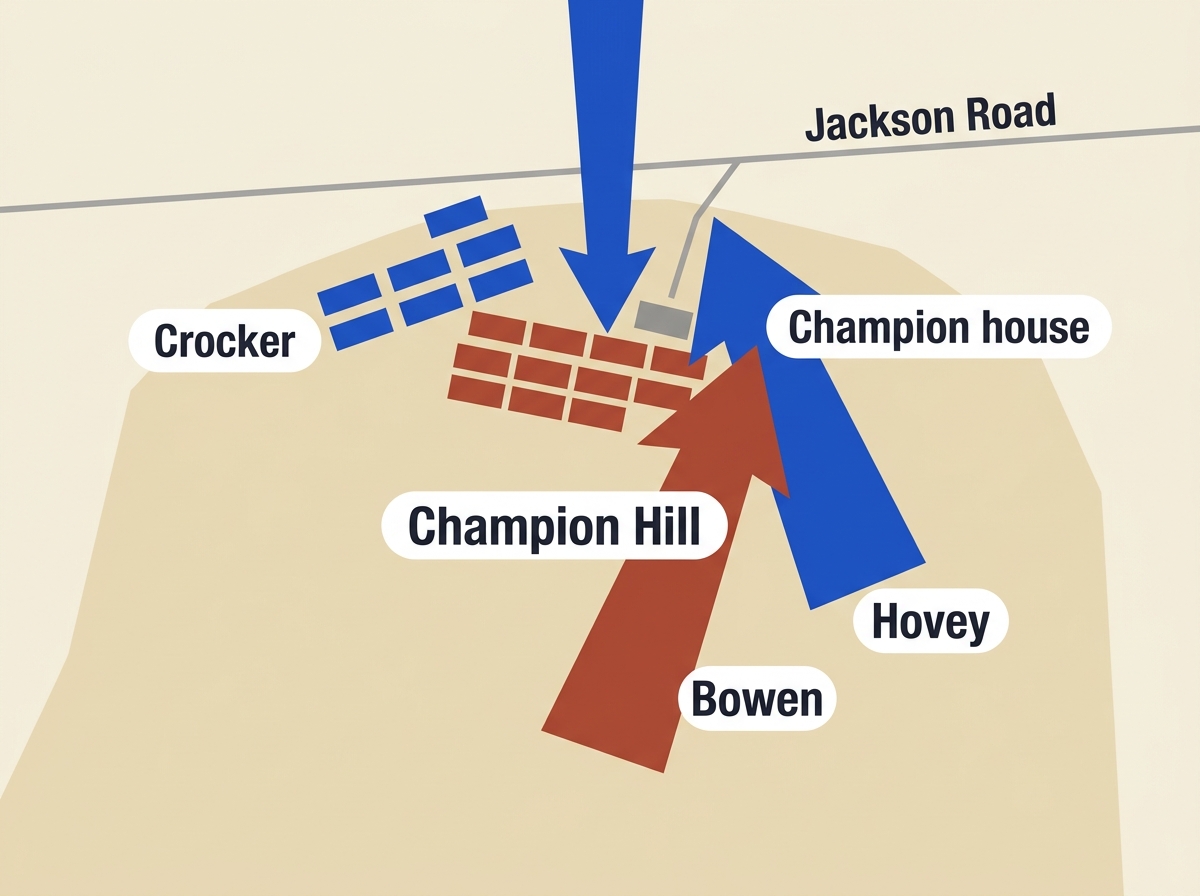
Grant reached the field around ten in the morning and put his blow in where the crossroads could be reached: straight up the Jackson Road, against the northern, exposed end of the Confederate line. Brigadier General Alvin P. Hovey’s (North) men and the division of Major General John A. Logan (North) pushed up the road and into the timber. By about half past eleven they were against the Confederate main line, and the fight became a climb, up the slope of Champion Hill, into Major General Carter L. Stevenson’s (South) division holding the Confederate left, which was the northern end of their line. This was the flank Grant meant to break, and around one o’clock he broke it. The Union men carried the crest. Stevenson’s left came apart and fell back off the hill in disorder, and the Federals swept on down the far slope to the prize below: the crossroads. For a moment, Pemberton’s escape route up the Jackson Road was shut.
There was more to what Logan’s men had done than they knew at the time. Pushing up and across the Jackson Road, they had planted a Union division squarely across the one direct road the Confederate army could use to reach its crossing over Baker’s Creek. The men who had helped take the hill were now, without quite realizing it, standing on the road home, and that fact would decide the fate of a whole Confederate division before the day was out.
The Hill of Death
The man whose soldiers paid the most to take that crest gave it the name that stuck. Hovey’s (North) division bore the brunt of the day’s killing, and afterward Hovey himself, walking the ground he had won, wrote it down plainly:
“Champion Hill was, after the battle, literally the hill of death. Men, horses, cannon, and the debris of an army lay scattered in wild confusion.”
Brigadier General Alvin P. Hovey
The ground those men climbed for was a slaveholding plantation. The hill was named for the family that owned it, and the county around it was worked by enslaved people, the same human property the Confederacy had been founded to keep. The army Hovey’s men broke on that crest existed to defend that arrangement. The hill of death was a hill on a plantation, and that was not incidental to the war; it was the war.
The Crest and the Crossroads
The right blow in the right place: not the heaviest part of the army, but the part aimed at the flank that held the road home.
Grant’s main effort up the Jackson Road broke Stevenson’s division, carried the seventy-five-foot crest of Champion Hill by about one o’clock, and pressed on to take the crossroads below, briefly closing Pemberton’s best line of retreat to Vicksburg and planting Logan’s division across the army’s only direct road to the creek. The cost fell hardest on Hovey’s division, the hill of death.