A beaten army’s worst moment is usually the retreat, and everything Lieutenant General John C. Pemberton (South) had to fear was waiting behind his line: Baker’s Creek, running north to south between the battlefield and Vicksburg, with the army needing to cross it to escape. And here the morning’s fighting came due. Major General John A. Logan’s (North) division had cut the Jackson Road, the direct way to the crossing, so Pemberton’s only road left over the creek was a single bridge on the Raymond Road, to the south. Getting the whole army over that one bridge before Grant’s men arrived was now the only thing that mattered. The job of holding it open fell to the rearguard, Brigadier General Lloyd Tilghman’s (South) brigade, posted at the creek to buy time with their bodies while the rest of the army filed across. A Union artillery shell struck and killed Tilghman at the crossing.
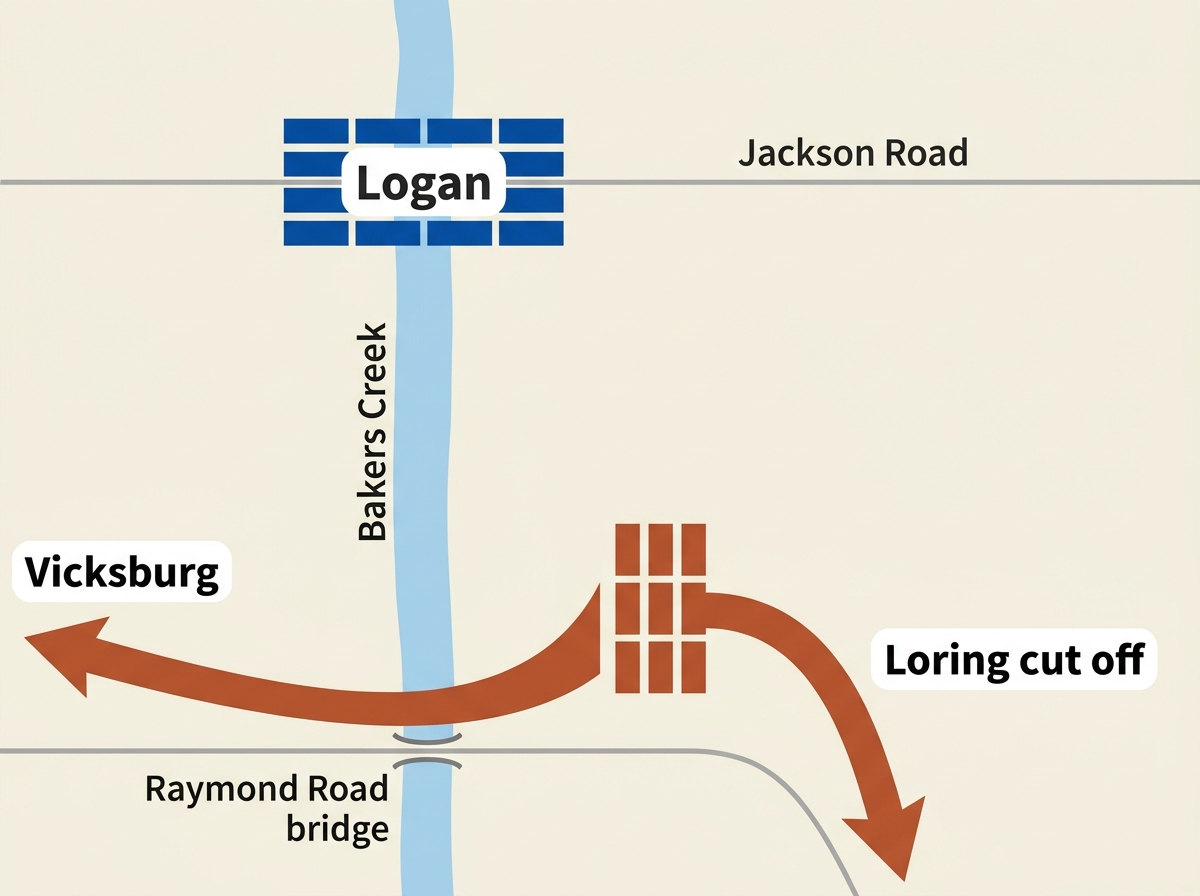
Most of Pemberton’s army got over. By late afternoon Grant’s troops had seized the Baker’s Creek bridge themselves, and by midnight they held Edwards Station, the little depot to the east. The Confederate army that had stood on the ridge that morning was streaming southwest toward Vicksburg, broken but largely intact, except for one division, and that exception decided the war in Mississippi.
Loring’s (South) division, the one that had refused to march all afternoon, came back too late to its own salvation. By the time it turned to follow the army, the single Raymond Road bridge was lost and Union troops sat across the Jackson Road behind it; there was no crossing left for Loring to take. So a whole division of the Confederate army, thousands of men who had barely been bloodied that day, simply turned away from the war they were in. Rather than fight through, Loring peeled his column off to the south and east, marched it clear around the outside of the Union army through the night, and kept going until he reached Johnston (South) near Jackson. He never recrossed the creek. He never rejoined Pemberton. He never entered Vicksburg.
The two endings sat side by side. Pemberton walked back into the fortress city to stand the siege of his life, and he walked in a full division short, thousands of men he would need on the works simply not there, gone without a battle to show for it. And somewhere off to the southeast, in the dark, those same thousands were tramping the long way around to another general’s camp, alive, intact, and lost to the cause they were marching for as surely as if they had been killed on the hill. It was the strangest casualty of the day: a loss with no body count to put on a return.
Why One Day Decided the Campaign
This one day on a plantation hill decided the whole campaign. Champion Hill was the day Grant beat Pemberton in the open, the decisive field battle of the operation, the fight that settled the campaign before the siege ever began. The Confederates lost something like 3,840 men to the Union’s 2,457, and the shape of those losses matters: the killed and wounded were close on both sides, but the Confederate total is blown out by roughly 2,441 men missing or captured, the price of a broken army funneling back across a single creek. It is frequently called the bloodiest single day of the entire Vicksburg campaign. The deepest cost, Loring’s vanished division, never made it onto a casualty return at all.
From there the end came fast. The next day Grant’s men ran Pemberton’s rearguard off the field at Big Black River Bridge, the last river crossing before the city, and on May 18 the beaten army was shut up inside Vicksburg’s works. The forty-seven-day siege that followed, ending in the surrender of the city and its garrison (the troops defending it) on the Fourth of July, ran straight out of this hill. When the city fell, slavery fell with it there, the great river opened along its whole length from the North down to the Gulf of Mexico, and the Confederacy was cut in two. All of that was decided, in the open, on the sixteenth of May, on the crest of a slaveholders’ plantation, over a crossroads, in a near-even fight that Grant won because of where he put the blow. Grant himself never doubted what the day had bought. He had ended it, he wrote, with his army planted between Johnston and Pemberton, with no possibility of the two Confederate forces ever joining, which had been the whole point of the campaign from the start.
Western TheatreVicksburg: the siege and the surrender Champion Hill set in motionThe Day That Doomed Vicksburg
A decisive Union victory, and the day the campaign to split the slaveholders’ republic was actually decided.
Grant beat Pemberton in the open in a near-even fight, broke his army off the field, and cut an entire Confederate division (Loring’s) away from it forever, a loss with no body count, the price of Logan’s men holding the Jackson Road and the lone Raymond Road bridge falling to the Federals. Pemberton fell back into Vicksburg short a division and out of options; the siege and the July 4 surrender followed within weeks. Champion Hill is the battle where the campaign to take Vicksburg, and to split the slaveholders’ republic in half, was actually decided.